
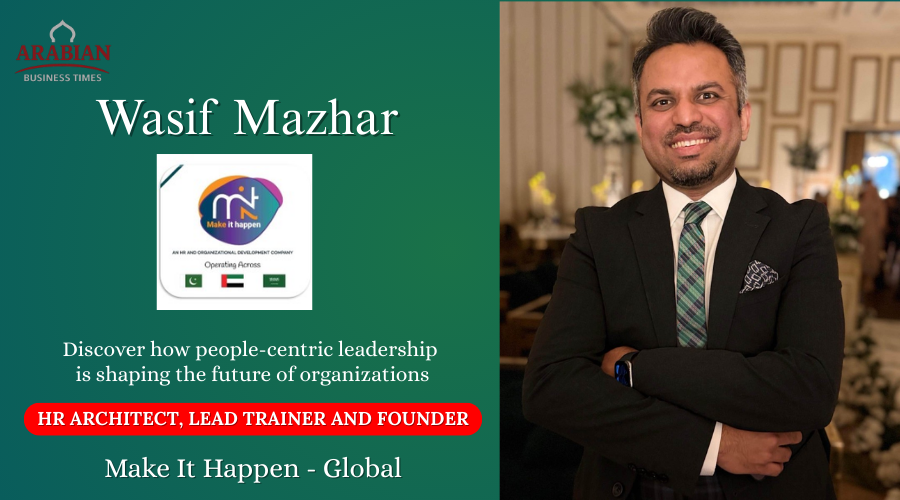
There’s no shortage of conversations today around performance, growth, and transformation. But very few of them begin with people.
For Wasif Mazhar, that’s where everything starts.
Known as The Monday Man, Wasif has spent over two decades working closely with organizations across Pakistan, Saudi Arabia, and the UAE. As the founder of Make It Happen, Global, he focuses on something many companies still overlook, how people actually experience work, not just how they perform on paper.
In this conversation with Arabian Business Times, Wasif speaks openly about leadership, culture, and why most organizations don’t have a strategy problem; they have a people problem.
Q1. You’ve worn many hats over the years. How do you see your role today?
Wasif Mazhar:
Honestly, I don’t think in terms of titles anymore. Over time, I’ve come to see myself as someone who helps things connect.
Organizations usually have strong strategies. That’s rarely the issue. The gap shows up when those strategies need to be executed by people who may not feel aligned, clear, or even motivated.
So my role is simple in theory, but not always easy in practice. I help bring clarity. I help people see where they fit. And once that happens, you don’t have to push performance, it starts to show up on its own.
Q2. What made you step away from corporate roles and start your own venture?
Wasif Mazhar:
It wasn’t one big moment. It was built over time.
I was doing meaningful work in my corporate roles, but there were always limitations, systems, processes, and and sometimes even mindsets. I felt there was more that could be done if I had the flexibility to design solutions without those constraints.
Starting my own venture gave me that space. It also came with uncertainty, of course. But I think at some point, you either stay comfortable or you take that step. I chose to take it.
Q3. Your company runs on a GIG-based model, which is still quite different for HR. Why go that route?
Wasif Mazhar:
Because the world of work has already changed, even if some organizations haven’t fully accepted it yet.
Not every problem needs a full-time team. Sometimes you just need the right people, at the right time, for the right challenge.
The GIG model allows us to stay flexible. It also keeps us honest. You’re not relying on structure, you’re relying on capability. And that shifts the focus back to outcomes, which is where it should be.
Q4. “The Monday Man” is a unique identity. Where did that come from?
Wasif Mazhar:
(Laughs) It started very simply. I’ve always liked Mondays.
While most people see it as the hardest day of the week, I’ve always seen it as a reset. A chance to start again, maybe do things a little better than last week.
Over time, that idea stuck. But it’s not really about Monday as a day. It’s about how you show up. If you can bring that mindset regularly, not just once a week, it changes your relationship with work.
Q5. Tell us about your Hoka model. What problem were you trying to solve?
Wasif Mazhar:
Frustration, mostly.
I kept seeing organizations chase numbers without really understanding the people behind them. There was always this disconnect: targets on one side, human experience on the other.
HOKA was my attempt to bridge that. It aligns human effort with business outcomes in a way that feels real, not forced. When people understand how their work contributes to something bigger, they engage differently. That’s when performance becomes sustainable.
Q6. You’ve worked across different countries. How do you handle cultural differences?
Wasif Mazhar:
You respect them. That’s the starting point.
Every region has its own way of working, communicating, and even thinking about leadership. You can’t ignore that. At the same time, some things don’t change, people everywhere want to feel trusted and valued.
So I try to balance both. Keep the intent consistent, but adapt the approach. And most importantly, involve people in the process instead of imposing solutions on them.
Q7. If there’s one thing leaders need to unlearn today, what would it be?
Wasif Mazhar:
The need to control everything.
For a long time, leadership was about having authority and making decisions from the top. That approach doesn’t work the same way anymore. People want ownership. They want to contribute.
Letting go of control is not easy, but it’s necessary. When leaders shift from controlling to enabling, you start to see a different kind of energy in the organization.
Q8. What were the hardest moments in your journey as a founder?
Wasif Mazhar:
The early days, without a doubt.
When you don’t have a long track record as a company, people hesitate. They want proof. That’s fair. So you have to build that trust step by step.
There were moments of doubt. That’s normal. But those moments also push you to refine your thinking and your approach. Looking back, I think those challenges helped more than they hurt.
Q9. How do you define agility in a practical sense?
Wasif Mazhar:
Agility is often misunderstood. People think it means moving fast without structure. That’s not true.
Real agility comes from clarity. When people know what’s expected of them and feel safe to try new things, things move faster naturally.
It’s not about removing structure; it’s about making sure structure doesn’t slow you down.
Q10. You speak a lot about trust. How can leaders actually build it?
Wasif Mazhar:
There’s no shortcut.
It comes down to everyday actions. Being consistent. Following through. Listening properly, not just to respond, but to understand.
People notice these things. Over time, trust builds. And once it’s there, it changes how teams work together. You don’t have to force alignment; it starts to happen on its own.
Q11. Why do so many organizations still struggle with engagement?
Wasif Mazhar:
Because they try to simplify something that isn’t simple.
Engagement is not one thing. It’s different for every individual. But organizations often treat it like a checklist, benefits, incentives, and activities.
What really matters is whether people feel seen and heard. Whether they feel their work has meaning. Those are harder to measure, but they make a bigger difference.
Q12. Finally, what would you say to leaders dealing with uncertainty right now?
Wasif Mazhar:
Uncertainty is not going anywhere.
The question is how you respond to it. You can resist it, or you can work with it. The leaders who do well are the ones who stay open, keep learning, and trust their people.
You don’t need all the answers. But you do need belief, both in what you’re building and in the people building it with you.
Conclusion
Talking to Wasif Mazhar doesn’t feel like listening to a typical leadership expert. There’s a simplicity in how he explains things, but also depth that comes from experience.
His message is not complicated. Organizations don’t transform because of frameworks alone. They transform when people feel connected, trusted, and clear about what they are doing.
And maybe that’s the real takeaway: performance doesn’t begin with targets. It begins with people who believe in what they’re doing.


Hi, Neat post. There’s a problem together with your website in web explorer, might test this?
IE still is the marketplace leader and a good component to people will
omit your excellent writing because of this problem.
What’s up mates, how is all, and what you want to say about this
article, in my view its really remarkable in support of me.
Hi! This post could not be written any better! Reading this post
reminds me of my old room mate! He always kept talking about
this. I will forward this page to him. Fairly certain he will
have a good read. Thank you for sharing!
I’m curious to find out what blog platform you’re using?
I’m having some small security issues with my latest website and I’d like
to find something more secure. Do you have any suggestions?