
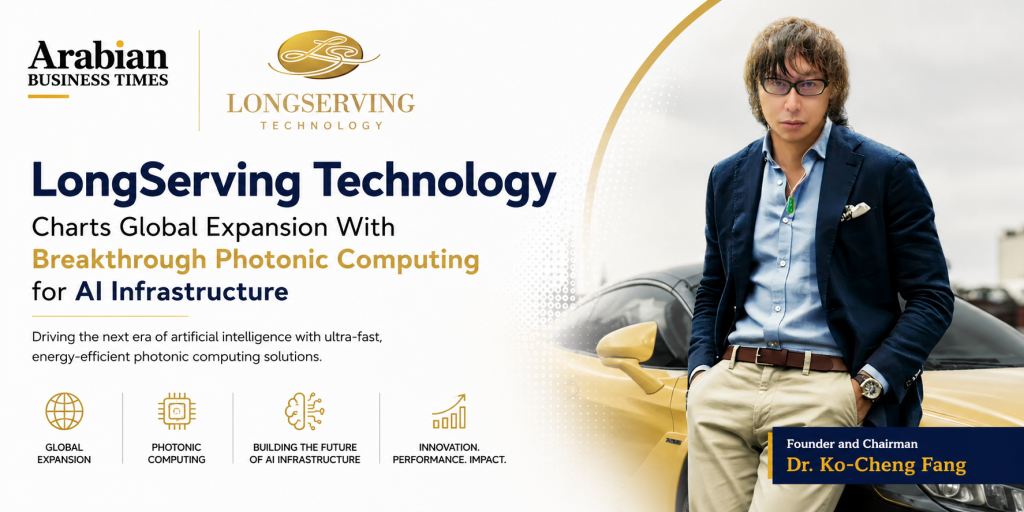
In the race to build the next generation of computing infrastructure, few companies are betting as boldly on light itself as LongServing Technology. Under the leadership of Founder and Chairman Dr. Ko-Cheng Fang, the company has spent over two decades building a technology portfolio that spans cybersecurity, photonic quantum computing, artificial intelligence, and advanced materials science — with a singular thesis at its core: that the future of AI infrastructure will be constrained not by algorithms, but by the physical limits of electronic computing.
That thesis is now entering a new chapter. LongServing Technology has announced a major global fundraising initiative aimed at accelerating its photonic computing roadmap, expanding manufacturing capacity, and advancing plans toward a Wall Street listing. The company is also courting strategic partners across some of the world’s most influential capital markets, from Middle Eastern sovereign wealth funds to the semiconductor and public markets hubs of Silicon Valley and Wall Street.
Arabian Business Times sat down with Dr. Fang to discuss what’s driving this next phase of growth, how LongServing Technology’s cross-disciplinary technology stack creates a defensible competitive edge, and where the company sees itself in the broader story of AI’s next decade.
Longserving Technology has recently announced a major strategic milestone, including its latest global financing initiative. What inspired this new phase of growth, and how does it align with your long-term vision for the company?
This global fundraising initiative was launched based on our assessment of future technology trends and our mission to commercialize disruptive technologies. Over the years, we have continued to invest in the research and development of core technologies, including X-Photon materials, photonic memory, and photonic computing architectures, achieving a number of key breakthroughs. However, I firmly believe that true innovation should not remain confined to the laboratory; it must be industrialized and deployed globally in order to truly change the world.
To me, this global fundraising initiative is not simply about raising capital. It is about accelerating LongServing Technology into its next stage of development. By bringing in strategic investors and international partners who share our long-term vision, we aim to further expand our R&D capabilities, establish manufacturing capacity, advance our plans for a Wall Street listing and future semiconductor fabrication facilities, and accelerate the commercialization of photonic computing technology, enabling it to become a key foundation of global AI infrastructure.
Longserving Technology operates across cybersecurity, photonic quantum computing, AI, advanced materials, and intellectual property. How do these technologies work together to create a unique competitive advantage?

LongServing Technology’s core competitive advantage lies in the deep integration of cybersecurity, photonic quantum computing, artificial intelligence, advanced materials, and intellectual property, creating a comprehensive cross-disciplinary technology ecosystem. Our self-developed 2nm X-Photon material overcomes the limitations of traditional silicon photonics technology. Combined with all-optical logic computing, photonic memory, and photoelectric conversion architecture, it establishes the core technological foundation for next-generation photonic CPUs. It is expected to overcome the traditional “memory wall” bottleneck of electronic chips and provide a new-generation computing platform with higher efficiency and lower power consumption for large AI models, high-performance computing, and intelligent robotics.
In addition, LongServing Technology accumulated multiple international patents in cloud information security and password lock technologies during its early development (U.S. Patent Nos. US 8060933B2 and US 7930745B2). Combined with our innovative “Strategic Equity Hedging Protocol” model, we transform intellectual property from purely legal protection into a strategic asset for corporate collaboration, strategic alliances, and equity investment, thereby establishing a long-term competitive advantage that integrates technology, intellectual property, and business models.
Photonic quantum chips are expected to transform next-generation computing. What differentiates Longserving Technology’s innovation in this space, and what real-world impact do you expect it to have?
LongServing Technology’s photonic quantum chip breaks through the micron-scale limitations and scattering bottlenecks of traditional silicon photonics. It adopts X-Photon insulating material with an average wavelength of only 2 to 3 nanometers and a ceramic substrate, and realizes 90-degree vertical refraction technology and Photonic Memory. This completely breaks through the “memory wall,” allowing data to be processed and stored directly within the optical spectrum without electro-optical conversion.
In terms of industrial impact, this innovation delivers a computing speed improvement of up to 1,000 times and a 90% reduction in energy consumption, significantly alleviating the power grid and heat dissipation challenges of AI data centers worldwide. In the future, it will further reshape the computing foundation of key fields including artificial intelligence training, medical drug development, financial big data analysis, and intelligent robotics.
Your company has built a strong portfolio of cybersecurity and technology patents across multiple international markets. How has intellectual property shaped Longserving Technology’s growth strategy, and why is it such a critical asset for future innovation?
Intellectual property (IP) is LongServing Technology’s irreplaceable technological advantage and an important source of capital driving the Company’s growth. More than twenty years ago, Dr. Ko-Cheng Fang, President of LongServing Technology, strategically established core technology patents in cloud data storage, anti-hacking mechanisms, and software password lock technologies (including US 8060933B2 and US 7930745B2). These patents were recognized by the United States Patent and Trademark Office (USPTO) as Prior Art Citations for the products of multiple international technology companies. In terms of corporate development strategy, LongServing Technology has further introduced its proprietary “Strategic Equity Hedging Protocol,” transforming historical infringement risks into opportunities for international technology companies and Middle Eastern sovereign wealth funds to subscribe to 20% of the Company’s equity, further becoming an important source of capital to drive the Company toward a Wall Street listing and the construction of a 2nm semiconductor fabrication plant.
For LongServing Technology, intellectual property is not only a legal tool for protecting technological innovation, but also a core asset supporting its global market strategy. Through a comprehensive global patent portfolio, the Company is able to effectively reduce the risks of technology imitation and reverse engineering, while establishing a solid legal safeguard for Deep Tech research and development, ensuring that breakthrough technologies can continue to be transformed into long-term commercial value and global competitive advantages.
The company is actively pursuing global strategic partnerships and investment opportunities. What qualities do you look for in investors and partners, and which international markets offer the greatest potential for Longserving Technology’s future expansion?

When selecting strategic investors and partners, LongServing Technology places the greatest emphasis on whether they share a long-term vision and possess cross-industry resource integration capabilities. The partners we seek are not only providers of capital, but also collaborators who can jointly advance technology, connect with global markets, and support the long-term commercialization of Deep Tech.
In terms of international market strategy, sovereign wealth funds in the Middle East (such as Dubai and Bahrain) are an important direction for capital cooperation. At the same time, Silicon Valley and Wall Street in the United States represent the strategic centers of the advanced semiconductor ecosystem and the public capital markets. In addition, Paris, New York, and Tokyo, as global luxury and high-end consumer markets, are important hubs for the establishment of our laboratory-grown jadeite flagship stores. Together, these markets will drive LongServing Technology toward large-scale global development.
As Founder and Chairman, you have built a company focused on long-term technological innovation rather than short-term trends. What leadership principles have guided your journey, and what lessons have been most valuable along the way?
I have always believed that truly impactful technological innovation should not merely follow short-term market trends, but instead anticipate the needs of humanity over the next ten, twenty, or even more years. Whether it was my early work in cybersecurity and digital access control or my current research into photonic computing and advanced materials, the value of technological innovation lies in solving the major challenges that the future may bring.
Throughout my entrepreneurial journey, three core principles have guided my leadership. First is maintaining a spirit of exploration toward the unknown. Many significant breakthroughs come from challenging existing assumptions and asking whether there is a better way forward. Second, Deep Tech research requires long-term commitment. From proof of concept and technological breakthroughs to commercialization, every stage demands sustained investment and patience.
Third is cross-disciplinary integration and value creation. Modern technological breakthroughs are no longer confined to a single field. They require the integration of materials science, computing, artificial intelligence, and industrial applications to build a complete innovation ecosystem.
The most valuable lesson I have learned throughout my entrepreneurial journey is that true innovation requires time, conviction, and continuous dedication. Many breakthrough technologies are not understood in their early stages and often face skepticism and challenges. However, as long as the direction is right and every step is supported by rigorous research and continuous validation, their true value will ultimately be realized.
Artificial Intelligence is rapidly reshaping industries worldwide. How do you see AI evolving over the next decade, and what role will photonic computing play in enabling faster, more efficient AI infrastructure?
Over the next decade, artificial intelligence will no longer be merely an assistive tool, but will gradually become the core foundation driving global industrial transformation and technological innovation. From scientific research, healthcare, biotechnology, manufacturing, and finance to smart cities, AI will penetrate every sector, helping humanity solve increasingly complex problems, create more efficient production models, and enable entirely new application scenarios.
However, the rapid development of artificial intelligence also brings unprecedented computing demands. As AI models continue to grow in scale, traditional electronic computing architectures will face increasing challenges in processing speed, energy consumption, and data transmission efficiency. The future of AI competition will depend not only on the capabilities of algorithms, but also on whether a more powerful and energy-efficient next-generation computing infrastructure can be established. Photonic computing may become one of the key technological directions for overcoming these limitations. By leveraging the high-speed transmission and low-energy characteristics of light, photonic technology has the potential to significantly improve data processing efficiency while reducing the energy costs required for large-scale AI systems.
Innovation often requires years of research, persistence, and calculated risk. Looking back on your career, what technological achievement are you most proud of, and what advice would you give entrepreneurs building deep-tech companies?

Looking back on my career, the technological achievement I am most proud of is the journey from my early research in cybersecurity and digital access control technologies to my current exploration of next-generation computing architectures, including photonic computing, photonic chips, and photonic memory. To me, what truly matters is not simply completing a technology or obtaining a patent, but being able to propose new directions and possibilities when technological progress reaches its limits.
The development of photonic technology is aimed at overcoming the limitations of traditional electronic computing in processing speed, energy efficiency, and data transmission, laying a new foundation for artificial intelligence, high-performance computing, and future technologies. Throughout this journey, I have come to realize that the greatest challenge in Deep Tech innovation is not only achieving technological breakthroughs, but also maintaining long-term conviction, sustained commitment, and the ability to transform visionary technologies into real-world value.
For entrepreneurs building Deep Tech companies, my advice is to maintain a long-term perspective and not be influenced by short-term market fluctuations. Technologies with the potential to change the world often require time to be validated and may face skepticism in their early stages. Therefore, entrepreneurs must remain committed to their core vision while developing cross-disciplinary integration capabilities, maintaining a rigorous approach to research and development, and possessing the determination to bring innovation into commercial application.
Beyond technology development, how do you envision Longserving Technology contributing to the future of global industries, including cybersecurity, semiconductor innovation, AI, and sustainable advanced manufacturing?
Beyond technological research and development, I believe LongServing Technology’s future role is not merely to be a provider of individual technologies, but to become an important driving force in building the next generation of technological infrastructure.
Future industrial development will increasingly depend on secure, efficient, and sustainable computing capabilities. As artificial intelligence, photonic quantum technologies, and global digitalization continue to advance rapidly, cybersecurity will become the fundamental foundation of all technological applications. Therefore, LongServing Technology will continue integrating cybersecurity technologies, artificial intelligence, and advanced computing architectures to establish a safer and more reliable intelligent technology environment.
The development of photonic computing and next-generation technologies will not be limited to a single industry. As digital transformation accelerates and artificial intelligence applications rapidly expand, industries across the world will have growing demands for faster, more energy-efficient, and more intelligent computing capabilities.
In the future, fields including scientific research, healthcare, biotechnology, finance, manufacturing, energy, smart cities, national security, communications, and consumer electronics may all gain new development opportunities through breakthroughs in high-performance computing technologies. For example, in healthcare and biotechnology, photonic computing can help accelerate drug discovery, genetic analysis, and precision medicine. In manufacturing, it can enhance smart manufacturing, automation, and production efficiency. The financial industry can strengthen analysis and decision-making capabilities through more powerful data processing. At the same time, artificial intelligence and robotics technologies will also benefit from more advanced computing foundations, creating more innovative applications.
Looking ahead over the next three to five years, what are Longserving Technology’s top priorities, and what lasting legacy do you hope the company will leave for the global technology industry?

The most important development direction for LongServing Technology is to transform our core technologies from the research and development stage into global commercial applications, while gradually establishing a complete industrial ecosystem. We believe that the value of photonic computing should not remain only within laboratory research, but must truly enter the market.
Currently, we are actively advancing the mass production planning of photonic chip-related technologies, including photonic-electronic conversion architecture, chip manufacturing processes, and strategic cooperation with advanced global foundry partners. Through industrial chain integration, we aim to entrust key manufacturing processes to semiconductor foundries with mass production capabilities, accelerating the transition of photonic technology from prototype validation to large-scale applications and truly driving the transformation of the next-generation computing industry.
In addition to our photonic technology development, laboratory-grown Imperial Green jadeite is also one of LongServing Technology’s important commercialization directions. In the future, we will actively promote global brand expansion and establish flagship locations in major cities around the world, bringing this advanced material that combines technological innovation and artistic value to the global market.
I hope that what LongServing Technology ultimately leaves behind is not merely a single technology or product, but an innovative platform that bridges technology, industry, and the future of humanity. Through photonic computing to overcome the limitations of traditional electronic architectures, and through advanced materials to create new industrial value, we hope to demonstrate that Deep Tech can not only transform the direction of industrial development, but also leave a lasting impact in advancing human civilization.
Conclusion
As LongServing Technology moves from laboratory breakthroughs toward commercialization and global expansion, Dr. Fang’s message is one of patience matched with ambition: that Deep Tech innovation is a long game, and that the companies willing to play it — across materials science, computing architecture, and intellectual property; are the ones positioned to shape the next era of global technology infrastructure.
This feature is part of Arabian Business Times‘ ongoing coverage of technology leaders and innovators shaping the future of AI, computing, and advanced industry across global markets.