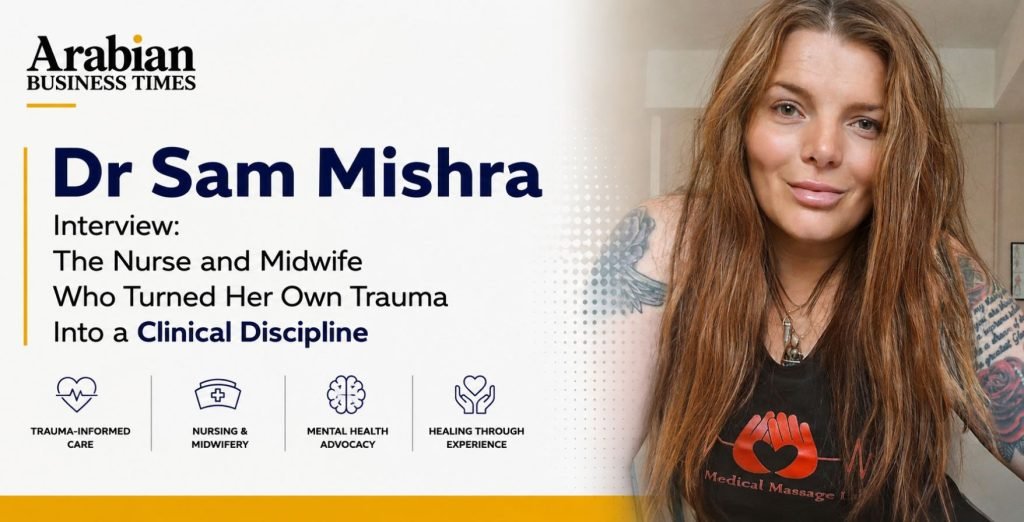
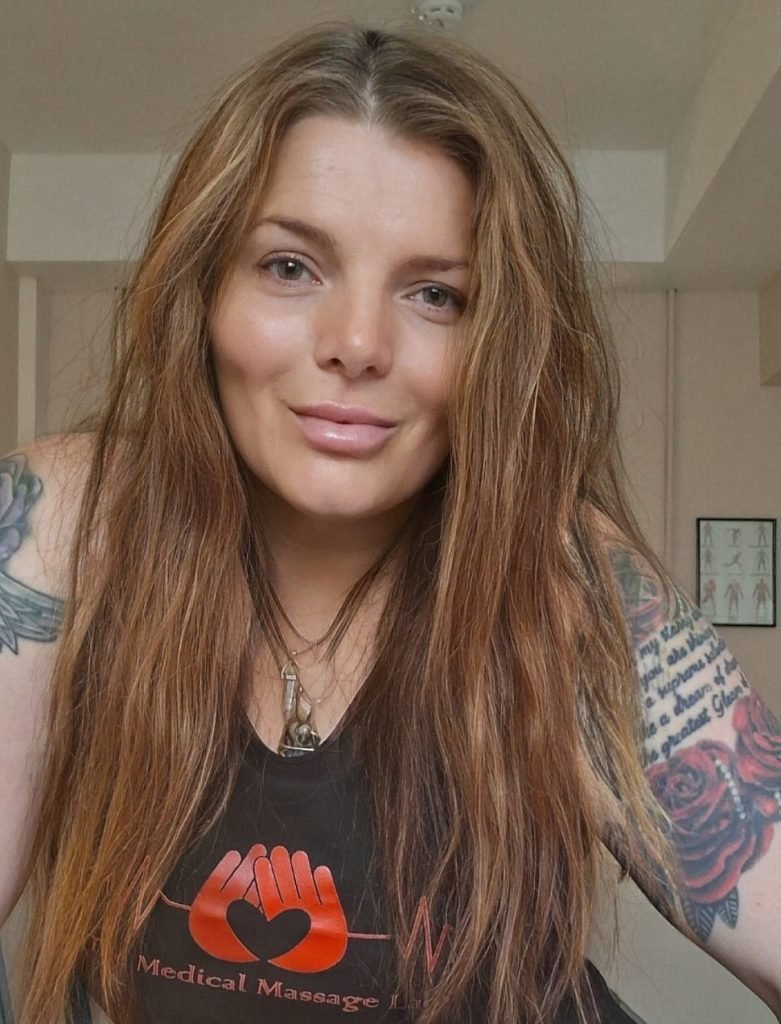
Dr Sam Mishra didn’t plan a career in holistic therapy. It started, by her own account, almost by accident: a careers advisor’s suggestion, a course she could get into without working hard for her A-levels, and a detour through occupational therapy before she transferred into nursing and midwifery. She trained in massage therapy along the way, almost as a footnote to a medical career spanning close to thirty years, including experience in operating theatres, oncology wards, and maternity delivery suites for close to thirty years. It’s a background that now sits behind everything she does under the name The Medical Massage Lady, including an honorary doctorate, a growing list of awards, and a body of published work on trauma.
The real foundation of her work, though, came from somewhere else entirely. “My own personal life, experiencing domestic abuse, chronic pain, prolonged, complicated grief, a long history of depression and complex PTSD, taught me what healing actually requires,” Dr Sam Mishra says. “That’s not something you can learn from a textbook. I know what it is to sit with pain that has nowhere to go.” The turning point arrived during the hardest period of her life, when a friend’s mention of sports massage brought her back to the therapy training she’d done years earlier. “It felt like starting something new, and in a way, coming home to myself,” she says. “My clinical training and my personal history weren’t separate things pulling me in different directions. They were always meant to work together.”
From there came a trauma-informed, medically grounded approach to massage that didn’t previously exist in the industry, including protocols like her post-mastectomy program and training courses built to close gaps she’d seen leaving clients in unsafe treatment environments. “Turning my pain into a purpose was never a private act of survival,” she says. “It was a very public one, meant to help others going through the same thing.”
Why Medical Massage Isn’t Relaxation
Dr Sam Mishra draws a hard line between the massage she trained in back in 1997 and the work she does now. “Traditional massage is often about relaxation. Medical massage starts from a different place. It starts with clinical understanding,” she says. Her nursing and midwifery background shapes every decision she makes on the table. “I understand anatomy, physiology and pathology at a level that shapes every decision I make. It’s not just about the pressure I apply to a client.”
That distinction matters most with her more complex cases: people recovering from surgery, living with chronic conditions, undergoing cancer treatment, or even waiting for organ donation. “These clients need more than a therapist who knows movement,” she says. “They need someone who understands what’s happening beneath the surface.” She’s built her practice, and the 26 training courses she now teaches, around a gap she sees across the industry. “Too many therapists are being taught techniques without being taught why those techniques work, or when they shouldn’t be used.” Her post-mastectomy program illustrates the point: it addresses circulation, scar tissue, wound healing, and range of motion, but also the psychological weight of a changed body and the anxiety many women carry alone. “Traditional massage relaxes. Medical massage treats,” she says, though she’s careful to draw a boundary around that word. “That’s not saying an oncology massage will treat the cancer. It won’t.”

What Trauma Recovery Actually Looks Like
Dr Sam Mishra’s understanding of trauma is shaped as much by her own body as by her clinical training. “Trauma doesn’t just live in the mind. It lives in the body,” she says. “Someone can talk through their experiences in therapy for years and still flinch at a certain kind of touch, or carry tension in their shoulders, or have a nervous system stuck in survival mode years after the danger has passed.”
She knows that firsthand. After leaving an abusive marriage in early 2008, she experienced flashbacks around neck touch for roughly a decade, including one that surfaced mid-session in front of ten fellow students during her sports therapy training. She eventually worked through it with a therapist who, while not formally trauma-informed, earned her trust. That experience shaped the trauma massage technique she later developed, adapting gentler oncology bodywork principles that don’t overstimulate an already dysregulated nervous system. “For trauma survivors, this isn’t a stylistic choice. It’s a clinically necessary one,” she says. The goal is to help the body shift out of chronic fight-flight-freeze into a parasympathetic state, using calming, carefully paced touch, breathwork, and vagus nerve regulation. “Part of my role is reintroducing safe touch in a way that lets someone reconnect with a body they may have learned to disconnect from as a survival mechanism,” she says, which is also why she works closely with domestic abuse and sexual assault charities, offering free or reduced-cost sessions to survivors in the critical early weeks after an assault. As she puts it, echoing Bessel van der Kolk’s well-known framing: “The body remembers what the mind sometimes can’t say out loud.”
The Misconceptions She Spends Her Career Correcting
Dr Sam Mishra names several misconceptions she considers actively dangerous. The first is that massage is purely a luxury. “About two thirds of the people coming through the door now are dealing with a medical issue or a sports injury,” she says. “When the industry treats itself as purely cosmetic, it’s failing the people who need it most.” The second is the assumption that a single accredited course qualifies a therapist to work with any client, regardless of complexity. Without genuine understanding of anatomy, pathology, and trauma physiology, she says, well-meaning therapists can cause real harm, physically or by retraumatizing someone through an uninformed approach.
She’s particularly direct about the reluctance many therapists have to ask clients about trauma history. “Asking about trauma is not intrusive. Not asking is what puts clients in danger,” she says, noting it can be as simple as a tick box on a consultation form. She’s also wary of how loosely “trauma informed” gets applied across the industry. “A therapist who’s completed a fifteen-minute online module is not trauma informed. They’ve simply been told they are. Using that label without the depth behind it is more dangerous than no label at all.” On oncology work specifically, she pushes back on the persistent myth that massage spreads cancer, pointing out that doctors routinely encourage cancer patients to stay active, and that exercise affects lymphatic circulation more than massage does. She’s equally direct about breast massage being misread as sexual rather than clinical, despite its endorsement by oncology and cosmetic surgery consultants for post-mastectomy, post-surgical, and gender-reassignment clients. “Holistic doesn’t mean uninformed,” she says. “It means comprehensively informed.”
A Women’s Health Advocate on the Issues That Get Overlooked
Dr Sam Mishra’s advocacy work spans several under-discussed areas. As a former member of a designated FGM team during her midwifery career, she’s seen firsthand how limited understanding of female genital mutilation and honour-based abuse in the UK can compromise patient safety, and she’s supported charities like Savera UK that work directly with survivors. She’s also fundraised for period poverty charities, including Bloody Good Period before its closure, and personally donated over 2,000 sanitary products to her local food bank last year. “They were literally all gone within a couple of days,” she says.
She’s blunt about how dismissively women’s pain is often treated in medicine, describing how conditions like endometriosis frequently get labeled as the more general “pelvic inflammatory disease” rather than properly diagnosed, leaving women without a real treatment pathway. Through referrals from her local rape crisis centre, she’s also seen how long the effects of sexual assault can last well beyond the “immediate crisis period” that support systems are typically built around. And she speaks from personal experience about how coercive control and psychological, financial, and social abuse go unrecognized by courts and social services when there’s no physical evidence to point to. “My abuser was careful enough never to leave marks that needed hospital treatment,” she says. “In the eyes of the system, it was as though the abuse and neglect toward my children simply hadn’t happened.” She wants judges, social workers, and child services professionals trained specifically to recognize narcissistic abuse patterns, including how calm, composed abusers can present convincingly in court. “That composure is very often exactly how they got away with the abuse for so long.”
Writing, Podcasting, and Reaching Beyond the Treatment Room
Dr Sam Mishra’s clinical work is necessarily one-to-one, which is part of why she’s expanded into writing and podcasting. Her book, Where Wounds Live, grew out of the belief that trauma-informed understanding shouldn’t be locked behind clinical language or a consultation fee. Her podcast, MML Talks, tackles subjects she says people rarely discuss anywhere outside a therapy room: childhood trauma, narcissistic parents, self-harm, and generational cycles of dysfunction. “They’re not lectures. They’re more of a verbal holding space,” she says. Between the book, the podcast, and three years as a senior executive contributor to an international business publication, she says her reach now extends across four continents. “That’s a reach a treatment room alone could never give me.”
Where Technology Fits, and Where It Can’t
Dr Sam Mishra sees real value in technology extending access to trauma-informed education, particularly through online theory components paired with in-person practical training. She also sees a role for AI in research, admin, and tracking client progress. But she’s wary of it becoming a shortcut around genuine clinical depth, in the same way she’s wary of fifteen-minute certification courses. “Trauma is not resolved through information alone. It’s resolved through safety, through being witnessed, through recalibrating your nervous system in real time, in the presence of another person,” she says. “No algorithm can offer that.”
Two Stories That Stay With Her
Asked about the most rewarding transformations she’s witnessed, Dr Sam Mishra points to two clients. The first was a sixteen-year-old who had experienced domestic and sexual abuse at home, referred to Mishra after falling through the gaps between child and adult services. Mishra took her on as a free referral, working with her individually for around nine months as she moved from self-harm and suicidal ideation to a “newfound confidence,” eventually training as a personal trainer focused on supporting other abuse survivors. The second was a rape referral client Mishra met in the early weeks after her assault, before she’d told her family or reported it to police. Over nearly a year of weekly sessions focused on nervous system regulation, her flashbacks stopped, she reported the assault, told her family, and began dating again. “Transformation like this doesn’t happen in a single session,” Mishra says. “It happens in the accumulation of many small moments of safety.”
What Comes Next
Over the next five years, Dr Sam Mishra is focused on deepening her existing work rather than expanding into new territory. Her fifteen-week transformation workshop remains central, alongside a new workshop on intimacy after trauma and a planned program supporting people navigating addiction or supporting loved ones through it. She has no plans to add to her 26 existing training courses, preferring to refine what already exists rather than grow the catalogue for its own sake. On the writing side, she’s working on a second book built around her transformation workshop, with three more planned: one on intimacy after trauma, one exploring addiction through a trauma-informed lens, and a deeply personal book on domestic abuse drawn from her own experience. “That one in particular feels like probably the most important thing I will ever write,” she says. Alongside the books and workshops, she plans to keep her charity and community work going and hopes to expand into public talks on trauma, addiction, domestic abuse, and women’s health, taking conversations she currently has through writing and podcasting into rooms with people directly.
Advice for the Next Generation of Therapists
Dr Sam Mishra’s advice to aspiring therapists centers on depth over breadth. “Practical skill without real knowledge is limited at best, and at worst, it is dangerous,” she says. “Go deep rather than wide.” She also encourages practitioners to bring their lived experience into their work rather than hiding it. “Clients and students don’t connect with perfection. They connect with authenticity.” Boundaries, she says, are non-negotiable, even for those, like her, shaped by people-pleasing. Her final measure of success has nothing to do with income or recognition. “It was about how many people feel less alone,” she says. “This work is not about fixing people. It’s about creating safety and space for people to do their own healing at their own pace.”
Lets connect her:
www.themedicalmassagelady.co.uk
https://www.instagram.com/themedicalmassagelady/
www.linkedin.com/in/dr-sam-mishra-h-c-0a6781106