In a business environment shaped by artificial intelligence, cybersecurity risks, rapid technological change, and increasingly complex decision-making, organizations do not always struggle because they lack talent, resources, or ideas. Sometimes, the real problem is much harder to see: they have stopped converging on the same direction.
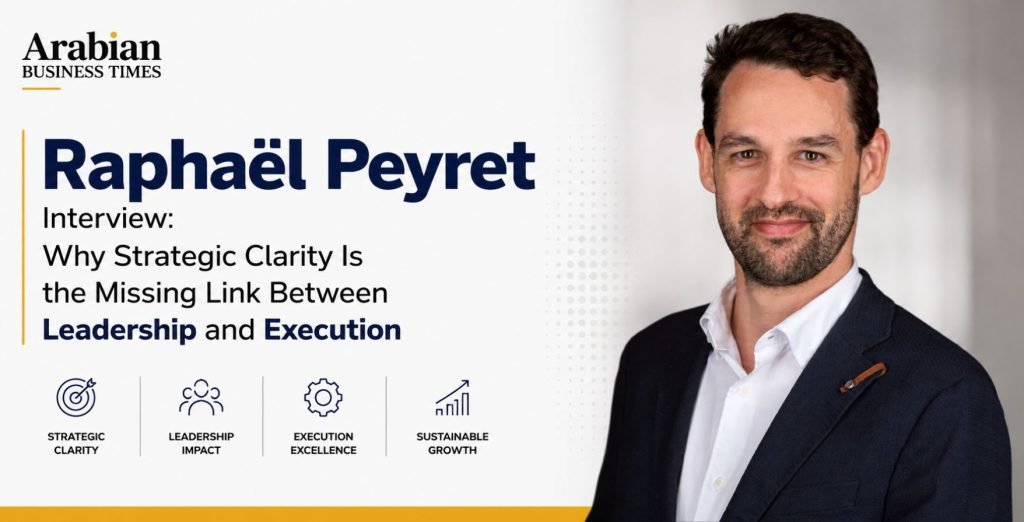
For Raphaël Peyret, Founder and Principal Advisor at SHA/RP, this is what strategic drift looks like. When priorities multiply, decisions remain unresolved, and ownership becomes unclear, even highly capable teams can lose momentum. The result is often a company that appears busy on the surface while making surprisingly little progress underneath.
In this exclusive interview with Arabian Business Times, Raphaël Peyret discusses the evolution of product leadership, why organizations experience strategic drift, how businesses can move beyond AI experimentation toward measurable value, the balance between innovation and cybersecurity, and why the next generation of product leaders will be defined less by their ability to produce and more by their ability to decide.
From his 70% rule for strategy to his belief that “motion” should never be confused with “progress,” Peyret offers a practical perspective on what it takes to keep organizations aligned when complexity and competing priorities begin pulling them in different directions.
What inspired your journey into product leadership, and what has most influenced your leadership philosophy?
Raphaël Peyret: I have always been driven by impact, and I have always been close to technology. I started on the technical side and moved steadily toward the business side, because I kept running into the same realization: it is not the best technology that wins. That is what pulled me into product. The best-built thing does not succeed on its own. Someone has to decide what is worth building and why.
From there the logic continued. If you want to scale impact in product, you do it through product leadership, because you scale people instead of scaling things directly. That is a different order of leverage. It also shapes how I lead. The job is to unlock the power of the people you bring in. Find the right people, then grow them into what they are capable of becoming. That scale is what produces the impact.
How would you define strategic drift, and why do so many businesses struggle to recognize it?
Raphaël Peyret: Strategic drift has a few distinct forms.
The first is a direction defined too loosely. In principle there is alignment, everyone agrees we are going north, but there is no real alignment, so teams head off in slightly different directions from the same vague heading. Think of geographic north versus magnetic north. At the start the gap is a rounding error. Six months later teams are building in completely different directions.
The second is no direction at all. Everyone rows a different way because a north was never set. That is the worst case, but it is also the more obvious one, easier to catch than a leader who believes the problem is solved because a direction was named, when it was never made actionable for a team over the long term.
The third, closely related, is a lack of coordination. There is a lot of motion and a lot of effort expended, but it does not drive progress. The picture I use is a drowning person next to an Olympic swimmer. Both are thrashing arms and legs, both are burning enormous energy, and yet one is about to die and the other is world-class at making progress. The work is coordinating all those moving parts and focusing that energy on one goal that is extremely clear.
What patterns separate organizations that execute well from those that struggle?
Raphaël Peyret: The organizations that do well are extremely clear about their goals, in a way that is both specific and correct. Specificity alone is not enough. The goal has to be meaningful. “We need to adopt AI” is a poor goal. “Identify where AI can be transformative to the core parts of our business” is a real one. The second immediately tells you the work: evaluate where AI genuinely has that potential, look at what comparable businesses have done successfully. Now you are solving business problems instead of blindly shoving technology everywhere, and teams understand what they are actually trying to move.
The second pattern is alignment at the top that cascades all the way down. You need a hierarchy of goals, each level a breakdown of the one above, so that at the bottom, where the work happens, teams are not executing a task because they were told to. They are executing it because it moves the goal, and they understand why. That understanding is what makes execution intelligent. When someone on the ground sees that a task is not moving the goal, or finds a better path to it, they surface the change upward. Execution stops being the top of the food chain dictating to the bottom and starts using the richest information in the company, which is on the ground. What this solves is the most expensive failure of all: a team executing flawlessly on the thing it should not be doing. The problem there is never the task. It is that conditions changed and the plan did not.
How should business leaders move beyond AI experimentation and begin creating measurable value?
Raphaël Peyret: Stop starting with the technology. AI adoption rarely breaks on the model. It breaks on everything around it. Legal blocks a vendor. A board member has a veto nobody surfaced during the pilot. Accountability nobody thought through. The technical work gets done and the rest does not.
So the reframe is simple. If adoption fails on everything around the technology, why is so much of the pilot phase still spent on the technology? The organizations getting it right share one trait: the business defined what it needed, not the tech team. When the business owns the problem, the technology follows. Pick one workflow where the outcome is measurable, assign clear ownership, and treat the model as the last mile, not the starting point. That is the move from AI hype to AI utility.
How can organizations balance innovation and speed with resilient security?
Raphaël Peyret: Approach it as a question of risk. You are not looking for the best, most resilient security. You are looking for the right level of security to match your appetite for risk.
Early on, a startup usually has a large risk appetite. There is little to lose, and too much security simply slows it down, so the basics are usually enough. That changes if you are regulated, in fintech or handling medical data, where the appetite is different from the start. A large bank sits at the other end entirely, with very different needs. The level is not fixed. It is set by the stage and the stakes.
The big mistake shows up in new or fast-moving areas like AI, and it shows up as two extremes. On one side, people who do not understand the technology ignore its security entirely. You get speed and innovation, and something reckless with no security at all. On the other side, the reflex is to say no to anything new until there is enough information to be sure. You get resilient security and no innovation or speed. Both fail.
The balance is in the middle. To get innovation and speed you almost always have to take some risk. The discipline is managing it: making sure that if something does go wrong, it is not catastrophic. You are not trying to prevent every bad outcome. You are extracting the most benefit from the new technology while holding a clear picture of the absolute worst case and judging, honestly, that it is acceptable against the gain.
6. What framework do you recommend for founders facing uncertainty and competing priorities?
Raphaël Peyret: Two rules and one habit.
The first rule is the 70% rule. If a strategy is 70 percent clear, stop refining. The remaining 30 percent is only discoverable through execution, not more thinking. Analysis past that point is drift wearing the costume of diligence. You will most likely be wrong, but you need a starting point, and 70 percent is enough clarity to start seeing where you are wrong. Start from nothing and you cannot tell which parts you misunderstood. So you commit, then you iterate. The first time you take your understanding to a real customer, you will find you are using most of the wrong words, but something will resonate. You take that, refine it, and close the loop.
The second rule is a circuit breaker. If the same variable gets debated more than a few times without a decision, force the issue: state the assumption you are making, define the minimum evidence that would prove it, then commit to one small action that produces that evidence. The habit underneath both is spending your time on the problem, not the answer. Most people jump straight to “should we do A or B.” The better question is “what information would let us decide.” Define the problem well and the decision often makes itself.
What leadership practices align engineering, marketing, sales, and customer success?
Raphaël Peyret: This is what product management exists to do, deliberately, and there is a whole range of tools for it. The objective is to build a layer of translation between the worldviews, the objectives, and the work of very different stakeholders, so that each one aligns to a common ground rather than trying to align directly with the others. Direct alignment does not hold, because those teams speak different languages. You route through the middle, and that middle is the hard part. It starts with a very clear, shared understanding of what we are trying to achieve, why, and within what parameters.
The tool I lean on is pillars. As a leadership team, based on what the business needs, you decide how effort is allocated for the quarter. Say 50 percent toward functionality that drives immediate, short-term revenue, where every item is tied to a revenue number that is coming soon: imminent customer requests, what is required for an upsell. Then 30 percent toward the vision, because if you never build toward it, it never happens, so you protect the capacity on purpose. Then 20 percent toward business as usual and customer experience, the small bugs and the polish, the things that never hurt you individually but kill you by a thousand cuts if you never address them.
Once that mix is set and agreed, you stop debating apples against oranges against bananas. You have already decided how many of each. Inside a pillar the comparison becomes tractable. You can ask the sales team which of these features drives the most immediate revenue, and that is a question they can actually answer. You are no longer weighing a revenue-tied feature against a single small fix that only becomes fatal in aggregate. That is the translation layer. Do not try to make the functions communicate directly. Route them through the level in the middle.
How do you see the role of product leaders evolving over the next decade?
Raphaël Peyret: The production layer is collapsing. I built and shipped a full website in a day with just a vision and a couple of AI tools. Work that used to require a specialized skill set, that you either had or paid for or waited on, is becoming close to free. Most people have not felt that shift yet. They will.
When producing the artifact gets cheap, the scarce skill moves up the stack. The product leader of the next decade is not the best artifact producer. They are the person who can define the right problem, force convergence across functions, and exercise judgment about what is worth building at all. Taste, clarity, and the ability to say no become the differentiators. The tools will handle more of the how. The value is in the what and the why, and that has always been a clarity problem.
What is the most valuable leadership lesson from guiding acquisitions and rapid growth?
Raphaël Peyret: Knowing the right answer and doing the right thing are not the same thing.
You can have excellent people individually and still get very little from them. The lesson is that performance is unlocked only when you get them working together, with clarity in how each of them works and a real understanding of why they are doing a given task and what it means for the goal one level above. That is where performance transforms. You go from a great deal of effort with little progress to a team that is genuinely converging, and alignment accelerates everything. Often it is not a big-bang change that gets you there. It is a set of small adjustments, each one securing a higher level of clarity. Clarity is easy when things are calm. Leadership is holding it when they are not.
What advice would you give founders and executives who want to build innovative organizations while maintaining strategic clarity?
Raphaël Peyret: Do not confuse motion for progress. A busy company and a converging company look identical from the outside and could not be more different underneath.
Do the hard work of defining what you are trying to achieve in the medium term, whatever medium means for you. Not the grand vision, not the next step. The first real milestone, a combination of steps far enough out that you are not thinking purely tactically. Align everyone on that, and then deliberately stop asking, for a while, whether each move gets you closer to the ultimate goal, so that the team can stop thinking about where it is going and simply execute. Treat it as a series of short sprints. Put your head down, pick the best course of action, and run. Then come back up and check: did that get us closer or not? Adjust, then head back down and execute. You correct course periodically, not constantly, because constant correction means you are always thinking about direction instead of moving.
And protect a simple test as you scale: can five people on your team define your top priority the same way? When the answer is no, you have found your next problem before it finds you.
Optional closing: a personal principle for the next generation of leaders.
Raphaël Peyret: Execution is a clarity problem. I have staked a company on that sentence because I have watched it hold in every context I have worked in, from Google to a cybersecurity acquisition to founders building across three continents.
The principle I would pass on is this. The hard part is rarely finding the answer. The hard part is holding direction when complexity, pressure, and everyone’s competing certainty pull you off it. Get radically aligned on what matters, then harden the execution so it survives contact with reality. Clarity is not a personality trait. It is a discipline you can build. Build it.
Connect with him