
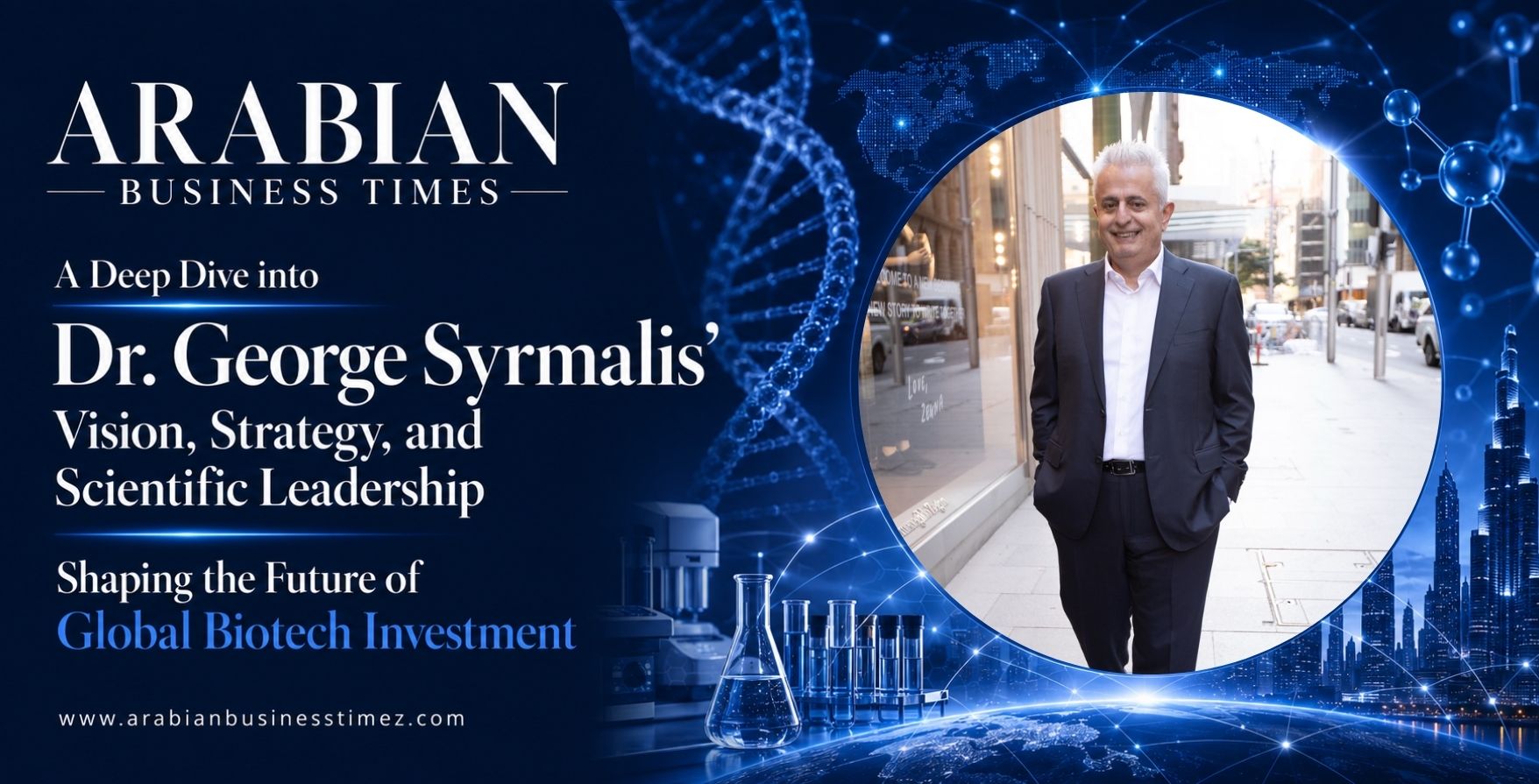
From working in hospitals and research labs to building biotechnology companies and working with global investors, Dr. George Syrmalis has spent more than 30 years at the crossroads of science and business. Throughout his career, he noticed an important problem: many great scientific discoveries never reach patients. The issue is often not the science itself. But the lack of the right funding, planning, and support.
This understanding eventually led him to create Bioscience Equity Partners (BEP). A firm that combines scientific expertise with investment strategy. In this interview, Dr. Syrmalis shares his journey, explains the thinking behind BEP. Aldo discusses where he believes the future of biotechnology is heading. Readers interested in Dr. Syrmalis’ broader perspective on the biotechnology industry can also explore his analysis of why Dubai is emerging as a leading destination for biotech companies and investors.
Amira:
Dr. Syrmalis, can you begin by telling us about yourself and what led you from a scientific career to founding Bioscience Equity Partners?
Dr. George Syrmalis:
My career started in medicine and scientific research. I earned a medical degree, completed a fellowship in nuclear medicine. Also, received a PhD in radiation immunology. These experiences taught me the importance of evidence, careful decision-making. It also made me understand how our choices can affect patients’ lives.
For many years, I thought my main contribution would come through medicine and academic research. However, as I gained experience, I noticed something that kept happening. Many excellent scientific discoveries were not reaching patients. The science was often strong, but the companies behind these innovations struggled with funding, planning, or managing the challenges of bringing a product to market.
I saw promising technologies slow down or fail because the financial structures supporting them were not designed to handle the complexity of biotechnology. This made me realize that good science alone is not always enough.
That experience encouraged me to move into entrepreneurship. With support from a NATO research grant, I founded Antisoma in 1995 and later established the Bionuclear Group. Through these ventures, I learned that emerging areas such as theranostics—which combines targeted diagnostics and treatments—require not only scientific expertise but also strong financial planning.
When I returned to Australia, I built a biotechnology group that developed intellectual property internally and helped bring several companies to public markets, including NASDAQ, the Australian Securities Exchange (ASX), and European exchanges.
Across all these experiences, one lesson remained the same: even the best science can struggle without the right funding strategy and governance. Bioscience Equity Partners was created from that realization. It represents more than three decades of experience connecting scientific innovation with the financial support needed to bring it to patients around the world.
Amira:
What were some of the key moments in your journey that eventually shaped the vision behind BEP?
Dr. George Syrmalis:
There were several important moments.
The first was realizing that strong science alone does not guarantee success. Biotechnology companies also need clear operations, strong governance. Also, the ability to earn the trust of investors, regulators, and strategic partners. Without these things, even promising projects can struggle.
Another important lesson came from watching companies repeatedly raise small amounts of money over time. While this may seem helpful in the short term. It often creates bigger problems later. It can dilute ownership, slow development, and make institutional investors less confident about the company’s future.
A third turning point came from seeing both sides of the industry. As a founder, I understood how difficult it is to build a company with limited resources. As an investor, I learned how carefully institutional capital must be managed.
Those experiences showed me that biotechnology needed a different model, one that combines scientific understanding with investment banking discipline and long-term capital planning. Dr. Syrmalis recently explored how biotech startups are raising capital in today’s market and what institutional investors now expect before funding a company.
That is why BEP was built to evaluate science in depth while also creating a structured funding pathway. This can include institutional investment rounds, crossover financing, and a roadmap toward a NASDAQ listing. Our goal is to help transform biotechnology into a more stable and investable sector.
Amira:
How is BEP different from a traditional venture capital firm or investment bank when working with biotechnology companies?
Dr. George Syrmalis:
BEP is not a traditional venture capital firm, and it is not a typical investment bank.
Together with Antisoma, our family-office venture capital entity, we have developed a consortium-based underwriting model specifically for life sciences.
Biotechnology is different from many other industries. Development takes longer, regulations are more complex, and the scientific risks are higher. Because of this, companies need a much deeper level of evaluation than most financial institutions can provide.
We work exclusively with institutional investors, mainly sovereign and quasi-sovereign funds, and we focus on transactions valued at around $20 million to $25 million and above. These investors are looking for scientific credibility, strong governance, and long-term opportunities.
Unlike many venture capital firms, we do not simply follow market trends. And unlike traditional investment banks, we do not run broad auction processes. Instead, we develop a long-term capital strategy from the start and stay committed to that strategy for years.
Before presenting any opportunity to our institutional network, we conduct extensive scientific, regulatory, technical, and operational due diligence. Only after completing that process do we move forward.
This approach gives founders something they often struggle to find—predictable funding, a clear roadmap, and a partner who can help guide a company from early-stage development all the way to a public listing.
Amira:
When you evaluate an early-stage biotech or med-tech company, what factors matter most to you?
Dr. George Syrmalis:
Everything begins with the science.
We look at the quality of the underlying research, the strength of the intellectual property, and whether there is a realistic regulatory pathway. We also examine whether the technology can move successfully from research into clinical use.
Commercial factors are important too. We ask whether the technology solves a real healthcare problem, whether it can be adopted by healthcare systems, and whether there is a realistic path to reimbursement.
However, if I had to choose one factor that stands above the rest, it would be the leadership team.
Scientific founders are incredibly important. But success in biotechnology requires much more than scientific expertise. Leaders need operational discipline, transparency, strong governance, and the ability to manage the long process of bringing a product to market.
Many projects fail not because the science is weak. But, because the leadership team underestimates the challenges involved.
At BEP, we look for teams that can not only innovate but also execute. That combination is essential for long-term success.
Amira:
Looking ahead, which areas of biotechnology excite you the most, and how do you see BEP supporting their growth?
Dr. George Syrmalis:
We are entering a very exciting period in healthcare.
Fields such as radiopharmaceuticals, precision immunotherapy, AI-powered drug discovery, advanced diagnostics, and next-generation biomanufacturing have the potential to change the way medicine is practiced. These are not small improvements. They could transform entire areas of healthcare.
At the same time, we are seeing strong support from governments and institutional investors. Across the Gulf region, particularly in Saudi Arabia, there is growing investment in healthcare, biotechnology, and local manufacturing capabilities.
Sovereign and quasi-sovereign funds are becoming increasingly interested in supporting the technologies that will shape the future of medicine.
BEP’s role is to identify strong scientific platforms, conduct thorough due diligence, support them through Antisoma and our institutional consortium, and help guide them toward regulatory approval and public market listings such as NASDAQ.
Our mission is straightforward. We want to ensure that strong science is supported by the right structure, funding, and execution so that innovative technologies can become real medicines that improve patients’ lives.
Conclusion
Dr. George Syrmalis has spent more than three decades working across science, medicine, entrepreneurship, and investment. Through Bioscience Equity Partners, he has created a model that brings these worlds together.
As healthcare enters a new era shaped by radiopharmaceuticals, precision medicine, and artificial intelligence, Dr. Syrmalis believes success will depend not only on scientific discovery but also on strong leadership, disciplined planning, and long-term investment.
His goal remains clear: to help promising scientific innovations move beyond the laboratory and become real healthcare solutions that benefit patients around the world.
Related Insights
As innovation continues to reshape industries worldwide, readers may also find these expert interviews and thought leadership articles valuable:
- Explore how AI is transforming education, workforce development, and global learning ecosystems in our interview with Dr. Darcell L. Streeter:
- Discover insights on AI leadership, responsible innovation, and the future of technology adoption with Ammara Aftab:
- Learn how artificial intelligence is reshaping Dubai’s real estate sector and driving digital transformation in our conversation with Anis Sfar: