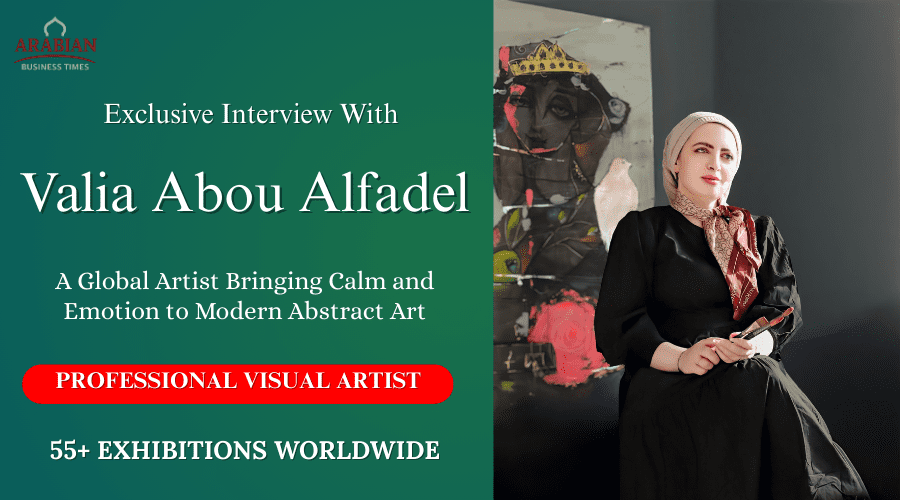
In a world where art is often reduced to aesthetics, Valia Abou Alfadel brings it back to something deeper—emotion, memory, and meaning. A Syrian-born visual artist now based in the UAE, she carries a quiet intensity in her work. With over 50 exhibitions worldwide and recognition as one of the top watercolor artists globally, her journey reflects not just growth but transformation.
In this conversation, Valia opens up about her beginnings, her philosophy, and the emotional force that continues to shape her work.
Q1. Valia, your relationship with art feels very personal. How did it all begin for you?
Valia Abou Alfadel:
I don’t remember a moment when art “began” for me. It was always present. As a child in Syria, I didn’t look at things the way others did. I didn’t see objects; I saw feelings, colors, and movement. Even silence had a presence.
Art became my way of understanding the world before I had the words to explain it. It was never about learning how to draw. It was about recognizing something that already lived inside me.
When I joined the High Institute of Fine Arts, I didn’t feel like I was acquiring a skill. I felt like I was uncovering a voice that had been waiting.
Q2. Was there a defining moment that shaped your path as an artist?
Valia Abou Alfadel:
Yes, but not in the way people might expect. It came through loss. Losing my mother at a young age changed something in me. It made me more sensitive to everything—people, emotions, silence.
Art became a space where I could hold that feeling without explaining it. I didn’t try to escape pain. Instead, I tried to transform it into something that could bring light to others.
That’s when I realized art was not just expression, it was responsibility.
Q3. You’ve participated in over 50 exhibitions worldwide. What keeps the journey alive for you today?
Valia Abou Alfadel:
The journey is alive because I still don’t have all the answers. Every canvas is a question. Even now, I stand in front of it with the same uncertainty I had in the beginning.
It’s not the exhibitions or recognition that drive me. Those are moments, not reasons. What keeps me going is the quiet dialogue between my inner world and something unknown.
As long as there are emotions I haven’t fully understood, I will continue to paint.
Q4. “Love is my message” has become a defining idea in your work. How do you interpret love in your art?
Valia Abou Alfadel:
Love, for me, is not a feeling that comes and goes. It is the foundation of everything. It is the energy that connects all existence.
When I speak about love, I am not referring to romance. I am speaking about a deeper awareness, an understanding that beauty exists beyond appearances, that connection exists beyond words.
Art, beauty, and love are not separate. When you truly see beauty, you begin to understand love. And when you understand love, you understand something essential about being human.
Q5. Women appear frequently in your work. What do they represent for you?
Valia Abou Alfadel:
Women, in my work, are not simply figures. They are carriers of meaning. They hold contradictions, strength and fragility, silence and expression, and creation and endurance.
To me, the feminine presence represents life itself. It carries memory, emotion, and transformation. A woman in my painting is not just an image; she is a universe.
Through her, I can express layers of feeling that go beyond language.
Q6. Your artistic style feels both spontaneous and controlled. How do you approach that balance?
Valia Abou Alfadel:
It’s a delicate balance, and it comes with time. My brushstrokes are often fast, almost like improvisation, because emotion cannot be forced. It needs to move freely.
At the same time, there is awareness behind every movement. I simplify forms, reduce details, and focus on what truly matters: the feeling.
So even in chaos, there is intention. And within structure, there is freedom.
Q7. Watercolor is central to your work. What makes it so important to you?
Valia Abou Alfadel:
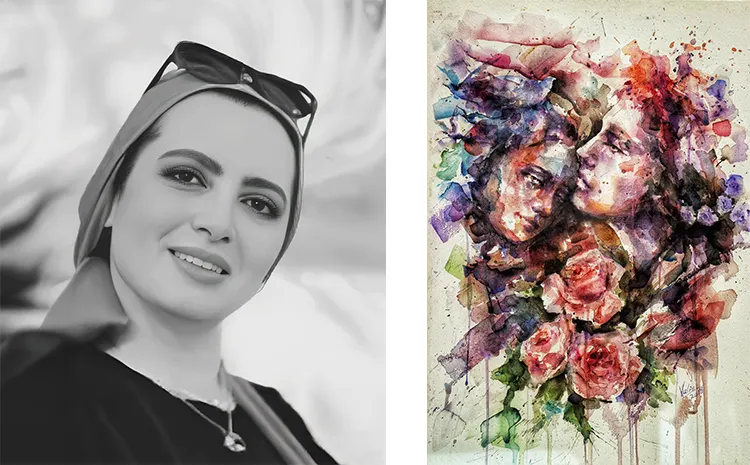
Watercolor reflects life in a very honest way. You cannot control it completely. It flows, spreads, and reacts on its own.
This unpredictability is what draws me to it. It reminds me that not everything needs to be controlled. Sometimes, you have to allow things to unfold.
When I paint with watercolor, I don’t feel like I am leading. I feel like I am in conversation with the water, with the color, with something deeper.
Q8. You also work digitally. How does that fit into your creative process?
Valia Abou Alfadel:
Digital art gives me space to expand. Most of my work begins in a physical form, such as sketches or watercolor layers. From there, I sometimes move into digital, where I can build on what already exists.
I don’t see digital and traditional as separate worlds. They are connected. One carries the raw emotion; the other allows me to explore it further.
The essence of the work remains the same. Only the language changes.
Q9. Your career in the UAE spans both art and media. How has that shaped your perspective?
Valia Abou Alfadel:
Working in media taught me how powerful visual communication can be. An image can speak directly to people without explanation. That understanding influenced how I approach my work.
The UAE also gave me something important: space. It is a place where creativity is welcomed and supported. Being surrounded by different cultures expanded my way of seeing.
It allowed my work to grow, not only in reach but in depth.
Q10. Receiving Dubai’s Golden Residency is a major milestone. What did it represent for you?
Valia Abou Alfadel:
It felt like a quiet acknowledgment of the journey. Coming from Syria and building a life elsewhere carries its own challenges.
The Golden Residency gave me a sense of belonging. But more than that, it reminded me that art has no borders. It travels. It connects.
It also carries responsibility to continue creating with honesty and purpose.
Q11. Your work often includes recurring symbols like the apple and the rose. What do they mean to you?
Valia Abou Alfadel:
Symbols come to me naturally. I don’t always plan them. The apple, for example, carries both personal and universal meaning. It connects to my childhood memories but also to larger human stories.
The rose often represents femininity and beauty. These symbols allow the work to speak on different levels.
Each person who sees them may understand something different, and that is what makes art alive.
Q12. When someone stands in front of your work, what do you hope they experience?
Valia Abou Alfadel:
I don’t expect them to understand everything. Art is not about explanation. It is about feeling.
If someone pauses, even for a moment, and feels something genuine, like peace, memory, or reflection, then the painting has fulfilled its purpose.
I don’t paint reality as it is. I try to paint what it could become: softer, more connected, more human.
Closing Reflection
The journey of Valia Abou Alfadel is not defined by exhibitions or recognition alone. It is shaped by emotion, resilience, and a deep commitment to meaning.
Her work reminds us that art is not only something we see—it is something we feel, carry, and sometimes, quietly understand.
And at the center of it all lies her enduring message: love, in its purest form, remains the most powerful language we have.