
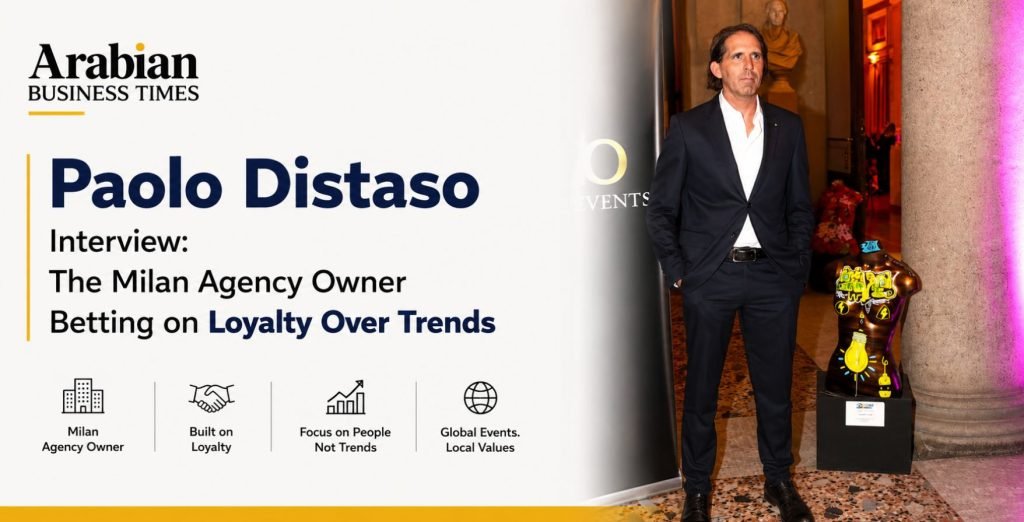
Paolo Distaso built B20 Events from modest beginnings a decade ago, and today the agency moves between six of the world’s biggest fashion and events capitals: Milan, London, Paris, New York, Tokyo, and Dubai. For a business that now operates on that scale, Paolo Distaso’s account of how it started stays notably unembellished. “I founded this company ten years ago, starting with small businesses, and my desire to always do better has brought me here,” he says.
It’s a founding story with a familiar shape in the events world: a business that didn’t launch with international ambitions fully formed, but grew into them by taking on progressively bigger work and following the momentum of each success into the next opportunity. A decade later, that trajectory has landed B20 in the position of running fashion shows and brand experiences in cities with very different creative cultures, client expectations, and production standards, from Milan’s fashion week calendar to New York’s media market to Dubai’s rapidly expanding luxury scene.
There’s no single formula city-hopping agencies rely on to keep pace across such different markets, and Paolo Distaso doesn’t pretend B20 reinvents its approach in every location it enters. Instead, he points to something structural. “We’ve created this format that encompasses many sectors, so it can be scaled anywhere in the world,” he says, describing the model behind the agency’s ability to move between fashion shows, luxury events, and brand experiences without losing consistency along the way. It’s a pragmatic answer from someone running an operation across multiple time zones and cultures at once, where the harder problem is rarely coming up with a single good idea, but building something repeatable enough to travel.
On Technology and What Might Be Lost
Fashion and events agencies have spent the past few years absorbing the same question every creative industry is wrestling with: what happens to the human hand in a world of AI-assisted production. Paolo Distaso’s view leans more cautious than celebratory. “With artificial intelligence advancing so rapidly, I believe manual creation will be lost, along with many jobs and traditions,” he says. It’s a concern that runs deeper than automation replacing a task here or there; it touches on craftsmanship and the traditions that fashion events have historically been built around.
At the same time, Paolo Distaso doesn’t treat the shift as something to resist outright. “You have to keep up, but now we have more tools, and if used well, great things can be achieved,” he says. That balance, between protecting what technology threatens to erode and using it to do more with less, is one a lot of agencies in his position are still trying to work out for themselves, particularly in an industry where the value clients pay for is often the very human sense of craft, spectacle, and occasion that AI-generated content struggles to replicate.
What Makes a Partnership Last
Asked what it takes to build long-term relationships with designers, brands, and creative professionals across markets as different as Tokyo and New York, Paolo Distaso keeps his answer to two words. “Loyalty and the desire to grow together,” he says. It’s a short answer, but a telling one for an agency owner whose business depends less on winning a single event and more on being invited back season after season, market after market. In an industry where brands routinely rotate between agencies chasing the newest concept, betting on loyalty as a differentiator is itself a kind of positioning, one that favors depth of relationship over constant reinvention.
Why Dubai
Dubai has become one of B20’s key markets, and Paolo Distaso frames the city in almost mythic terms. “Dubai has been seen as the city of dreams and possibilities,” he says. “It’s there, great material to work with, and we want to take advantage of the opportunity.” For an agency already operating in Europe, the US, and Asia, adding a Middle East hub reflects a broader pattern across the luxury and fashion events industry, where Dubai has increasingly become a proving ground for brands looking to reach both regional and international audiences at once. The city’s combination of high-net-worth residents, a steady flow of international visitors, and government investment in positioning itself as a global events destination has made it a natural extension for agencies that already operate at the top end of the fashion and luxury calendar elsewhere.
On Setbacks
Not every entrepreneur claims to have sailed through a decade in business without a defining crisis, but Paolo Distaso does. “Honestly, I’ve never had a problem so big I couldn’t solve it. I always have a backup plan for anything,” he says. It’s a confidence that comes across less as bravado and more as a working philosophy: plan for the version of the event that doesn’t go as scripted, because in live events, something always shifts at the last minute, whether it’s a delayed shipment, a change in venue, or a talent schedule that moves without warning.
Balancing Creativity and Commerce
For Paolo Distaso, the commercial side of the business comes down to giving clients multiple channels to be seen, rather than treating any single platform as the whole strategy. “We try to give clients many ways to highlight their product. Magazines, for example, are an excellent way to gain visibility, in addition to social media, of course,” he says. The comment reflects a fairly deliberate view of what an events agency is actually selling: not just a night’s production, but a spread of visibility across print, digital, and the event itself, each reinforcing the others.
Looking Toward Asia
Paolo Distaso’s expansion plans have a clear next destination in mind, and it’s a personal one as much as a strategic one. “I’d also like to cover the Asian world, which I personally find very fascinating. But we can collaborate anywhere, so we’re moving in that direction.” With Tokyo already part of B20’s footprint, that ambition suggests deeper build-out across the region rather than a first foothold, extending a network that already spans Europe, the US, and the Middle East. For an agency whose growth so far has followed opportunity as much as strategy, framing Asia as an area of personal fascination rather than pure market calculation fits the pattern of how B20 has expanded until now.
Advice for the Next Generation
Asked what advice he’d give to aspiring entrepreneurs hoping to build careers in fashion, luxury branding, and event management, Paolo Distaso warns against a specific trap he’s clearly watched other people fall into. “My advice is very simple: don’t get caught up in the mania for making money while neglecting the professionalism you always need,” he says. “Success comes with hard work and the enthusiasm that gets us out of bed every morning.” It’s advice that doubles as a description of his own decade-long path, from a small operation to an agency running events across six global cities, built one professional relationship at a time. For an industry often associated with glamour on the surface, it’s a reminder that the businesses that last tend to be the ones built on the less photogenic fundamentals: consistency, reputation, and showing up prepared, market after market, year after year.