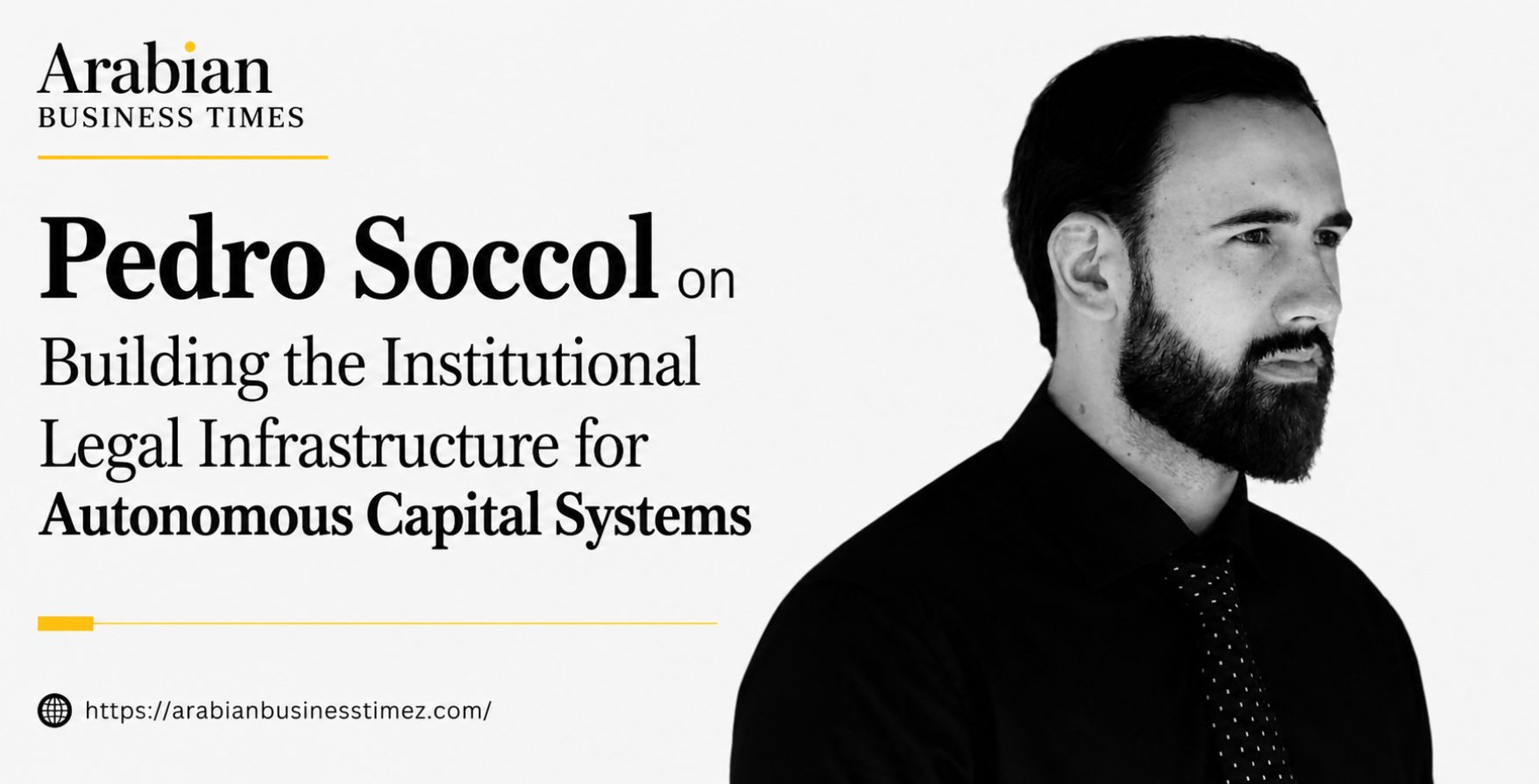
In an exclusive interview with Arabian Business Times, the Chairman and CEO of Cognisynth discusses why programmable capital, tokenized assets, artificial intelligence, and autonomous systems require a new architecture of legal authority, accountability, and cross-border governance.
| “Technology may execute the transaction, but governance determines whether that transaction can be trusted, authorized, audited, and defended.” |
Pedro Soccol is a Brazilian founder and legal systems strategist working at the intersection of law, institutional governance, smart contracts, tokenized assets, artificial intelligence, and autonomous capital systems.
As Chairman and CEO of Cognisynth, Soccol is developing an institutional framework based on a central proposition: before capital becomes increasingly programmable and autonomous, institutions must establish the legal architecture that defines authority, responsibility, validation, accountability, and control.
Cognisynth summarizes this position through a concise institutional principle:
“The layer before the code.”
Rather than approaching legal technology as another software interface or document-automation service, Cognisynth is being structured around a broader challenge: how governments, companies, financial institutions, asset managers, developers, and other stakeholders can govern increasingly automated economic systems across multiple jurisdictions.
In this interview with Arabian Business Times, Pedro Soccol discusses the origins of Cognisynth, the meaning of institutional legal infrastructure, the limitations of code without governance, the role of artificial intelligence, the strategic relevance of the Gulf region, and why the next generation of global capital systems will require more than technological efficiency.
Q1. Your work is positioned at the intersection of law, technology, governance, and capital. What led you to create Cognisynth?

Pedro Soccol: Cognisynth emerged from a question that became increasingly difficult for me to ignore: what happens when economic systems become capable of executing decisions faster than traditional legal structures can interpret, supervise, or assign responsibility for them?
My initial interest was closely connected to smart contracts and blockchain-based transactions. At first, the discussion appeared to be primarily technological. Most conversations focused on automation, decentralization, speed, efficiency, and the reduction of intermediaries.
But the deeper I studied the subject, the clearer it became that the most consequential questions were not exclusively technical.
A system may execute a transaction automatically, but that does not independently determine who had the authority to initiate it, which jurisdiction governs it, what happens if the underlying information is incorrect, how the decision can be challenged, who bears responsibility, or how regulators and institutions can verify what occurred.
Code can execute instructions. It does not automatically establish legitimate authority.
That distinction became the foundation of Cognisynth.
I identified a gap between what technology could technically perform and what institutions could legally recognize, supervise, and trust. Cognisynth was created to operate within that gap.
The objective is not to compete with software developers or replace existing legal institutions. It is to establish the governance layer that allows sophisticated technological systems to operate within a credible institutional structure.
Technology can accelerate execution. Governance determines whether that execution is legitimate.
Q2. Cognisynth describes itself as developing “institutional legal infrastructure for autonomous capital systems.” What does that mean in practical terms?
Pedro Soccol: Institutional legal infrastructure is the architecture that defines how authority, responsibility, validation, compliance, and accountability operate within a technological or financial system.
When people hear the word infrastructure, they often imagine physical assets, servers, networks, or software. But institutions also depend on invisible infrastructure.
They depend on rules, decision rights, authorization procedures, audit mechanisms, escalation paths, accountability structures, and legally recognizable records.
In a conventional organization, these elements are distributed across contracts, policies, committees, departments, regulatory requirements, and human decision-making processes.
In a programmable or autonomous environment, these same elements must be translated into a structure capable of interacting with technology.
That does not mean reducing law to code. It means ensuring that code operates within an institutional framework.
In practical terms, this may involve defining who can authorize an automated transaction, which conditions must be satisfied before execution, how exceptions are handled, which evidence must be preserved, how regulatory obligations are mapped, and when human intervention becomes mandatory.
It also requires traceability.
Institutions must be able to understand not only what happened, but why it happened, which rule authorized it, which data informed it, who approved the relevant parameters, and what mechanism exists to review or contest the outcome.
Without that structure, automation may increase operational speed while simultaneously increasing institutional uncertainty.
Cognisynth is therefore being developed around the principle that advanced systems should be governable by design, rather than governed only after something goes wrong.
Q3. Cognisynth frequently uses the expression “The layer before the code.” Why do you consider governance the layer before technology?
Pedro Soccol: Because every serious technological system operates on decisions that were made before the code executed anything.
Someone defined the objective.
Someone established the permissions.
Someone selected the relevant data sources.
Someone determined the acceptable level of risk.
Someone decided which actions would be automated and which would require human review.
Someone defined what the system would recognize as valid.
Those are governance decisions.
“The layer before the code” expresses the idea that technology does not exist in an institutional vacuum. Before a system can execute reliably, there must be clarity regarding authority, purpose, responsibility, and limits.
This is particularly important when technology is connected to capital, assets, contractual rights, ownership structures, or legal obligations.
A poorly governed automated system can execute an invalid instruction with extraordinary efficiency.
Speed does not correct a defective authority structure. Automation does not eliminate responsibility. Decentralization does not remove the need for accountability.
Governance should not be treated as something added after development merely to satisfy a compliance requirement. It should influence the architecture from the beginning.
The strongest systems will not necessarily be those that execute the fastest. They will be those that institutions can understand, audit, supervise, and rely upon.
That is why governance precedes scale.
Q4. How do you distinguish smart contracts from the broader concept of autonomous capital systems?

Pedro Soccol: A smart contract is generally understood as code capable of executing predefined actions when specific conditions are satisfied.
That is an important component, but an autonomous capital system represents a much broader institutional environment.
We are moving toward structures in which capital may be transferred, allocated, collateralized, invested, distributed, or rebalanced through interconnected technological systems.
These environments may involve smart contracts, artificial intelligence, tokenized assets, digital identities, automated treasury functions, real-world asset data, governance protocols, and multiple institutional participants.
The legal complexity increases substantially when these components begin interacting.
The relevant question is no longer only whether an individual smart contract performs as programmed. The question becomes whether an entire sequence of automated decisions remains legally valid, institutionally authorized, transparent, and accountable across different stages and jurisdictions.
An automated system may receive external data, interpret a contractual condition, authorize a transfer, update an ownership record, and trigger a subsequent obligation.
Every stage may be technically successful while still raising significant legal questions.
Was the data reliable?
Was the system authorized to make that interpretation?
Was the transaction compliant in every relevant jurisdiction?
Can the outcome be reviewed or reversed?
Who is responsible if the automated sequence produces an unintended consequence?
Autonomous capital therefore requires more than executable code. It requires a legal and governance architecture capable of operating across the complete decision chain.
The system must not only function. It must remain understandable, accountable, and institutionally defensible.
Q5. Why is cross-border governance such an important part of the Cognisynth vision?
Pedro Soccol: Capital is increasingly global, while legal authority remains largely jurisdictional.
A digital transaction may involve parties, assets, infrastructure, data, custody arrangements, and execution mechanisms located across several countries. Technology can connect these components almost instantly, but the legal systems governing them remain distinct.
That creates one of the defining institutional challenges of programmable capital.
A system may be technologically unified while remaining legally fragmented.
Different jurisdictions may classify the same digital asset differently. They may impose different requirements concerning ownership, disclosure, consumer protection, taxation, licensing, custody, reporting, data protection, or dispute resolution.
Those differences do not disappear simply because a transaction occurs through a blockchain, smart contract, or automated platform.
Cross-border governance requires an architecture capable of identifying which legal obligations apply, how authority is distributed, where accountability sits, and what happens when different regulatory expectations overlap or conflict.
This does not mean that one universal legal model will replace national legal systems.
A more realistic objective is interoperability: creating governance structures capable of interacting with multiple legal environments while preserving traceability, responsibility, and institutional clarity.
Cognisynth is being developed with that international dimension in mind.
The future of capital may be increasingly programmable, but institutional legitimacy will continue to depend on the ability to connect technology with recognizable legal authority.
Q6. Trust is central to financial and legal systems. How can autonomous systems preserve institutional trust?
Pedro Soccol: Trust in sophisticated systems cannot depend solely on branding, reputation, or technological complexity.
It must be supported by verifiable structure.
Institutional trust requires clarity about who can act, under which authority, according to which rules, using which information, and subject to which form of review.
In an autonomous system, trust must be translated into architecture.
That includes permission structures, validation layers, reliable records, audit trails, separation of functions, defined intervention thresholds, and mechanisms for accountability.
It also requires intellectual honesty about the limits of automation.
Not every decision should be autonomous. Not every contractual interpretation should be delegated to software. Not every risk can be translated into a binary rule.
Human judgment remains essential, particularly where rights, context, proportionality, conflicting obligations, or exceptional circumstances are involved.
The objective should not be to eliminate human institutions. It should be to design a more disciplined relationship between human authority and technological execution.
A trustworthy autonomous system should make it possible to identify the origin of a decision, the data used, the rule applied, the authorization granted, and the person or institution ultimately responsible for the framework.
If no one can explain why a system acted, institutional trust becomes extremely difficult to sustain.
Transparency, however, does not require exposing every piece of sensitive information publicly. It means ensuring that the appropriate institution, regulator, auditor, or authorized party can inspect and verify the necessary evidence.
Trust is not created merely by describing a system as autonomous.
Trust is created when autonomy operates inside a structure of responsibility.
Q7. What role will artificial intelligence play in the future of legal and institutional infrastructure?

Pedro Soccol: Artificial intelligence will become increasingly relevant in legal analysis, regulatory monitoring, document interpretation, risk detection, data classification, and institutional decision support.
Its ability to process large volumes of information can improve institutional awareness and reduce the time required to identify relevant patterns, inconsistencies, and risks.
But artificial intelligence also introduces another layer of governance complexity.
An AI system may produce a recommendation, classification, or interpretation, but institutions must still determine whether that output is reliable, explainable, authorized, and appropriate for the relevant legal context.
The use of artificial intelligence does not eliminate responsibility. It makes the allocation of responsibility more important.
Organizations will need to establish who approved the system, which data informed it, what limitations were identified, how outputs are reviewed, when human validation is mandatory, and how affected parties can question a decision.
There is also an important distinction between using AI to support a decision and allowing AI-generated outputs to produce legal or financial consequences independently.
The second situation requires a substantially stronger governance architecture.
The future will not simply involve artificial intelligence replacing professionals. It will involve institutions reorganizing themselves around environments in which human judgment and machine intelligence operate together.
The quality of that relationship will depend on governance.
Institutions that treat AI only as a productivity tool may underestimate its structural implications. Artificial intelligence does not merely accelerate existing work. It can transform how decisions are formed, delegated, recorded, reviewed, and challenged.
That is why its legal and institutional architecture must be considered before widespread execution, not after.
Q8. Cognisynth presents itself differently from conventional legal-technology companies. What is the strategic distinction?
Pedro Soccol: Many legal-technology companies focus on improving a particular professional activity. They may automate documents, organize cases, simplify research, manage contracts, or increase operational efficiency.
Those are valuable applications, but Cognisynth is being developed from a different starting point.
Our central question is not only how technology can improve legal work. It is how legal and institutional architecture must evolve when economic systems themselves become programmable.
That places Cognisynth closer to infrastructure, governance, and institutional design than to a conventional legal software product.
The ambition is not to become another interface placed on top of existing processes.
The ambition is to contribute to the foundational structure through which automated operations can be authorized, validated, monitored, audited, and governed.
This also requires discipline in how the company develops and communicates.
Cognisynth is currently building and refining its architecture. Certain components are being examined through controlled development and internal validation, while some technical details remain intentionally restricted because of intellectual property and confidentiality considerations.
I believe serious infrastructure should not be built through excessive public promises.
Markets may temporarily reward announcements, but institutions ultimately evaluate coherence, reliability, resilience, and execution.
Our approach is to establish the conceptual and governance foundation carefully, develop the system in stages, and communicate only what can be presented responsibly.
Infrastructure must remain credible under scrutiny.
Q9. Why do you consider the Gulf region, and particularly the United Arab Emirates, strategically relevant to this conversation?
Pedro Soccol: The Gulf is highly relevant because it brings together capital, international business, technological ambition, institutional transformation, and cross-border connectivity.
The region is not simply adopting new technologies. It is actively participating in discussions about how future economic and financial systems should be structured.
That creates an important environment for conversations involving digital assets, artificial intelligence, tokenization, financial infrastructure, institutional governance, and international investment.
The United Arab Emirates is particularly significant because of its position as a connection point between different markets, legal traditions, sources of capital, and entrepreneurial communities.
For a project concerned with autonomous capital and cross-border institutional systems, that environment is strategically important.
Cognisynth does not view the region simply as a potential market for expansion.
We view it as one of the environments in which the future relationship between capital, technology, regulation, and institutional authority is likely to be shaped.
Across the Gulf, institutions have demonstrated a long-term orientation toward economic transformation, infrastructure development, international connectivity, and technological modernization.
That perspective is compatible with the Cognisynth philosophy.
Technology may attract attention, but institutions create durability.
Our interest is in constructive dialogue with organizations, technical partners, legal professionals, investors, and institutional leaders who recognize that programmable systems require credible governance.
Any future presence, partnership, or institutional collaboration must be developed responsibly, with substance preceding visibility.
Q10. What is the long-term vision for Cognisynth?

Pedro Soccol: The long-term vision is for Cognisynth to become a trusted institutional layer for systems in which capital, contractual rights, digital assets, and automated decisions interact.
That vision is intentionally broader than a single application.
Different industries will have different technical and regulatory requirements, but many of the fundamental governance questions will remain consistent.
Who has authority?
How is that authority verified?
Which conditions permit execution?
Which evidence must be retained?
How are obligations monitored?
When must a human intervene?
How is responsibility assigned?
How can institutions supervise the system across borders?
Cognisynth is being structured around those recurring institutional questions.
Over time, the architecture may support different use cases involving global contracts, tokenized real-world assets, automated operations, legal intelligence, institutional compliance, and programmable governance.
But scale should follow validation.
It is important not to confuse an ambitious long-term vision with a claim of immediate completion.
We are building toward an institutional objective that requires technical development, legal analysis, strategic partnerships, controlled testing, and the ability to adapt to regulatory evolution.
My objective is not for Cognisynth to be perceived as a company that appeared quickly because a particular market became fashionable.
The objective is to build something capable of remaining relevant after the initial excitement surrounding a specific technology has disappeared.
Institutional infrastructure is not measured through a single announcement or market cycle.
It is measured over time.
Closing Question. What single principle best summarizes your approach to the future of law, technology, and capital?
Pedro Soccol: Governance is not an obstacle to innovation. Properly designed governance is what allows innovation to become legitimate, scalable, and durable.
There is a tendency to describe law and regulation exclusively as friction.
Sometimes institutions are inefficient. Sometimes legal systems move too slowly. Those problems should be acknowledged and addressed honestly.
But removing every form of friction is not the same as creating progress.
Some friction represents verification.
Some friction represents consent.
Some friction represents accountability.
Some friction exists because decisions affect rights, capital, institutions, and human lives.
The challenge is not to eliminate governance. It is to make governance more precise, transparent, interoperable, and compatible with the speed of modern systems.
The future will become increasingly automated.
But automation without authority creates uncertainty.
Automation without traceability creates risk.
Automation without accountability creates institutional weakness.
The organizations that understand this early will be better positioned to build systems that people, regulators, investors, and institutions can genuinely trust.
That is the principle behind Cognisynth.
| The technology executes. The governance decides. |
Connect with Pedro Soccol and Cognisynth
| Website | https://cognisynthlegal.com |
| Cognisynth on Instagram | @cognisynth.sol |
| Pedro Soccol on Instagram | @chairman.pedrosoccol |
| Pedro Soccol | |
| Institutional inquiries | Available through the official Cognisynth website. |
About Pedro Soccol
Pedro Soccol is a Brazilian founder and legal systems strategist focused on the intersection of law, institutional governance, smart contracts, tokenized assets, artificial intelligence, and autonomous capital systems.
He is the Chairman and CEO of Cognisynth, an initiative developing institutional legal infrastructure for programmable and automated economic operations.
His work examines how authority, accountability, compliance, traceability, and cross-border legal structures can be incorporated into the design of emerging technological systems.
Through Cognisynth, Soccol advocates for an infrastructure-first approach in which governance precedes execution and institutional legitimacy precedes scale.