
By Dr. Mariam (Currim) Shaikh Founder & CEO, MS Education Consultants | Dubai, UAE | Global 200 Women Power Leaders 2024
I have spent more than 35 years in education — first running a nursery school inspired by my own children in the early 1980s, then leading one of the largest Asian school groups in the UAE, and later helping establish foreign university branch campuses here in Dubai. I have sat across from thousands of students and their parents. I have watched brilliant young people make avoidable mistakes, and I have seen students with average grades go on to build remarkable careers simply because they made smarter decisions about where and how they studied.
This article is everything I wish someone had told those students earlier.
Why Studying Abroad Is a Different Decision in 2026 Than It Was a Decade Ago
When I first helped students apply to universities abroad in the 1990s, the conversation was simple: Can you afford it? Do you have the grades?
That conversation is entirely different today.
The UAE now produces students who have grown up in one of the most multicultural cities on earth. They have studied alongside classmates from 50 different countries. They have seen global business happen in real time around them. When these students go abroad, they are not going to gain exposure — they already have exposure. They are going to gain credentials, specialisation, and professional networks in markets where their careers will take them.
According to the UAE Ministry of Education, the number of Emirati students pursuing degrees abroad has grown steadily year-on-year, with the UK, Canada, Australia and the US consistently ranking as top destinations. But the decision today is far more nuanced than picking a country on a map.
Here is what I tell every student who walks through my door at MS Education Consultants.
Understanding global industries is equally important — especially when looking at international business expansion strategies that shape career opportunities worldwide.
The Rankings Trap – Why the Best University Is Rarely the Most Famous One
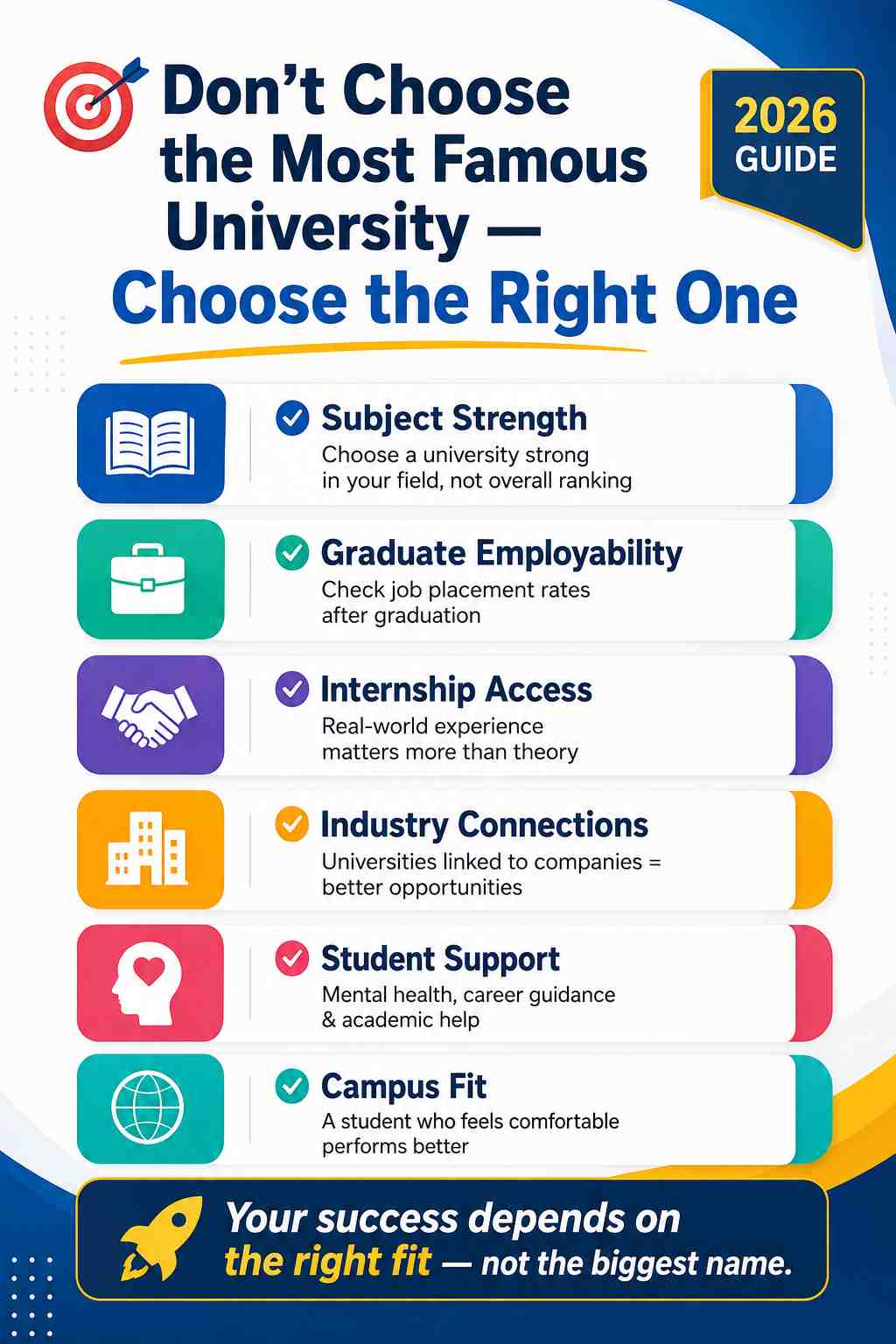
I say this clearly to every family I meet: a university’s global ranking is the least important factor in your child’s success.
I have watched students chase prestige, enrol in a top-20 university in a subject that university is not particularly strong in, struggle through three years without adequate support, and graduate with a degree that opened fewer doors than a well-chosen degree from a ranked-50 institution would have.
What actually matters when choosing a university:
- Strength in your specific subject — a university ranked 80th globally may rank 5th in the world for petroleum engineering or supply chain management
- Graduate employment rate in your field — ask the admissions office directly; reputable universities publish this data
- Industry partnerships and internship access — in fields like finance, technology and healthcare, internships convert into job offers at an astonishing rate
- Research opportunities for students — especially important if postgraduate study is a possibility
- Student support infrastructure — mental health services, career counselling, academic support. This matters enormously when a student is 4,000 miles from home for the first time
- Campus culture and community — a student who feels at home performs better. This is not a soft metric; it is a performance metric
My advice: shortlist five universities where your target subject is genuinely strong. Then apply to the one that fits your budget, learning style and long-term goals – not the one with the biggest name.
Today’s students are entering a world where industries are rapidly evolving, including sectors like biotech, where understanding the global biotech funding landscape is becoming increasingly relevant.
Where UAE Students Are Choosing to Study – and Why
Over the past decade at MS Education Consultants, these are the destinations I see UAE students choose most often, and the real reasons behind each choice:
Canada
Canada has become the number one destination for many of my students, and it is not hard to understand why. The education system is excellent, the environment is welcoming, and post-graduation work permit options give students a real pathway to build careers after they graduate. Cities like Toronto, Vancouver and Montreal offer large South Asian and Arab communities, which eases the transition for many UAE-based students.
United Kingdom
The UK remains a powerhouse — and the three-year undergraduate degree structure is a genuine advantage for families managing education costs. Russell Group universities carry real weight with employers globally, and London in particular offers unmatched access to finance, media, law and technology industries.
United States
The US offers something no other destination matches: academic flexibility. The ability to change majors, take interdisciplinary minors, and access world-class research facilities makes it ideal for students who are still discovering what they want. The scale of the alumni network, particularly in technology and finance, is also unmatched.
Australia
Australia has grown significantly as a destination over the past five years, and I believe it is still underrated by many UAE families. The quality of education is high, the cost of living — while not cheap — is more manageable than London or New York, and the student community is genuinely diverse and welcoming.
Europe
Germany, the Netherlands, Ireland and France are increasingly on my radar for students from the UAE, particularly those pursuing engineering, data science, and business. Several top European universities offer English-taught programmes at tuition fees that are a fraction of UK or US equivalents. For cost-conscious families with academically strong students, Europe deserves serious consideration.
The right destination is always individual. A student’s goals, budget, field of study, and where they want to build their career after graduation should drive this decision — not trends, not peer pressure, and not what worked for a family friend’s child.
The UAE itself is becoming a global innovation hub, particularly in life sciences. This is evident in the growing biotech opportunities in Dubai.
Scholarships: The Area Where Most Families Give Up Too Early
Financing international education is the single biggest concern I hear from families, and I want to be direct about something: most families do not search hard enough or early enough.
I have helped students access scholarships from sources their parents had never heard of. Here is where the real funding exists:
- University merit scholarships — many top universities allocate significant scholarship budgets specifically for international students; these are competitive but absolutely accessible with strong applications
- Government scholarships — the UAE government, as well as several Gulf foundations, fund international study; these require planning 12–18 months in advance
- Corporate sponsorships — major UAE employers, particularly in energy, finance and aviation, actively sponsor students in return for graduate employment commitments; I have seen these cover entire degree costs
- Foundation and NGO grants — there are dozens of education foundations operating in the MENA region whose scholarship funds go partly unclaimed each year simply because students do not know they exist
- UNHCR scholarships — I work closely with UNHCR to help student refugees access higher education funding; this is a cause I am deeply committed to and one that reminds me every day why education access matters
My practical advice: begin your scholarship search in Year 11, not after you receive your A-level results. By then, most deadlines have passed.
Build a simple budget that accounts for: tuition fees, accommodation (which varies enormously — a university dormitory versus private renting can differ by £8,000–£12,000 a year in the UK), health insurance, travel, books and materials, and a realistic living allowance. Then reverse-engineer how much funding you need to close the gap.
What a Strong University Application Actually Looks Like in 2026
Admissions at top universities have become significantly more competitive over the past five years. The number of international applicants has risen sharply, and admissions teams are better at identifying strong candidates than they have ever been.
Here is what I have seen consistently distinguish successful applicants:
Academic consistency matters more than a single strong year. Universities look at your trajectory — three years of solid grades is more compelling than two difficult years followed by one excellent one.
Leadership experience is not about titles. You do not need to be Head Boy or Head Girl. A student who identified a problem in their school community and organised a response to it — even something modest — demonstrates exactly the kind of initiative top universities are looking for.
Community involvement signals character. Volunteer work, particularly sustained involvement over a year or more, tells an admissions officer something important: that you are a person who gives back, not just a person who achieves.
The personal statement is your voice — and it must sound like you. I review personal statements every week, and I can tell within three sentences whether a student has written it themselves or relied too heavily on a template or AI-generated draft. Admissions officers can tell too. They read thousands of these. Authentic, specific, slightly imperfect writing that genuinely reflects a real person’s journey is far more compelling than polished, generic prose.
A note on AI in applications: I am not opposed to students using AI tools to brainstorm ideas, check grammar or improve the structure of a draft. But the final essay must be yours. Your specific experiences, your honest reflections, your actual voice. Universities are admitting a person — help them see who that person is.
As industries evolve, students must also understand trends like the future of affiliate marketing in 2026, where data and attribution are reshaping business strategies.
The Career Lens: Degrees That Open Doors in the Decades Ahead
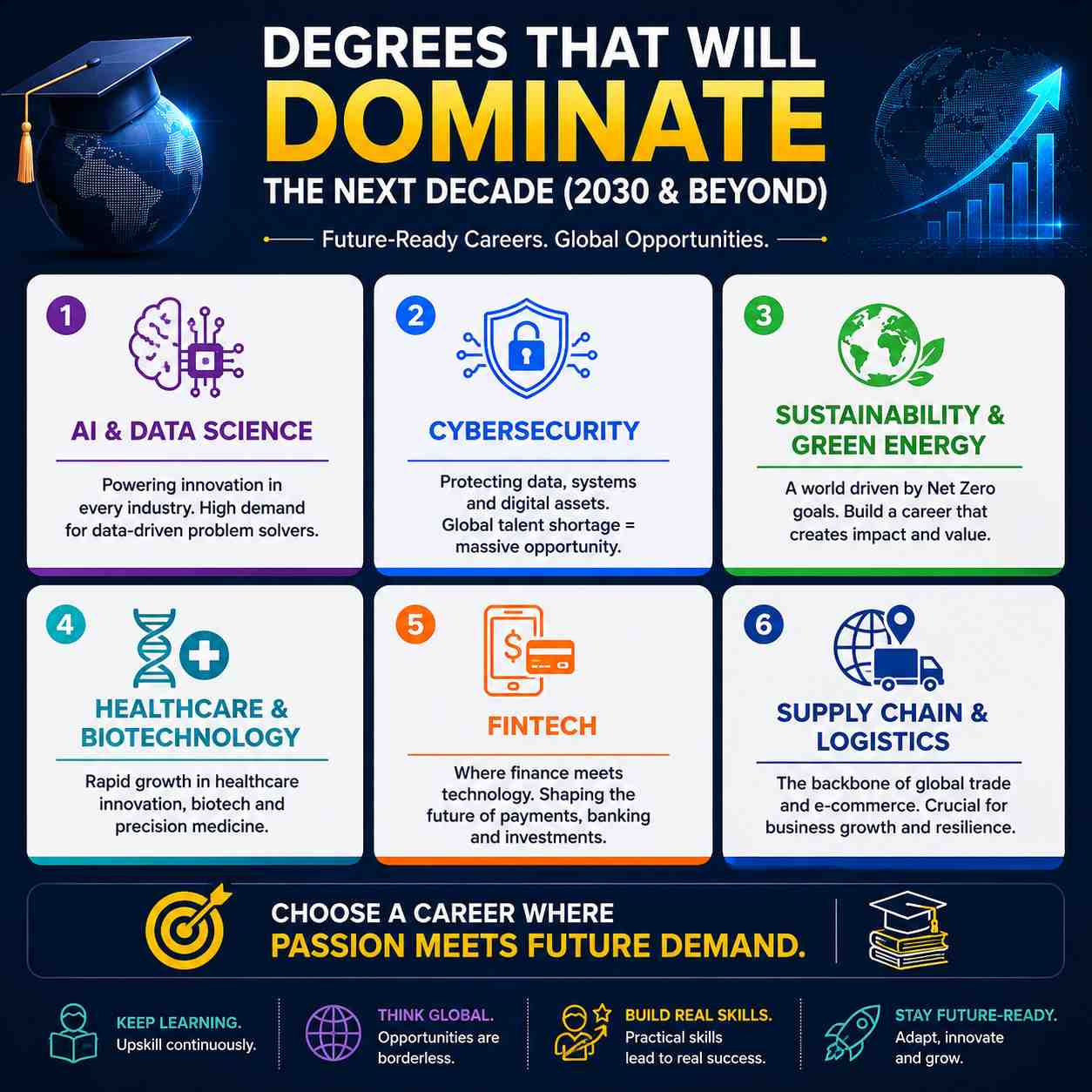
I spend a great deal of time thinking about where the job market is heading, because the degree a student chooses today will largely determine the professional options they have in 2030 and beyond.
Fields I am watching closely — and advising students to consider seriously:
Artificial Intelligence and Data Science — demand is extraordinary and shows no sign of slowing. But more importantly, these skills are cross-sectoral; a data science graduate can work in healthcare, finance, government, logistics or entertainment.
Cybersecurity — the UAE alone faces a significant talent shortage in this field. Students who graduate with strong cybersecurity credentials are entering a market that is actively searching for them.
Sustainability and Environmental Engineering — the GCC’s commitment to Net Zero targets is creating genuine career demand, not just policy rhetoric. Renewable energy, environmental consulting and green infrastructure are growing sectors across the region.
Healthcare and Biotechnology — the pandemic fundamentally accelerated healthcare investment across the world. The UAE’s healthcare sector is expanding rapidly, and students with clinical or biotech credentials face a strong homecoming market.
Financial Technology — the convergence of finance and technology is reshaping banking, investment and payments. Dubai specifically is positioning itself as a global fintech hub, and the talent demand is real.
Supply Chain and Logistics Management — often overlooked by students, this is a field where the UAE genuinely leads globally. With DP World, Aramex and dozens of major logistics operators headquartered here, a strong supply chain degree is a direct pipeline into regional leadership roles.
My consistent advice: pursue what genuinely interests you, then make sure the market values it. Passion without market demand is a hobby. Market demand without passion is a miserable career. Look for the intersection.
The rise of digital platforms has also created new opportunities, with social commerce in 2026 revolutionizing how brands and consumers interact.
Mistakes I See Students Make — Every Single Year
After 35 years, these patterns repeat themselves with painful consistency:
Applying too late. I cannot stress this enough. Top university application deadlines — UCAS in the UK, Common App in the US, university-specific portals in Canada and Australia — operate on fixed timelines. Missing them by even a few days means waiting an entire additional year. Start your applications in September of your final school year at the latest.
Letting rankings make the decision. I have addressed this above, but it bears repeating: a university’s ranking in your specific field matters. Its overall ranking is largely irrelevant to your employability.
Ignoring financial planning until it becomes a crisis. I have seen families commit to universities they cannot genuinely afford, assuming “something will work out.” Financial stress is one of the primary reasons international students struggle academically or withdraw from their programmes. Plan the finances before you accept the offer.
Writing a personal statement that could have been written by anyone. Generic statements about “wanting to help people” or “being passionate about business” say nothing. Write about a specific moment. A specific challenge. A specific question that won’t leave you alone.
Not researching the country they’re moving to. Visa requirements, healthcare access, right-to-work rules, cultural expectations, banking setup — students who research these in advance settle in faster and focus on their studies sooner.
A Personal Note to Parents
I speak with as many parents as I do students, and I want to say something directly to you.
The pressure you place on your children to attend a specific university — often one you have heard is prestigious, or one a colleague’s child attended — can cause real harm. I have watched students apply to programmes they have no interest in, gain admission, and then spend three years quietly suffering through a degree that was chosen for status rather than fit.
Your child’s success is not measured by the name on their degree certificate. It is measured by the quality of their thinking, the strength of their character, and the relevance of their skills to the world they are entering.
Guide them. Support them. But let them lead the conversation about where they want to go and why. In my experience, the students who own their educational decisions tend to work harder, adapt faster, and build more satisfying careers than those who followed a path chosen for them.
Frequently Asked Questions
Which country is best for UAE students to study abroad?
There is no single answer — it depends on your subject, budget, and post-graduation plans. Canada offers strong post-study work pathways. The UK offers shorter, more affordable degrees. The US offers unmatched academic flexibility. Australia offers a high quality of life at a competitive cost. Europe offers excellent value for academically strong students.
How early should UAE students start preparing university applications?
Ideally, begin in Year 10 or Year 11. Build your extracurricular profile, research scholarship options, and understand entry requirements before your final year. Starting in Year 13 puts you at a significant disadvantage.
Are there scholarships specifically available to UAE-based students?
Yes — through UAE government programmes, Gulf foundations, university-specific international merit awards, and sector scholarships in fields like engineering and business. Many go unclaimed because students simply do not know they exist. A good education consultant can map these for you.
What do admissions officers at top universities actually look for?
Academic consistency, demonstrated initiative, genuine community involvement, and a personal statement that sounds like a real person wrote it. They are looking for students who will contribute to campus life, not just perform academically.
Is it worth hiring an education consultant for university applications?
For complex applications — particularly to the US, UK or Canada — the process involves careful strategy around school selection, essay positioning, interview preparation and scholarship applications. An experienced consultant who knows the current admissions landscape can meaningfully improve outcomes, particularly for competitive programmes.
Published in Arabian Business Times | arabianbusinesstimez.com