

Affiliate attribution is undergoing a very practical reset in 2026. It shows up in revenue reviews, partner calls, finance checks, and payout disputes.
A partner brings a conversion, the dashboard gives credit, and then someone in the room asks: “Did this partner really create value, or did they only appear at the end?”
That question has become more serious because an affiliate is no longer a small support channel.
U.S. affiliate spend is projected to reach $13.81 billion in 2026, and affiliate marketing is expected to generate $241.03 billion in U.S. ecommerce sales in 2026. When a channel reaches that level, attribution can no longer remain a payout formality. It becomes a revenue decision.
For years, the industry lived with a simple model. A click happened, a conversion followed, and the last partner usually got credit. It was easy to explain, easy to report, and easy to settle. But easy does not always mean accurate. In 2026, the buying journey has too many touchpoints, too many partner types, and too many privacy gaps for one final click to explain the full story.
The Last Click is Still Useful, But it Should Not Run the Room
Last-click attribution is not wrong in every case. For short buying journeys, urgent offers, or simple consumer purchases, it can still give teams a workable payout rule.
The issue starts when the last click becomes the only truth in the program. That is when the report begins to reward the partner closest to checkout, not always the partner who created buyer intent.
We see this often in affiliate programs that have grown quickly. Coupon and cashback partners may show strong conversion numbers because they catch users near the end of the journey.
At the same time, review publishers, creators, comparison sites, and niche communities may appear weaker because they influence people earlier. On paper, one partner looks efficient. In reality, another partner may have done the harder job.
This is why traditional last-click attribution gives full credit to the final touchpoint, even when several partners shaped the decision before that moment. Attribution guides in 2026 note that customers may interact with a brand 7 to 12 times before purchase, which makes single-touch credit too narrow for many modern affiliate journeys.
The mistake brands make is treating every final click as equal.
A user who discovers a product through a review, compares it on a content site, returns through branded search, and then clicks a coupon link is not the same as a user who first discovers the brand through that coupon link. Both may convert. But the partner value is different, and the payout logic should reflect that difference.
Attribution is Now Tied to Revenue Quality, Not Just Conversion Count
A few years ago, affiliate teams were mostly asked to show volume.
How many clicks came in, how many leads were generated, how many sales were tracked, and how much commission was due. Those numbers still matter, but they do not answer the question a business cares about most. Are these conversions good for the business after quality, margin, refund risk, approval status, and repeat purchase are considered?
A lead is not the same as a qualified lead. A signup is not the same as an active customer. A sale is not the same as profitable revenue. A first deposit is not the same as long-term player value. Once brands look at affiliates through this lens, the reporting conversation changes very quickly.
For example, one partner may deliver 500 leads at a low cost, but only a small share may move beyond sales review. Another partner may deliver 80 leads, but those leads may carry stronger intent, better fit, and higher deal value. If the attribution system only reports lead count, the brand may scale the wrong partner and cut the right one.
At Trackier, this is one of the patterns we see most often. The team does not always have an attribution problem first. It has a data flow problem first.
The partner ID is missing, the approval status does not sync back, the CRM stage is not connected, or rejected conversions remain visible in payout reports. When that happens, the dashboard may look complete, but the truth is still missing.
As businesses grow, understanding which marketing channels truly drive revenue becomes critical. Companies focused on long-term expansion often use attribution data to optimize budgets and scale operations efficiently.
Privacy Has Made Weak Attribution Setups Easier to Expose
Privacy changes have made affiliate measurement less forgiving. Chrome has not removed third-party cookies completely, but marketers still have to work in a more fragmented reality.
Google’s own documentation says teams should test how their sites behave when third-party cookies are blocked by user choice, and cookies can also be blocked by browser design, enterprise policy, or user settings.
For affiliate programs, this means brands cannot depend only on fragile browser signals. They need cleaner first-party tracking, stronger postbacks, consent-aware data flows, server-side setups where suitable, and CRM feedback loops that carry conversion quality back into the partner system.
This sounds technical, but it is really a commercial issue. If the tracking breaks, partner trust breaks with it.
The pressure is different across India, the EU, and the U.S., but the direction is similar. In India, Affiliate and partner programs are scaling fast across SaaS, fintech, commerce, apps, and gaming-led businesses. For founders looking to build sustainable growth channels from day one, understanding attribution is just as important as the principles covered in our guide on How to Build a Successful Startup in the GCC. If the base tracking is weak, the scale only makes the error larger.
In the EU, consent and data handling need much stronger control. In the U.S., the affiliate channel is already mature enough that small attribution gaps can move real budget.
A privacy-ready affiliate setup is not only about compliance. It is about confidence. When a brand can clearly show which partner sent the user, which consent state applied, which event fired, which revenue was approved, and which payout rule was used, the whole program becomes easier to defend. That matters in front of finance, legal, partner teams, and the partners themselves.
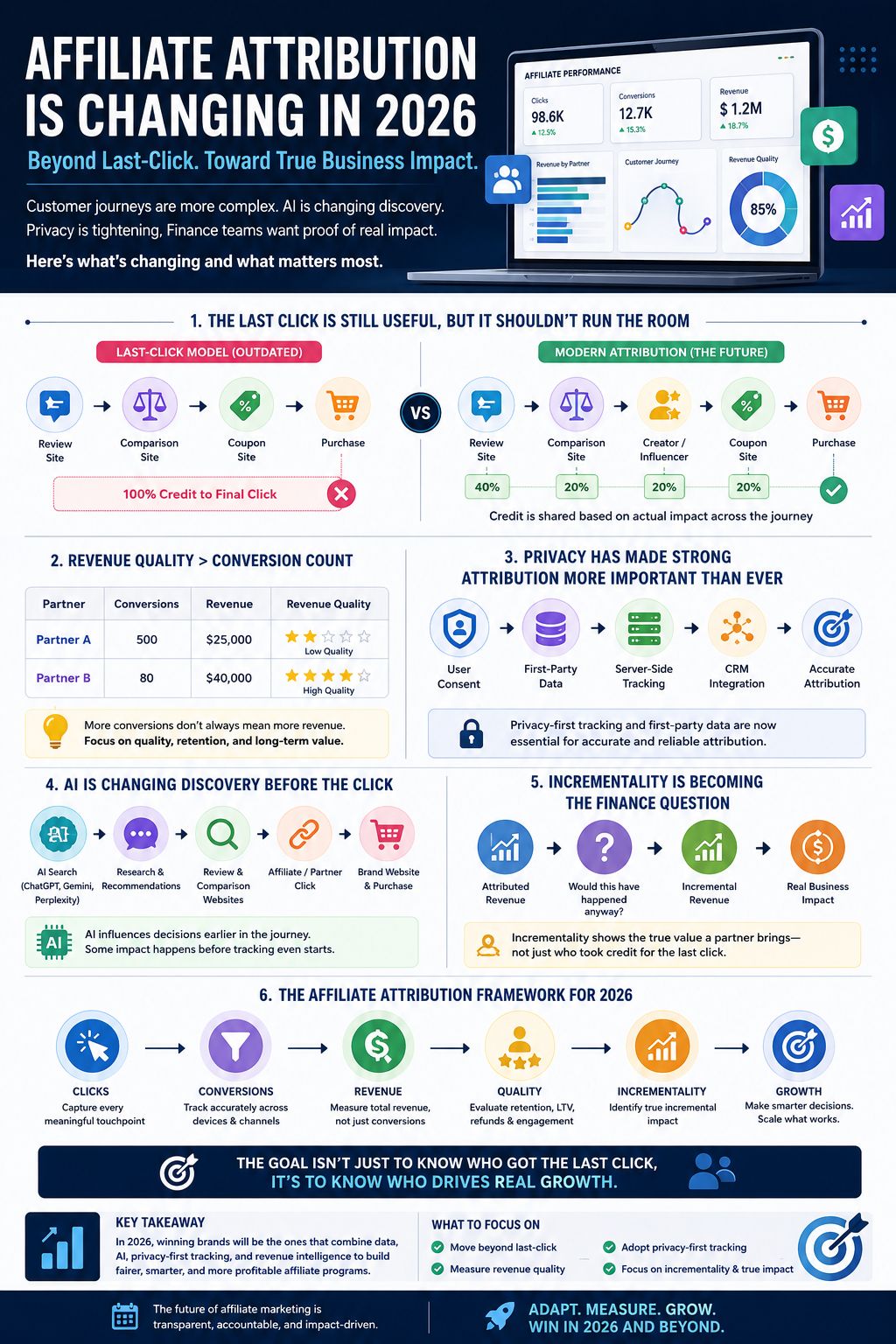
AI is Changing Discovery Before The Tracked Click
AI is changing affiliate attribution from both sides. On one side, buyers are using AI tools to compare products, shortlist vendors, understand categories, and ask for recommendations before they visit a brand website. This trend mirrors how many GCC companies are already leveraging AI for growth, as discussed in our guide on How GCC Leaders Are Using AI to Grow Their Business.
On the other side, affiliates are using AI to create content, test offers, build comparison pages, and scale their traffic systems faster than before.
This creates a new measurement gap. A buyer may read affiliate content that later appears inside an AI-generated answer or influences an AI-led recommendation. That buyer may then visit the brand through search, direct traffic, or another partner link. The final click may look clean, but the earlier influence may not be visible in the normal affiliate report.
That is why marketers need to move beyond last-click attribution, build visibility into AI-led discovery, invest in long-term creator partnerships, and bring affiliate into broader measurement models instead of treating them as a separate performance bucket.
AI also helps on the brand side. It can flag traffic spikes, unusual click patterns, duplicate claims, suspicious conversion behavior, and partners whose volume does not match downstream quality.
But AI should not become the person in charge of payouts. It should help revenue teams see patterns faster. The final judgment still needs commercial context, because a model does not fully understand margin pressure, market entry goals, partner relationships, or brand risk.
Incrementality is Becoming The Finance Question
Attribution tells you who touched the journey. Incrementality tells you what would not have happened without that touch. That second question is harder, but it is the one finance teams care about when affiliate budgets start rising.
A partner may show strong attributed revenue, but if most of those buyers were already going to purchase, the real value is smaller than the report suggests.
Another partner may not win the final click often, but may introduce high-fit buyers who later return through search, sales outreach, retargeting, or direct traffic. If the model ignores that early influence, the program may slowly push away partners who create demand.
This is why 2026 affiliate strategy is moving toward incrementality measurement and creator partnerships across multiple funnel stages.
It is also why brands are starting to treat affiliate as an active growth system, not a passive revenue line that runs quietly in the background.
Brands can compare new customer rates by partner type, study cart-stage entries, check branded search overlap, review repeat purchase behavior, and test commission changes in controlled segments. The aim is not perfect attribution. The aim is better judgment.
The Real Change in 2026
Affiliate attribution is becoming less about credit and more about confidence. Brands do not only want to know who touched the sale. They want to know who changed the outcome, who improved customer quality, who brought demand that would not have arrived otherwise, and who deserves more budget.
For partners, this is also a good shift. The partners who bring real influence, useful content, cleaner traffic, and better customer quality will have a stronger case for better terms. The partners who depend only on standing closest to the final click will face tougher questions.
At Trackier, this is the shift we keep coming back to in our conversations with brands, agencies, affiliate networks, and partner-led businesses. The future of affiliate attribution is about giving every number a business meaning. A click should connect to a customer. A customer should connect to approved revenue. Revenue should connect to quality. And quality should guide how partners are rewarded.
That is also why attribution platforms now have to do more than track links. They need to help teams understand campaign movement, partner behaviour, fraud signals, payout logic, traffic quality, and the wider customer journey across web and app.
Trackier’s own affiliate tracking software is built around many of these needs, including click tracking, conversion attribution, fraud detection, automated payouts, customizable reporting, partner management, cross-device tracking, API integrations, and deep linking.
The strongest programs will not be the ones with the longest partner list or the most crowded dashboard.
They will be the ones that can connect partner activity with real business movement and answer one revenue question clearly: “Who helped us grow, and what would we have missed without them?”
Frequently Asked Questions (FAQs)
1. What is affiliate attribution in 2026?
Affiliate attribution is the process of determining which affiliate partner deserves credit for a conversion. In 2026, brands are moving beyond simple last-click models and focusing on customer quality, revenue impact, and incrementality to understand the true value each partner brings.
2. Why is last-click attribution becoming less effective?
Last-click attribution gives 100% credit to the final touchpoint before a conversion. While it remains useful for simple buying journeys, it often overlooks content creators, review sites, and influencers who helped build customer intent earlier in the decision-making process.
3. What is incrementality in affiliate marketing?
Incrementality measures whether a conversion would have happened without an affiliate’s influence. It helps brands identify partners who generate new demand rather than simply capturing customers who were already planning to buy.
4. How does AI impact affiliate attribution?
AI tools are changing how consumers discover products and services. Buyers often use AI assistants for research, comparisons, and recommendations before clicking a link. As a result, some affiliate influence may occur before the tracked customer journey begins, making attribution more complex.
5. Why are privacy regulations affecting affiliate tracking?
Privacy-focused browser settings, consent requirements, and restrictions on third-party cookies have reduced the reliability of traditional tracking methods. Brands now rely more on first-party data, server-side tracking, and consent-aware measurement to maintain attribution accuracy.
6. What metrics should brands track beyond clicks and conversions?
Modern affiliate programs should track approved revenue, customer lifetime value, repeat purchases, lead quality, refund rates, and new customer acquisition. These metrics provide a clearer picture of long-term business impact than conversion volume alone.
7. How can brands improve affiliate attribution accuracy?
Brands can improve attribution by implementing first-party tracking, integrating CRM data, using server-to-server postbacks, monitoring conversion quality, and analyzing the full customer journey instead of relying solely on last-click reports.
8. What role does customer quality play in affiliate marketing?
Not all conversions deliver equal value. A partner generating fewer but higher-quality customers may contribute more revenue and retention than a partner delivering large volumes of low-intent traffic. Measuring customer quality helps brands allocate budgets more effectively.
9. How can businesses identify high-performing affiliate partners?
Businesses should evaluate affiliates based on revenue quality, customer retention, incrementality, conversion approval rates, and long-term profitability rather than focusing only on clicks or attributed sales.
10. What is the future of affiliate attribution?
The future of affiliate attribution lies in combining attribution models, incrementality testing, AI-assisted analysis, privacy-compliant tracking, and customer-quality measurement. The goal is not simply to identify who received the last click, but to understand who genuinely contributed to business growth.