Author: Written by an AI and Digital Transformation Consultant Arif Hussain with over five years of hands-on experience advising businesses across the GCC – including Dubai, Riyadh, and Doha. Having worked directly with clients in retail, logistics, fintech, and real estate, this work draws on real implementations, not theory. Linkedln
There’s a meeting I keep having, and after five years advising businesses across Dubai, Riyadh, and Doha, I still find it one of the most important conversations a business owner can have. They’ve heard of AI. They know it matters. Some have even signed up for a tool or two. Then they look at me and say: ‘But what do we actually do with it?’ My name is Arif Hussain, and I’m an AI and digital transformation consultant who has spent the last five years inside these conversations, not writing about them from the outside, but sitting across the table from the people making the decisions.
There’s a meeting I keep having with business owners across Dubai, Riyadh, and Doha. It’s something like this: they’ve heard of AI, they know it’s important, they may have even signed up for a tool or two—and then they look at me and say, “But what do we actually do with it?”
It’s a question that most people are more truthful about when they’re by themselves than they are in public. Because the talk about AI in GCC business has been loud, but a lot of it has been abstract. Buzzwords for the boardroom. Keynotes of the conference. Press releases about “digital transformation.” The reality on the ground—what’s working, what’s not, and where companies are quietly gaining an edge – is another story.
So let me tell you that story.
The Quiet Shift Happening in GCC Boardrooms
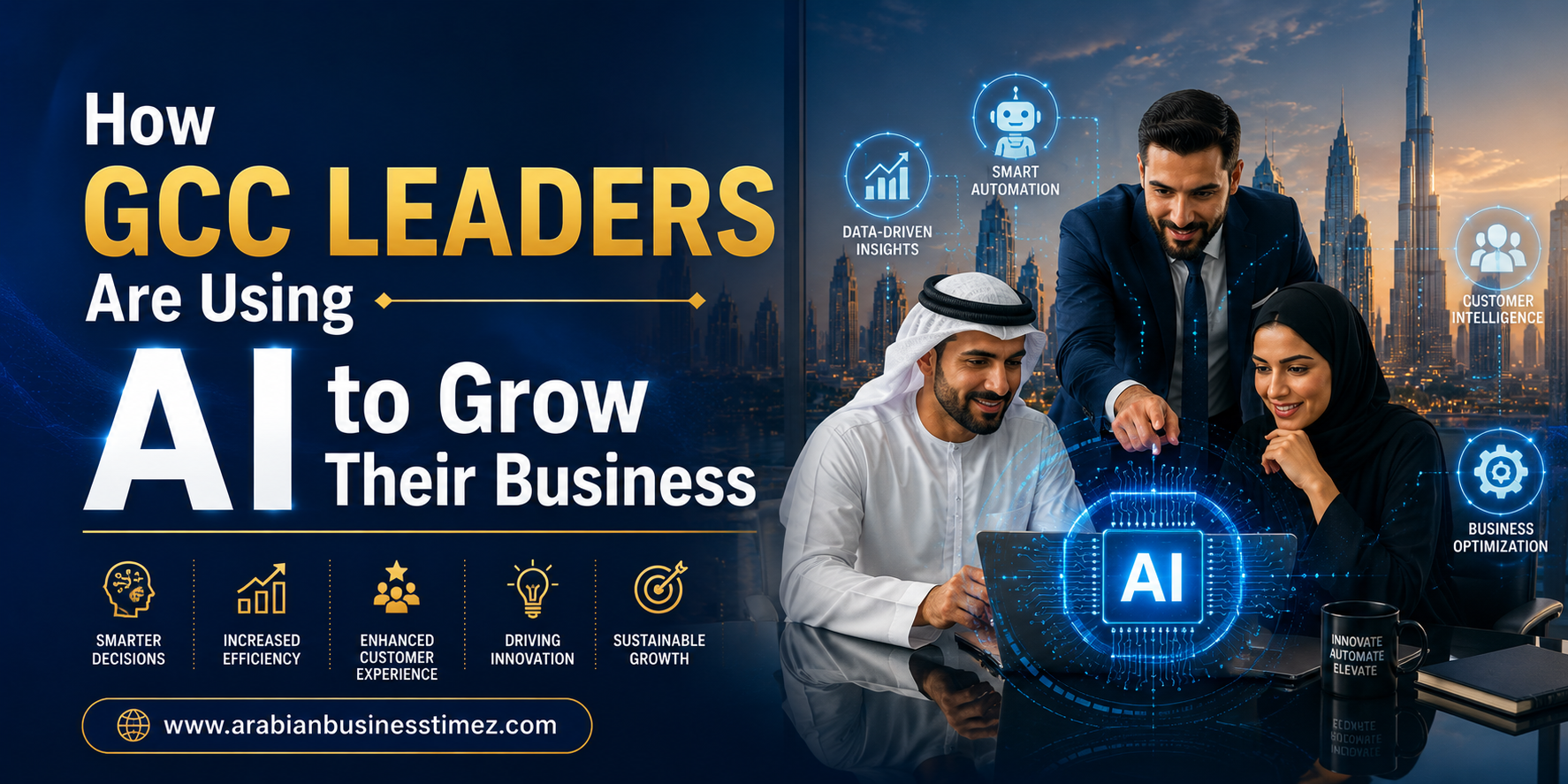
Whenever the GCC has decided to move, it has always moved quickly. Saudi Arabia’s Vision 2030, UAE’s AI Strategy 2031, Qatar National Vision 2030—these are not just government papers. They are also setting the tone for private-sector behavior. What I see, especially over the last 18 months, is that in the UAE and wider GCC, AI adoption has gone from a discussion of ‘pilot projects’ to an operational reality.
The companies doing it well aren’t the ones that put together an AI department and hold a press conference. They are the ones who found one or two painful, repetitive problems and quietly, efficiently, and without fuss, fixed them.
How Companies Are Actually Using AI in GCC
Automating What Used to Drain People
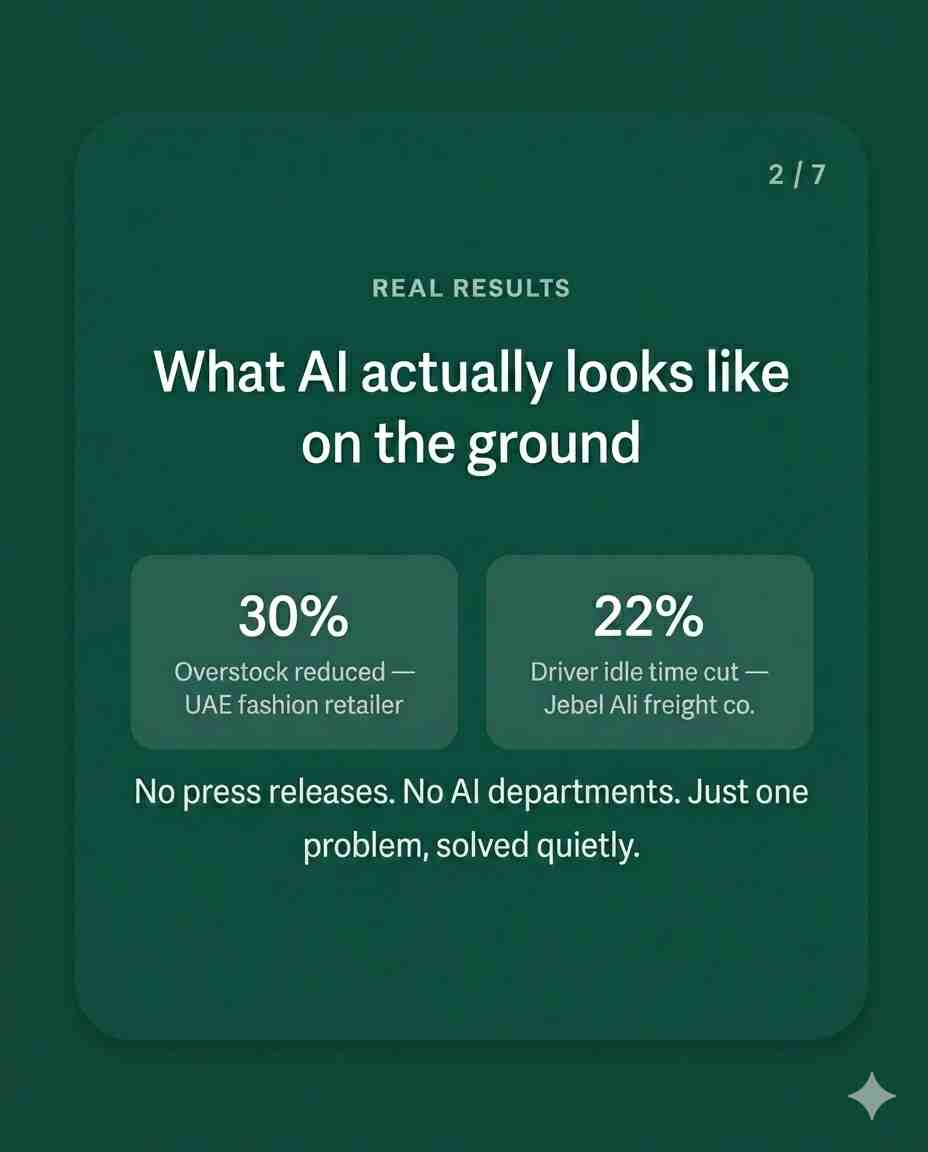
Look at retail. A mid-sized UAE fashion retailer — operating six outlets across Abu Dhabi and Sharjah, with a team of roughly 60 — came to me in early 2023 with a forecasting problem that was costing them real money. Their merchandising team was spending the better part of two days every week on inventory planning, and still getting it wrong. Too much stock sitting at Yas Mall, chronic shortages at their Sharjah outlet. After deploying an AI-powered demand forecasting tool integrated with their existing POS data, they reduced overstock by close to 30% within two quarters — without hiring a single additional analyst. With an AI-powered demand forecasting tool, they reduced their overstock by almost 30% in two quarters. No case study was done on it. They just made more money in silence.
The not-so-glamorous side of AI for business growth in the Middle East – and that’s where most of the real value is. Process automation. Demand forecasting. Service bots that actually solve problems instead of simply pushing them around.
In logistics, Dubai is one of the most complex logistics environments in the world – AI is being deployed to optimize route planning, predict port congestion, and manage last-mile delivery. One mid-sized freight and logistics operator I worked with in late 2023 — based in the Jebel Ali Free Zone, running a fleet of around 40 vehicles across the UAE — implemented AI-powered route scheduling after struggling with unpredictable port congestion that was eating into delivery windows. Within four months of going live, driver idle time had dropped by roughly 22%. That’s not a headline number, but across a 40-vehicle fleet operating six days a week, it compounded into meaningful cost savings inside the first year. It’s not a headline number, but it adds up over months to meaningful cost savings.
Personalization at Scale
Saudi Arabia’s fintech sector is where things get particularly interesting. With a young, mobile-first population and rapid growth in digital banking, personalization has become a genuine differentiator. Working with financial services clients in Saudi Arabia and the UAE between 2022 and 2024, the pattern I kept seeing was this: the institutions winning customer loyalty weren’t necessarily the ones with the slickest apps. They were the ones making customers feel understood. One Riyadh-based digital banking client — serving a predominantly 25–40 age bracket — moved from generic promotional pushes to AI-driven recommendations built on transaction history, lifestyle signals, and seasonal behaviour specific to Ramadan and Hajj spending patterns. Engagement with personalised offers ran roughly three times higher than their previous campaigns.
From what I’ve seen working with financial services clients in the region, the ones winning customer loyalty aren’t necessarily the ones with the slickest apps. They’re the ones who make their customers feel understood. AI is making that possible at a scale no human team could manage.
Predictive Analytics and Smarter Decision-Making
How companies use AI in GCC is increasingly about better decisions, not just faster ones. A mid-sized residential developer I’ve been advising in Dubai — active primarily across emerging districts in Dubai South and Jumeirah Village Circle — shifted their project selection process in 2023 to include AI-powered market analysis alongside their traditional broker data. Instead of relying solely on historical sales and gut instinct, their team began layering in mobility pattern data, demographic shift modelling, and social sentiment from property forums and listing platforms. Their next two project launches, both in 2024, sold out faster than anything they had previously brought to market. The sites they chose wouldn’t have ranked highly on their old criteria. Instead of relying solely on broker instincts and historical sales data, they now factor in mobility patterns, demographic shifts, and even sentiment from social media and property forums. Their last two launches sold out faster than any previous project.
That’s not magic. That’s better information, processed faster than any analyst team could manage manually.
The Challenges Nobody Likes to Talk About
Here’s where I want to be honest, because too much of the AI conversation in this region glosses over the friction.
Talent Is Still the Bottleneck
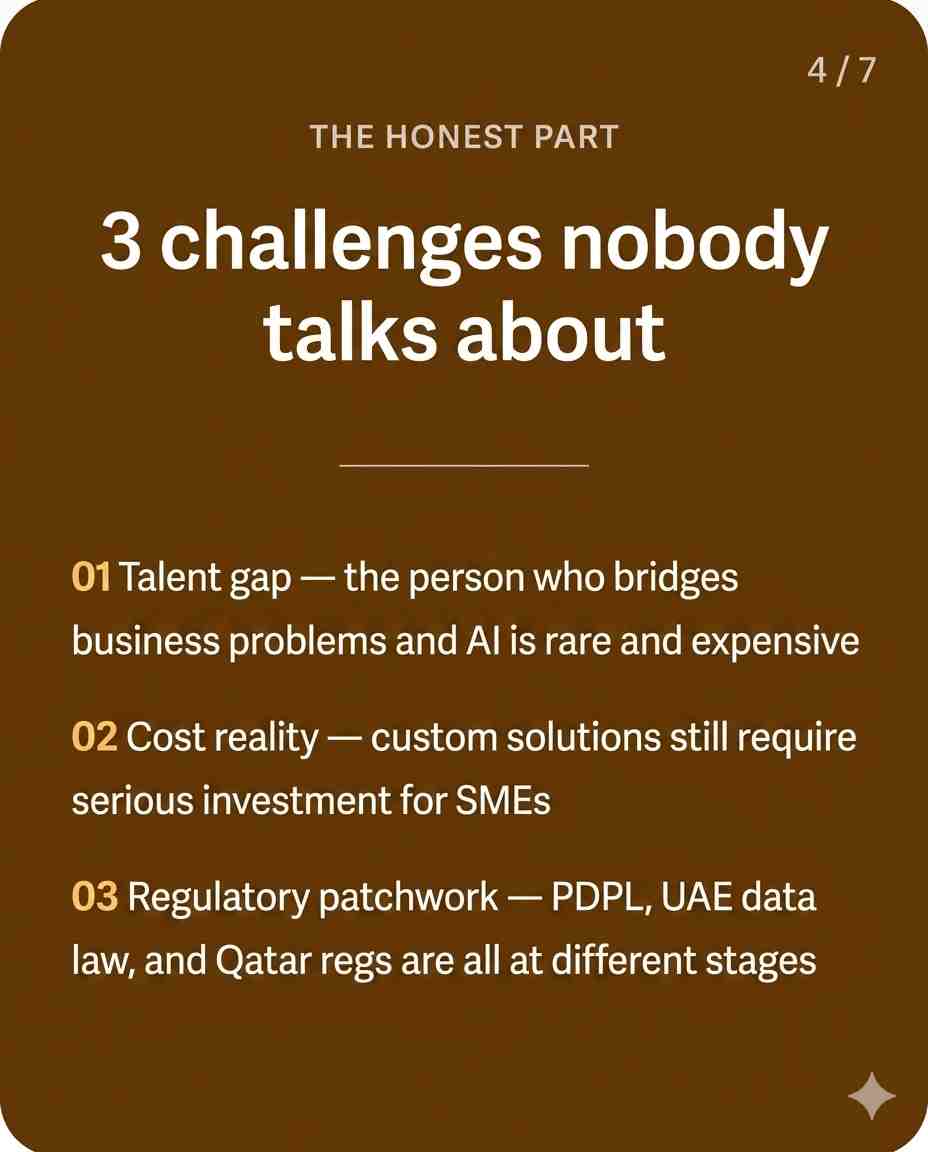
There is a real shortage of people who can bridge business problems and AI solutions in the GCC. Data scientists exist. Business strategists exist. The person who can sit in both chairs, who understands what an operations team actually needs and how to build or configure a model to solve it, is rare and expensive.
Most companies end up either over-investing in technology they can’t use properly, or under-using capable tools because they don’t have someone who knows how to apply them. This isn’t a criticism; it’s just where the market is right now. It will improve, but it takes time.
The Cost Reality
Enterprise-grade AI solutions are not cheap. For large corporations and government-linked entities, this is manageable. For SMEs, which make up a massive portion of GCC economies, particularly in the UAE, the economics can be difficult. The good news is that off-the-shelf AI tools (think AI writing assistants, customer service platforms, and analytics dashboards) have dropped dramatically in cost and become far more accessible. But truly customized solutions still require meaningful investment.
Regulatory Uncertainty
The regulatory landscape around data privacy and AI governance is evolving, and unevenly across markets. Saudi Arabia’s PDPL (Personal Data Protection Law), the UAE’s data protection frameworks, and Qatar’s regulations are each at different stages of development and enforcement. For businesses operating across multiple GCC markets, which many do,navigating this patchwork adds complexity to any AI implementation that touches customer data.
This isn’t a reason to wait. But it is a reason to build with legal counsel involved from the start, not as an afterthought.
Practical Takeaways for GCC Decision-Makers
If I were advising a business owner in the region today, here’s what I’d say:
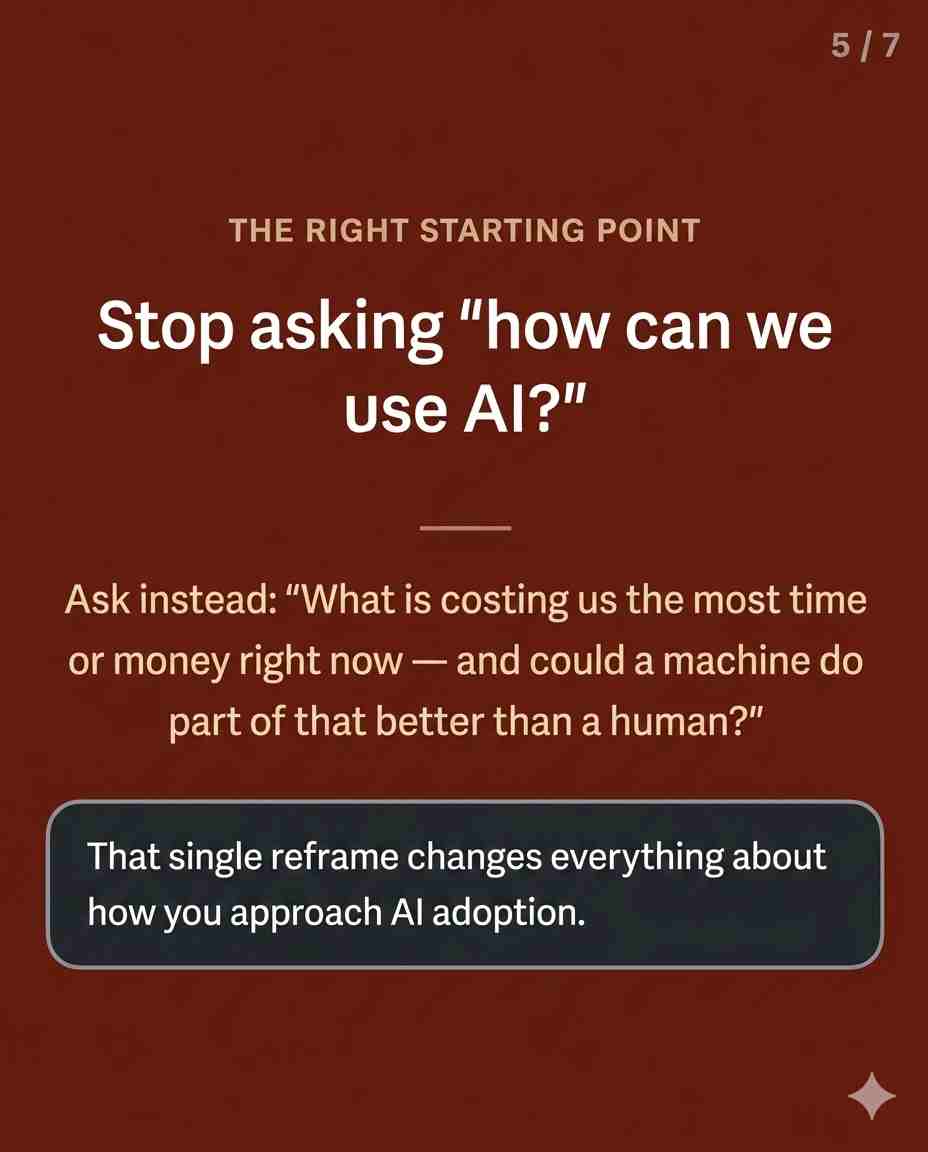
Start with a problem, not a technology. Don’t ask, “How can we use AI?” Ask, “What is costing us the most time or money right now, and could a machine do part of that better than a human?” That reframing changes everything.
Pick one use case and go deep. The businesses wasting money on AI are the ones trying to do six things at once. The ones seeing results picked one area—customer service, inventory, or sales forecasting – and actually implemented it properly before moving on.
Invest in internal literacy. You don’t need everyone to become a data scientist. But if your senior managers can’t ask the right questions of an AI system or can’t evaluate whether outputs are trustworthy, you’re flying blind. Short training programs, external workshops, and bringing in consultants to run internal sessions, this pays back quickly.
Think about data before you think about AI. Every AI system is only as good as the data feeding it. Many businesses in the GCC are sitting on fragmented, siloed, poorly labeled data. Cleaning that up isn’t exciting. But it is foundational.
What’s Coming Next: AI Trends Shaping the GCC
A few developments worth watching closely over the next two to three years:
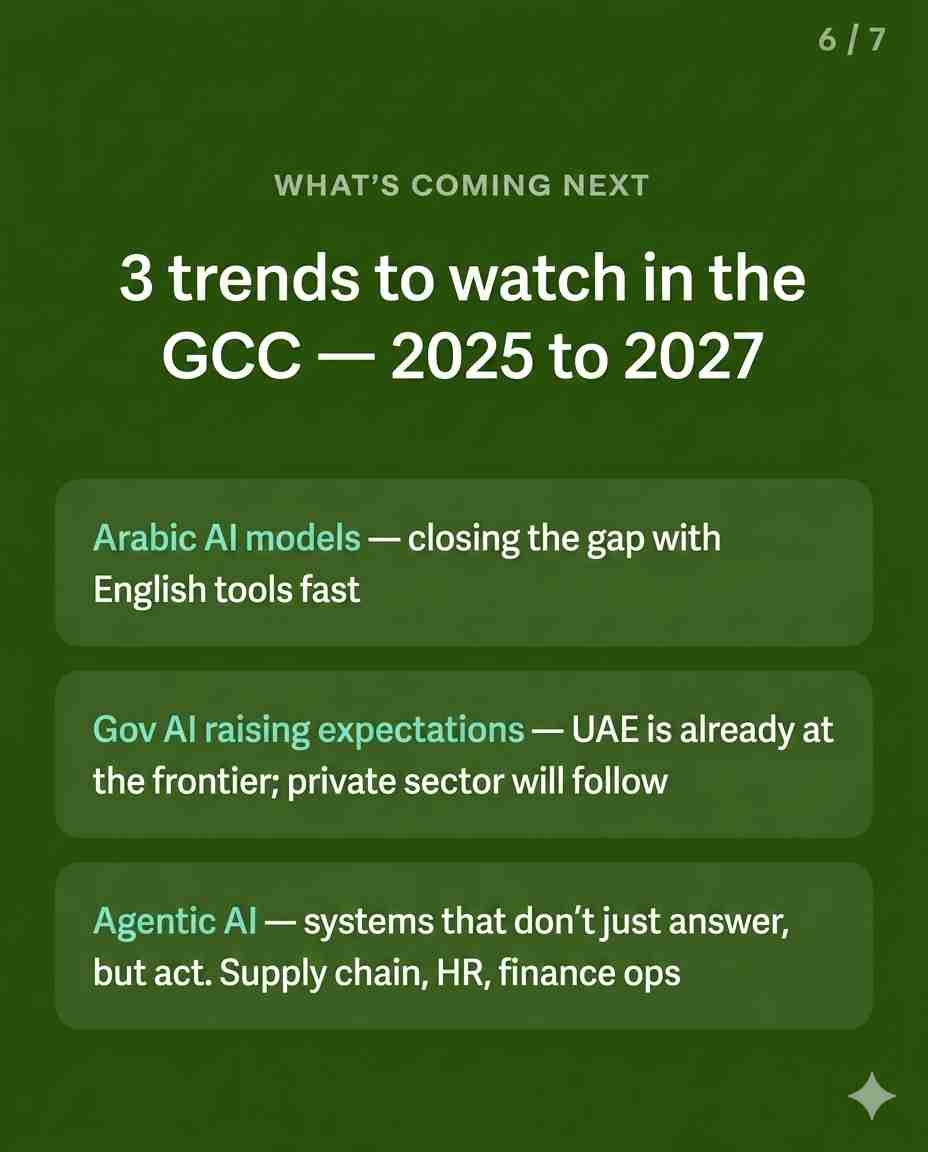
Arabic-language AI models are improving rapidly. For years, most leading AI tools were overwhelmingly English-optimized, which created real friction for GCC businesses serving Arabic-speaking markets. That gap is closing, and when it does, the use cases for customer-facing AI will expand significantly.
AI in government services will continue to push private sector adoption indirectly. As residents and customers experience seamless AI-powered government interactions, and the UAE is already at the frontier here, expectations for private sector experiences will rise in step.
Agentic AI – systems that don’t just answer questions but take actions autonomously- is moving from research labs into real business applications. Supply chain management, financial operations, HR workflows. This is where the next wave of efficiency gains will come from for GCC enterprises willing to move early.
Final Thought
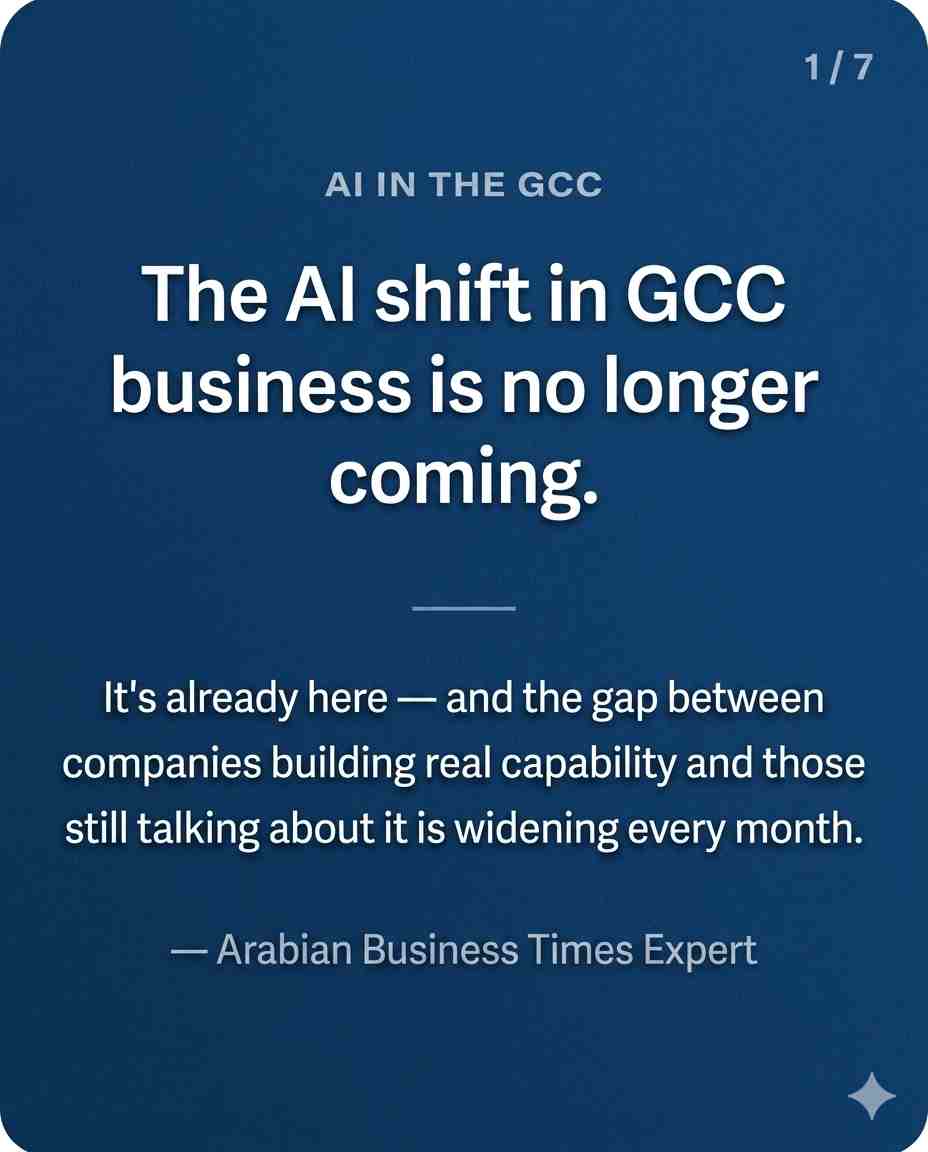
AI in GCC business is no longer a future conversation. It’s now a conversation, and the gap between companies building real capability and those still circling the idea is widening every month.
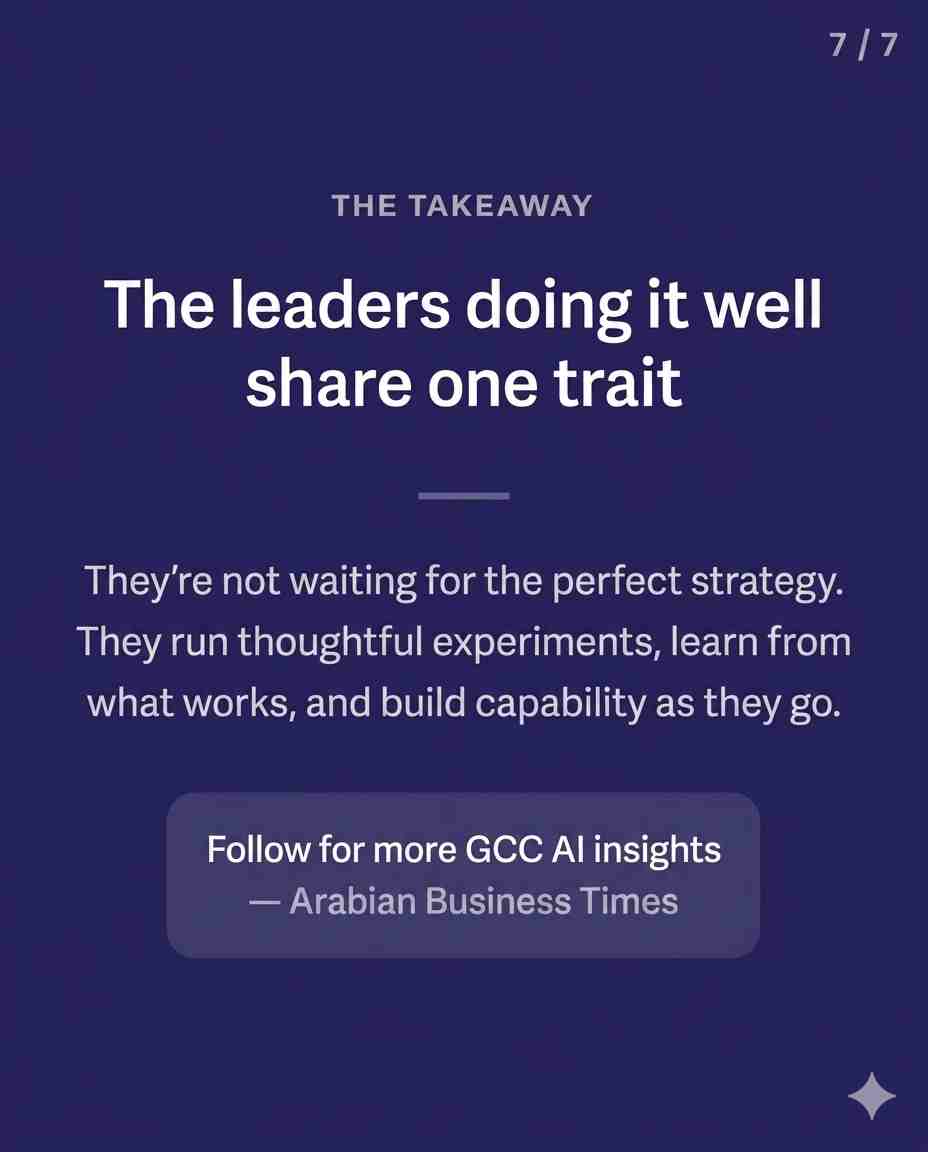
The leaders I see doing it well share one trait: they’re not waiting for the perfect strategy. They’re running thoughtful experiments, learning from what works, and building internal knowledge as they go.
If you’re a business owner or decision-maker in the GCC and you’re not sure where to start, or you’ve started but feel like you’re not getting traction, that’s probably the most important conversation you can have right now. Not about which tools to buy, but about what problem you’re actually trying to solve and whether AI is genuinely the right answer.
Sometimes it is. Often it’s part of the answer. The skill is knowing the difference.
Frequently Asked Questions About AI in GCC Business
Q: What industries in the GCC are benefiting most from AI right now?
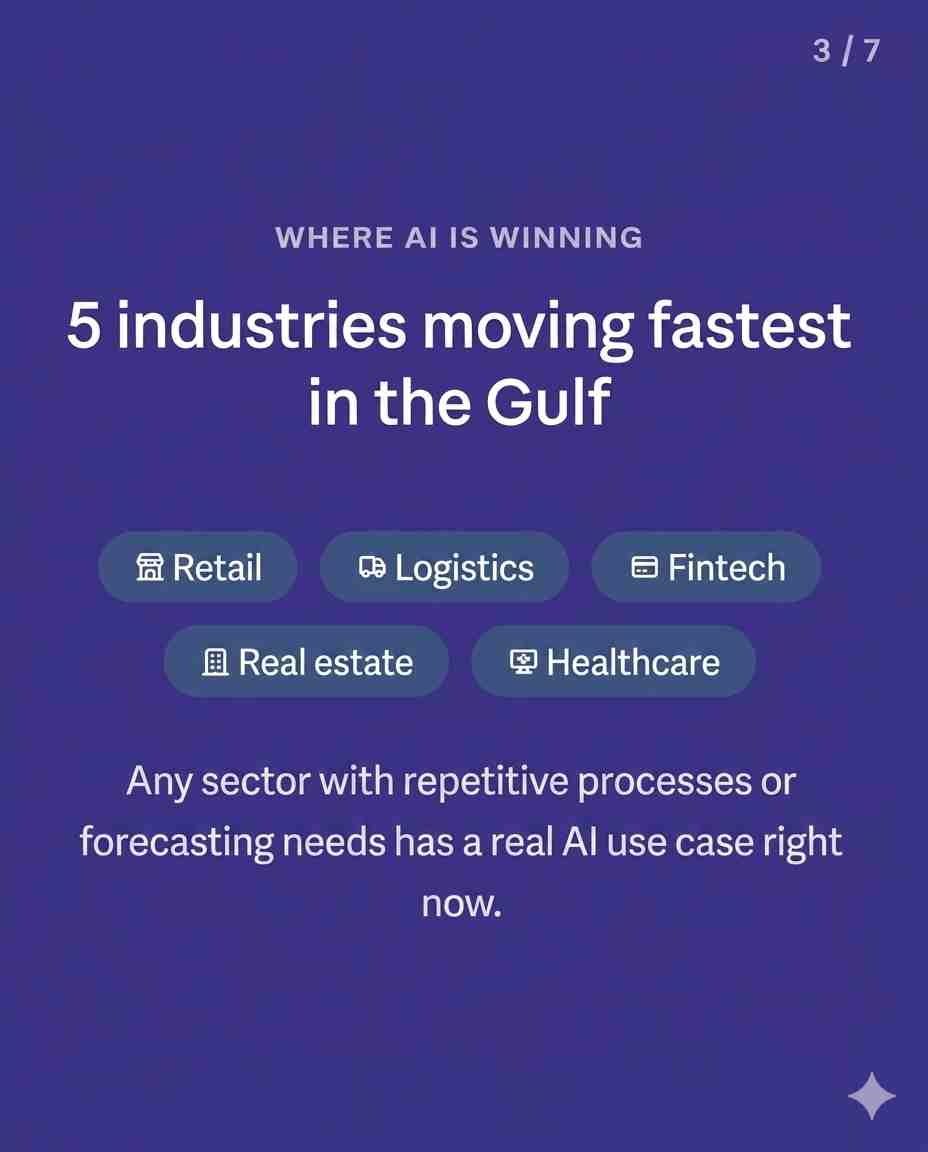
The most tangible results are seen in retail, logistics, fintech, real estate, and healthcare. Dubai’s trade corridors are early movers when it comes to logistics and supply chain in the UAE. And the financial sector in Saudi Arabia is also moving fast, fuelled by a young digitally-native population and the major investment in Vision 2030. With that being said, the truth is that almost any industry with repetitive processes, customer data or forecasting needs has a meaningful AI application. It’s less about the sector and more about having the right problem to solve.
Q: Is AI adoption in the UAE ahead of other GCC markets?
Yes, in terms of government-led infrastructure and policy, the UAE moved earliest and has been most aggressive with dedicated AI ministries, national strategies and institutions such as the Mohamed bin Zayed University of Artificial Intelligence (MBZUAI). But Saudi Arabia is moving fast, with vast sums of money being poured into tech and AI through vehicles like NEOM and the Public Investment Fund. Qatar and Bahrain are investing heavily, too. A more accurate picture is that the whole GCC is moving, although at slightly different speeds and with different sectoral priorities.
Q: How much does it cost to implement AI in a mid-sized GCC business?
Depends a lot on what you are trying to do. Off-the-shelf AI tools like customer service chatbots, AI-powered analytics dashboards, and automation platforms can cost as little as a few hundred dollars a month. That’s a conversation for another day – a custom-built AI solution embedded into your existing systems, which can cost anywhere from AED 200,000 to several million depending on complexity and scale. For most SMEs, the smarter question is not ‘how much does AI cost?’ but ‘which specific problem has a large enough financial impact to justify the investment? Begin there, and the cost-benefit analysis gets much sharper.
Q: Do GCC businesses need to hire AI experts to get started?
Not necessarily, at least not at first. Many of the useful AI tools today are built for non-technical users; they’re designed to operate through dashboards, not code. What becomes interesting is the specialist talent, the tuning models, integrating AI into complex internal systems or working with proprietary data at scale. Especially for businesses just starting, a good AI-literate consultant or a strong vendor partner will often get you further, faster than an expensive in-house hire you’re not quite ready to deploy properly.
Q: What are the main risks GCC businesses should be aware of when adopting AI?
Three emerge again and again. First, data quality – AI built on messy, incomplete, or biased data will produce unreliable outputs, and you might not know right away that it’s wrong. Second, regulatory exposure. Across the GCC, data privacy laws are tightening, and any AI application that touches customer data requires proper legal review. Third, over-reliance, there is a tendency, especially after early wins, to trust AI outputs without critical scrutiny. The best AI-using companies think of it as a very smart helper, not an infallible authority. Human judgment remains in the loop.
Q: How long does it typically take to see results from AI implementation?
For well-scoped, targeted use cases-automating a specific workflow, deploying a customer service bot, running AI-assisted demand forecasting-meaningful results can often be observed within three to six months. Wider transformation programs take longer, often 12 to 24 months, before the impact compounds. The most common mistake I see is thinking you don’t need to do anything, or that “AI takes time” is a valid reason to not measure anything. Create clear metrics before you begin, and review them at 90-day intervals. That discipline is what differentiates businesses that gain traction from businesses that get lost in implementation.
Have a specific AI challenge you’re working through in your business? I’d be glad to hear about it, and share what I’ve seen work in similar contexts across the region.