Let’s be straightforward about something most startup guides won’t tell you.
GCC is not Silicon Valley. It’s not working like South East Asia, and it’s certainly not working like the European playbook. It has a beat all its own, a beat built on royal-vision strategies, a relationship-first business culture, and a young population hungry for change, with governments that are, for real, writing checks.
If you don’t know the ground you are standing on and try to transplant a foreign startup model here, you will be in trouble. But if you take the time to read this market right, the GCC is probably the best place on earth to build right now.
Here’s everything you need to know.
Why the GCC Is Becoming a Serious Startup Destination
Before getting into tactics, let’s look at what’s actually happening on the ground.
Saudi Arabia has now become the MENA region’s leader in venture funding, with a 33% increase in startups over the past few years and a 1-year growth of USD 1.38 billion. Abu Dhabi’s startup ecosystem is one of the fastest-growing in the world.
Dubai Chamber of Commerce said new registrations in Dubai surged 43% on the year. The GCC’s VC ecosystem grew at a 19% compound annual growth rate from 2020 to 2024, reaching USD 1.7 billion in deployed capital, despite a global slowdown in venture capital elsewhere.
These aren’t ego numbers. They reflect something structural: governments across the UAE, Saudi Arabia, Qatar, Bahrain, Oman and Kuwait have decided that diversification away from oil is not a future option, it is a current emergency. And startups are the heart of that plan.
Bahrain made a strong comeback in 2025, with its ecosystem score growing by more than 40% thanks to efforts to streamline startup registration processes and improve tech infrastructure.
5G now covers more than 90% of GCC countries. Saudi Arabia’s Vision 2030 is working to create a policy that allows local startups to grow globally, not just survive at home.
Here’s one simple reason why this matters for founders: the government is on your side here in a way that almost no other region can match.
Step 1: Understand the Market Before You Build Anything
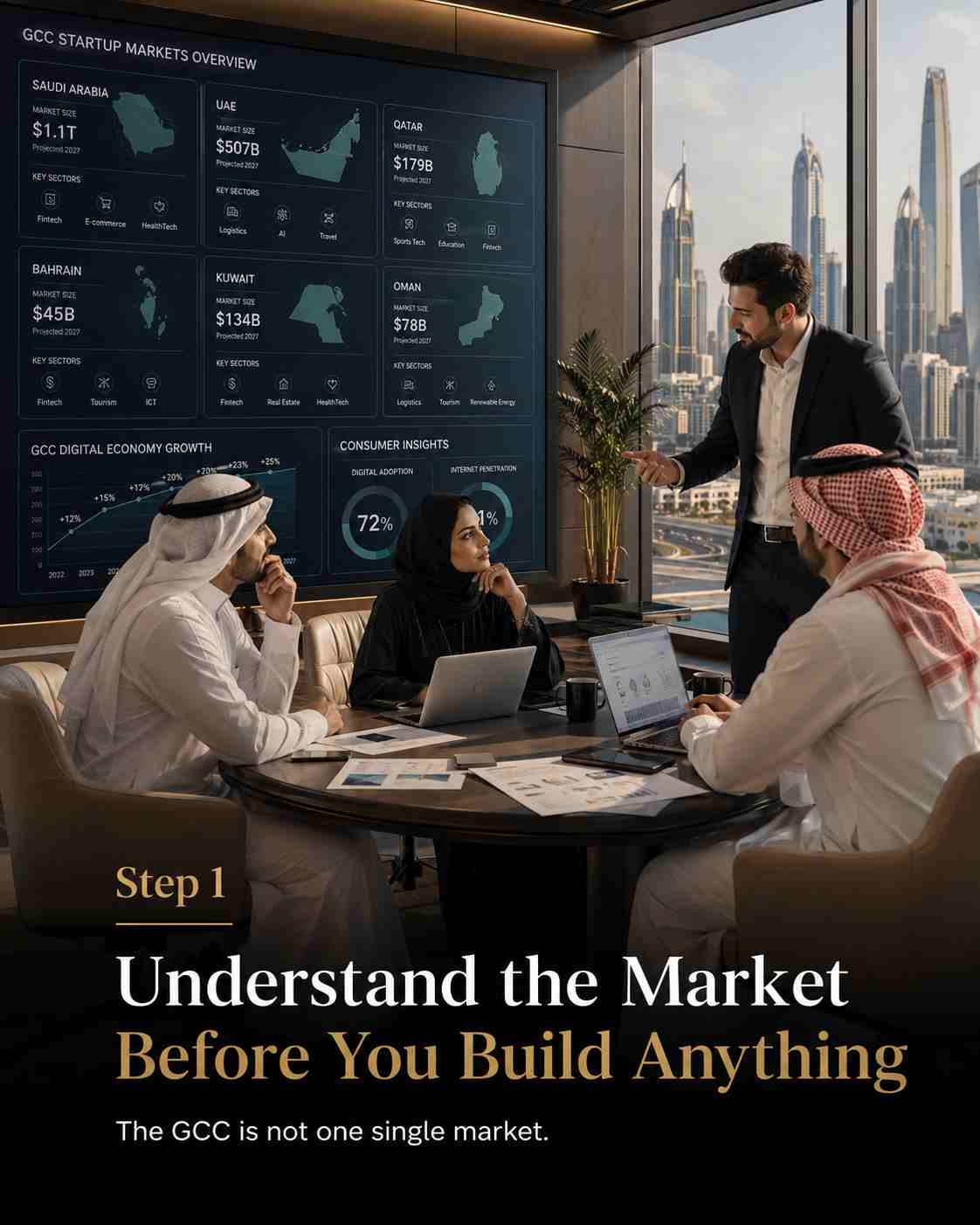
The GCC is not a single market. This is exactly the mistake that kills promising startups before they even get their licence.
Saudi Arabia is the region’s largest economy, with more than 35 million people, a huge domestic consumer base that is young, increasingly digital and underserved in several sectors.
The UAE is the region’s business hub, globally connected, expat-heavy, more tolerant of risk and faster processes on company formation.
Qatar is a high-income, concentrated market with robust government spending. Bahrain punches above its weight in the area of fintech. Kuwait has money and appetite, but is behind the curve in infrastructure. Oman is quieter but steadily opening.
Treating these six countries as one homogeneous block is how you end up launching a product that resonates in Dubai and confuses everyone in Riyadh. Consumer behaviour, payment preferences, the role of Arabic in your UX, and the sensitivity around pricing all of these vary in meaningful ways across borders.
What to do: Before writing a single line of code or spending a dirham on incorporation, spend at least 60 days doing real customer discovery.
Talk to 50 potential users. Conduct research in your specific target country, not the region in general. The GCC market has unique pain points in urban mobility, sustainable energy, digital payments and access to credit, but the texture of each problem differs by country.
Step 2: Pick a Sector With Structural Tailwinds

Not all sectors are equal in the GCC. Some have a decade of government backing behind them. Others are swimming against the current.
Fintech is the most obvious high-growth space in the region. The FinTech Bay in Bahrain, the SAMA sandbox in Saudi Arabia, and the DIFC Innovation Hub in Dubai have all created environments that actively encourage financial innovation. Platforms like Tabby and Tamara, which offer Buy Now Pay Later, have already shown the appetite for alternative credit structures in a region where one-third of the population is unbanked.
Healthtech is growing rapidly post-pandemic and hasn’t slowed down. Telehealth, diagnostics and digital pharmacy infrastructure remain underdeveloped relative to demand. Healthcare innovation is a significant investment in the national visions of GCC governments.
Clean tech and green energy are not just a fad but a real opportunity. The region is investing USD 100 billion in renewable energy and targeting a 20% reduction in emissions by 2030. Saudi Arabia recently built the tallest vertical farm in the MENA. The Gulf’s geography lends a certain global relevance to carbon capture and desalination, which are fields being targeted by deep tech startups from institutions such as KAUST and Hub71. Many climate-tech opportunities are emerging alongside the region’s traditional energy economy, which is still heavily influenced by the top oil and gas industry CEOs in the GCC.
Another area where the GCC’s geography is an asset is in logistics and supply chain. With its location at the crossroads of Asia, Africa and Europe, it is a natural hub for trade infrastructure. Here, companies like TruKKer have shown that B2B logistics can grow fast.
E-commerce and retail technology are being driven by high internet penetration and a mobile-savvy, high-income consumer base. Niche e-commerce bets such as modest fashion, specialty food and home goods are gaining momentum as shoppers look for alternatives to the region’s big hitters.
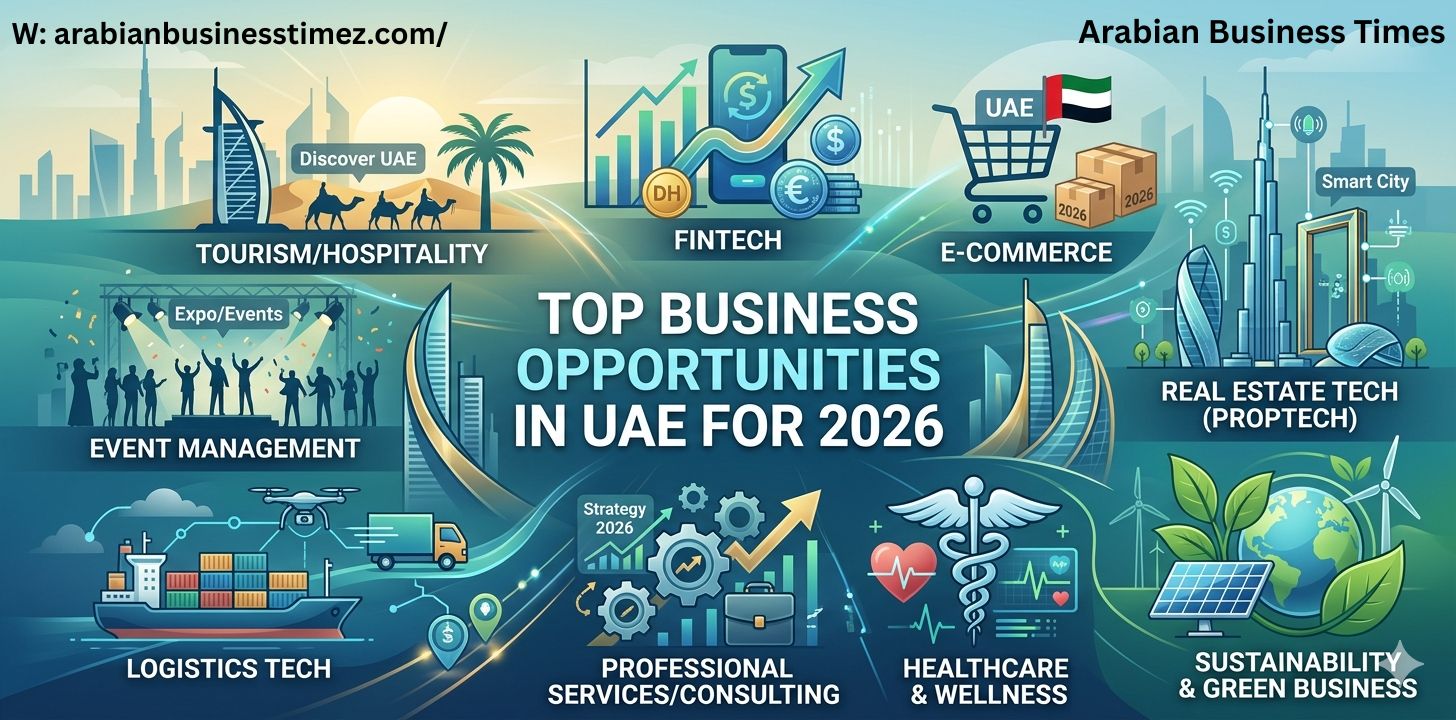
Founders exploring high-growth sectors should also study the latest business opportunities in the UAE for 2026 to understand where government spending and private investment are accelerating fastest.
Step 3: Choose Your Base Wisely
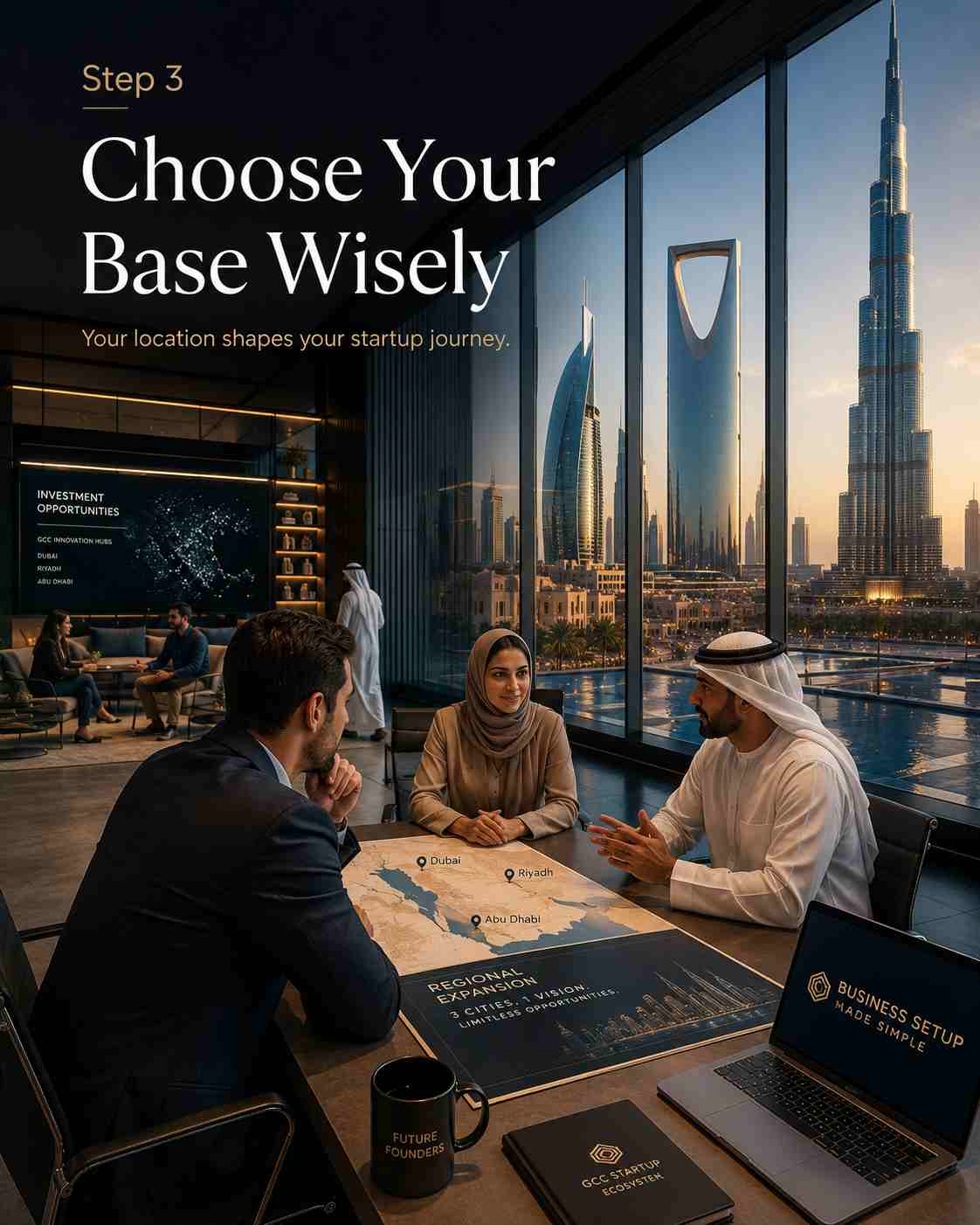
Where you incorporate changes everything: your tax exposure, your access to funding, your talent pool and the relationships you can build.
Dubai (through free zones such as Dubai Internet City, Dubai Silicon Oasis or DMCC) provides 100% foreign ownership, zero corporate tax on qualifying income and a cosmopolitan environment that makes it easier to recruit international talent. The DIFC Fintech Hive and In5 accelerators are not mere branding exercises; they are real.
Abu Dhabi offers Hub71, which has partnered with Mubadala, Sequoia, Microsoft and NYU Abu Dhabi. Hub71-onboarded startups have collectively raised more than USD 1 billion in global venture capital. If you’re building in deep tech, climate, or Web3, Hub71 is worth pursuing seriously.
Saudi Arabia, particularly Riyadh, is where you must be if you’re building for the Saudi consumer market. The kingdom’s USD 40 billion technology fund ambitions and direct support from PIF (Public Investment Fund) make it the largest single-opportunity market in the region. Monsha’at (the Saudi SME Authority) offers grants, loan guarantees through the Kafalah program and regulatory guidance. The Technology Development Financing Initiative offers loan guarantees covering up to 90% of funding for qualifying tech startups.
Bahrain remains an underrated choice for early-stage fintech founders. Regulatory sandboxes allow you to test financial products in a controlled environment, a gift for startups that need to prove their model before scaling.
The rapid expansion of infrastructure and property development is also creating major opportunities for proptech startups, especially around the ecosystem dominated by the top real estate companies in Dubai.
Step 4: Navigate the Cultural Landscape With Intention
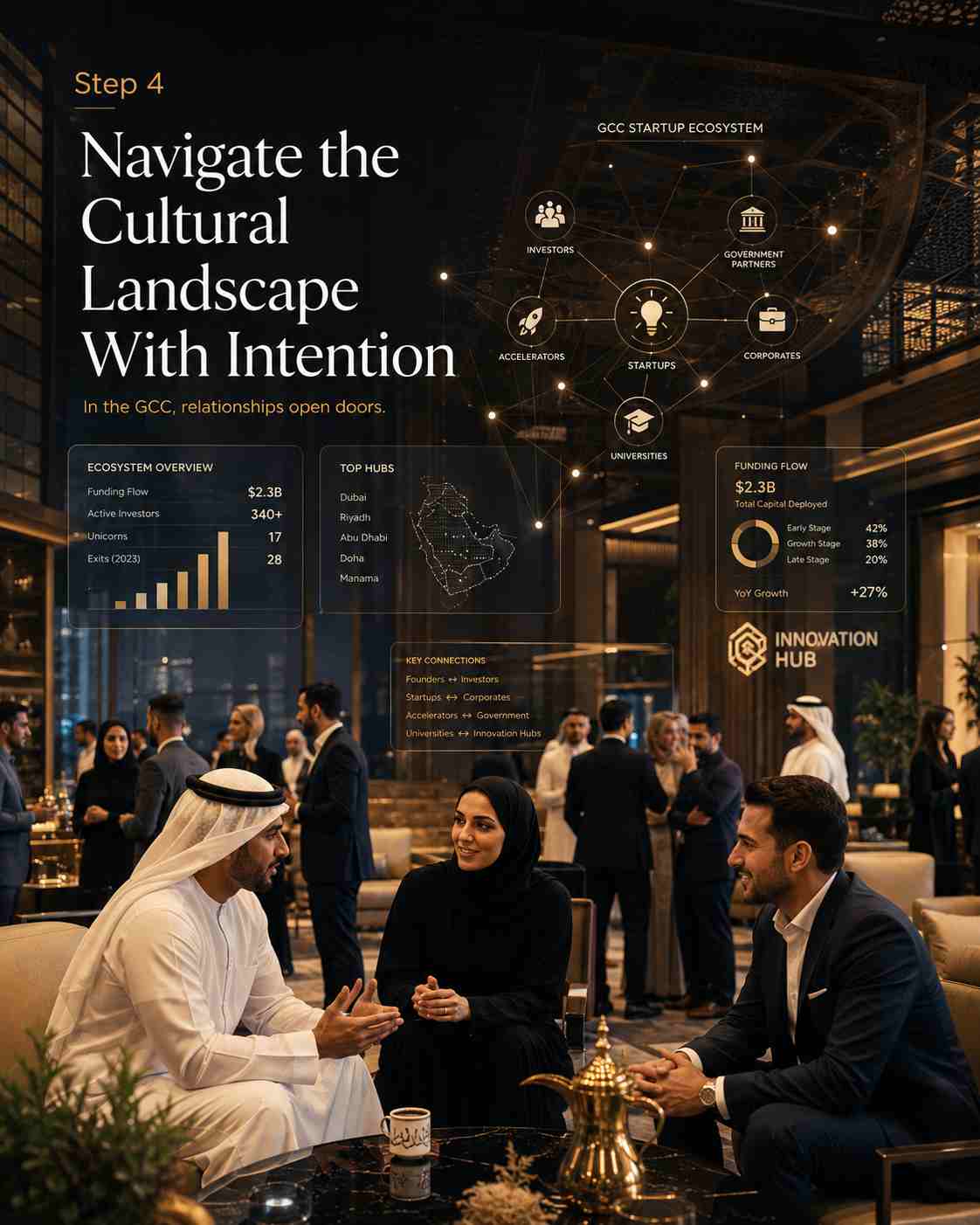
This is the section most startup guides skip because it’s harder to quantify. It’s also the section that most foreign founders underestimate and pay for later.
Business in the GCC is built on trust, and trust is built through relationships, not pitch decks. The concept of wasta (social capital, connections, influence) is real and functional. A warm introduction from a mutual contact will open a door that a cold email with a polished one-pager never will.
Spend time at industry events, at government-hosted forums and in the accelerator communities before you need something from them. Build the relationship in the quarter before you’re pitching for funding or chasing a government contract. This is not inefficiency; it is the system working exactly as designed.
The population of the GCC is predominantly young, with more than 50% under the age of 30. This is a generation that grew up with smartphones, expects seamless digital experiences and is less impressed by “innovation theatre” than by products that actually solve real problems in their everyday lives.
Many of the region’s startups also grow out of or alongside family businesses, which come with their own dynamics around decision-making, capital and access to networks.
If you are truly serving Saudi or wider Gulf audiences, Arabic-language UX is not optional. It’s the cultural nuance of how you present pricing, how you talk about credit and how you communicate around health and wellness. Use local advisers who know this. Pay them a fair wage.
For founders entering the market for the first time, understanding how to start a business in Dubai without existing connections can significantly reduce early operational mistakes. Read our detailed Dubai startup networking guide.
Step 5: Raise Money the Right Way in This Market
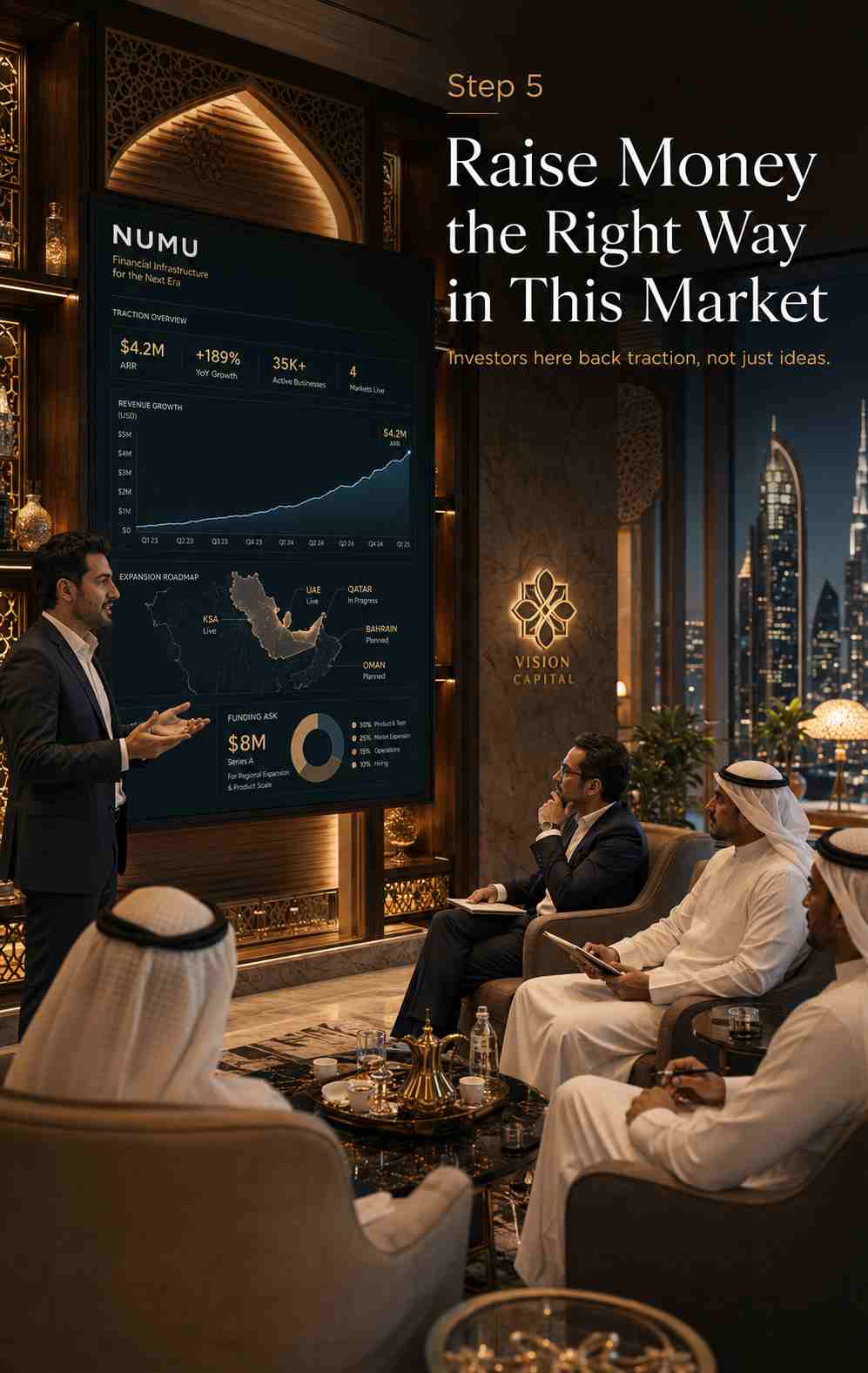
GCC investors think differently from Silicon Valley VCs. Understanding this saves you from months of misaligned conversations.
The market is shifting toward larger checks into fewer, more structurally mature companies. Average deal sizes hit record highs recently, even as deal counts fell. What this means for you: investors want to see proof. They want unit economics, real customers and a clear path to revenue, not just a vision and a deck.
Early-stage funding is still active and accelerating, but you need to approach it through the right channels. Hub71, Monsha’at and the Bahrain Development Bank are legitimate government-backed sources worth pursuing early. Regional VCs with local knowledge who understand the cultural considerations and regulatory environment will often be more valuable than chasing a global name with no regional presence.
Corporate venture capital is also growing fast, representing nearly 13% of total VC funding deployed in the GCC in 2024. Large regional corporations in banking, telecoms and logistics are actively looking to co-invest with or acquire startups. Building a partnership before pitching for investment is a strategy that works here.
And increasingly, the exit conversation has matured. The Saudi Stock Exchange (Tadawul) and its parallel market Nomu are becoming viable exit paths for regional startups, giving investors confidence that the journey has a credible end.
Step 6: Build a Team That Can Win Here

Talent is the GCC startup ecosystem’s most honest challenge. The competition for skilled tech talent is intense, and building a team that combines technical capability with local market knowledge is genuinely difficult.
The region’s governments know this. Saudi Arabia’s National Strategy for Data and AI has set a target of creating over 300 specialized startups. The UAE made certain STEM disciplines mandatory in government schools. Bahrain is training tens of thousands of nationals in technical skills through labour-market development initiatives.
For founders, this means a few things. First, your hiring network matters. Plug into the accelerator and university communities early. Institutions like the American University of Sharjah, KAUST and NYU Abu Dhabi are producing strong technical talent. Second, be realistic about the cost of importing senior talent from abroad.
Third, invest in junior local talent and develop them. It builds goodwill, reduces long-term costs and in an increasingly nationalization-aware regulatory environment, it’s a smart business strategy.
The UAE’s startup ecosystem is also being shaped by influential founders and operators. Understanding how leading tech CEOs in the UAE are scaling businesses can offer valuable insight for early-stage founders.
The Real Mistakes to Avoid
Scaling before you’ve validated. The GCC consumer has money and will pay for convenience, but they won’t forgive a bad experience twice. Get your core product working perfectly for your first 100 customers before talking about expansion.
Treating the GCC as one country. I already said this, but it bears repeating. Your go-to-market in Dubai is not your go-to-market in Riyadh.
Ignoring Arabic. Even for B2B startups, the language question will come up. Plan for it early.
Underestimating the government as a customer. In many sectors, landing a government pilot is the fastest way to credibility and, often, significant revenue. GCC governments are moving from experimentation to full-scale deployment of tech solutions faster than most founders expect.
Chasing the wrong investors. A term sheet from a fund with no regional presence or relationships is worth less than it looks. The right investor here brings a network, not just capital.
Final Thought: The Window Is Open, But It Won’t Stay This Wide
The GCC is at an inflection point. Governments are acting as accelerators. Capital is available and, in many cases, patient. The consumer base is young, connected and underserved in multiple categories. Regional collaboration is increasing, making cross-border scale genuinely achievable in a way it wasn’t five years ago.
Founders who engage seriously with this market now, who take the time to understand the culture, pick their geography deliberately, build relationships before they need them and solve real problems for real people, are building companies that will define the region’s next decade.
The infrastructure is there. The capital is there. The market need is enormous. What’s left is the founder willing to do the work.
Frequently Asked Questions About Building a Startup in the GCC
Q: Which GCC country is best for launching a startup?
The answer is, there is no one right answer. It depends entirely on what you are building and who you are building it for. For fintechs and products aimed at a global audience, Dubai is the fastest to get set up, has the best international connectivity and the most mature investor network.
If your core market is Saudi consumers, you have to be on the ground in Riyadh. No amount of Dubai incorporation will compensate for that. If you are in financial services and you want to test a regulated product cheaply, then the regulatory sandbox in Bahrain is genuinely useful.
A lot of founders operate a dual structure, incorporated in the UAE for global operations and a Saudi entity to access the local market.
Q: How much money do I need to start a business in the GCC?
It varies widely by country and structure. In Dubai’s free zones, you can set up a company from as little as AED 10,000 (about USD 2,700) to AED 50,000 (about USD 13,600), depending on the zone and licence type.
UAE mainland companies need more capital. Saudi Arabia has been working to reduce barriers, with some licence types now allowing registration with minimal capital requirements for Saudi nationals, although foreign investors still face stricter criteria.
You will generally need even a flexi-desk address. Budget separately for visa costs for yourself and your team, and legal/accounting fees for the first year. Getting legally and operationally set up in the UAE in the early stage of a startup would cost about USD 30,000 to USD 60,000 (excluding product development) for 12 months.
Q: Can foreigners own 100% of a company in the GCC?
In the UAE, yes, federal reforms now allow 100% foreign ownership across most sectors, and free zones have always offered this. Saudi Arabia has opened up significantly under Vision 2030, with 100% foreign ownership now permitted in a growing number of sectors, though some strategic industries still require a local partner.
Qatar, Bahrain, Oman, and Kuwait have varying rules, and these are evolving. Always get current legal advice specific to your sector before structuring your entity. The rules genuinely do change, and what applied two years ago may not apply today.
Q: How do I find investors for my GCC startup?
The GCC investor community is smaller and more relationship-driven than Silicon Valley, which is both a challenge and an advantage. Start by getting into a structured accelerator program. Hub71 in Abu Dhabi, In5 in Dubai, and Flat6Labs (which operates across the region) all have established investor connections and will make warm introductions that cold outreach never will.
Monsha’at in Saudi Arabia offers direct grants and connects founders with the kingdom’s VC ecosystem. Attend major regional events like GITEX, Step Conference, and Biban; these are genuinely where deals get started, not just celebrated.
Also, look at corporate venture arms: regional banks, telecoms, and logistics companies are increasingly active early-stage investors with strategic motivations beyond just financial return.
Q: What are the most common reasons GCC startups fail?
Based on patterns visible across the ecosystem, the most common reasons are: launching too broadly across multiple GCC countries before nailing one, underestimating how relationship-dependent the sales cycle is (especially for B2B and government contracts), hiring a team that lacks deep local market knowledge, running out of runway before product-market fit because burn rates in the GCC can be deceptively high, and building an English-only product for a market where Arabic is the operational language for a large portion of your users.
Scaling quickly is tempting here because capital is available, but many startups that raised significant seed rounds in 2021 and 2022 collapsed by 2024 because they scaled operations before validating their core offering.
Q: Do I need to speak Arabic to build a startup in the GCC?
You don’t personally need to speak Arabic to found a company here; the business language in the UAE free zones and among investor communities is predominantly English. However, if your product serves end consumers, particularly in Saudi Arabia, Arabic language support in your app or platform is not optional.
Saudi users expect Arabic-first experiences. Even in the UAE, where English is widely used, having Arabic customer support and localized content significantly improves trust and conversion, particularly in sectors like finance, healthcare, and e-commerce. Hire a strong Arabic-speaking product or marketing lead early rather than treating localization as a phase-two problem.
Q: How long does it take to set up a company in the GCC?
The UAE is one of the fastest places in the world to incorporate a free zone company formation that can happen in as little as 3 to 7 business days once your documents are in order. Saudi Arabia has dramatically improved its timeline under Vision 2030 reforms; foreign company branches can now be registered in a matter of weeks rather than months. Bahrain’s startup-friendly environment means registration is similarly fast. The longer delays usually come not from incorporation itself but from opening a corporate bank account; this can take 4 to 12 weeks, depending on the bank, your business type, and your documentation quality. Factor this into your cash flow planning.
Q: What government support programs exist for GCC startups?
The list is long and genuinely useful. Many government programs are bureaucratic in theory and slow in practice, but several GCC initiatives are actively moving capital and resources to startups.
In Saudi Arabia: Monsha’at (grants, mentorship, co-working), the Kafalah loan guarantee program (which has deployed USD 53 billion in guarantees to SMEs since 2020), and the Technology Development Financing Initiative (covering up to 90% of loan value for tech start-ups).
In the UAE: Hub71 (equity-free support and access to investor networks), DIFC Innovation Hub, DMCC’s Astro Labs and the UAE Venture Capital Fund. In Bahrain, there are active training and funding programs for entrepreneurs in place with the Bahrain Development Bank and Tamkeen.
Qatar Financial Centre has fintech programs. Most of these programs are updated on a regular basis; check the official websites directly for current eligibility requirements.
Sources: PwC Corporate Venturing GCC Report 2025 | World Bank Gulf Economic Update 2025 | Startup Genome GSER 2025 | StartupBlink Global Index 2025 | Wamda GCC Ecosystem Analysis | Communicate Online GCC Startup Report