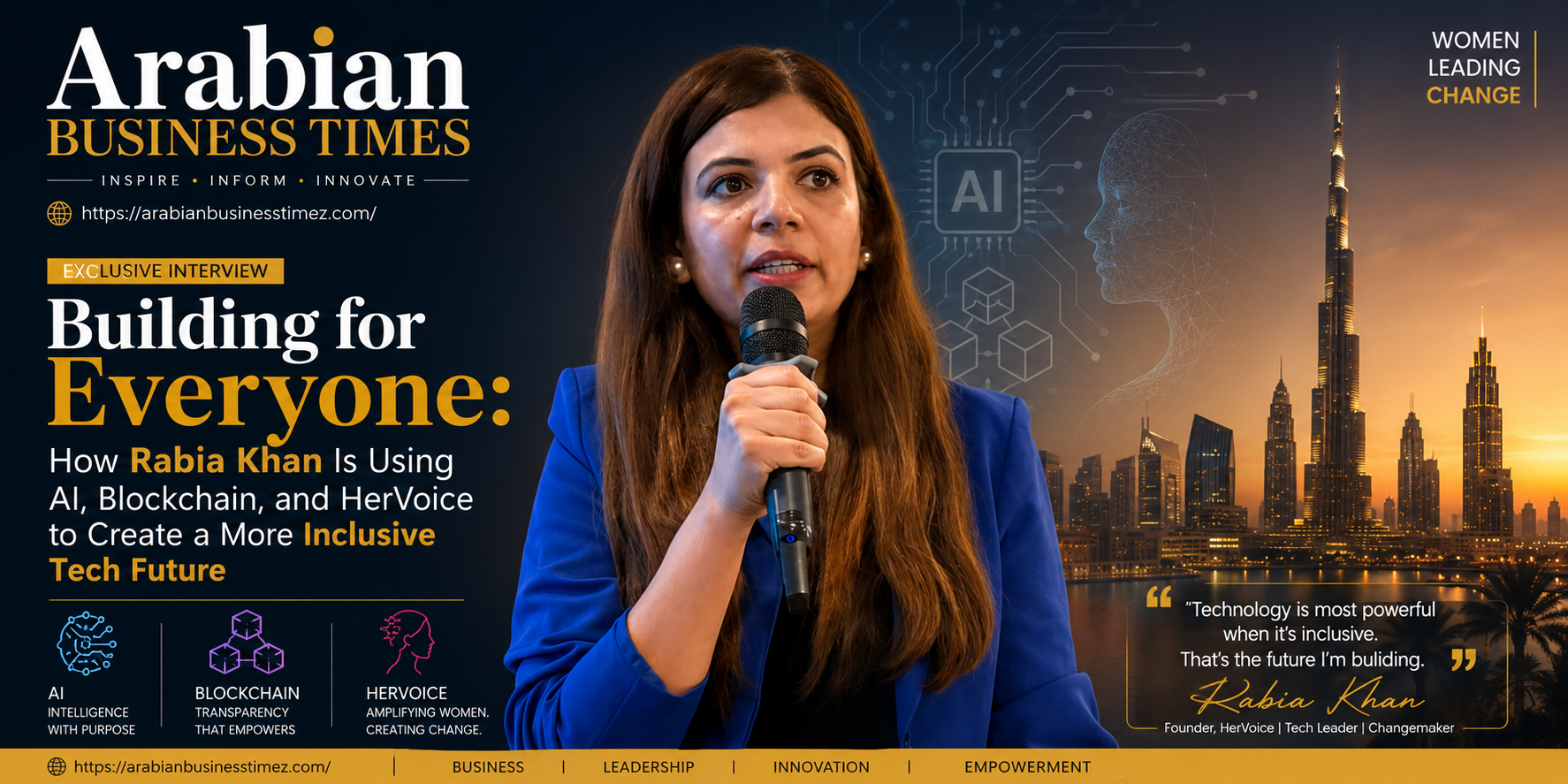
Founder of HerVoice, AI and Blockchain expert, educationist, and Assistant Registrar at the University of Greater Manchester, Rabia Khan has spent her career asking one question that most people in technology skip: who are we actually building this for?
Rabia Khan did not plan her path into emerging technologies. It grew from curiosity, from watching gaps form between innovation and the people it was supposed to serve, and from a decision to stop working around those gaps and start building something that addressed them directly.
Today she is a speaker, AI and Blockchain expert, program manager, educationist, career counsellor, community leader, and the Founder of HerVoice, a platform where technology, storytelling, and community leadership come together to amplify women’s voices in spaces where they are often underrepresented. She also serves as Assistant Registrar at the University of Greater Manchester, bringing the same commitment to inclusion and practical impact into the institutional world of higher education.
Her work sits at the intersection of innovation and responsibility. And the thread running through all of it is the same question she kept returning to early in her career: not just what are we building, but who are we building it for.
At Arabian Business Times, we continue to feature visionary leaders who are driving innovation across industries. You may also enjoy our exclusive interview with Vishwa Mohan, where he shares valuable insights on leadership, innovation, and business growth.
1. Your career spans AI, blockchain, education, program management, and community leadership. What inspired your journey into emerging technologies, and what has been the defining milestone of your career?
My journey into emerging technologies wasn’t planned in a linear way it evolved from my childhood curiosity, parents guidance that I choosed it.
Early in my career, working across education and program management, I consistently saw a gap between innovation and inclusion. We were adopting new systems AI, digital platforms, even blockchain concepts but many communities, especially women and youth, were not part of that transformation. That realization stayed with me. It made me question not just what we are building, but who we are building it for.
That question ultimately led me to explore AI and blockchain more deeply not as buzzwords, but as tools for transparency, access, and empowerment. Education remained central throughout, because I believe it is the foundation through which any emerging technology becomes meaningful and scalable in society.
The defining milestone of my career was founding HerVoice. It marked the moment I moved from working within systems to building one. HerVoice became a platform where technology, storytelling, and community leadership intersect to amplify women’s perspectives in spaces where they are often underrepresented. It wasn’t just a project it was a shift in purpose. It taught me that leadership in emerging technologies is not only about innovation, but about responsibility, representation, and impact.
Today, I continue to see my work as a bridge connecting innovation with inclusion, and ensuring that as technology evolves, it carries diverse voices with it. Rabia Khan’s journey reflects how purpose-driven leaders are shaping the future through innovation and education. Readers interested in leadership and global impact can also explore our interview with Professor Ona C. Miller, who shares her perspective on education, leadership, and creating meaningful change.
2. Artificial Intelligence is transforming every industry. In your opinion, what are the biggest opportunities AI presents for businesses, education, and society over the next five years?
AI over the next five years will be less about “new technology” and more about how deeply it gets embedded into decision-making, systems, and everyday workflows. I see the biggest opportunities across three key areas:
For businesses, the most immediate impact is productivity and decision intelligence. AI is shifting organizations from reactive to predictive models whether that’s forecasting demand, automating routine operations, or improving customer experience through personalization at scale. But the real opportunity goes beyond efficiency. Companies that learn to use AI ethically and strategically will be able to innovate faster, reduce operational gaps, and build more adaptive business models. It will also level the playing field for smaller organizations that previously lacked access to advanced analytics and infrastructure.
In education, AI has the potential to completely redefine access and personalization. We are moving away from one-size-fits-all learning toward adaptive learning systems that respond to individual student needs, pace, and style. For educators, AI can reduce administrative burden and free up more time for mentorship and critical thinking development. At the same time, it opens opportunities for lifelong learning, where skills can be continuously updated in line with industry demands. However, it also requires us to rethink academic integrity, assessment models, and digital literacy as core competencies.
For society, the opportunity is both transformative and sensitive. AI can improve healthcare access, strengthen governance systems, and enhance public service delivery through better data-driven decisions. It can also amplify civic participation if used transparently. But equally important is addressing the risks—bias, misinformation, and unequal access. The next five years will determine whether AI deepens existing divides or helps close them.
Ultimately, I see AI not just as a tool for automation, but as a catalyst for redesigning systems—economic, educational, and socialin a way that is more inclusive, efficient, and human-centered. The future of AI depends not only on technology but also on visionary leadership. For another inspiring perspective on innovation and global business leadership, read our exclusive interview with Bassel Babbili.
3. As both an AI and Blockchain expert, how do you see these technologies complementing each other to create innovative solutions for organizations and governments?
AI and blockchain are often discussed separately, but their real potential emerges when they are designed to complement each other one brings intelligence, the other brings trust.
AI is fundamentally about prediction, automation, and decision-making. It thrives on data analyzing patterns, optimizing processes, and generating insights at scale. Blockchain, on the other hand, is about verification, transparency, and accountability. It ensures that data is traceable, tamper-resistant, and governed by clear rules.
When combined, they solve a core problem that both organizations and governments struggle with today: how to trust data-driven systems at scale.
For organizations, AI can optimize supply chains, customer engagement, and financial forecasting, while blockchain can secure the integrity of that data ensuring auditability and reducing fraud. In government systems, the combination is even more powerful. AI can help analyze large-scale citizen data to improve service delivery such as identifying welfare eligibility, predicting infrastructure needs, or detecting anomalies in tax systems. Blockchain can then ensure that these processes remain transparent, traceable, and resistant to manipulation, which is critical for public trust.
Another important intersection is data governance and AI ethics. One of the biggest challenges in AI today is data credibility and bias. Blockchain can provide provenance tracking where data comes from, how it has been used, and whether it has been altered. This creates a more responsible AI ecosystem where decisions are not only intelligent but also accountable.
In the next few years, I see the most impactful use cases emerging in areas like digital identity, smart contracts powered by AI decision layers, transparent public procurement systems, and secure cross-border data exchange.
Ultimately, AI gives us intelligence, and blockchain gives us integrity. Together, they create systems that are not only smarter, but also more trustworthy and that combination is essential for both organizations and governments moving into a digital-first future. Trust, innovation, and digital transformation are becoming essential themes across industries. Discover how other global business leaders are embracing innovation in our exclusive interview with Ambe Fidelis Ndang.

4. You are passionate about youth and women empowerment. How can AI and digital technologies help bridge the gap and create more opportunities for the next generation of leaders?
AI and digital technologies can play a real role in narrowing long-standing gaps but only if access, skills, and inclusion are intentionally built into the system.
For youth, the biggest barrier is often not talent, but opportunity and exposure. AI can help bridge this through personalized learning platforms that adapt to individual pace and needs, giving students in under-resourced environments access to the same quality of learning support as those in more privileged settings. Digital tools also expand access to mentorship, global knowledge, and remote work opportunities allowing young people to participate in economies that were previously out of reach.
For women, the impact is even more transformative when it comes to access and visibility. Digital platforms reduce traditional barriers like geography, mobility, and gatekeeping in professional spaces. AI-powered tools can support skill development, career matching, and entrepreneurship by helping women identify opportunities, build digital businesses, and access global markets. Importantly, technology also enables storytelling and representation allowing more women to share their voices, experiences, and expertise at scale, which is essential for shifting narratives and leadership norms.
At the same time, we have to be honest that technology alone does not solve inequality. If digital literacy is low, or if access to devices and connectivity is unequal, AI can actually widen the gap. That is why capacity building is just as important as innovation teaching not only how to use tools, but how to think critically about them.
This is where initiatives like HerVoice become meaningful because empowerment is not just about access to technology, but about ensuring people have the confidence, skills, and platforms to use it effectively. When AI and digital ecosystems are combined with inclusive education and mentorship, they don’t just create users of technology they help develop the next generation of leaders, creators, and decision-makers. Women leaders around the world are transforming industries through innovation and entrepreneurship. You may also enjoy reading our exclusive interview with Orinta Petruzyte, who is making an impact in the luxury interior design sector.
Another inspiring story is our conversation with May Ahmed, who has built a successful luxury fashion brand while redefining entrepreneurship and creativity.
5. Many organizations are eager to adopt AI but struggle with implementation. What practical advice would you give to businesses looking to integrate AI effectively into their operations?
The biggest misconception about AI adoption is that it starts with technology. In reality, successful implementation starts with clarity of purpose and organizational readiness not tools.
First, organizations need to identify specific, high-impact use cases rather than trying to “do AI everywhere.” The most effective starting points are usually repetitive, data-heavy, or decision-support processes such as customer service automation, forecasting, document processing, or internal reporting. AI works best when it solves a clearly defined business problem, not when it is applied as a general upgrade.
Second, data readiness is non-negotiable. Many organizations underestimate how fragmented or inconsistent their data is. Before deploying advanced AI models, businesses need to invest in data cleaning, integration, and governance. Without reliable data, even the most advanced AI systems will produce weak or biased outcomes.
Third, AI adoption should be treated as a gradual integration, not a one-time transformation. Starting with pilot projects allows organizations to test value, understand limitations, and refine workflows before scaling. This also helps reduce resistance within teams, which is often one of the biggest hidden barriers.
Equally important is people readiness. AI does not replace the need for human judgment—it changes the nature of work. Organizations need to invest in upskilling employees so they can work alongside AI tools confidently. When teams understand how AI supports their roles rather than threatens them, adoption becomes significantly smoother.
From a governance perspective, businesses also need to establish clear ethical and operational frameworks defining how decisions are made, how bias is monitored, and who is accountable for AI-driven outputs. This is especially important in customer-facing and high-stakes environments.
Finally, leadership commitment is critical. AI cannot be delegated purely to IT departments. It needs to be part of strategic decision-making, with leadership actively guiding how it aligns with business goals.
In short, effective AI adoption is not about rushing into automation it is about building a structured, responsible, and people-centered approach that aligns technology with real organizational value. As businesses embrace emerging technologies, strong leadership remains the foundation of sustainable growth. Read more insights from experienced industry leaders in our exclusive interview with Bassel Babbili.

6. With the rapid advancement of AI, ethical concerns such as privacy, bias, and misinformation are becoming increasingly important. How can organizations ensure responsible and trustworthy AI adoption?
Responsible AI adoption requires a balance of governance, transparency, and accountability.
Organizations should start with strong data privacy practices and ensure data is collected and used ethically. They must actively address bias through regular testing and audits, not just at launch but throughout the AI system’s lifecycle.
Human oversight is also essential AI should support decisions, not fully replace them, especially in high-impact areas. At the same time, organizations should ensure transparency, so users understand how and why AI-driven decisions are made.
Finally, leadership must take ownership by putting in place clear ethical frameworks and policies. In short, responsible AI is about building systems that are not only intelligent, but also fair, transparent, and accountable.
7. Your background in education and career counseling gives you a unique perspective. What skills should students and professionals develop today to remain relevant in an AI-driven economy?
Students and professionals should focus on a mix of technical and human skills to stay relevant in an AI-driven economy.
Key priorities include AI and data literacy, strong critical thinking, and the ability to adapt and continuously learn as technology evolves. Alongside this, communication, teamwork, and emotional intelligence remain essential because they are areas where humans still lead.
Finally, ethical awareness and responsible use of technology will be important for future leadership roles.
In short, success will come from combining digital skills with strong human judgment and adaptability.
Education continues to play a vital role in preparing future leaders. Explore our interview with Dr. Darcell Streeter, where she discusses leadership, education, and building impactful learning ecosystems.
8. As a speaker and community leader, what emerging AI trends or innovations excite you the most, and how do you believe they will reshape industries in the coming decade?
What excites me most about AI is its shift from a tool to a core driver of decision-making and innovation.
Key trends include generative AI, which is transforming productivity and creativity across industries, personalized learning systems that are reshaping education, and AI agents that can automate complex tasks and workflows.
I’m also excited about the growing focus on trust, ethics, and data governance, especially when AI is combined with technologies like blockchain.
Overall, these innovations will make industries more efficient, personalized, and intelligent, but also require strong ethical oversight.
9. Leadership in technology requires continuous learning and adaptability. What leadership principles have guided your success, and how do you stay ahead in such a rapidly evolving field?
My leadership is guided by purpose, adaptability, and people-focused innovation.
I believe technology should solve real problems and create inclusion, not just efficiency. In AI and emerging tech, I stay relevant by continuously learning, adapting, and updating my thinking.
I also value collaboration better solutions come from diverse perspectives, not isolated work. And above all, I focus on ethics, ensuring innovation stays responsible and accountable.
To stay ahead, I keep learning, engage with real-world use cases, and stay connected to both industry trends and community needs.

10. Finally, what advice would you give to aspiring AI entrepreneurs, innovators, and young professionals who want to build impactful careers while contributing positively to society?
Just star, don’t overthink it. AI makes it easier than ever to build, even if you’re starting with a small idea, business, or startup. You don’t need everything perfect at the beginning.
Build strong basics in AI, think critically, and keep learning as the field evolves. Focus early on doing things right especially around ethics, privacy, and fairness.
Don’t do it alone mentors and collaboration really matter in building impactful solutions.
Most importantly, stay focused on creating real value for people and society, not just chasing trends.
If you could make one prediction about the future of Artificial Intelligence that most people are currently overlooking, what would it be, and why?
AI won’t just be a tool you useit will quietly run the background of many systems like schools, hospitals, banks, and government services.
Instead of people “using AI,” AI will start making small decisions in the background. The big issue won’t be how smart it is, but whether people can understand and trust those hidden decisions.
Connect with her:
- W: https://officialhervoice.com/
- LinkedIn: https://www.linkedin.com/in/rabiya-khn/
- Instagram: https://www.instagram.com/officialhervoice/
Rabia Khan, Founder HerVOICE, Assistant Registrar University of Greater Manchester
Frequently Asked Questions
Q: Who is Rabia Khan?
Rabia Khan is a Speaker, AI and Blockchain Expert, Program Manager, Educationist, Career Counsellor, Community Leader, and the Founder of HerVoice. She also serves as Assistant Registrar at the University of Greater Manchester. Her work focuses on using emerging technologies to create more inclusive systems, with a particular emphasis on youth and women empowerment.
Q: What is HerVoice?
HerVoice is a platform founded by Rabia Khan where technology, storytelling, and community leadership intersect to amplify women’s perspectives in spaces where they are often underrepresented. It was created to ensure that as technology evolves, it carries diverse voices with it, not just the ones that have historically dominated the conversation.
Q: How do AI and blockchain complement each other?
AI brings intelligence to systems through prediction, automation, and data-driven decision-making. Blockchain brings integrity through verification, transparency, and tamper-resistant records. Together, they solve one of the most pressing challenges facing organizations and governments today: how to trust data-driven systems at scale. Key use cases include digital identity, transparent procurement, secure cross-border data exchange, and AI-powered smart contracts.
Q: What practical advice does Rabia Khan give to organizations adopting AI?
She recommends starting with specific, clearly defined use cases rather than trying to apply AI everywhere at once. Organizations need to invest in data readiness before deploying advanced models, treat adoption as a gradual integration rather than a one-time transformation, upskill their people so they can work alongside AI with confidence, and establish clear ethical and governance frameworks from the beginning. Leadership commitment to AI as a strategic priority, not just an IT project, is also essential.
Q: What skills does she recommend developing for an AI-driven economy?
Rabia Khan recommends a combination of AI and data literacy, critical thinking, adaptability, and continuous learning on the technical side, alongside communication, teamwork, emotional intelligence, and ethical awareness on the human side. She is clear that success in an AI-driven economy will come from combining digital skills with strong human judgment, not from choosing one over the other.
Q: What is her prediction about the future of AI that most people are overlooking?
She believes AI will stop being something people actively use and will instead become something that quietly runs in the background of everyday systems, including schools, hospitals, banks, and government services. The most important challenge will not be how intelligent AI becomes, but whether people can understand and trust the decisions it makes without their direct awareness or input.