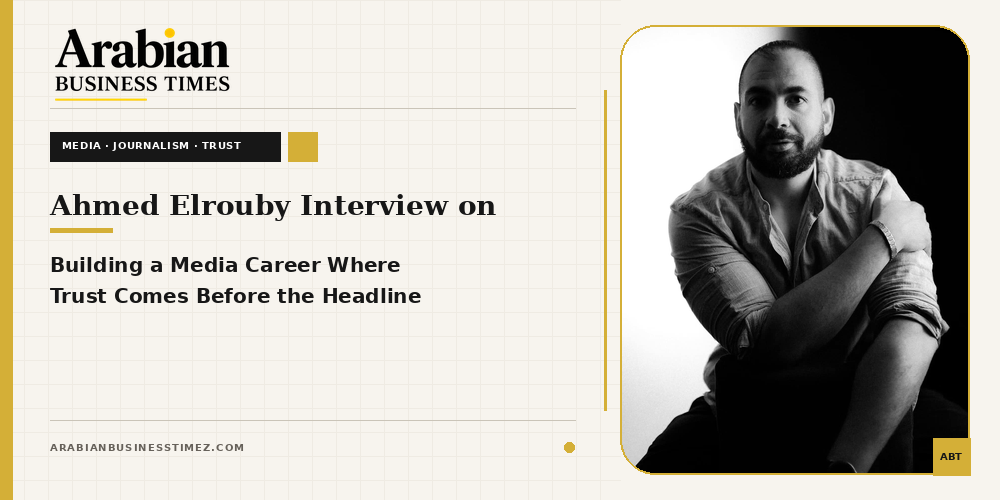
Few people move as fluidly between the newsroom, the red carpet, and the boardroom as Ahmed Elrouby. Now Head of Media & Partnerships at After8 Magazine, the Egyptian journalist and media consultant has spent more than a decade shaping how public figures across Egypt and the GCC are seen and heard, from bylines at Al Khaleej Newspaper to producing and hosting over 170 interviews and digital episodes across the Miniz Platform. In this conversation with Arabian Business Times, Elrouby reflects on the discipline behind a lasting media career, and why, in his view, every conversation ultimately comes down to trust.
Ahmed Elrouby’s Journey from Journalism to Media Leadership
Elrouby traces his path back to a simple belief that every person has a story worth telling, a conviction that led him to study Media and Journalism at the Academy of Akhbar Al Youm, graduating in 2012, and to build a career now spanning more than a decade across journalism, public relations, media production, and strategic communications. He began as a journalist with Al Khaleej Newspaper in the UAE, covering entertainment, culture, and public affairs while conducting exclusive interviews with artists, executives, and public figures, work he also carried out for Majlis Kul Al Usra Magazine and the Arageek Platform. Over time, his storytelling expanded beyond reporting into producing interviews, managing media strategies, and building partnerships. As Guest Producer, Host, and Account Manager at Miniz Platform since 2022, he has produced and hosted more than 170 episodes across formats including Miniz x Dubai, spanning talent booking, guest coordination, and content direction. Today, as Head of Media & Partnerships at After8 Magazine, he oversees strategic collaborations, media relations, editorial partnerships, and high-profile interviews. For Elrouby, media has never been just a profession. He describes it as a responsibility to create conversations that inform, inspire, and leave a lasting impact.
Defining Experiences in the UAE Media Industry
Elrouby describes the UAE as home to one of the most dynamic media ecosystems in the region, where innovation, business, entertainment, and culture intersect daily. Across more than a decade with Al Khaleej Newspaper, he interviewed celebrities, entrepreneurs, government representatives, and industry leaders, and also stepped beyond the interview chair to serve as Red Carpet Manager for Power of Her Season 2 in 2023 and Season 3 in 2024, coordinating media appearances, guest logistics, and on-ground production for high-profile events. Yet what has shaped him most, he says, are the conversations that revealed the human side behind success. Working across both editorial journalism and media production taught him that audiences are looking for authenticity rather than headlines, and some of his most rewarding experiences came from producing interviews that allowed influential personalities to share lessons, failures, and personal journeys instead of simply promoting projects.
How Digital Media Is Changing the Role of Journalists
Journalists today are no longer limited to writing articles, Elrouby says. They have become researchers, storytellers, video producers, content strategists, and digital communicators, roles he has occupied himself while moving between print journalism and digital formats across Miniz Platform and Miniz x Dubai. Technology has increased the speed at which information travels, but he is quick to note that it has also increased the responsibility to verify facts before publishing. He believes the journalists who will thrive going forward are those who combine traditional journalistic ethics with modern digital storytelling while remaining committed to accuracy and credibility.
Journalism vs Public Relations: Understanding the Difference
Although journalism and public relations frequently interact, Elrouby is clear that they serve different purposes. Journalism exists to inform the public objectively, while public relations focuses on building trust and maintaining meaningful relationships between organizations and their audiences. His own PR experience, including managing communications for Samer Morsi between 2016 and 2022, Suzan Najm Al Deen from 2022 to 2025, and Tamer Shaltout from 2024 to 2025, has given him a working understanding of both sides of that relationship. As a journalist, he knows what makes a story newsworthy. As a PR professional, he understands how to communicate value without compromising authenticity. That balance, he says, has become one of his greatest professional strengths.
What Makes an Interview Truly Impactful?
Preparation, Elrouby says, is everything. A successful interview starts long before the cameras are turned on, and it depends on research, understanding a guest’s background, and identifying the questions that have never been asked. Drawing on the more than 170 episodes he has produced and hosted across his career, he explains that he always aims to move beyond promotional discussion and explore the experiences, decisions, failures, and lessons that shaped a person’s journey. Those, he says, are the moments audiences remember.
Why Trust and Credibility Matter in Modern Journalism
Credibility, in Elrouby’s view, is earned through consistency. Media organizations must prioritize accuracy over speed, transparency over sensationalism, and facts over algorithms. Audiences may forget who published a story first, he says, but they always remember who published it correctly. For Elrouby, trust remains the most valuable asset any journalist or media organization can build, and it is the standard he has tried to hold himself to across newsrooms, PR campaigns, and on-camera productions alike.
Building Meaningful Media Visibility for Brands and Executives
Visibility, Elrouby cautions, should never be the goal by itself. The real objective is credibility. He advises business leaders to invest in thought leadership, share valuable insights, and communicate their expertise instead of relying solely on promotional campaigns, since people trust authentic voices far more than polished advertisements. Strong reputations, he says, are built through consistency, transparency, and meaningful conversations over time, a philosophy he has applied while managing media days, press coverage, and campaigns for the artists and public figures he has represented.
How AI Could Transform Journalism and Media Production
Elrouby expects Artificial Intelligence to become one of the most powerful tools available to media professionals, improving research, data analysis, transcription, translation, content optimization, and production efficiency. Still, he is firm that AI cannot replace curiosity, emotional intelligence, editorial judgment, or the ability to build trust with audiences. The future of the industry, he believes, belongs to professionals who know how to combine technology with human creativity.
The Future of Journalism and Digital Storytelling in the Middle East
The Middle East, Elrouby says, is entering a new era of media innovation. He expects the next decade to be defined by video-first journalism, AI-assisted production, creator-led media, multilingual storytelling, strategic partnerships, and highly personalized content experiences. The region is investing heavily in media, technology, and entertainment, he notes, creating substantial opportunities for professionals who can adapt quickly while maintaining editorial integrity.
Ahmed Elrouby’s Advice for Aspiring Journalists
Elrouby’s advice is direct: stay curious, read more than you publish, and listen more than you speak. Technology will continue to evolve, he says, but integrity, credibility, and professionalism will always distinguish exceptional media professionals from average ones. His closing guidance to those starting out is to build a reputation before building an audience.
The Biggest Lesson: Communication Begins with Trust
The greatest lesson Elrouby’s career has taught him is that communication is ultimately about trust. Whether interviewing a public figure, representing a brand, or leading a media partnership, he says success begins when people trust your intentions, your professionalism, and your commitment to delivering value. For Elrouby, leadership is not about having the loudest voice. It is about creating opportunities, building meaningful relationships, and helping others tell their stories with honesty and purpose.