
Larisa Magomatova, MD
Every year, more than a million children worldwide are born with congenital heart defects. A million families who hear a diagnosis one day and understand not a word of it.
Ask parents what that diagnosis means for their child’s future and you will hear the same fear in different words. A hard life. Disability. Limitations. A childhood spent between hospitals.
The fear is understandable. And usually inaccurate.
Paediatric cardiology has come a long way over recent decades. Most patients with congenital heart defects, given a timely diagnosis and well-organised treatment, grow up and live ordinary lives. They study. They play sport. They start families of their own. And how the story ends is shaped in large part by how quickly the family understood what they were dealing with.
That is why education is not a pleasant addition to paediatric cardiology. It is one of its instruments, standing beside surgery and medication rather than behind them.
The Danger Is Not the Diagnosis. The Danger Is Delay
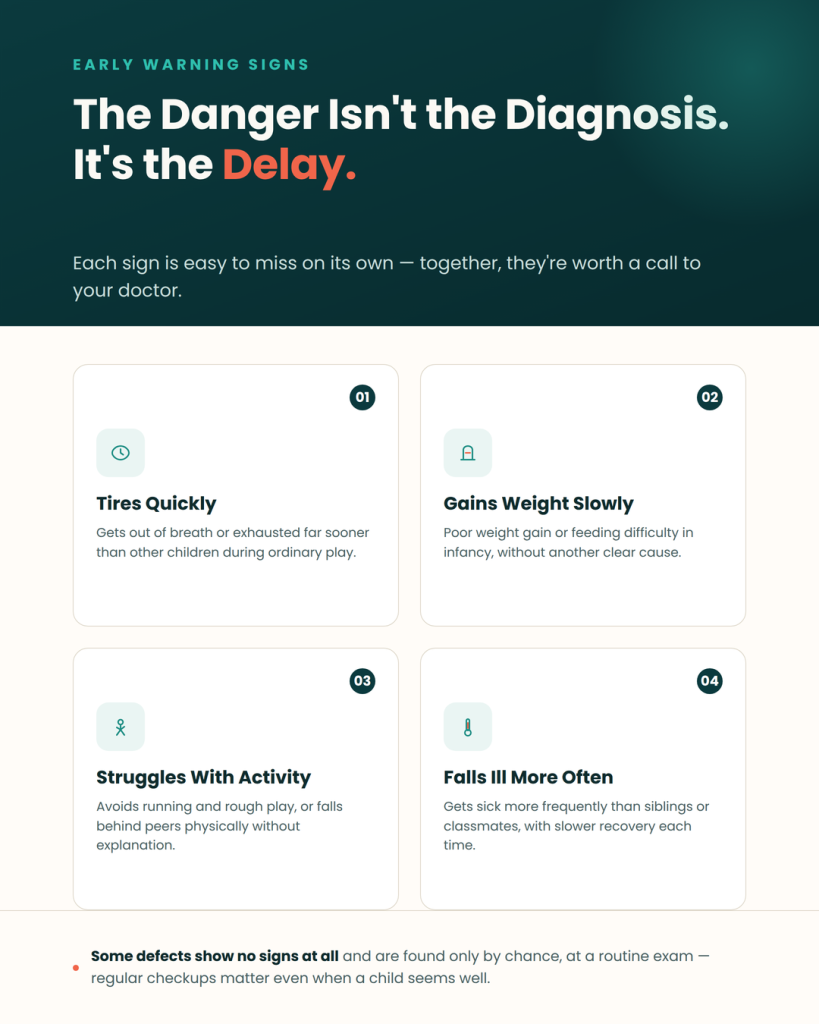
Do not fear the diagnosis. Seek to understand it.
Far more dangerous than the defect itself is the defect found late. Months, sometimes years, lost simply because no one explained to the parents what to look for. The child tires quickly. Gains weight slowly. Struggles with physical activity. Falls ill more often than others. Each of these signs on its own is easy to put down to temperament, to age, to the weather. And sometimes a defect gives no visible signs at all and is found by chance, at a routine examination.
The earlier a problem is found, the more options a family has and the better the outlook tends to be. That is the whole reason education deserves so much attention. A family that knows what early symptoms look like acts faster. And here speed changes the outcome.
The Path Begins Long Before the Operating Theatre
Much is decided before birth.
Detection of the defect early in pregnancy. Properly organised management of that pregnancy once the diagnosis is known. Delivery in a specialised centre where the cardiac surgical team is close at hand rather than hours away. Each of these links affects the outcome no less than the operation itself.
This is also the place to mention something that not long ago seemed impossible: intrauterine interventions now exist that help the heart develop correctly before birth. There was a time when the diagnoses for which this is now used meant a child had almost no chance, and the conversation with the family went very differently. As physicians we stand on the side of preserving life, improving its quality and extending it. That the list of hopeless diagnoses keeps shrinking is one of the most significant shifts I have watched.
Parents See What a Doctor Cannot
A doctor sees a child for a few minutes every few months. A parent sees them every day.
Every change in appetite. Every dip in energy. Every shift in mood. Parents notice all of this without being told — the problem lies elsewhere. They do not know which of it matters, or how to describe it in a way a doctor can use.
What helps here is something almost embarrassingly simple: an ordinary written diary. A few lines a day. How the child tolerated activity. What their appetite was like. Whether anything about their behaviour changed. A small thing — but a few weeks of such notes give a physician exactly the picture needed for a faster, better-grounded decision. A picture that would otherwise be lost to memory by the next appointment.
I built this idea into my parent-education books for precisely this reason. Knowledge only works when it can be turned into action.
Parents Ask Different Questions Now — and That Is a Success of Its Own
There is one change I have seen over the course of my own career that pleases me almost more than the technical advances.
When I started out, the questions parents asked most often were about the cosmetic side: what the incision would look like, how large it would be, whether a scar would remain. Understandable, human questions — but surface ones.
Today such questions are rare. Parents ask about other things. How long cardiopulmonary bypass will last. How it will affect the child’s development. What the long-term results are. Whether repeat or staged interventions will be needed, and when. What quality of life will look like in ten and twenty years.
This is the result of information becoming more accessible and of specialists learning to talk to families and explain. A well-informed parent raises the bar for the whole specialty: they ask for answers that cannot be given in general terms. That, too, is an achievement of paediatric cardiology — no less real than a new technique.
A Diagnosis Is Not the End of the Story but the Beginning
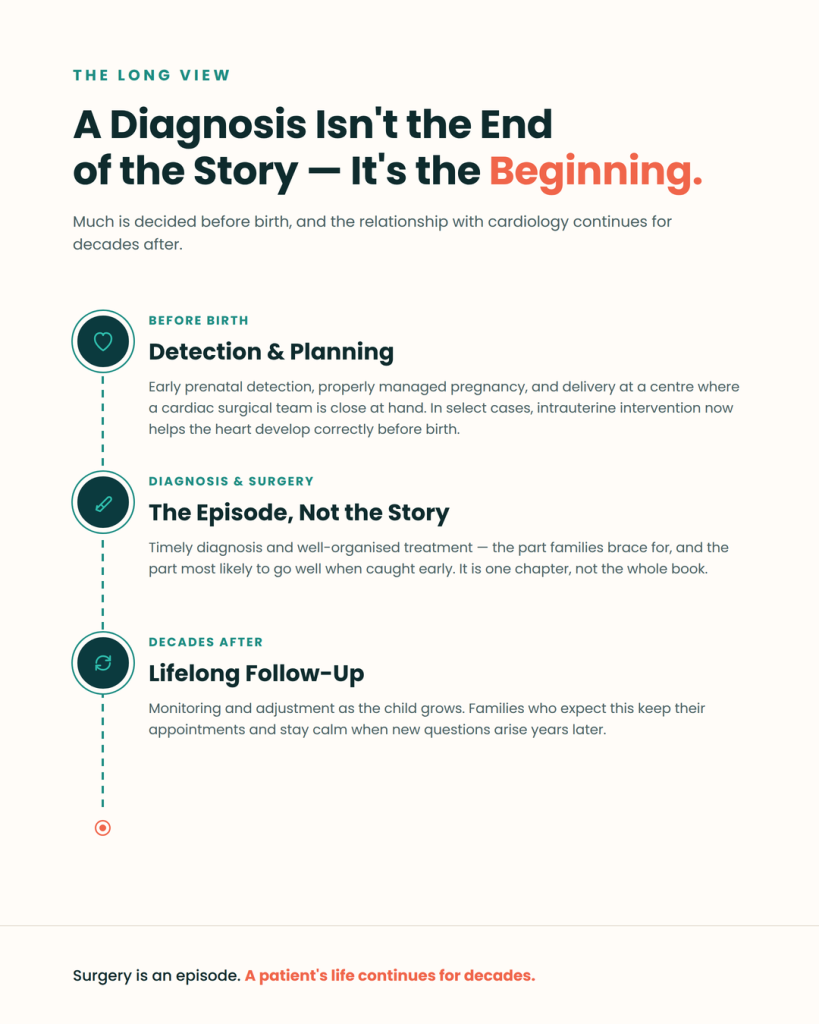
There is one misconception worth correcting more persistently than the rest: that once surgery is over, the problem is over.
For many patients a congenital heart defect is not a single event to get through and forget. It is the beginning of a long relationship with medicine: follow-up, monitoring, adjustment as the person grows. Parents told this from the outset are incomparably better prepared than those who were waiting for a finish line.
This is another place where knowledge changes behaviour. A family that knows follow-up will be long keeps its appointments, watches for the right signs, and is not alarmed when new questions come up years later. A family that was not told this usually goes to one of two extremes: living in constant anxiety, or deciding it is all behind them and missing the very examinations at which a problem could have been caught in time.
Rehabilitation and regular follow-up receive incomparably less attention than surgery — though they bear directly on the long-term result. Surgery is an episode. A patient’s life continues for decades.
A Child’s Emotional State Is Part of Heart Health Too
Caring for a child’s heart is not only about tests, scans and the result of an operation. It is also about the environment the child grows up in.
Parents can build a flawless schedule of medication and examinations — and not notice that anxiety has been sitting in the house for months. And the emotional environment affects how a child develops, how they cope with a difficult diagnosis, and how they recover from treatment. A child who feels safe and knows they are loved handles the demands of treatment more easily than one who is also carrying the weight of a frightened household.
This is why parent education does not come down to a list of symptoms. It also means helping the parents themselves — so that their fear does not become the environment their child is trying to recover in.
Technology Helps. It Does Not Replace
I am often asked whether artificial intelligence changes any of this. My honest answer: it helps, but it replaces nothing described above.
For years one of the biggest problems in paediatric cardiology was unequal access to information. A family near a major centre had one set of opportunities; a family in a remote region had quite another. That gap is gradually narrowing. Today even those far from leading clinics can find educational material, credible information and tools that help them make sense of a diagnosis.
Used well, this strengthens exactly what I am describing: it helps people ask more precise questions, understand test results, and take part in decisions about their child’s care. Used badly — as a substitute for a conversation with a physician, or as a way to diagnose oneself — it does real harm. The goal is not to replace the doctor. The goal is for a family to arrive prepared.
What I Ask of Parents
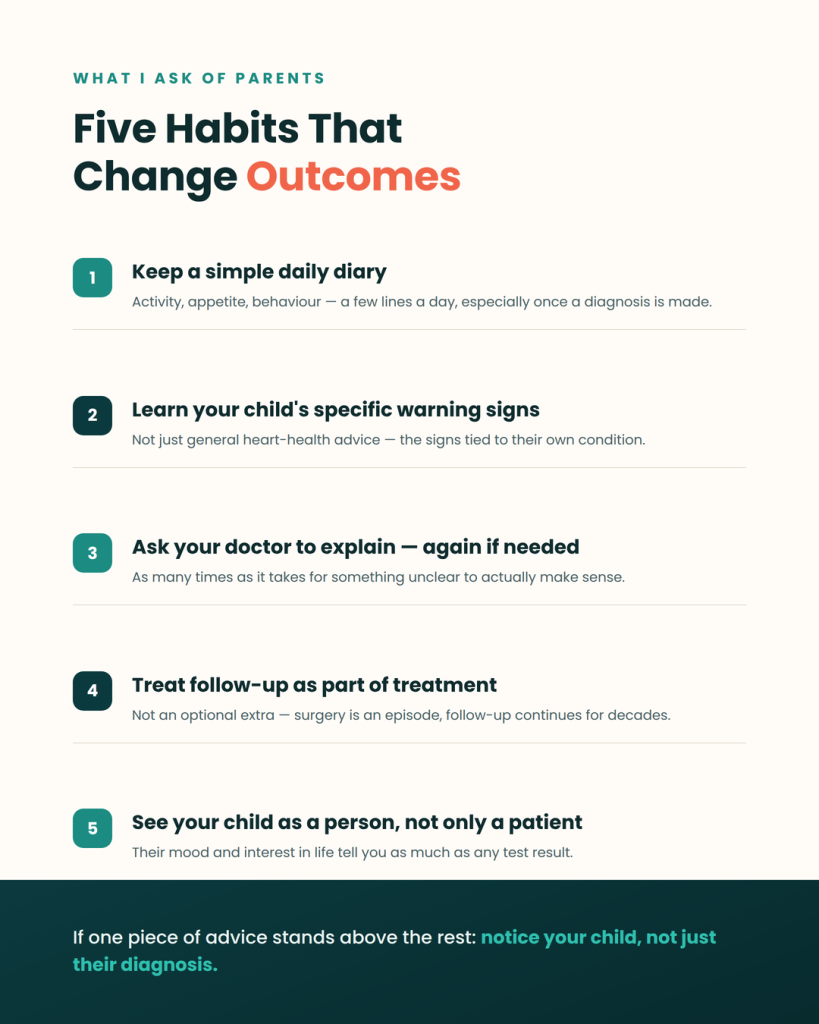
None of this requires medical training. It requires attention and a few consistent habits:
- Keep a simple daily diary: activity, appetite, behaviour — especially once a diagnosis has been made
- Learn the warning signs tied to your own child’s condition, not just general heart-health advice
- Ask your doctor to explain anything unclear — as many times as it takes
- Treat follow-up after surgery as part of the treatment, not an optional extra
- See your child as a person, not only as a patient: their mood and interest in life tell you as much as any test result
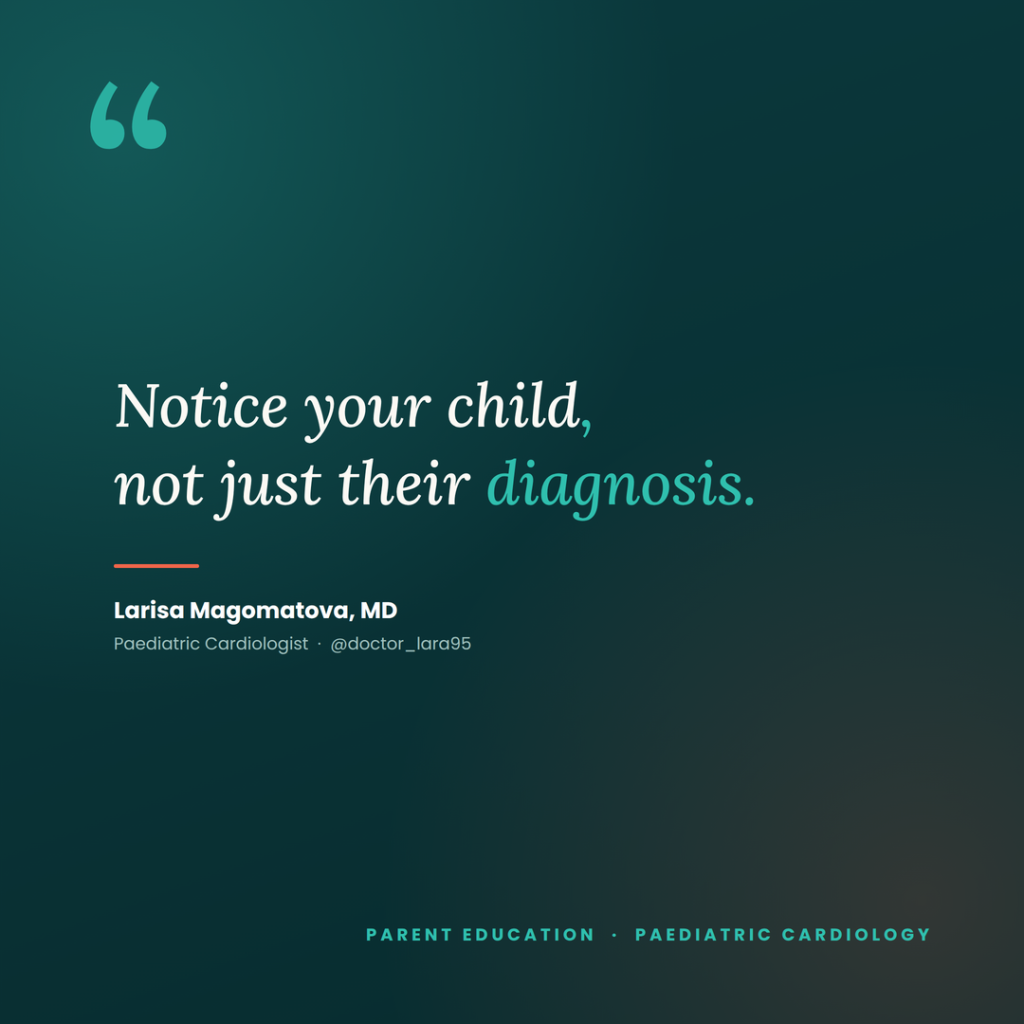
If one piece of advice had to stand above the rest, it would be this: notice your child, not just their diagnosis.
Why This Matters Beyond One Family
Education works on two levels. The first is the individual family: the parent who understands that breathlessness on the stairs is not simply tiredness, tells the doctor straight away rather than waiting for the scheduled appointment, and arrives at it prepared. The second is wider than any single family.
An informed parent does not only make sounder decisions. They ask the right questions, seek a second opinion, and find their way to help that would otherwise have been missed.
The same logic applies within the profession. Experience is not passed on by a lecture or a manual but by working together: reviewing every case, daily practice alongside those who have been through it hundreds of times. That is how clinical thinking is formed — and it is why training is built into the field missions of the team I write about as part of the work itself rather than as an addition. When the team comes to a hospital to operate on patients with complex defects, local doctors and nurses work beside them on real cases. What remains after the team leaves is more than a list of discharged patients.
I am a paediatric cardiologist with many years of clinical experience. Most of this team are colleagues I worked alongside for many years. Educating parents and passing experience to doctors are not two separate tasks for us. They are one task addressed to two audiences.
Awareness changes outcomes no less often than technology does. A patient’s fate is often decided not only by the quality of the surgery available to them, but by how quickly their family understood what they were facing and knew where to turn. That conviction stands behind every parent-education book I write, and behind the team’s work in hospitals across a number of countries.
About the Author
Larisa Magomatova, MD is a paediatric cardiologist specialising in congenital heart defects (CHD), parent education and child heart health. Alongside her clinical work, she is an author of parent-education books designed to help families better understand their child’s diagnosis, recognise important warning signs and take a more informed role in their child’s care.
Through her educational work, online guidance and CHD advocacy, Dr. Magomatova focuses on making complex paediatric cardiology information clearer and more practical for parents.
Instagram: @doctor_lara95