
When people ask me what the future of congenital heart care looks like, they usually expect a conversation about technology. New imaging. New surgical techniques. New devices. Understandably so: technology changes fastest and photographs best.
But when I think about the next generation of children born with heart defects, I see something else. Technology reaches the places with the money and the will to buy it — that is a matter of a few years. What takes longer to form is what stands behind it: teams able to work with complex anatomy, and the service built around the operation.
The Path Begins Long Before the Operating Theatre
Much is decided before a child is born.
Detection of the defect early in pregnancy. Properly organised management of that pregnancy once the diagnosis is known. Delivery in a specialised centre where the cardiac surgical team is close at hand rather than hours away. Each of these links affects the outcome no less than the operation itself — and none of them belongs to surgery directly.
This is also the place to mention something that not long ago seemed impossible: intrauterine interventions now exist that help the heart develop correctly before birth. There was a time when the diagnoses for which this is now used meant a child had almost no chance, and the conversation with the family went very differently. As physicians we stand on the side of preserving life, improving its quality and extending it. That the list of hopeless diagnoses keeps shrinking is one of the most significant shifts I have watched.
“Healthier Generations” Means More Than Good Surgery
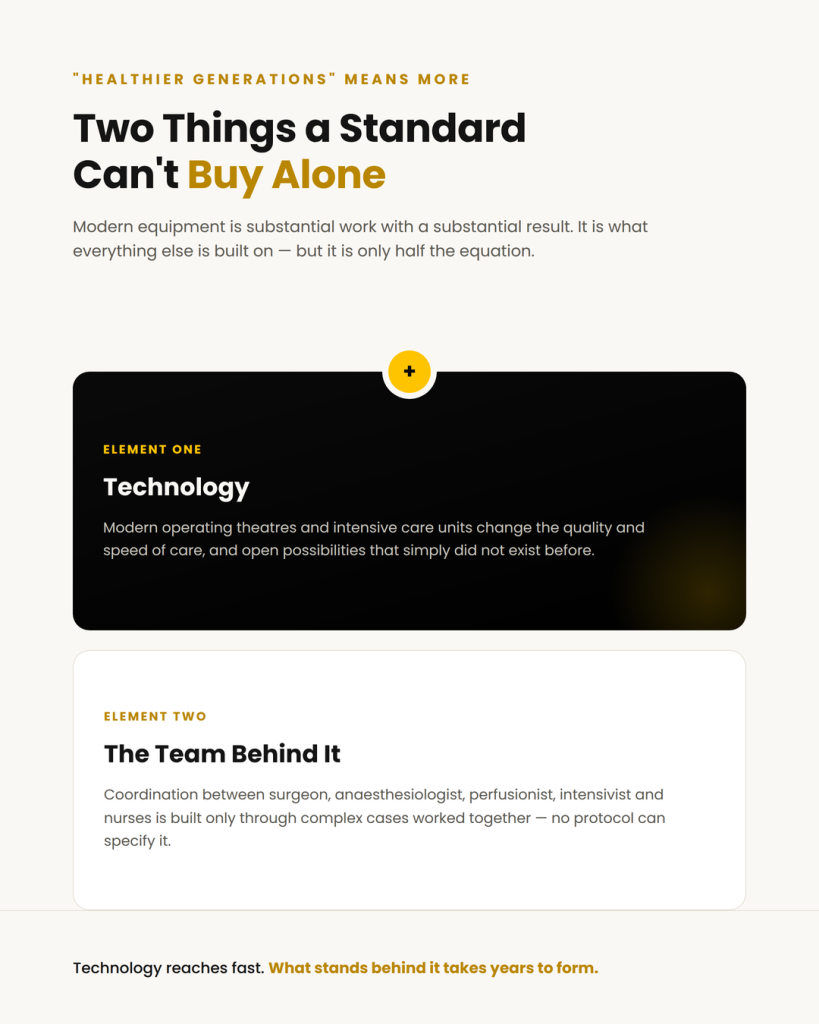
When a hospital or a ministry equips its operating theatres and intensive care units with modern technology, that is substantial work and a substantial result. The quality of care changes, its speed changes, possibilities appear that simply did not exist before. It is what everything else is built on.
The second element is the team. Experience is not accumulated by the surgeon alone: the anaesthesiologist, the perfusionist, the intensivist and the intensive care nurses go through complex cases together, and that is what produces the coordination no protocol can specify. Experience of that kind lives in people and is passed on only through working together.
Where Real Progress Will Come From
I will not try to predict every technical advance of the coming decade. But I can say where, judging by what is already shifting, the most meaningful progress is likely to appear.
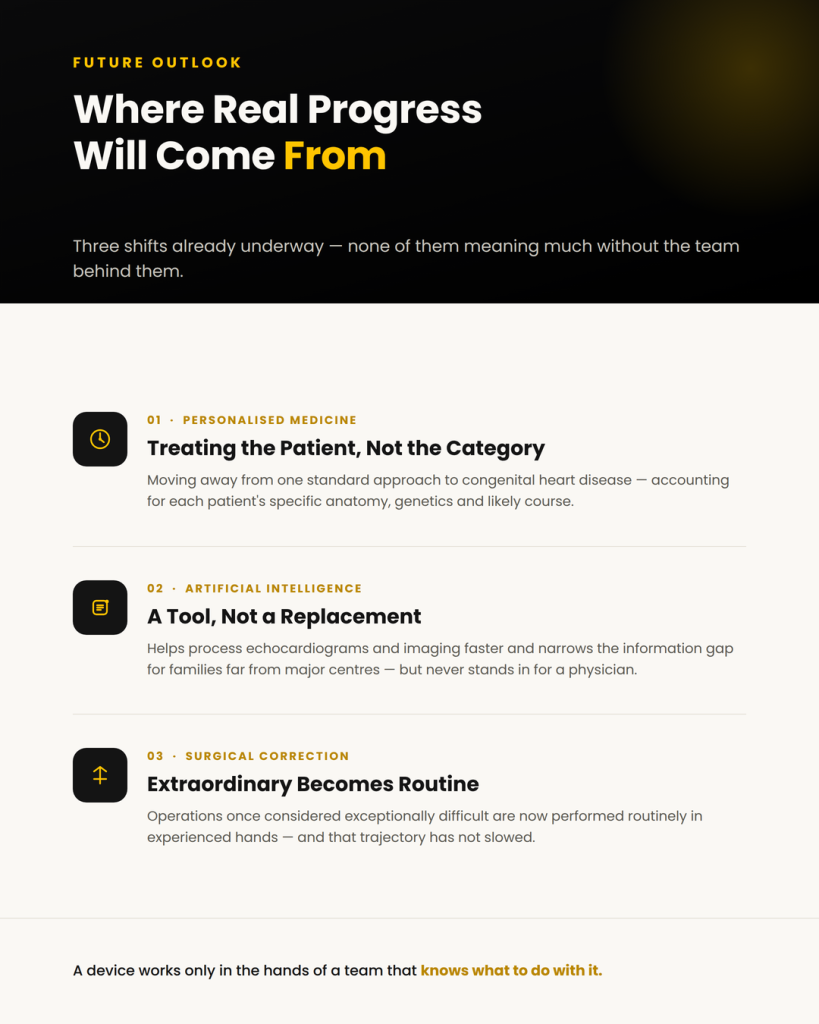
Personalised medicine. We are gradually moving away from treating congenital heart disease as one category with a standard approach, and learning to account more precisely for the particulars of each patient — the specific anatomy, the genetics, the likely course. The more precisely the course can be anticipated, the more precisely the tactics can be chosen.
Artificial intelligence as a tool, not a replacement. I do not believe AI will replace physicians, and I do not think it should. Medicine is not only the analysis of data. It is the ability to see the whole patient, to weigh many factors at once, and to make decisions under real uncertainty. That remains human. But AI already helps process echocardiograms, monitoring data, imaging and the research literature faster — which means patterns are recognised sooner. For families it narrows the information gap between those who live near a major centre and those who live far from one. On one condition: that it helps people ask more precise questions rather than standing in for a physician.
Advances in complex surgical correction. Operations once considered extraordinarily difficult are now routine in experienced hands, and that trajectory has not slowed. Every year more children with severe defects are given a real chance at a full life thanks to techniques that would have seemed impossible a few decades ago.
But none of these advances means much on its own. A device works in the hands of a team that knows what to do with it.
Parents Have Become Better Informed — and That Is a Success of Its Own
There is one change I have seen over the course of my own career that pleases me almost more than the technical advances.
When I started out, the questions parents asked most often were about the cosmetic side: what the incision would look like, how large it would be, whether a scar would remain. Understandable, human questions — but surface ones.
Today such questions are rare. Parents ask about other things. How long cardiopulmonary bypass will last. How it will affect the child’s development. What the long-term results are. Whether repeat or staged interventions will be needed, and when. What quality of life will look like in ten and twenty years.
This is the result of information becoming more accessible and of specialists learning to talk to families and explain. A well-informed parent raises the bar for the whole specialty: they ask for answers that cannot be given in general terms. That, too, is an achievement of paediatric cardiology — no less real than a new technique.
What Accumulates Only Over Time
The number of complex combined defects that have passed through the hands of one particular team. Experience in post-operative care. Repeat and staged palliative corrections spread across the years of a patient’s life. An understanding of haemodynamics developed on complex anatomy — where standard tactics call for individual adaptation.
And one thing discussed less often: experience in organising the service itself. A patient’s pathway from birth in a specialised clinic through follow-up and repeat interventions years later. The work of an intensive care unit. The logic by which flow is built. Operating and building a functioning service are different skills.
What Twelve Missions Have Shown
Since 2021 an international team led by Dr. David Berishvili has carried out twelve field missions dedicated entirely to congenital heart defects, based at Imam Zain Al-Abidin Hospital in Karbala, in close cooperation with the medical company EMC (European Medical Centre). Surgeons, anaesthesiologists, perfusionists, intensivists and intensive care nurses from Georgia, Russia, Iraq, Switzerland, Azerbaijan, Armenia, Lebanon and Syria.
I am a paediatric cardiologist with many years of clinical experience. Most of this team are colleagues I worked alongside for many years.
Over five years that amounts to roughly 700 operations under field conditions. Survival of approximately 97 percent — in children of any age and weight with complex defects, often referred late, on minimal medical therapy and in serious condition. Roughly half were under six months old at the time of surgery, more than half weighed between 2.1 and 6 kilograms. The work covers the full range of correction for complex defects: open-heart procedures on cardiopulmonary bypass, staged and palliative interventions. The figures come from the team’s own mission records; full clinical data is made available to partner institutions and health authorities on request.
Each deployment is a continuous cycle of 25 to 35 operating days, two to three operations a day. The team covers the full cycle: pre-operative assessment, surgery, and care of every patient through to discharge. The work is done at the host hospital and together with its staff — local doctors and nurses take part in the treatment process on equal terms with the visiting team.
Working with seriously ill patients and reviewing every case together is what clinical thinking is made of. Neither a lecture nor a manual replaces it, and the exchange travels in both directions.
Follow-Up and Rehabilitation Deserve More Attention Than They Get
Conversations about the future of paediatric cardiology almost always come down to diagnosis and surgery. But surgery is an episode, and a patient with a congenital heart defect goes on living for decades.
Rehabilitation after an intervention. Regular follow-up. A parent’s day-to-day attention to their child’s condition. This area receives incomparably less attention than surgery, though it bears directly on the long-term result.
An informed parent knows what to watch for, how to judge what they have noticed, and whom to approach. They do not miss scheduled follow-up, and they do not panic where panic is not called for. A patient’s outcome is shaped no less by whether a parent noticed a warning sign in time than by which technique was used in theatre. Real progress means investing in both at once.
This is why I write parent-education books on congenital heart disease. A healthier next generation is not produced by better operating theatres alone. It is produced by parents who understand what they are looking at, by specialists who have worked alongside strong teams, and by hospitals that carry accumulated expertise forward.
What This Means for the Gulf
![What This Means for the Gulf" or just before the "[Note to the editors...]" line, as a closing visual before the piece wraps up.](https://arabianbusinesstimez.com/wp-content/uploads/2026/09/05_Pull_Quote-819x1024.png "The Future of Congenital Heart Care: A View on Healthier Generations 6")
In recent years the region has achieved in this field what took others decades. Modern centres have been built, serious investment made, strong specialists brought in, programmes established that did not exist not long ago. That is substantial work with a visible result — and it deserves to be described in exactly those terms.
Our contribution may lie elsewhere. Behind this team are years of work with complex combined defects, post-operative care, and repeat and staged corrections in patients followed for decades. That kind of experience builds slowly and exists only in the people who have lived it. It can be shared.
The format is straightforward: not instead of an existing service, but alongside it. Joint operations. Joint reviews. Daily practice on complex cases. As the joint work gathers pace, the visiting team’s involvement decreases — that is the aim.
Several formats are possible: a single deployment, a series of visits with staff trained in parallel, or continuous work over several months. The terms are discussed separately each time, because one hospital’s needs rarely match another’s. Full clinical data from the missions is available to any partner who wishes to review it directly. Figures that cannot be checked are worth nothing.
A healthier generation of people with congenital heart defects is not produced by one operation, one country or one technology. It is built year by year, team by team, hospital by hospital. And the Gulf is one of the places where this is already happening.