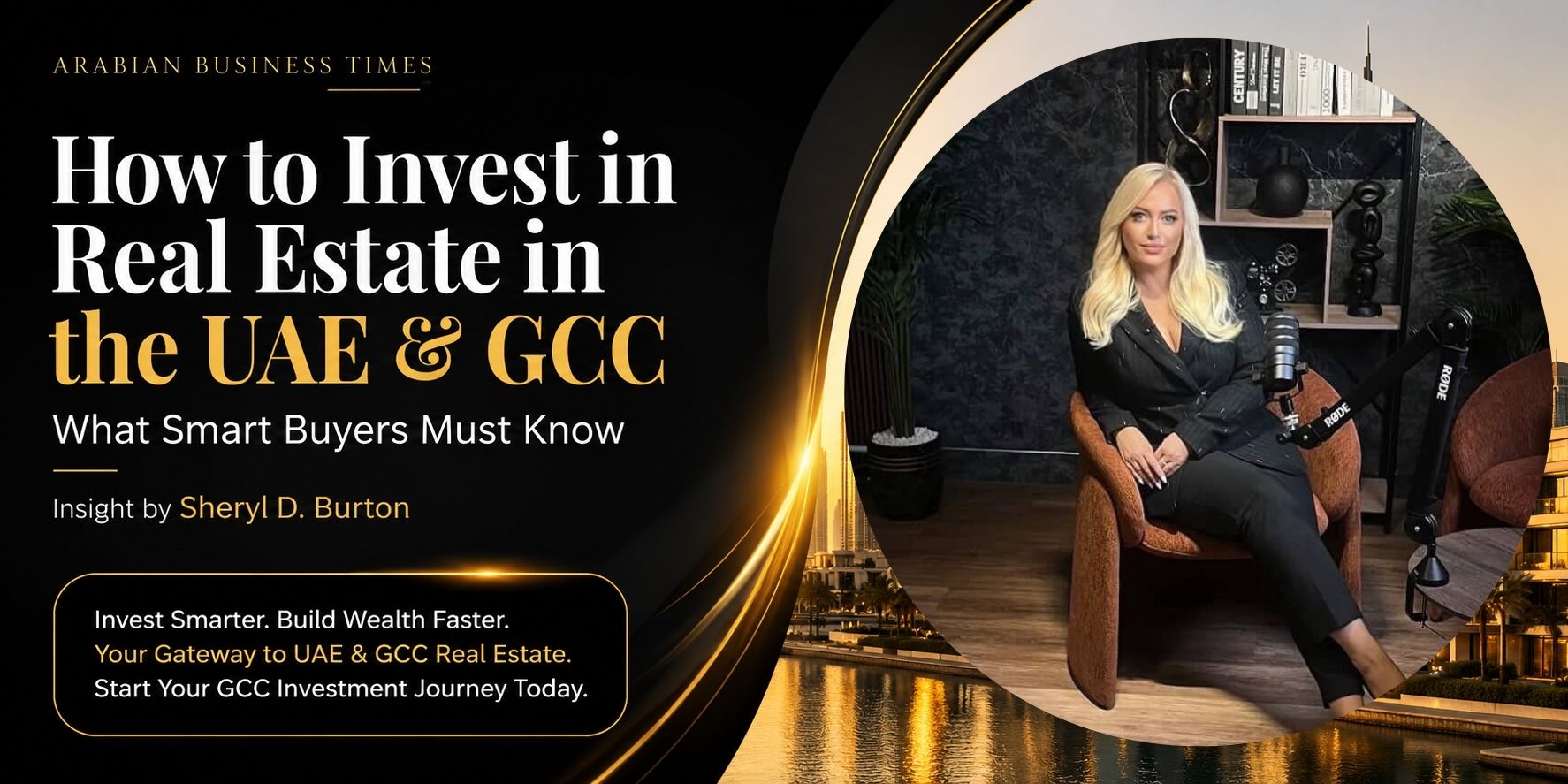
A practical, data-backed guide for international buyers navigating Dubai, Abu Dhabi, Riyadh, and beyond — from someone who operates across all of them.
Sheryl D. Burton
International Investment Manager · GCC Real Estate Specialist
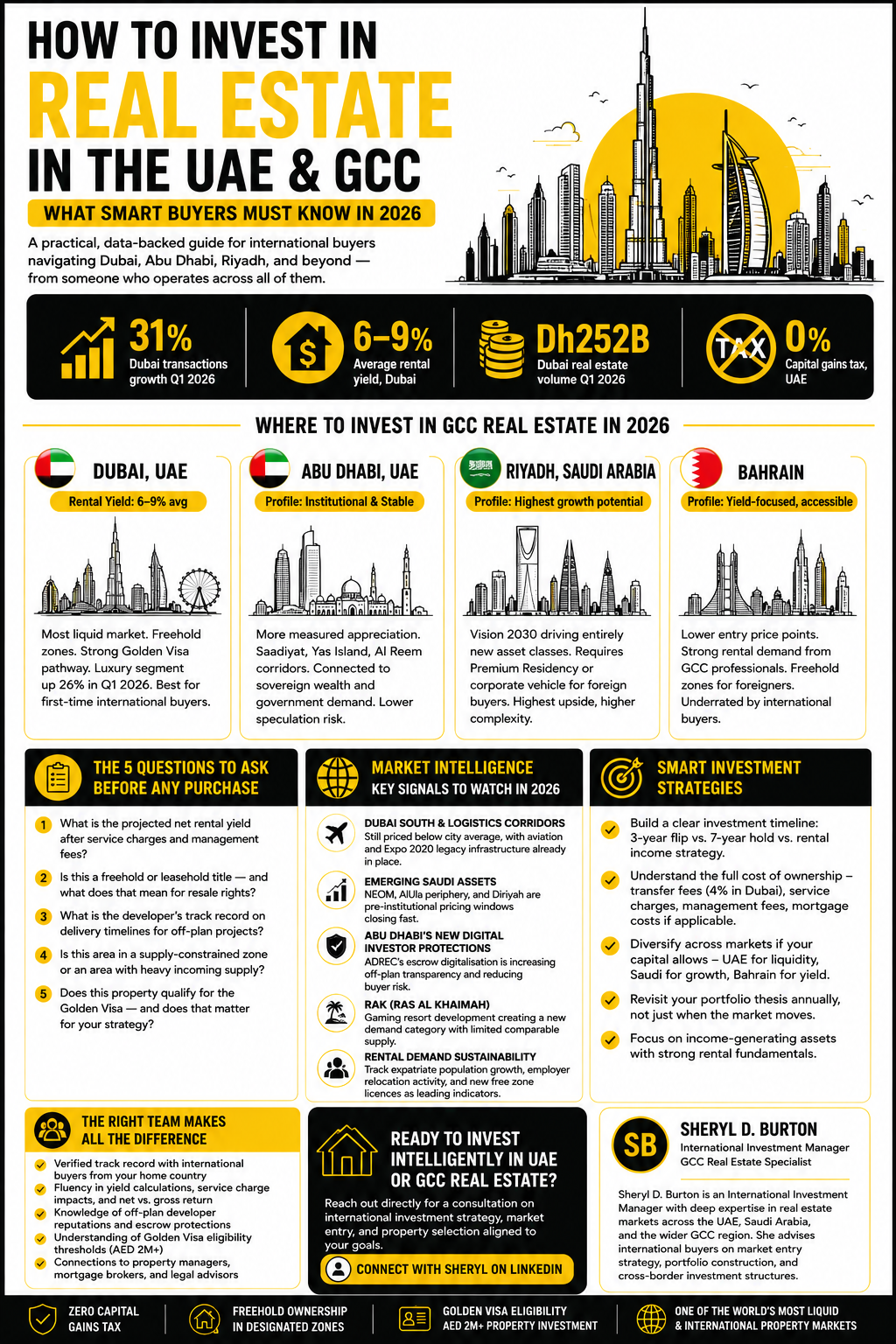
31% Dubai transactions growth Q1 2026
6–9% Average rental yield, Dubai
Dh252B Dubai real estate volume Q1 2026
0% Capital gains tax, UAE
Everyone wants to invest in GCC real estate when the market headlines are positive. The harder question — and the one that actually determines whether you build wealth or just buy a liability — is whether you know how to invest smart in a market this fast-moving, this globally competitive, and this structurally unique.
Having operated across UAE, Saudi Arabia, and wider GCC investment markets, I’ve seen buyers at every level make the same preventable mistakes. This guide exists to make sure you don’t.
Why the GCC Market Is Different
The UAE and GCC Are Not Like Any Other Real Estate Market in the World
Before applying generic real estate advice to a Dubai or Riyadh purchase, understand what makes this market structurally distinct. The UAE levies zero capital gains tax and zero property income tax for foreign investors. Freehold ownership in designated zones allows full international buyer rights. The Golden Visa programme ties 10-year residency directly to property investment thresholds – creating a buyer motivation unique to this region.
Dubai’s real estate transaction volume reached Dh252 billion in Q1 2026 alone – a 31% jump year-on-year — while foreign investments rose 11% to over 48,000 transactions. This is not a speculative micro-market. It is one of the most liquid, internationally active property markets on earth.
“The investors who win in the GCC are not the ones reacting to headlines. They are the ones who understood the structural drivers before the headlines were written.” – Sheryl D. Burton, International Investment Manager
Saudi Arabia’s Vision 2030 is simultaneously creating entirely new real estate categories — NEOM, Diriyah, Red Sea — while Bahrain and Qatar offer regulated freehold zones with strong institutional yield profiles. Each market has its own entry rules, ownership structures, and risk profile. Treating the GCC as one homogeneous block is the first expensive mistake buyers make.
Choosing Your Market
Where to Invest in GCC Real Estate in 2026: A Market-by-Market Overview
The right market depends on your investment thesis – yield-focused income, long-term capital appreciation, residency benefits, or portfolio diversification. Here is how the primary markets currently stack up:
???????? Dubai, UAE – Rental Yield: 6–9% avg – Most liquid market. Freehold zones. Strong Golden Visa pathway. Luxury segment up 26% in Q1 2026. Best for first-time international buyers.
???????? Abu Dhabi, UAEProfile: Institutional & Stable – More measured appreciation. Saadiyat, Yas Island, Al Reem corridors. Connected to sovereign wealth and government demand. Lower speculation risk.
???????? Riyadh, Saudi ArabiaProfile: Highest growth potential – Vision 2030 driving entirely new asset classes. Requires Premium Residency or corporate vehicle for foreign buyers. Highest upside, higher complexity.
???????? BahrainProfile: Yield-focused, accessible – Lower entry price points. Strong rental demand from GCC professionals. Freehold zones for foreigners. Underrated by international buyers.
The Right Team
Find an Agent Who Understands International Investment — Not Just Local Sales
In the GCC property market, not every licensed agent is built for investors – and the difference is not subtle. You need someone who understands cross-border ownership structures, DLD (Dubai Land Department) transfer processes, off-plan escrow rules, RERA regulations, and how yield projections vary across freehold zones.
The right agent will tell you when a deal does not make sense. A sales-focused agent will tell you every deal makes sense.
- Verified track record with international buyers from your home country
- Fluency in yield calculations, service charge impacts, and net vs. gross return
- Knowledge of off-plan developer reputations and escrow protections
- Understanding of Golden Visa eligibility thresholds (currently AED 2M+)
- Connections to property managers, mortgage brokers, and legal advisors
In real estate, your agent’s ceiling becomes your floor. Choose accordingly.
Investment Fundamentals
Stop Buying Emotionally. The GCC Market Rewards Discipline.
GCC property marketing is world-class. Renders of beachfront villas, promises of lifestyle, luxury showrooms in prime locations – they are designed to make you feel, not think. The best investors I work with have learned to separate the experience of viewing a property from the process of evaluating it.
The Five Questions to Ask Before Any GCC Property Purchase
1. What is the projected net rental yield after service charges and management fees?
2. Is this a freehold or leasehold title — and what does that mean for resale rights?
3. What is the developer’s track record on delivery timelines for off-plan projects?
4. Is this area in a supply-constrained zone or an area with heavy incoming supply?
5. Does this property qualify for the Golden Visa — and does that matter for your strategy?
Market Intelligence
Study the GCC Market Before You Spend a Single Dirham
The GCC’s market dynamics shift faster than most international buyers expect. Interest rate expectations, oil price cycles, government infrastructure announcements, and changes to foreign ownership laws can all reshape a micro-market within a single quarter.
Smart buyers in 2026 are watching these specific signals:
- Dubai South and logistics corridors – still priced below city average, with aviation and Expo 2020 legacy infrastructure already in place
- Emerging Saudi assets – NEOM, AlUla periphery, and Diriyah are pre-institutional pricing windows closing fast
- Abu Dhabi’s new digital investor protections – ADREC’s escrow digitalisation is increasing off-plan transparency and reducing buyer risk
- RAK (Ras Al Khaimah) – gaming resort development creating a new demand category with limited comparable supply
- Rental demand sustainability – track expatriate population growth, employer relocation activity, and new free zone licences as leading indicators
Long-Term Strategy
Consistency and Timing Beat Hype in Every Cycle
The GCC real estate market has produced extraordinary returns for patient, structured investors – and painful losses for those who bought at peak media enthusiasm without an exit strategy. The cycle is real. Understanding where you are in it is as important as understanding what you’re buying.
Current analyst consensus points to the UAE market approaching a gradual moderation in price growth through 2026 – not a correction, but a transition from appreciation-led to yield-led returns. That is not a signal to stay out. It is a signal to shift your criteria toward income-generating assets with strong rental fundamentals, rather than purely speculative capital gain plays.
- Build a clear investment timeline: 3-year flip vs. 7-year hold vs. rental income strategy
- Understand the full cost of ownership – transfer fees (4% in Dubai), service charges, management fees, mortgage costs if applicable
- Diversify across markets if your capital allows – UAE for liquidity, Saudi for growth, Bahrain for yield
- Revisit your portfolio thesis annually, not just when the market moves
Network & Relationships
Your Network in This Market Is Worth More Than Your Research
The GCC’s most attractive real estate opportunities – off-market deals, early-access off-plan launches, developer incentive packages, distressed sales – move through relationships before they reach any public listing platform. This is not unique to real estate, but it is especially true here, where trust-based commercial culture shapes how opportunities are shared.
Build genuine relationships with investors already active in your target markets. Attend DLD, RICS, and Cityscape events. Connect with free zone authorities, PRO services, and property managers who see transaction flow daily. The intelligence you get from a well-placed conversation often outweighs anything published on a property portal.
Ready to Invest Intelligently in UAE or GCC Real Estate?
Reach out directly for a consultation on international investment strategy, market entry, and property selection aligned to your goals.
Connect with Sheryl on LinkedIn
Related Insights from Arabian Business Times
- How Biotech Startups Raise Money in 2026
Learn how biotech founders secure funding through venture capital, grants, strategic partnerships, and IPO pathways. - Affiliate Attribution Is Changing in 2026: What Businesses Need to Know
Discover how modern attribution models and performance marketing are reshaping digital growth strategies. - Why TikTok Shop Is Transforming Fragrance Brands and Social Commerce in 2026
Explore how social commerce and creator-led marketing are changing the future of consumer brands.