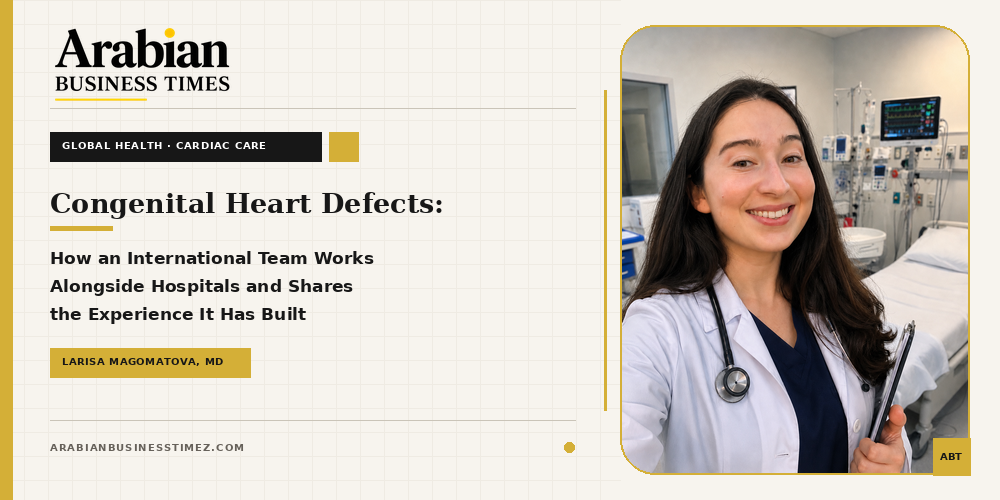
Larisa Magomatova, MD
Every year, more than a million children worldwide are born with congenital heart defects. Surgery for complex defects rests on two things at once, and the two are built in different ways.
The first is facilities and technology. A modern operating theatre, modern optics, modern techniques of correction, and movement alongside a specialty that changes quickly. This is built through investment and will — and where those decisions have been made, the results show quickly.
The second is built differently, through years of practice. It is volume: the number of complex combined defects that have passed through the hands of one particular team. Experience in post-operative care. Repeat and staged palliative corrections spread across the years of a patient’s life. An understanding of haemodynamics developed on complex anatomy — where standard tactics call for individual adaptation.
That kind of volume accumulates only over time, and it is accumulated by the team as a whole — surgeon, anaesthesiologist, perfusionist, intensivist, intensive care nurses. Which is precisely why such experience is natural to pass on: it does not live in written descriptions, it lives in the people who have been through it.
Who Does This
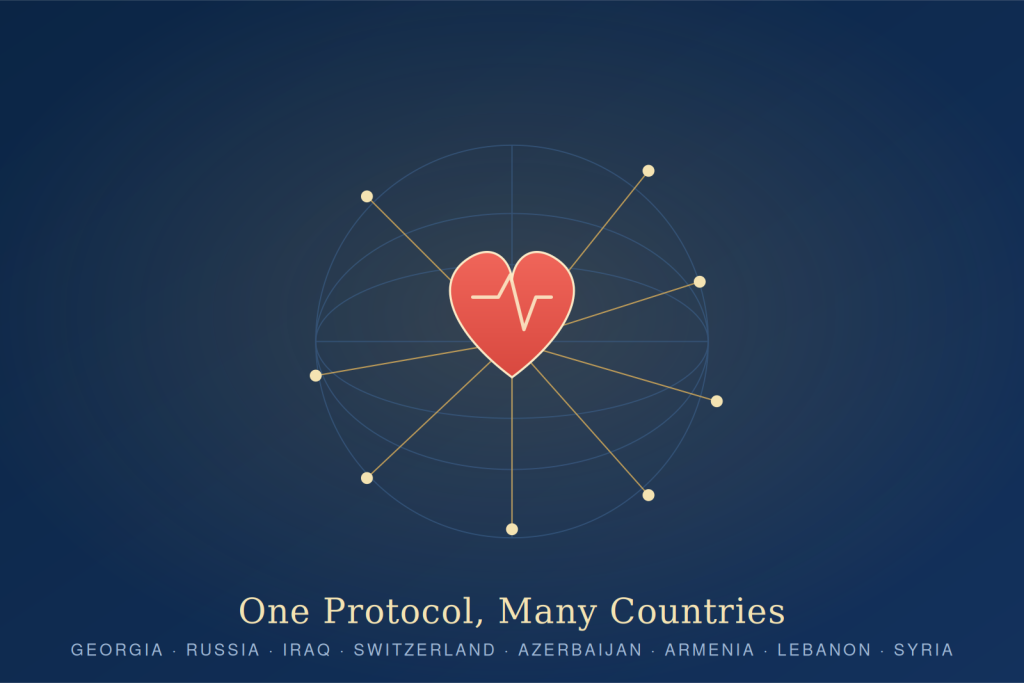
The team is led by Dr. David Berishvili, a cardiac surgeon based in Georgia. Its composition is international: surgeons, anaesthesiologists, perfusionists, intensivists and intensive care nurses from Georgia, Russia, Iraq, Switzerland, Azerbaijan, Armenia, Lebanon and Syria. One shared protocol, wherever the work takes place.
I am a paediatric cardiologist with many years of clinical experience. Most of this team are colleagues I worked alongside for many years.
And one thing is worth understanding about that experience: it is not limited to field work. Behind the team are years in a large specialised hospital — not only the operations, but the entire service around them. The organisation of congenital cardiac care as a whole: a child’s pathway from birth in a specialised clinic through follow-up, repeat interventions and decisions taken years later. Running a department. The work of an intensive care unit. The logic by which patient flow is built. Operating and building a functioning service are different skills, and the team has both.
How the Field Work Is Organised
Each deployment is a continuous surgical cycle of 25 to 35 operating days. The surgical team works without days off, two to three operations a day. Where patient flow allows, one cycle treats around seventy children.
The team covers the full cycle: pre-operative assessment, surgery, and post-operative care of every patient through to discharge. In paediatric cardiac surgery the outcome is often decided in the days and weeks after an operation — which is why that part is not handed over to whoever happens to be on shift.
The work is done at the host hospital and together with its people. Local doctors and nurses — from the paediatric ward to the intensive care unit — take part in the treatment process on equal terms with the visiting team.
The format is open to discussion. A single deployment. A series of visits with local staff trained in parallel. A visiting team working continuously for several months. There is no fixed package offered to everyone in the same form — one hospital’s needs rarely match another’s.
What Stands Behind This in Numbers
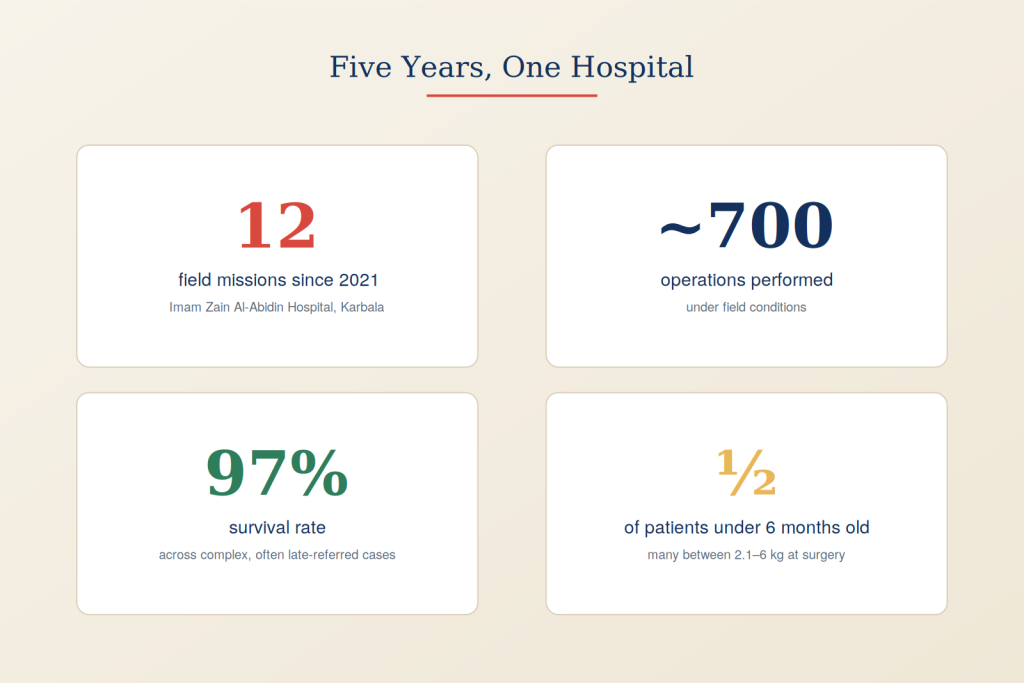
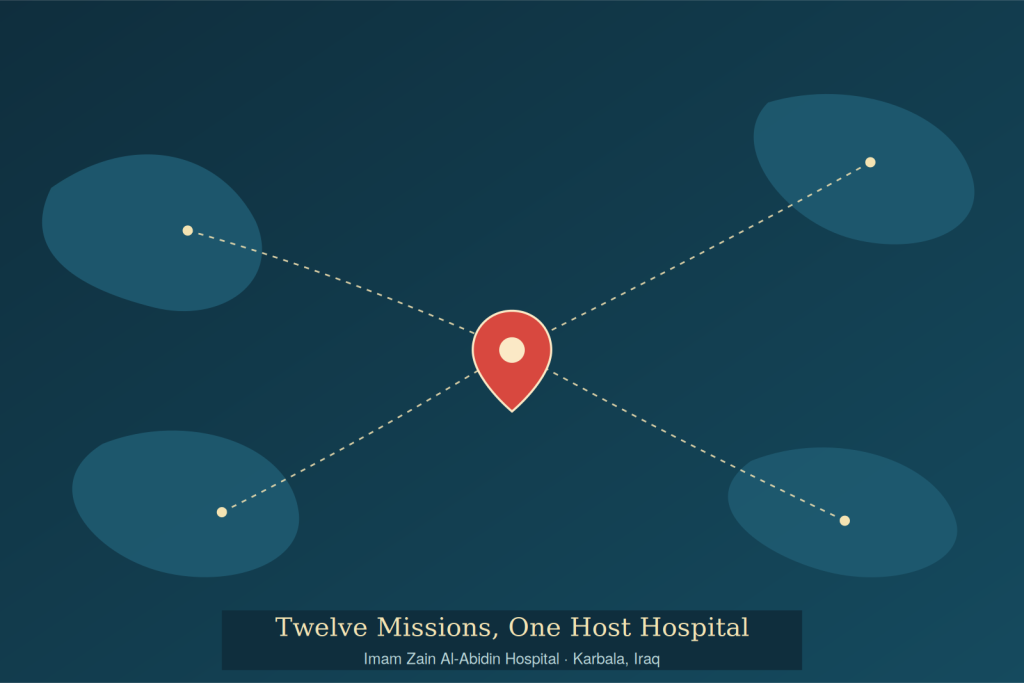
Since 2021 the team has carried out twelve field missions dedicated entirely to congenital heart defects, based at Imam Zain Al-Abidin Hospital in Karbala, in close cooperation with the medical company EMC (European Medical Centre). Each time it was the same hospital — and that repetition produced what a series of one-off trips does not: knowledge of its systems, working relationships with its staff, and trust.
- Roughly 700 operations over five years — all under field conditions rather than in a home institution with its usual resources at hand.
- A survival rate of approximately 97 percent — in children of any age and weight with complex defects, often referred late, on minimal medical therapy and in serious condition.
- Roughly half of the patients were under six months old at the time of surgery.
- More than half weighed between 2.1 and 6 kilograms — every stage of anaesthesia, bypass and post-operative care has to be scaled to their weight and condition.
- The full range of correction for complex congenital defects: open-heart procedures on cardiopulmonary bypass, staged and palliative interventions.
These figures come from the team’s own mission records. Full clinical data is made available to any partner institution or health authority on request. Figures that cannot be checked are worth nothing.
Passing On Experience
Training here is not a separate activity scheduled around the operations. It happens inside them: joint operations, joint case reviews, practice folded into the working day.
Working with seriously ill patients, reviewing every case, daily practice alongside those who have been through it hundreds of times — this is how clinical thinking is formed, and neither a lecture nor a manual conveys it. And it travels in both directions: the visiting team learns the system it is working in, while the host team gains experience its colleagues built on different material.
The logic is built around several consecutive visits. The local team builds experience, the visiting roster shrinks, and at some point the department runs continuously, calling in only a few key specialists. By the end of the joint work, the hospital is left not only with a treated cohort of patients but with its own accumulated experience in complex cases.
Where the Common Ground May Lie
In recent years the region has achieved in this field what took others decades: modern centres, serious investment, strong specialists, functioning programmes. That is substantial work with a visible result.
Our contribution may lie elsewhere. Behind this team are years of work with complex combined defects, post-operative care, and repeat and staged corrections in patients followed for decades. That kind of experience builds slowly and exists only in the people who have lived it. It can be shared.
This is not about replacing an existing service, but about working alongside it: joint operations, joint reviews, daily practice on complex cases. As the joint work gathers pace, the visiting team’s involvement decreases — that is the aim. The team is open to working with hospitals, foundations, ministries of health, private healthcare groups and individual donors; the terms of each engagement are discussed separately.
Charitable support runs inside the clinical work rather than beside it. The team accompanies families along the whole path; from diagnosis to surgery to recovery; including cases where a family cannot cover treatment on its own: those situations are addressed by finding funding. A family’s finances should not decide whether a child is treated.
Twelve missions in Iraq were not an end point. They showed the model travels: the team fits into another system and works inside it, not alongside it. In the Gulf, everything needed for that work is already in place — which makes a conversation about cooperation a practical one.
Connect with her:
https://www.instagram.com/doctor_lara95/