There is a particular kind of hospital corridor that exists only during a field mission: familiar equipment in an unfamiliar building, a rotating cast of nurses who arrived days ago and will leave in weeks, and a waiting room full of parents who have already been told, somewhere else, that nothing more could be done for their child. For the past five years, that corridor has belonged, for weeks at a time, to an international team of paediatric cardiac surgeons, anaesthesiologists, perfusionists, intensivists and intensive care nurses who fly into countries where congenital heart surgery is still developing, set up inside a local hospital, and operate on children who would otherwise have had to leave home to be treated.
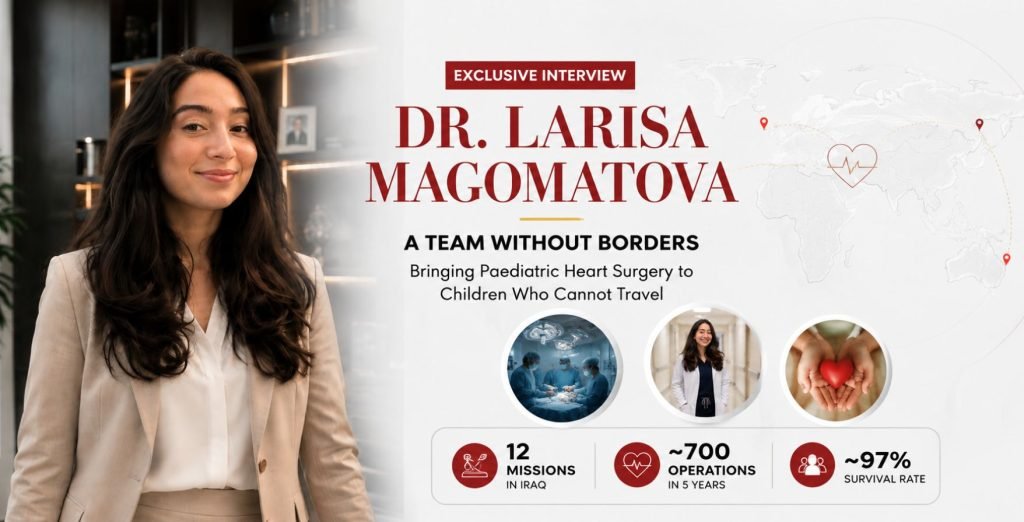
Dr. Larisa Magomatova, MD — who spent many years at one of the largest cardiology centres in Europe and is the author of parent-education books on congenital heart disease — describes how these missions work. “Behind every discovery stands a particular child and their family,” she says. “The true measure of progress is not the number of new devices or programmes, but the fact that more and more children are given the chance to grow up, go to school, pursue what they love, start a family, and live a long, full life.” And it is the team, more than any single member of it, that she wants this story to be about.
She is similarly measured about where artificial intelligence fits into medicine. “Medicine is not only the analysis of data,” she says. “It is the ability to see the whole patient, to understand context, to weigh many factors at once, and to make decisions under uncertainty.” AI, in her view, can help parents and doctors process information faster, but it does not replace clinical judgment or a real conversation with a family.
A Team That Carries a Child From Diagnosis to Discharge
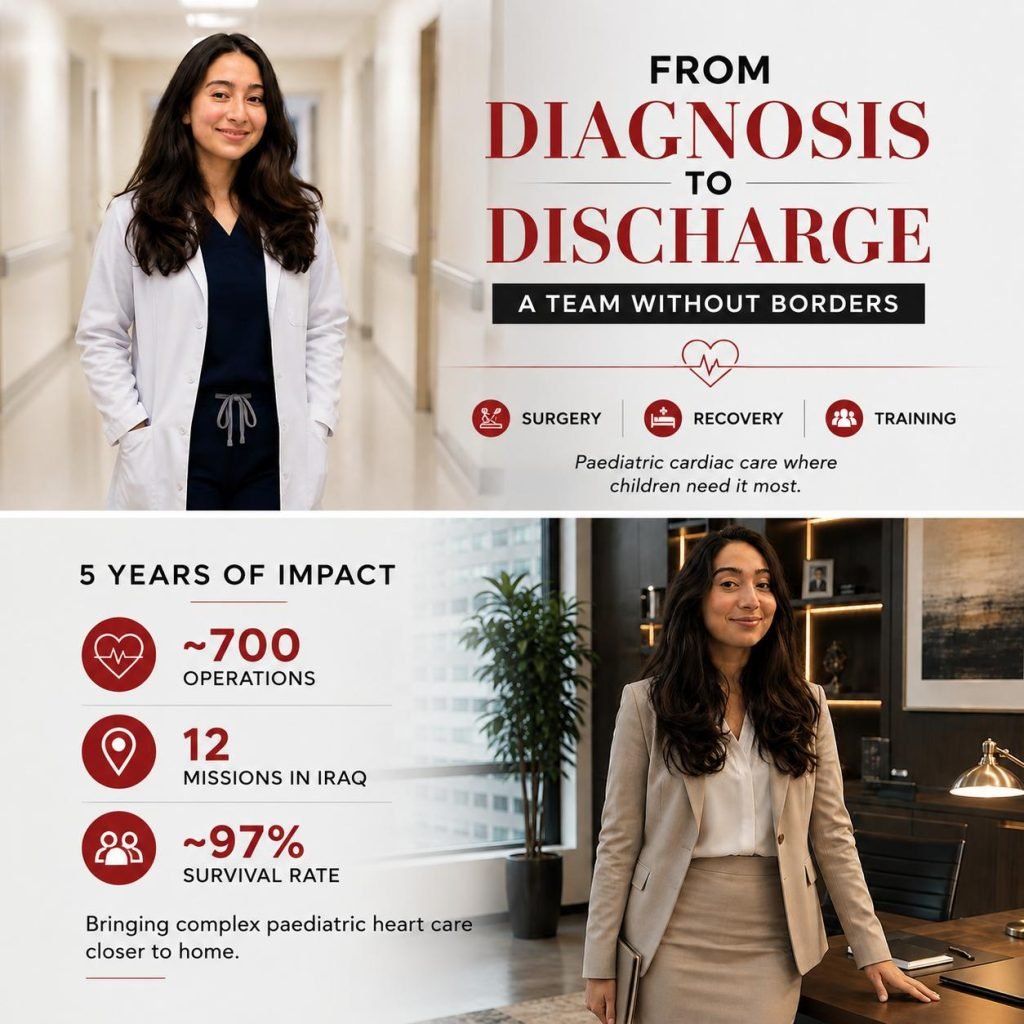
The team is led by Dr. David Berishvili, a cardiac surgeon based in Georgia, and its composition is itself a kind of statement: doctors and nurses drawn from Georgia, Russia, Iraq, Switzerland, Azerbaijan, Armenia, Lebanon and Syria, working under one protocol regardless of where the mission takes them. When they deploy, they do not reinforce an existing service with a handful of specialists — the team covers the full cycle of treatment. Cardiac surgeons, an anaesthesiologist, a perfusionist, a paediatric cardiologist, intensivists and intensive care nurses travel together and set up their own working rhythm inside the host hospital, from the first pre-operative assessment through the last day of a child’s post-operative recovery. The work is done at the host hospital and alongside its staff. Local specialists — from the paediatric ward to the intensive care unit — take part in the treatment process on equal terms with the visiting team: managing patients together, reviewing cases together, and receiving guidance as the work goes on where it is needed.
A single deployment is not a short visit. Each mission runs as one continuous surgical cycle of 25 to 35 operating days, during which the team carries every patient through to discharge rather than handing off post-operative care to whoever happens to be available locally. The surgical team works without days off, performing two to three operations a day; where patient flow allows, that rhythm treats roughly seventy children in a single deployment. In paediatric cardiac surgery, continuity matters in a way it might not elsewhere: a child who has had open-heart surgery needs days, sometimes weeks, of careful monitoring before anyone can call the operation a success, and a team that stays for the whole arc of that recovery is making a different kind of commitment than one that operates and moves on.
Since 2021, that commitment has taken the team to Iraq twelve times, on missions dedicated entirely to congenital heart defects, based out of Imam Zain Al-Abidin Hospital in Karbala, in close cooperation with the medical company EMC (European Medical Centre). It is a relationship with a single clinic, built mission by mission, which has allowed everyone involved to establish a rigorous clinical process within one specific system rather than starting over each time. That kind of repeat presence is much of what makes the model function: trust between the visiting team, the host institution’s staff and the patients is not built in a single visit.
The mixed roster is not incidental either. A unit drawn from several countries has, by necessity, learned to work across differences in training background, language and hospital culture before it ever appears in a new country — which is part of why it can slot into an unfamiliar system in Karbala, or potentially in other hospitals across the Gulf, without spending the mission’s limited time simply learning how to work together. That groundwork is largely invisible to a family waiting for news about their child, but it is, in practical terms, what makes it possible for a mission to move directly into treating patients rather than easing into it.
Five Years, Measured in Numbers the Team Is Careful Not to Round Up
Ask what the Iraq missions have added up to and the team points to figures it is precise about, deliberately so. Over five years of field-mission work, roughly 700 operations have been performed — every one of them under mission conditions rather than in a home institution with its usual resources on hand. Survival among those patients has run at approximately 97 percent, a number that carries more weight given who the patients tend to be: children of any age and weight with complex defects, often referred late, on minimal medical therapy and in serious condition.
Roughly half of the children treated were under six months old at the time of surgery. More than half weighed between 2.1 and 6 kilograms — infants small enough that every step of anaesthesia, bypass and post-operative care has to be scaled to their weight and condition. The surgical work spans the full range of repair for complex congenital defects, including open-heart procedures performed on cardiopulmonary bypass and staged and palliative procedures. The team describes this data as self-reported from its own mission records. Full clinical data is available to partner institutions and health authorities who request it.
What the Team Is Now Offering the Gulf
That next step is the reason this story exists. The team is ready to bring the same model — travel in, operate on-site, stay through recovery, then leave the skills behind — to the Gulf region. The offer rests on accumulated experience: a unit that has performed hundreds of complex procedures under mission conditions can operate at any level of complexity inside the host hospital itself, given adequate equipment, facilities, consumables and the necessary supporting services. The operation happens where the child lives, and the family remains nearby throughout.
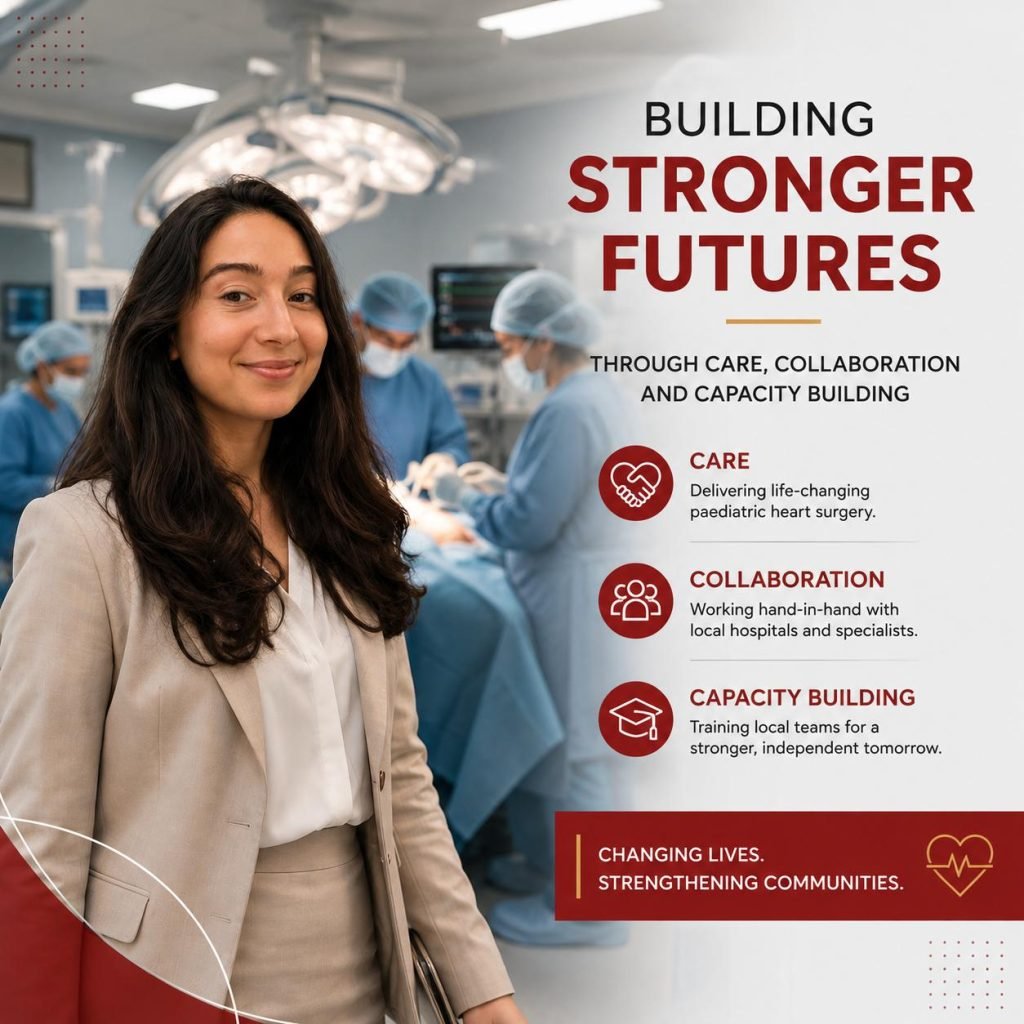
Training local specialists is central to the model rather than an activity alongside it. Local doctors and nurses work with the visiting team on actual cases — joint operations, case reviews conducted together, hands-on practice folded into the working day. The logic is built around a sequence of deployments: as local staff gain experience, the visiting roster shrinks, and at some point a paediatric cardiac surgery unit can run continuously, calling in only a few key specialists. The scope and format of training are discussed with each hospital individually.
Charitable support runs alongside the clinical work. The team helps families move through the entire path from diagnosis to surgery to recovery, including cases where a family cannot cover treatment on their own: those situations are addressed by finding funding and accompanying the family through the process, rather than being left to the family to solve. The aim is that a family’s finances should not decide whether a child is treated.
The team is open to working with hospitals, foundations, ministries of health, private healthcare groups and individual donors. Several formats are possible: individual deployments, a series of missions with local staff trained in parallel, or a visiting team working continuously for several months. Terms are discussed individually once a hospital or organisation reaches out — this is not a fixed package offered the same way to every partner, but a model the team is willing to adapt to what a given health system actually needs.
An Informed Family Is Part of the Treatment
Ask Magomatova what she wants parents and hospitals to understand about congenital heart disease more broadly, and she does not start with technology. “A well-informed family makes decisions faster and takes a more active part in treatment,” she says — a line she returns to in different forms throughout any conversation about her work. She talks about parents who spend months, sometimes years, not understanding why a child tires quickly or struggles with physical activity, simply because no one explained to them how to look for a problem or what the risks are. Dr. Magomatova recommends keeping a diary: a few lines a day about how a child tolerates activity, their appetite, small shifts in behaviour. Simple daily observations by parents, who spend far more time with a child than any doctor does, help to assess a child’s condition accurately and avoid delays in treatment.
She is equally direct about what a specific diagnosis means and what parents need to take into account. “As things stand today, a diagnosis of congenital heart disease is not a sentence,” she says. “Do not fear the diagnosis — seek to understand it.” It is advice aimed as much at health systems as at individual parents: a region that wants better outcomes for children with CHD needs not only surgical care but clear information reaching families early enough to give the best possible outcome.
That same instinct — that expertise is only useful once it reaches the people who need it — is what sits behind the team’s interest in the Gulf. Twelve missions and roughly 700 operations in Iraq were not, in the team’s own framing, an end point but a proof that the model works: a team can move into a hospital that needs it, treat children who have nowhere else to go, train the staff who will carry the work forward after the team leaves, and keep doing it. The team invites clinics, foundations and health authorities across the Gulf to consider how this same model could be brought closer to your own home.
Hospitals, foundations and organisations interested in exploring a mission or partnership are invited to reach out through Arabian Business Times.