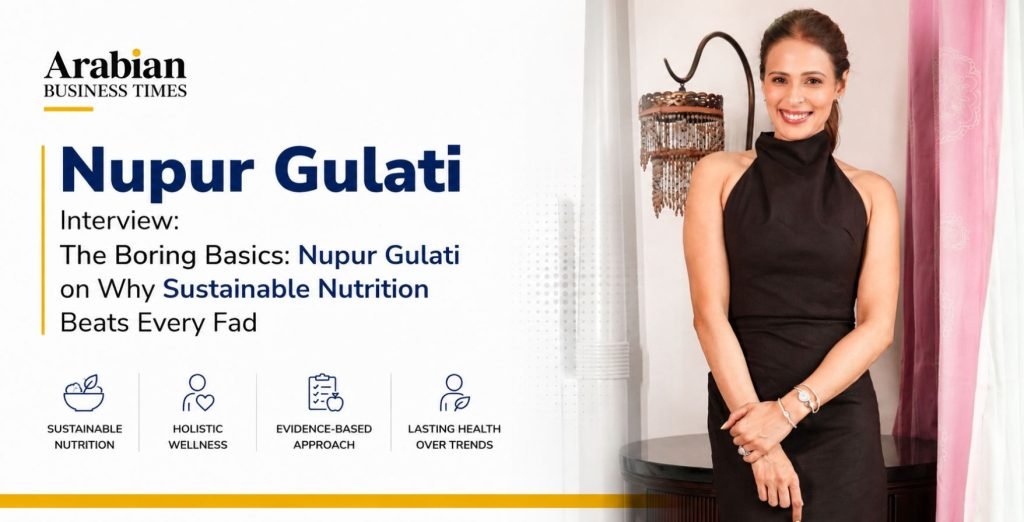
The Boring Basics: Nupur Gulati on Why Sustainable Nutrition Beats Every Fad
Nupur Gulati has built her practice on a principle she repeats almost like a mantra: sleep, eat, hydrate, workout, repeat. It sounds too simple for an industry that runs on trends, but the NASM-certified nutrition coach and Harvard Health-trained practitioner, who works with clients through her online practice and her Delhi clinic, has spent two decades proving that consistency, not cleverness, is what actually changes lives. In this conversation, she talks about the gap in nutrition education that shaped her career, the misconceptions she corrects every single day, and why she believes no algorithm will ever replace the human relationship at the centre of real transformation.

Your journey into nutrition and wellness has empowered many individuals to adopt healthier lifestyles. What inspired you to pursue this profession, and what motivated you to make nutrition your life’s mission?
Twenty years ago, Gulati says, the wellness space was dominated by fad diets. “There were keto, there was intermittent fasting, there was nothing that really talked about balanced nutrition, something that could heal my mind, handle my hormones, get me back to where I was before I became a mother, and yet be sustainable enough to become a lifestyle.” That gap is where her own journey began. She read widely, experimented with different training styles, and discovered resistance training at a time when it barely featured in mainstream conversations about women’s fitness. “I think I was the most curious person trying to understand my own body, and that’s how the journey began.”
That curiosity eventually became a qualification. She is a NASM-certified nutrition coach who has continued building on that foundation through Harvard Health Publishing, training in gut health and inflammation, and a degree in functional nutrition that she is currently pursuing. But what keeps her motivated, she says, is watching a client’s blood work change, watching someone regain confidence that has nothing to do with the number on a scale, and helping people whose relationship with food has become fearful and restrictive find their way back to something calmer. She has taken that mission into schools too, teaching nutritional science to children. “I want to empower kids, I want to empower adults,” she says. “It’s a very gratifying profession because you meet people at different stages of life, dealing with real situations every day.”
As a Certified Nutrition Coach and Registered Nutritionist, what are the most common misconceptions people have about healthy eating, and how can they make more informed nutritional choices?
The biggest misconception, Gulati says, is that healthy eating has to be restrictive. “People believe that eliminating an entire food group, whether it’s carbs or nuts, or chasing a certain diet type, is going to be a quick fix.” What actually works, she insists, is unglamorous: sleep, hydration, balanced meals, workouts, and doing them consistently. “Nutrition is all about repeating the same old habits every day.”
In India specifically, she encounters a particular set of anxieties on repeat, whether eggs are healthy, whether rice or rotis should be cut out entirely, whether keto or intermittent fasting will deliver the body someone is chasing. “Moving their minds and structuring their thoughts is, I think, the most intriguing part of the job,” she says. “It’s not about making a diet chart. It’s about convincing people to follow basic, consistent structures, because that is what gives you results.”

Lifestyle-related diseases are becoming increasingly common across all age groups. In your opinion, how important is preventive nutrition in reducing the burden of chronic illnesses?
This is a subject Gulati speaks about with visible urgency. PCOS, insulin resistance, thyroid conditions, type 2 diabetes, obesity, and a range of gut disorders are all, in her view, largely lifestyle driven, and much of it is preventable through education that most people simply never received. “We never learned in school what to eat, what a balanced meal is, how to use food for healing,” she says. “We knew about calories and energy, but never about the healing qualities of what we eat.”
She has seen clients improve lipid profiles, blood pressure, gut health, and muscle mass through preventive, personalised nutrition, changes she describes as directly tied to longevity and quality of life decades down the line. “Whether or not someone can play with their grandchildren, whether they can prevent sarcopenia or osteoporosis, so much of that is decided by how they treat their nutrition today.” She is encouraged by what she calls a genuine rise in curiosity on social media, and believes preventive nutrition, not medication after the fact, will define the future of healthcare. “People are going to move from going to a doctor and taking medication towards preparing their body for a better future.”
Every individual has unique nutritional needs. How do you approach creating personalized nutrition plans that are both practical and sustainable for long-term health?
Gulati is emphatic that a one-size-fits-all diet cannot work, because metabolism, lifestyle, preferences, health history, and goals differ from person to person. Her process begins with data: clients share their blood work and undergo a body composition assessment before anything else happens. From there, she and her team map out sleep patterns, stress levels, emotional wellbeing, work pressure, and health history through detailed conversations.
“So many times people don’t even have the right goals,” she says. “We have to counsel them on what to prioritise first, sometimes correcting the blood work before we even look at fat loss.” Only once the internal picture is clearer does she build toward specific outcomes, always designed around what a client can realistically sustain without ongoing supervision. Whether the client is a woman recovering from pregnancy or someone in her sixties navigating concerns about protein or workouts, the approach stays holistic. “It is very much personalised, very much in sync with their lifestyle, their goals, and their emotions.”
Social media has become a major source of health and diet information, but it has also contributed to widespread misinformation. How can individuals distinguish evidence-based nutritional advice from popular myths?
Social media has made health information more accessible, Gulati agrees, but it has also become a mixed bag of unrealistic promises and quick fixes, some of it, she notes, coming even from doctors online. Her advice is to check the source: is the person actually qualified to be giving this information? And to watch for a specific red flag, promises of a particular result within a particular number of days. “That is one clear cross. Real nutrition does not give you promises, it shows you a path.”
She describes her own approach as walking alongside clients through their challenges, understanding the psychology behind their relationship with food rather than selling a transformation. “Weight loss is just a periphery of a good life,” she says. Her closing test for anyone evaluating advice online is simple: real progress is slow, boring, and rooted in consistency, and anything that sounds too good to be true usually is.

Mental well-being and physical health are deeply interconnected. How does nutrition influence emotional wellness, stress management, and overall quality of life?
Gulati calls the gut the body’s second brain, a relationship she describes through the gut-brain axis, a two-way communication system involving the nervous system, hormones, and gut microbiome. Ninety percent of the body’s serotonin, the neurotransmitter central to mood regulation, is produced in the gut, not the brain. “Having a healthy gut microbiome isn’t just about digestion or bowel movements,” she says. “It’s about supporting your emotional health from the inside.”
When gut health deteriorates, she explains, so does a person’s capacity to regulate stress, anxiety, and emotional response, which in turn affects productivity and mood across every part of life. It is a connection she raises constantly with clients, reframing nutrition as something that shapes not just physical outcomes but emotional resilience.
Technology, wearable devices, and Artificial Intelligence are transforming healthcare and nutrition. How do you see these innovations shaping personalized nutrition and preventive wellness in the coming years?
Gulati hears this question often in a different form: why hire a nutritionist when ChatGPT can generate a diet plan for free? Her answer is direct. AI-generated diet charts are generic, she says, built from data rather than lived understanding. “We monitor lifestyle, emotional challenges, psychological struggles, someone’s relationship with food. An AI tool isn’t equipped to do that.”
She sees real value in wearables and tracking tools for interpreting patterns in sleep, activity, and lab markers, calling them a boon for data collection. But she draws a firm line at counselling and behaviour change. “A functional nutritionist sees beyond the lab report and asks why the markers look the way they do. Technology is primarily a tool. Real transformation happens under the guidance of someone who can process a client’s emotions, someone who can empathise.” Personalised nutrition delivered by a qualified human, she says, is not something AI can replace.
As an entrepreneur in the health and wellness sector, what challenges have you encountered while building your practice, and what lessons have been most valuable throughout your journey?
The hardest part of building her practice, Gulati says, has been standing out in an industry saturated with misinformation and magical-sounding promises. “For an honest person who is science backed, who has learned the hard way, and isn’t selling dreams, staying authentic while the industry grows this fast can be genuinely challenging.” She has chosen, deliberately, not to promise thirty-day transformations, focusing instead on equipping clients with tools and understanding that outlast any single programme.
She frames her own growth as an entrepreneur around staying a permanent student of the science, continuing education, and staying current with new research so that what she offers clients keeps improving. “My biggest achievement is that I have stayed authentic to my craft in a world full of noise and false promises, and built trust with people who come to me seeking real, sustainable results.”
Looking ahead, what emerging trends do you believe will redefine nutrition, wellness, and preventive healthcare over the next decade?
Gulati expects the next decade to mark a shift from reactive medicine to preventive, personalised healthcare, driven by people becoming smarter about understanding their own bodies before illness forces the issue. She believes artificial intelligence will play a genuine role in this shift by helping individuals collect and organise health data, spot patterns, and understand biomarkers more clearly, but insists the human element remains essential for translating that data into habits people can actually sustain.
“Functional medicine’s goal isn’t about treating a disease, it’s about improving quality of life and extending the years you live in good health,” she says. “Holistic nutrition isn’t about adding years to your life, it’s about adding healthier years.” She points to a generation of Gen Z clients who are already more attuned to exercise, supplementation, and hydration than her own generation was at the same age, and takes that as evidence the coming decade will bring measurable gains in longevity.
Finally, what advice would you give to aspiring nutrition professionals, healthcare entrepreneurs, and individuals who want to build healthier lives while making a positive impact on society?
Her advice begins with a warning against selling a dream that isn’t sustainable. “We’re in the health industry, we have morals, we have to be true to ourselves,” she says. Beyond that, she urges aspiring professionals to treat learning as continuous. “Health is a deep ocean. It’s important to stay abreast of the trends and the research and just keep evolving.”
The other half of her advice centres on empathy over rigidity, being flexible enough to meet each client where they are rather than forcing them into a fixed structure. “Give people hands-on solutions. It might not always be the answer they want to hear, but be truthful, be honest, and that’s what keeps you authentic in the long run.”

What personal philosophy or life principle has guided your journey, and what message would you like to share with the next generation of health professionals and wellness advocates?
Gulati’s guiding philosophy, in her own words, is no extremes, no shortcuts. “Health is earned in life, it’s a lifelong journey, and the more you understand, the more there is to learn.” She describes staying science backed and deeply empathetic as the two pillars of the work, alongside a willingness to keep evolving as she encounters the sheer diversity of human bodies and psychology through her clients.
She closes on the same note that runs through the entire conversation: the same five unglamorous principles, repeated without exception. “Sleep, eat, hydrate, workout, and repeat. That has been the philosophy of my life, and it’s the philosophy I’ve always advocated to the people who have sought guidance from me. It’s just going back to the boring basics.”