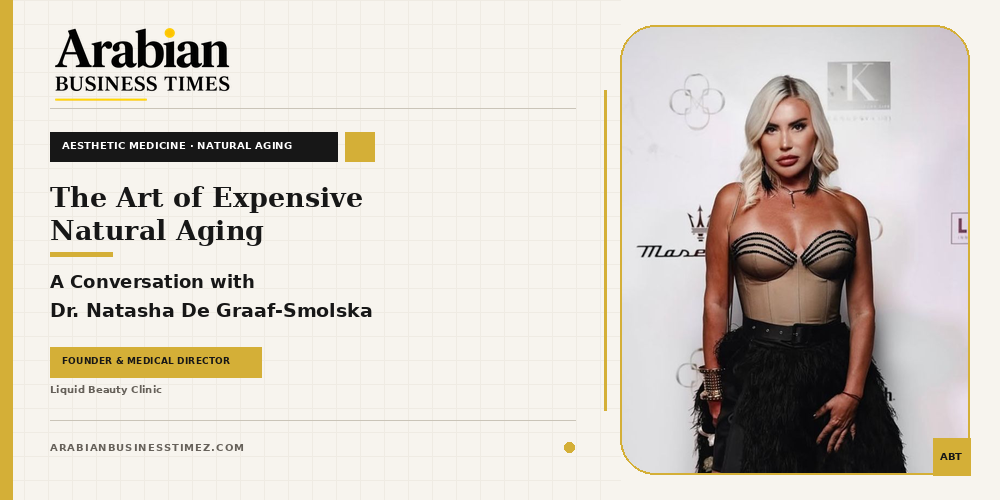
With over 250,000 followers and a clinic that has become a reference point for women navigating aesthetic medicine after 35, Dr. Natasha De Graaf-Smolska has built something rarer than a following — a philosophy. As Founder and Medical Director of Liquid Beauty Clinic, she has spent her career quietly pushing back against the industry’s obsession with erasing age, arguing instead for a smarter, more honest relationship with it. We sat down with her to talk about beauty, restraint, and what it really means to age well.
Where It Started
“My journey into aesthetic medicine started with my fascination for the connection between medicine, beauty and confidence,” she says. But somewhere along the way, the questions that interested her most changed. “I became increasingly interested in something deeper: why some women seem to age beautifully and naturally, while others lose their identity in the pursuit of looking younger.”
Years of treating women taught her something that now sits at the center of her practice. “Most women do not actually want to look different. They want to look like themselves — healthier, fresher, more rested and more confident.” That single observation reshaped how she works. Rather than chasing perfection or correcting every visible sign of age, she focuses on understanding the face and the aging process as a whole, then building a long-term strategy around the individual in front of her. “For me,” she says, “the highest level of aesthetic medicine is when the work itself becomes almost invisible.”
Redefining “Aging Well”
Dr. De Graaf-Smolska describes her approach as “the art of expensive natural aging” for women over 35 — a phrase, she’s quick to clarify, that has nothing to do with price. “It is that effortless appearance of a woman who takes exceptional care of herself but doesn’t look obviously treated. Her skin is healthy, her face still moves, her features remain her own, and there is a certain refinement to the way she ages.”
To her, that look is far more luxurious than trying to erase every line or chase the face of one’s twenties. “Aging well means respecting time while being intelligent about how you manage its effects,” she explains. “We can support the skin, preserve quality, maintain facial harmony and intervene when appropriate — but we should never remove the character from a woman’s face. The goal isn’t to look younger at any cost. The goal is to look exceptionally good at every age.”
Moving Past “Anti-Aging”
She’s outspoken about wanting the industry to retire a phrase it built itself on. “I would love to see us move away from the term ‘anti-aging.’ Aging is part of being alive. Making women feel that they should somehow defeat it creates an impossible standard.” The more useful question, she argues, is how to age better — a shift that opens the door to prevention, skin quality, collagen, structure, sun protection, sleep, nutrition, movement and stress, rather than reacting to every new wrinkle. “Women should be allowed to have lines, expression and maturity without feeling that something is wrong with them,” she says. “Aesthetic medicine should give women choices. It shouldn’t create new insecurities for them.”
The Bigger Picture: Skin and Longevity
Asked what actually drives how women age, she resists giving skin credit on its own. “Genetics obviously play a role, but lifestyle matters enormously — sun exposure, smoking, sleep, stress, nutrition, physical activity and environmental factors all contribute.” For women past 35, she adds, hormonal shifts become increasingly relevant, which is why she never looks at skin or facial structure in isolation. “My approach is becoming increasingly holistic: understand the woman first, and then understand what her skin and face need. Longevity is ultimately about maintaining health and quality of life for as long as possible, and beauty should follow the same principle — think in decades, not simply about how you want to look next week.”
Protecting Identity in the Treatment Room
If there’s one line she won’t cross, it’s homogenizing the faces she treats. “Preserving identity is one of my most important principles. Before deciding what to change, I look at what should never be changed. Every woman has certain characteristics that make her face recognizable and individual.” She’s blunt about wanting variety among her patients rather than a signature look. “I don’t want my patients to have the same lips, cheeks, jawline or facial proportions. Aesthetic medicine should not create a uniform.” Sometimes, she says, the most skilled decision is to do less — or nothing at all. “Restraint is an important part of expertise. My objective is that a woman walks out of my clinic looking like herself. Perhaps fresher, more balanced or more rested, but still completely herself.”
What Women Over 35 Actually Want
In her experience, this age group asks sharper questions than younger patients. “They start asking: How can I maintain my skin? How will my face age? What should I do now so that I still look good ten years from now?” They notice changes in pigmentation, elasticity or volume, she says, but rarely want dramatic correction — they want intelligent maintenance. “The future isn’t about selling a syringe. It is about creating a strategy.”
Innovation Versus Hype
She’s genuinely excited by where the science is heading — particularly work focused on improving tissue and skin quality rather than simply adding volume, along with advanced diagnostics and personalization. But she’s equally wary of how quickly the industry turns new science into marketing language. “‘Regenerative’ is a good example: it is an exciting field, but the word itself is sometimes used too freely. As a medical professional, I think we have a responsibility to separate innovation from marketing. New is exciting, but new does not automatically mean better.”
Social Media, Responsibly
With a substantial platform of her own, she’s candid about the tension it creates. “We are constantly exposed to perfect faces, perfect bodies, perfect lighting and perfect lives. But much of what we see has been filtered, edited or carefully selected.” Working in aesthetics, she feels an added responsibility not to add to that pressure. “Not every asymmetry needs correcting. Not every line needs treating. Not every trend belongs on your face. Social media should inspire women to take care of themselves, not make them afraid of getting older.”
Redefining Luxury
For Dr. De Graaf-Smolska, luxury has little to do with cost. “True luxury is having time, expertise and individual attention. It means having a doctor who understands your face rather than following a treatment template — and receiving honest advice, even when that advice is that you don’t need a particular procedure.” Above all, she says, “luxury is restraint. The most sophisticated aesthetic work is often the work nobody notices.”
A Closing Thought
If she could correct one misconception, it would be the idea that getting older means becoming less beautiful. “Beauty does not have an expiration date. It changes. There is something incredibly attractive about a woman who knows herself, takes care of herself and doesn’t feel the need to compete with a younger version of herself.”
Her advice to every woman entering her mid-thirties and beyond is simple: think long-term. “Invest in your health and your skin. Protect what is already beautiful. Be selective about treatments and even more selective about who performs them. Don’t allow trends to dictate what your face should look like. And don’t become obsessed with looking younger. The goal is not to stop aging. The goal is to become the most beautiful, healthy and confident version of yourself at every age.”
— Natasha De Graaf-Smolska, Founder & Medical Director, Liquid Beauty Clinic