
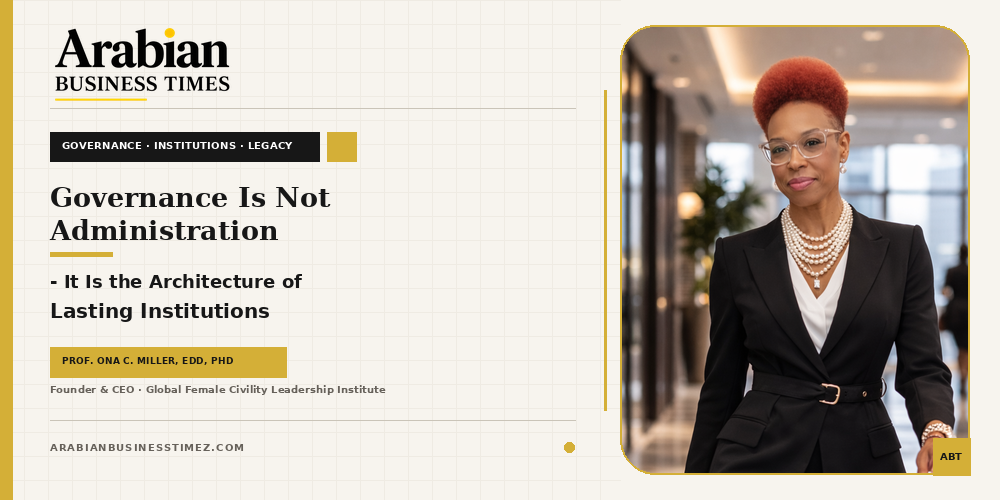
Most founders confuse the two. One manages what exists today. The other designs what will still be standing and still serving its mission decades from now. The distinction is not semantic. It is existential.
By Prof. Ona C. Miller, EdD, PhD · Founder & CEO, Global Female Civility Leadership Institute
There is a question I ask every founder and executive leader I work with, not at the end of our engagement, but at the very beginning, before we touch strategy or programmes or team structure. The question is this:
When you are no longer here, what will your organization do?
The answers I receive tell me more about an organization’s future than any financial statement or strategic plan ever could. Because the answer to that question is not determined by the strength of a leader’s vision. It is determined by the quality of an institution’s governance.
And governance, I have learned across years of advising women-led organizations on nearly every continent, is the single most misunderstood concept in organizational leadership. It is confused with administration. It is confused with management. It is confused with compliance, something you do to satisfy a regulator or a funder, a box to tick before moving on to the real work.
It is none of these things. Governance is the architecture of a lasting institution. And until leaders understand that distinction, fully, structurally, and practically, they will keep building organizations that are extraordinary in the hands of their founders and fragile the moment those founders step back.
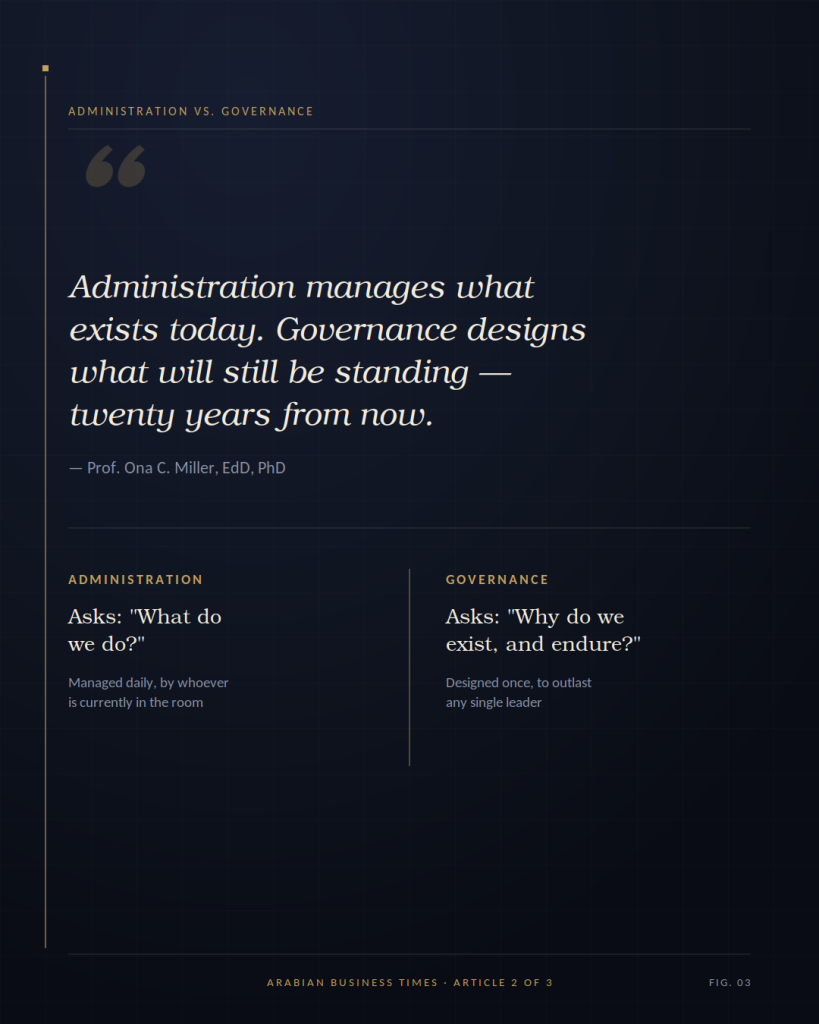
“Administration manages what exists today. Governance designs what will still be standing and still serving its mission twenty years from now.”
THE CONFUSION THAT IS COSTING ORGANIZATIONS EVERYTHING
Let us be precise about what we mean. Administration is the daily operational work of running an organization: managing schedules, processing paperwork, maintaining records, coordinating logistics, ensuring that what is supposed to happen today actually happens. Administration is essential. Without it, no organization functions.
Management extends slightly further: allocating resources, directing teams, executing strategy, meeting targets. Excellent management determines whether an organization performs well in the near term.
Governance is something else entirely. Governance is the system of structures, accountabilities, policies, and decision-making processes that determine how an organization is directed and controlled at the highest level. It answers the questions that administration and management never ask: Who has authority, and over what? How are major decisions made, and by whom? What happens when leadership fails or changes? What are the non-negotiable values that no executive, no board member, and no financial pressure can override? How is the organization held accountable to its mission across decades, not just quarters?
These are governance questions. And in most women-led organizations, from early-stage nonprofits to established institutes to international advocacy bodies, they are either completely unanswered or answered informally, in ways that live only in the founder’s head and dissolve the moment she steps aside.
ADMINISTRATION: Answers the question: ‘Are we operating smoothly today?’
GOVERNANCE: Answers the question: ‘Are we structured to fulfill our mission for the next 50 years?’
ADMINISTRATION: Manages people, tasks, and day-to-day decisions
GOVERNANCE: Designs the systems within which people, tasks, and decisions operate
ADMINISTRATION: Dependent on the skills of the current team
GOVERNANCE: Remains functional regardless of who is currently leading
ADMINISTRATION: Asks: ‘What do we do?’
GOVERNANCE: Asks: ‘Why do we exist, who holds us accountable, and how do we ensure we endure?’
WHAT GOVERNANCE FAILURES ACTUALLY LOOK LIKE
Before we discuss what strong governance looks like, it is worth examining what its absence produces, because governance failures are not always dramatic. They do not always look like fraud or collapse. Sometimes they are quiet, gradual, and only visible in retrospect.
Boeing is perhaps the most consequential recent example. Federal investigations and expert analyses from 2023 through 2025 concluded that the 737 MAX disasters and the 2024 Alaska Airlines door plug incident were not primarily engineering failures. They were governance failures. Boeing’s board lacked the capacity, the urgency, and the independence to hold management accountable for a gradual erosion of safety culture and quality controls. The result: a 32 percent drop in share price in 2024, billions in regulatory settlements, and a reputational crisis that continues to unfold. Governance delays, investigators concluded, turned solvable problems into national economic disruptions.
FTX and Sam Bankman-Fried present a different face of the same failure. What appeared to be a sophisticated financial institution was operating without the basic governance structures, independent board oversight, financial controls, accountability mechanisms, that would have caught, or prevented, the defrauding of investors. When governance is absent, one person’s judgment, or one person’s misconduct, becomes the entire institution’s fate.
The Silicon Valley Bank collapse of 2023, analyzed extensively through 2025 by federal economists, pointed to failures in board oversight, risk management, and internal controls. Boards lacked the expertise and urgency to understand the organization’s exposure. Governance gaps, not market forces alone, turned manageable problems into a systemic crisis.
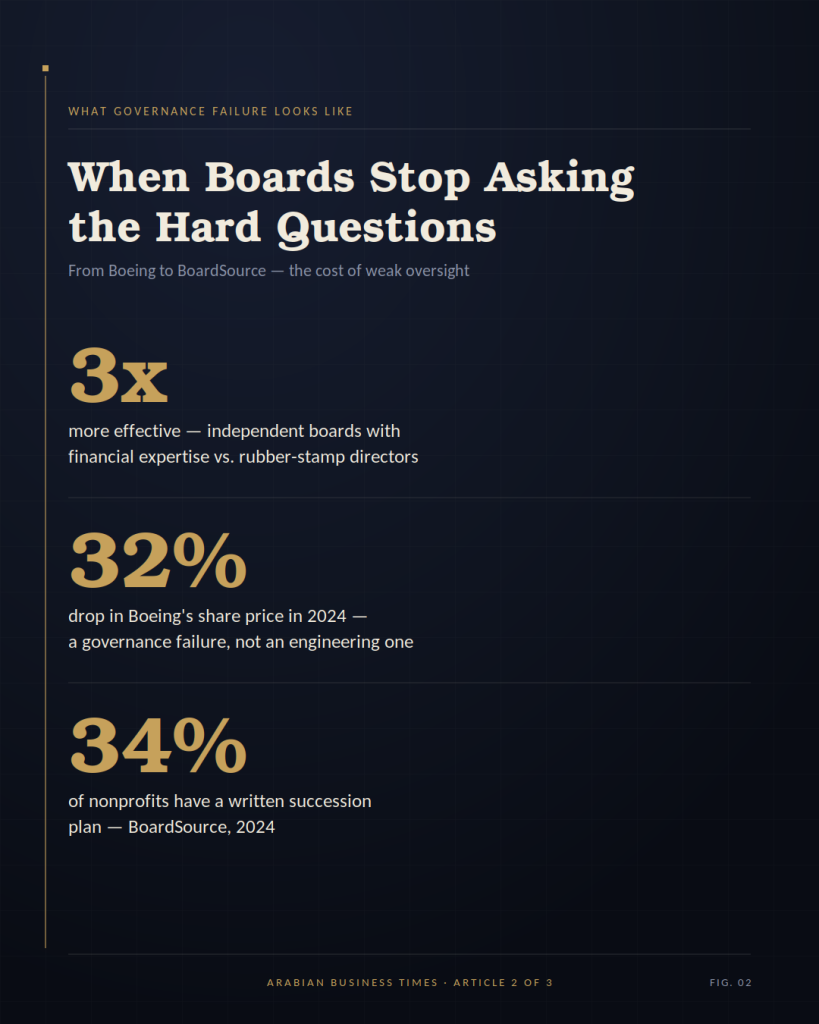
3x
more effective, independent boards with financial expertise vs. rubber-stamp directors at preventing organizational misconduct
32%
drop in Boeing’s share price in 2024, a governance failure, not an engineering one
34%
only 34% of nonprofits have a written succession plan, BoardSource 2024
These are large-scale, high-visibility examples. But the same dynamics play out daily in smaller women-led organizations that are doing important and meaningful work, quietly, without fanfare, until the founder steps back and the organization discovers that everything it was depended on one person’s presence rather than a system designed to outlast any individual.
“Every organization that collapsed after its founder departed made the same mistake: it confused the founder’s authority with the institution’s architecture. They are not the same thing.”
THE SIX ELEMENTS THAT SEPARATE GOVERNANCE FROM ADMINISTRATION
So what does governance actually look like in practice, specifically in women-led organizations and institutions? After years of advising organizations across sectors and regions, I have identified six elements that reliably distinguish governance from administration. Together they form what I call the Governance Architecture Framework, the structural backbone of any institution built to last.
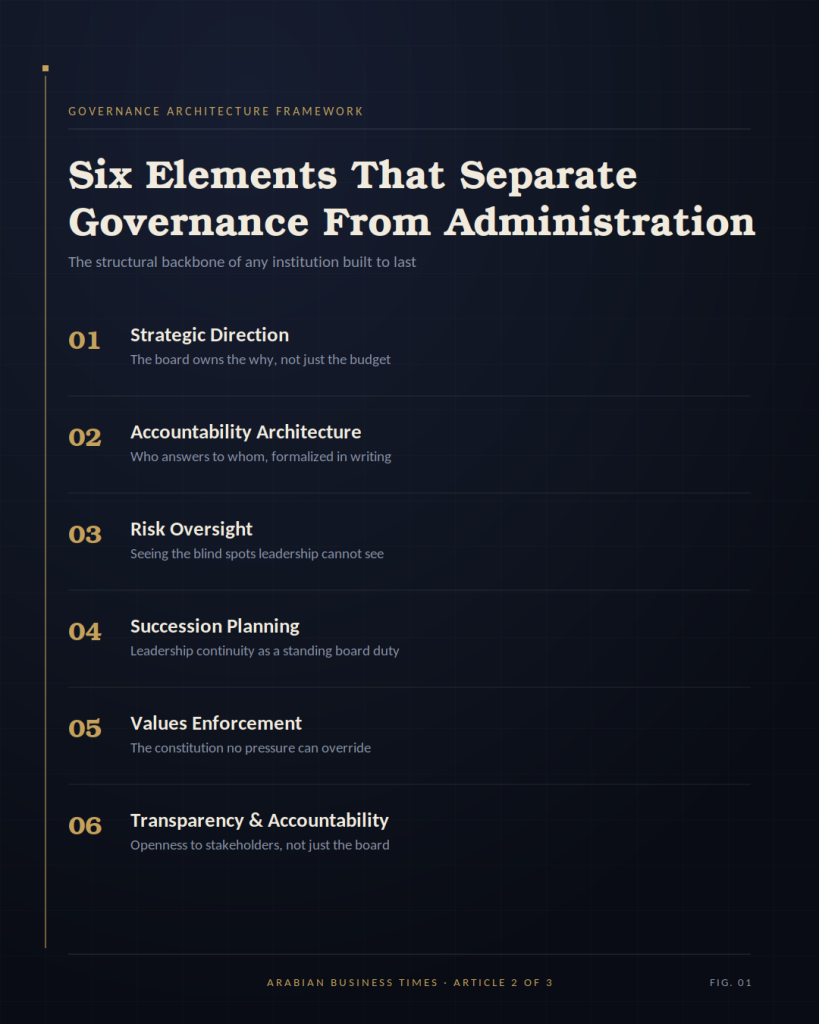
01. Strategic Direction: The Board Owns the Why
A governing board’s first and most fundamental responsibility is strategic direction: ensuring the organization remains aligned with its founding mission, even as tactics, programmes, and leadership change. This is not about approving the executive director’s annual plan. It is about asking, consistently, rigorously, and without deference, whether the organization is moving toward the future it was built to create. Boards that limit themselves to approving budgets and ratifying staff decisions are not governing. They are administrating. Governance begins when a board asks: ‘Are we still the right organization doing the right work in the right way to fulfill this mission for the next generation?’
02. Accountability Architecture: Who Answers to Whom
Governance defines accountability, clearly, formally, and in writing. Who has authority to make which decisions? Who reviews those decisions and on what timeline? What are the escalation processes when something goes wrong? What are the non-negotiable standards that cannot be overridden, regardless of who is in the executive chair? In too many founder-led organizations, accountability is informal, meaning it is personal, relationship-based, and non-transferable. When the founder leaves, accountability goes with her. Governance formalizes accountability so that it belongs to the institution, not to any individual who currently occupies a role within it.
03. Risk Oversight: Seeing What Leaders Cannot See
One of the most critical functions of a governing board is to see what the executive leadership cannot, or will not, see. Founders, by definition, are deeply invested in their organizations. This investment is a strength. But it also creates blind spots around risk. Strong governance provides independent risk oversight: financial risk, reputational risk, programmatic risk, governance risk itself. Boards with genuine independence and diverse expertise are three times more effective at preventing organizational misconduct than boards that simply ratify executive decisions. Risk oversight is not about distrust. It is about building an institution that can survive the things no one anticipated.
04. Succession Planning: Leadership Continuity as a Governance Duty
Only 34 percent of nonprofits have a written succession plan, according to BoardSource’s 2024 data. This is not a staffing gap. It is a governance failure. Succession planning is a board-level governance responsibility, not something to be handled reactively when a transition becomes unavoidable, but a continuous, strategic investment in the organization’s future leadership. Effective governance asks: Who are we developing right now to lead this organization in five years? What do they need to learn? What systems must we build so that a transition strengthens rather than destabilizes us? These questions must live in the boardroom, not the inbox of an overwhelmed executive director.
05. Values Enforcement: The Constitution of the Institution
Every institution that lasts has a set of values that function as a constitution, non-negotiable commitments that no financial pressure, personnel change, or strategic pivot can override. Governance is responsible for ensuring these values are not merely aspirational language on a website but operational standards that are enforced in hiring decisions, programme design, financial allocations, and board appointments. When values live only in the founder’s personal integrity, they are vulnerable. When they are embedded in governance structures, they become the institution’s immune system, protecting its character even when external pressures push toward compromise.
06. Transparency and Stakeholder Accountability
Strong governance ensures that the organization is transparent and accountable not just internally, to its own board and staff, but externally, to the communities it serves, the funders who support it, the governments that regulate it, and the stakeholders whose trust it depends on. This means regular, honest reporting; clear financial disclosure; mechanisms for stakeholder input into strategic decisions; and a culture of openness that does not retreat from scrutiny. Organizations with strong governance cultures experience 17 percent higher fundraising revenue growth year over year, according to Nonprofit Hub research, because funders invest in institutional stability, not individual charisma.
“Strong governance is not what you build for the regulator. It is what you build for the women who will lead this institution after you are gone, and for the communities they will serve.”
WHY WOMEN-LED ORGANIZATIONS MUST LEAD THE GOVERNANCE CONVERSATION
Women-led organizations face a specific and compounding governance challenge that most mainstream governance literature fails to name directly.
Women founders have historically had less access to the informal networks, mentorship relationships, and institutional knowledge that have helped male-led organizations develop governance structures naturally over time. When a man founds a major organization, he typically does so within an ecosystem of advisors, former colleagues, investors, and board members who bring governance knowledge with them. The structure builds itself, often invisibly, through networks.
Women founders, particularly those building in underserved communities, in developing markets, or in sectors that have historically been under-resourced, often build without that ecosystem. They build with vision, passion, and extraordinary personal capability. But they build, too often, without the governance infrastructure that would allow their institutions to grow beyond their own capacity.
As of 2025, women hold only 28.3 percent of board seats globally, and just 8.4 percent of board chair positions. Women of color hold just 7.7 percent of all corporate board seats, with no measurable quarter-over-quarter gain. These numbers are not simply about representation. They are about governance knowledge transfer. When women are absent from governance structures, the governance knowledge those structures develop does not flow back to women-led organizations.
This is why building strong governance in women-led institutions is not simply an organizational best practice. It is a form of systemic correction, creating, within our own organizations, the governance depth and institutional maturity that the broader ecosystem has failed to provide.
And the data shows the return is real. Companies that sustain gender balance in leadership demonstrate stronger governance and clearer succession planning, according to Grant Thornton’s 2026 Women in Business Report, outcomes that matter directly to investors, funders, and long-term partners.
28.3%
of global board seats held by women in 2025, MSCI Women on Boards Report
17%
higher fundraising revenue growth in organizations with engaged board governance, Nonprofit Hub
8.4%
of board chair positions held by women globally, IFC data
BUILDING A GOVERNANCE MINDSET: PRACTICAL STARTING POINTS
Shifting from an administrative mindset to a governance mindset does not require a complete organizational redesign. It requires a deliberate change in the questions leaders and boards ask, and the systems they build to answer them.
Here is where to begin:
Clarify what your board actually does. If your board’s primary activity is approving reports and attending events, it is not governing. Schedule a board retreat specifically focused on governance roles and responsibilities. Bring in an external facilitator. Ask hard questions about what your board is actually responsible for, and what the answer would be if your executive director left tomorrow.
Create a written governance charter. Document who has decision-making authority for what. Establish committee structures with clear mandates. Define the process for major decisions, leadership transitions, and value-based disputes. A governance charter is not a bureaucratic document. It is the institution’s constitutional framework.
Invest in board governance development. Many board members step into their roles without formal governance training, leaving organizations vulnerable to ineffective decision-making. Allocate budget, typically one to two percent of annual expenditure, specifically for board development. The return on this investment, in organizational resilience and stakeholder confidence, consistently exceeds the cost.
Build succession into the governance calendar. Succession planning should appear on the board agenda at least annually, not as a crisis response, but as a strategic conversation. Who is being developed? What is their readiness? What does the organization need from its next leader that it may not need from its current one?
Establish a values review process. At least annually, the board should formally review whether the organization’s activities, financial decisions, and partnership choices align with its founding values. This is not a rubber-stamp exercise. It is the board’s most fundamental governance duty.
“You do not build governance when you need it. You build it long before, so that when the moment comes, as it always does, the institution is already designed to carry on.”
THE WORK OF THE GLOBAL FEMALE CIVILITY LEADERSHIP INSTITUTE
This is precisely the work that drives everything we do at the Global Female Civility Leadership Institute. When we partner with a women-led organization, we do not begin with programmes or training curricula. We begin with governance. We audit what exists, what is documented, what is structural, what is genuinely independent, and what lives only in the founder’s presence.
Then we build. Board charters. Accountability frameworks. Succession planning processes. Values enforcement mechanisms. Stakeholder transparency structures. We build the governance architecture that allows an institution to carry its mission forward across leadership transitions, funding cycles, geopolitical shifts, and the inevitable changes that come with time.
Through PurposePhD, we are taking this work upstream, developing the governance literacy of emerging leaders before they find themselves leading organizations without the frameworks they need. Through the Global Library of Female Authors, we are preserving the intellectual contributions that will shape the governance thinking of future generations. And through our international advisory work, including our role with the Asian-African Chamber of Commerce and Industry, we are helping to build the policy and institutional frameworks that govern women’s economic participation at a global level.
The work is structural. It is architectural. And it is the most important work in women’s leadership today, because individual leaders come and go, but institutions, when properly governed, endure.
A FINAL WORD ON WHAT GOVERNANCE ACTUALLY REQUIRES OF YOU
If you are a founder reading this and finding it uncomfortable, that discomfort is meaningful. Because governance, real governance, requires something that founders find genuinely difficult: sharing authority. Accepting accountability to others, not just to your own vision. Building structures that will one day operate without your direct involvement, structures that may make decisions differently than you would, following principles you established rather than preferences you currently hold.
This is not a diminishment of the founder’s role. It is the fullest expression of it. The most significant thing a founder can do for the institution she has built is to design it so well that it no longer needs her.
That is governance. Not paperwork, not compliance, not a box to tick before moving on to the real work.
Governance is the real work. It always was.
“The most significant thing a founder can do for the institution she has built is to design it so well, so structurally, so deliberately, that it no longer needs her.”
ABOUT THE AUTHOR
Prof. Ona C. Miller, EdD, PhD
Global Institutional Leadership Advisor · Governance Strategist · Institution Builder
Professor Ona C. Miller is the Founder & CEO of the Global Female Civility Leadership Institute and PurposePhD. She holds an EdD in Organizational Leadership and a PhD, and has spent her career building the governance frameworks, leadership systems, and institutional architectures that allow women-led organizations to achieve lasting impact. She currently serves as National Chairman, Women & Entrepreneurship Committee (USA) with the Asian-African Chamber of Commerce & Industry, and is an Honorary Member of the World Peace and Diplomacy Organisation. She is a six-time published author, including three international publications.
🌐 conoriconsults.org · purposephd.com · 💼 linkedin.com/in/professorona · 📸 @dronaconori