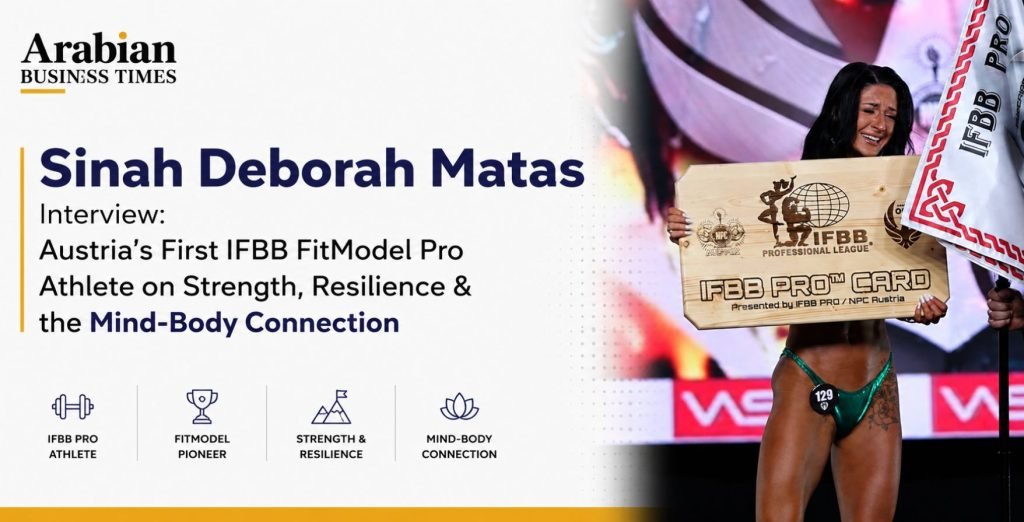

For Sinah Deborah Matas, fitness has never been simply about building a stronger physique. From discovering movement as a child to competing in bodybuilding and becoming Austria’s first IFBB FitModel Pro Athlete, her journey has been shaped by discipline, resilience, self-awareness, and a deep understanding of the connection between physical and mental well-being. Today, as a certified personal trainer, nutrition coach, competitive athlete, and future psychotherapist, Matas is building a distinctive approach to transformation; one that looks beyond aesthetics to help people develop greater confidence, healthier habits, and a stronger relationship with themselves.
You are recognized as Austria’s first IFBB FitModel Pro Athlete. Can you share your journey into fitness and bodybuilding, and what motivated you to pursue this path professionally?
Sinah Deborah Matas: My relationship with movement began long before bodybuilding. Ever since I was a child, movement has been my favorite way of feeling alive, connected to myself, and regulating my emotions. I explored many different sports—from dance, athletics, horseback riding, karate, swimming, and later pole dance—because being active simply felt like home.
When I was sixteen, I joined my first gym during one of the most challenging periods of my life. Strength training gave me the opportunity to reconnect with myself. It helped me regain a sense of agency and rebuild trust in my own abilities.
For the next four years, I trained consistently while finishing high school. Eventually I felt my progress no longer reflected the effort I was putting in, so I hired a coach and prepared for my first bodybuilding competition, planning to experience the sport and then return to my regular routine.
Life had different plans. During my first competitive season at twenty-one, I competed in five shows, starting by placing last and gradually working my way up until I won my first overall title at my fourth competition. That taught me one of the greatest lessons of my life: meaningful growth rarely happens overnight. It is built through resilience and consistency.
What truly captivated me wasn’t the trophy—it was the process. Bodybuilding challenged me to develop discipline, patience, resilience, and self-awareness. Around that same time, another dream became clearer. Since I was fifteen, I had known I wanted to become a psychotherapist and study at Sigmund Freud Private University in Vienna, though the tuition fees seemed out of reach at the time. Through bodybuilding, I found a path that connected both passions—building a career as a personal trainer and competitive athlete while working toward my education in psychotherapy.
Becoming Austria’s first IFBB FitModel Pro Athlete is an achievement I am incredibly proud of, but it has never been my final destination. It is one milestone on a much bigger mission: to bridge physical and mental health and help people realize that true strength is not defined by how your body looks, but by how deeply you trust yourself.

Your work focuses on transforming both body and mind. How did you develop this holistic philosophy, and why do you believe mental health and physical fitness should be addressed together?
Sinah Deborah Matas: Over the course of six competitive bodybuilding seasons, one thing became increasingly clear to me: the way you carry yourself is always a reflection of your inner world. You can train your body to perfection, but your mindset will inevitably reveal itself through your posture and presence.
I often say that the body follows the mind—but the mind also flourishes in a body that feels safe, healthy, and capable. After my first bodybuilding season, I began my own psychoanalysis, which transformed the way I understood health. Physical training is a powerful tool for emotional regulation, but movement alone cannot resolve the unconscious conflicts that shape how we experience ourselves. Psychological work alone isn’t enough either if we remain disconnected from our bodies—the body is the vessel through which we experience life.
Since I began coaching in 2020, I have witnessed this transformation in more than a hundred clients. When people regain ownership of their bodies, they also begin to take ownership of other areas of their lives. That is why I never separate mental and physical health in my work.
As a certified personal trainer, nutrition coach, and future psychotherapist, how do these different areas of expertise complement each other in your coaching approach?
Sinah Deborah Matas: To me, these disciplines don’t compete with one another—they complete one another. Professionally tailored training, evidence-based nutrition, and sustainable lifestyle habits create structure, safety, and a healthy environment in which the body can recover, adapt, and thrive. Once the body feels safe again, the mind has much more capacity to change as well.
One of the biggest misconceptions in the health and fitness industry is that people fail because they lack discipline. In my experience, that is rarely the real reason. More often, the obstacles lie much deeper—in low self-worth, unconscious self-sabotaging patterns, perfectionism, or fear of failure. No training plan or meal plan alone can resolve those underlying dynamics.
I don’t see the body as separate from the psyche—I see it as the space in which our inner life is expressed. My role as a coach is not to provide psychotherapy, but to create an environment in which lasting change becomes possible through movement, nutrition, and genuine human connection. As I continue my education in psychotherapy, sustainable transformation happens when body and mind begin working together instead of against each other.
Many people struggle with consistency when it comes to fitness and health goals. In your experience, what are the biggest mental barriers preventing people from achieving long-term success?
Sinah Deborah Matas: I don’t believe the biggest barrier is a lack of motivation. Motivation is an emotion—it comes and goes. Long-term change is built on something much deeper: identity. People are far more likely to stay consistent when they stop asking, “How do I stay motivated?” and start asking, “Who do I want to become?”
The second barrier is the belief that consistency means perfection. Many people miss one workout or have one difficult week and immediately question the entire journey. In reality, sustainable change is not about never falling off track—it’s about returning without making every setback mean something about your worth.
Discipline is not about being hard on yourself. It’s about developing the capacity to tolerate discomfort and delayed gratification without abandoning your long-term vision. When people stop trying to punish their bodies into changing and instead begin acting from self-respect rather than self-criticism, healthy habits become much more sustainable.
You have coached more than 100 clients through physical and personal transformations. What are some of the most rewarding success stories or lessons you have witnessed throughout your coaching career?
Sinah Deborah Matas: If there is one lesson I have learned from coaching more than a hundred clients, it is that the most meaningful transformations are rarely the visible ones. What stays with me most are the moments when people begin to see themselves differently—when someone who once believed, “I’ve never been athletic,” starts identifying as a person who genuinely enjoys movement, or when a client tells me the confidence they built through taking care of their body has positively affected their relationships or career.
Physical change often becomes the catalyst for much deeper personal growth. As people become stronger physically, they often become more resilient emotionally, set healthier boundaries, and begin making choices that reflect who they truly want to be. My role is not to create a perfect body, but to create an environment in which people feel safe enough to grow and discover strengths they didn’t know they had.

Your coaching emphasizes posture correction, pain reduction, mobility, and overall well-being before aesthetic goals. Why is this foundation so important for sustainable fitness results?
Sinah Deborah Matas: I believe aesthetics should be the result of health—not the price we pay for it. Many people enter the gym with the goal of changing how they look. But if we ignore posture, mobility, pain, movement quality, and recovery, we build that transformation on an unstable foundation.
That’s why I always begin with the basics. When people learn to move well, breathe well, and understand their bodies, everything else becomes more sustainable. Focusing exclusively on aesthetics can also create an unhealthy relationship with exercise—motivation rises and falls with the mirror. But when people notice their back pain is gone and they feel stronger in everyday life, fitness becomes something they want to maintain, not force. True fitness isn’t about looking healthy for a moment. It’s about feeling healthy for a lifetime.
Social media often promotes unrealistic fitness expectations. How can individuals develop a healthier relationship with fitness, body image, and self-confidence?
Sinah Deborah Matas: Social media has made it easier than ever to compare ourselves to others—but comparison is one of the fastest ways to lose sight of our own journey. The only meaningful comparison is with the person you were yesterday.
I also believe we need to redefine what fitness is. Social media often reduces it to aesthetics, but health is so much more than visible abs or a body fat percentage. Fitness is your energy, your mobility, your strength, and your ability to move without pain.
Self-confidence doesn’t come from looking perfect—it comes from keeping the promises you make to yourself. I always encourage my clients to use social media consciously, to follow people who educate and inspire rather than accounts that make them feel like they’re falling behind. Confidence isn’t built through comparison; it’s built through connection with who you already are.
As an entrepreneur balancing coaching, professional athletics, and academic studies in psychotherapy, how do you manage your time, maintain motivation, and avoid burnout?
Sinah Deborah Matas: For a long time, I believed that passion alone would protect me from burnout. It doesn’t. There were periods where I pushed far beyond my limits, and I experienced both physical and mental consequences—from a stress fracture in my foot to emotional exhaustion. Those experiences taught me that performance is only sustainable when recovery is treated with the same respect as productivity.
Balancing entrepreneurship, coaching, professional athletics, and my studies in psychotherapy requires structure, but even more, it requires boundaries. As part of my own development, I attend psychoanalysis twice a week, which has become an essential space for reflection and self-awareness.
I’m also incredibly grateful for the people around me—a supportive family, partner, and close friends who keep me grounded—and I’ve learned that I need regular moments of solitude, whether through training, long walks, or the sauna. True strength isn’t measured by how much you can endure—it’s measured by having the courage to respect your limits before your body is forced to remind you of them.
Looking ahead, what are your personal and professional goals, and what impact would you like to create in the fields of fitness, mental health, and personal development?
Sinah Deborah Matas: My biggest goal is to continue building a bridge between physical health, mental health, and human performance. We live in a society that celebrates achievement and constant optimization, and I see how easily performance becomes tied to self-worth. Too many people believe they have to earn the right to rest. That is something I want to challenge.
My vision is to help redefine what high performance really means. I don’t believe true excellence comes from constantly pushing beyond your limits—it comes from understanding yourself deeply enough to know when to push, when to recover, and why you’re pursuing your goals in the first place.
Professionally, I want to continue growing as both a coach and a psychotherapist. I hope to one day complete a doctorate, contribute to research, and make psychological knowledge more accessible. I also want to continue competing in bodybuilding for as long as it brings me joy.
Ultimately, I don’t want to be remembered for titles or achievements, but for helping people build a healthier relationship with themselves. My greatest ambition has never been to create stronger bodies—it has always been to help build stronger, freer human beings.
Optional Closing Question: If you could share one message with people who feel stuck in their health, fitness, or personal development journey, what would it be?
Sinah Deborah Matas: Be patient with yourself.
We live in a world that constantly tells us to become more—leaner, stronger, more productive, more successful. But real growth doesn’t happen because we constantly criticize ourselves. It happens because we learn to meet ourselves with honesty, compassion, and the courage to keep going, even when progress feels slow.
Your body is not the enemy you have to fight. It is the place where your entire life happens. Treat it with respect, listen to it, and allow it to become your ally instead of your opponent.
You don’t have to become a completely different person to change your life. Lasting transformation begins the moment you decide to consistently care for the person you already are. Your past does not define you, and neither do your setbacks. Every single day offers a new opportunity to make one decision that aligns a little more with the person you want to become. Because in the end, the strongest people are not those who never struggle. They are the ones who continue choosing themselves, again and again.

Conclusion:
Sinah Deborah Matas’ journey demonstrates that true strength extends far beyond physical appearance. Her experience in competitive bodybuilding, coaching, and personal development has shaped a philosophy centered on self-respect, sustainable growth, and the powerful connection between body and mind. As she continues to pursue her career in coaching and psychotherapy, her ambition is not simply to help people build stronger bodies, but to help them become stronger, freer, and more self-aware human beings. Her story is a reminder that lasting transformation does not happen through perfection or constant pressure—it begins with the decision to understand yourself, respect your limits, and consistently choose your own growth.