By Arif Hussain — AI & Digital Transformation Consultant | Published: May 2026 · Last updated: May 2026 · 18 min read
Dubai is no longer just a place to start a business. In 2026, it is one of the world’s most competitive places to scale.
That distinction matters. Starting a business here is relatively straightforward: a licence, a bank account, and a visa. Thousands of companies do it every year. Scaling is a different challenge entirely. It demands the right legal structure, genuine tax compliance, a customer acquisition engine that works in a city of 200+ nationalities, a hiring strategy that accounts for Emiratisation, and operational systems that do not collapse the moment growth accelerates.
I have spent the past five years advising businesses across Dubai, Riyadh, and Doha on exactly this. What follows is not a generic startup checklist. It is a practical, current, and honest guide to what scaling a small business in Dubai actually requires in 2026, written for founders and decision-makers who are past the registration stage and ready to grow.
If you’re exploring business opportunities before scaling, check our detailed guide on
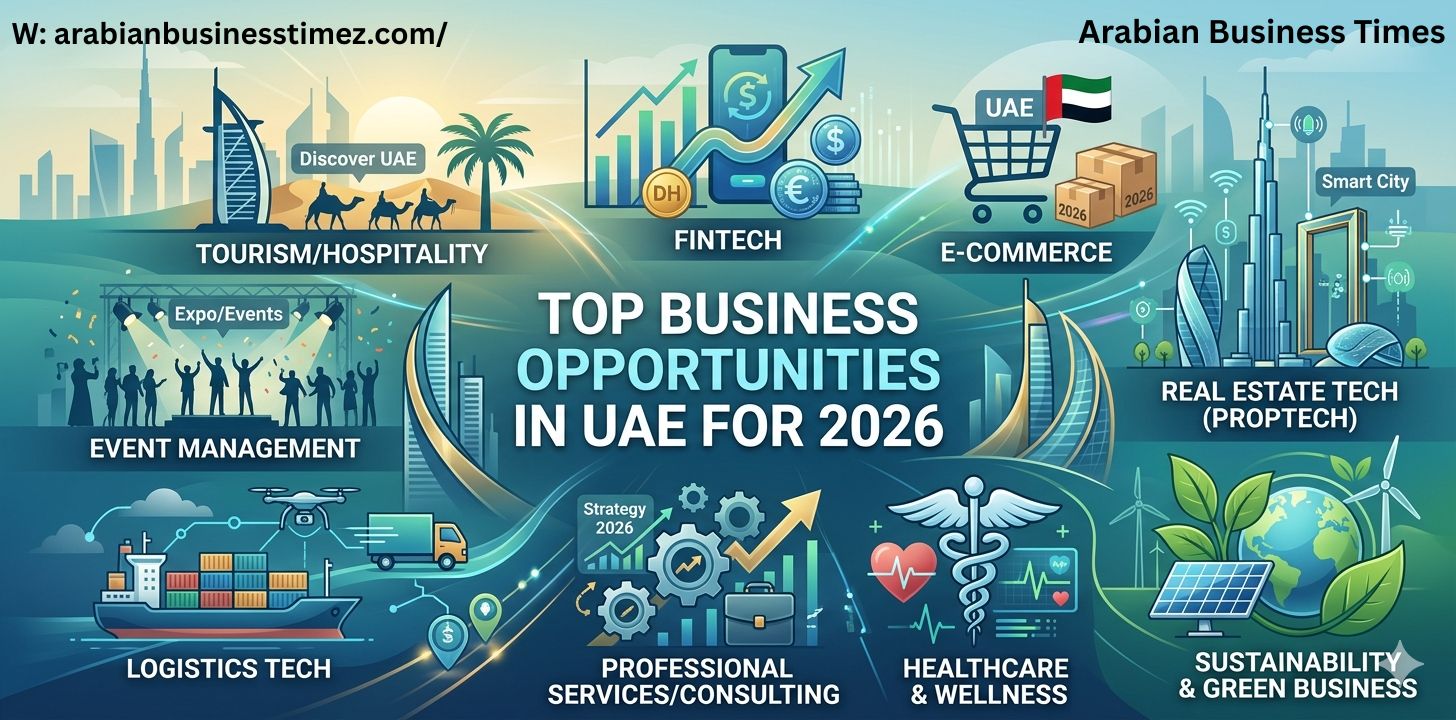
???? Top Business Opportunities in UAE for 2026
Why Dubai Is Still One of the World’s Best Markets for Business Growth in 2026
Skeptics occasionally suggest that Dubai’s best years as a business hub are behind it. The data says otherwise.
The Dubai Economic Agenda D33 — launched in January 2023 by HH Sheikh Mohammed bin Rashid Al Maktoum- is a ten-year masterplan targeting AED 32 trillion in cumulative GDP and positioning Dubai among the world’s top three cities for investment, business, and quality of life by 2033. It includes 100 transformational projects and a dedicated SME scale-up programme designed to identify 400 high-potential companies, build their capacity, and support their global expansion.
For growing businesses, D33 matters in practical terms: it commits the government to increasing FDI from an average of AED 32 billion to AED 60 billion annually, nearly doubling foreign trade to AED 25.6 trillion, and expanding government expenditure from AED 512 billion to AED 700 billion over the decade. That is government spending and foreign capital flowing into the economy at an accelerating pace, and businesses that are positioned correctly will benefit from it.

Beyond the agenda, the structural advantages of scaling in Dubai remain genuinely compelling in 2026:
Geographic position: Dubai sits within a four-hour flight of over two billion people across South Asia, East Africa, the GCC, and Eastern Europe. Emirates SkyCargo is on track to double its freighter fleet to 21 aircraft by the end of 2026. DP World operates in 75 countries. For any business with ambitions beyond the UAE, Dubai is a logistics and distribution hub with few equals.
Digital government: Dubai has achieved 100% digital processing of internal and external government transactions through its Paperless Strategy. The Dubai Unified Licence (DUL) now acts as a single identity for businesses operating across the emirate, reducing bureaucratic friction significantly. If you operated here five years ago and remember the paper-heavy processes, 2026 is a meaningfully different environment.
Tax environment: The UAE is not “tax-free” in 2026; that era is over, and any article telling you otherwise is not current. But it is genuinely low-tax and growth-friendly, which is meaningfully different. I cover the specifics in detail below.
Startup and SME ecosystem. Dubai Founders HQ, Dubai Future Accelerators, in5, Hub71 (Abu Dhabi), and the HiDubai business discovery platform – which now lists over 180,000 businesses – form a real, accessible support infrastructure. These are not just marketing initiatives; they are operating programmes with funding, mentorship, and market access attached.
Many founders start without networks — here’s how to do it effectively:
???? Start Business in Dubai Without Connections (2026 Guide)
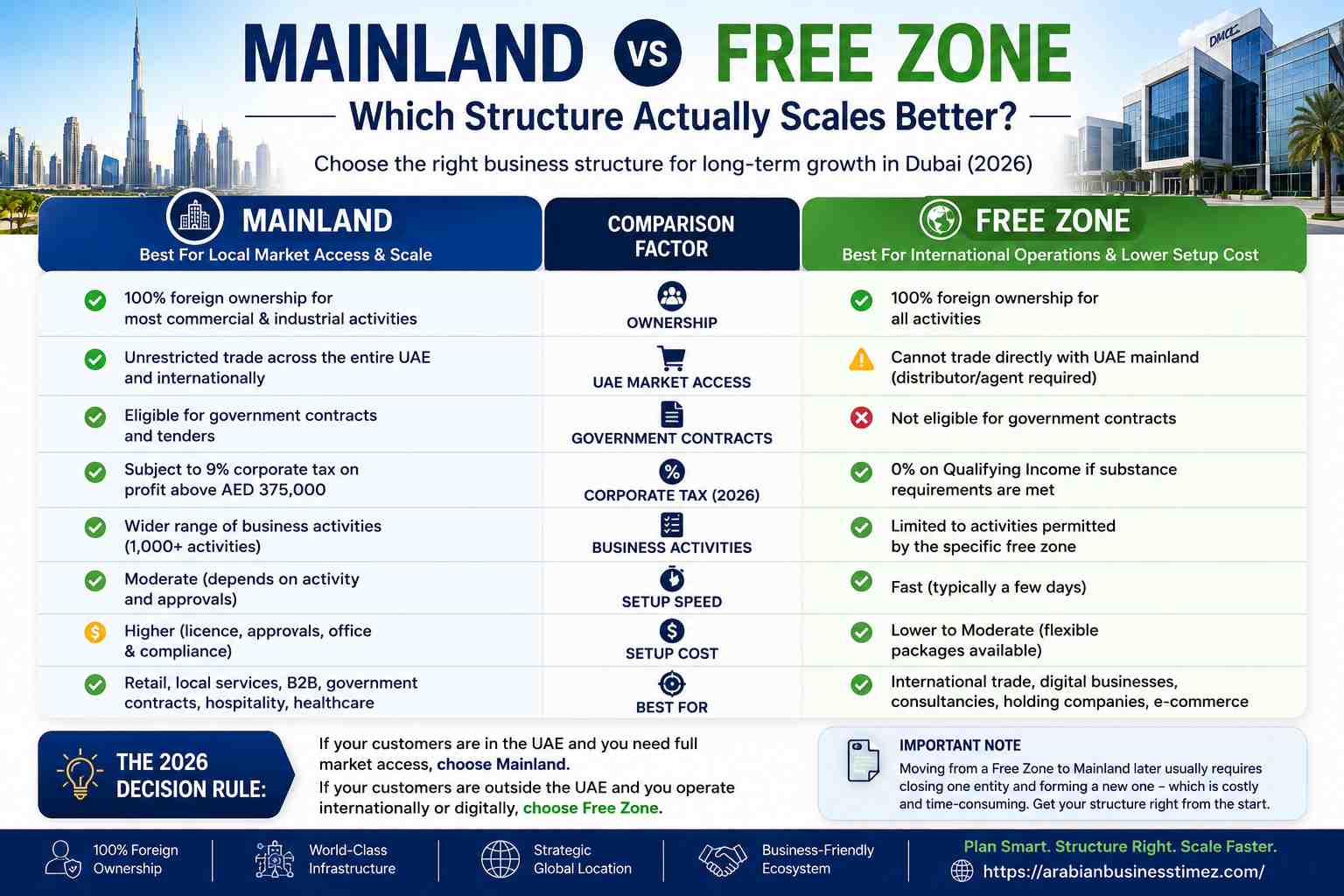
Mainland vs Free Zone: Which Structure Actually Scales Better?
This is the question I get asked more often than any other. The honest answer is: it depends entirely on your business model, your customers, and your growth trajectory. Here is the current reality in 2026.
Mainland – Best For Local Market Access and Scale
Since Federal Decree-Law No. 26 of 2020 took effect, mainland businesses can be 100% foreign-owned across more than 1,000 commercial and industrial activities – removing the old requirement for an Emirati partner holding 51% of shares. This was a genuine structural shift, not a marketing message.
What mainland give you in 2026:
- Unrestricted ability to trade across the entire UAE – not just in a designated zone
- Eligibility for government contracts and tenders, which can be a major growth channel, particularly in construction, healthcare, education, and professional services
- Flexibility to open physical locations anywhere in Dubai or the UAE
- Access to a broader range of business activities than most individual free zones offer
- The Dubai Unified Licence, which simplifies multi-activity operations
The trade-off: mainland companies are subject to 9% corporate tax on taxable profit above AED 375,000, and compliance requirements are more demanding than most free zones. If you are operating B2C retail, running physical locations, serving UAE government clients, or building a local service business, the mainland is almost always the right structure.
If you’re just starting out without a network, this guide will help:
???? Start Business in Dubai Without Connections (2026 Guide)
Free Zone – Best For International Operations and Lower Setup Cost
Dubai now has over 40 active free zones, each with its own regulatory authority, fee structure, and sector focus. DMCC (commodities and trading), DIFC (financial services), Dubai Media City (content and communications), Dubai Internet City (tech), Dubai CommerCity (e-commerce), and IFZA (general trading and services) each cater to different business profiles.
What free zones offer in 2026:
- 100% foreign ownership (this was always the case in free zones – it predates the mainland reform)
- Qualifying Income under the UAE corporate tax regime may be taxed at 0% – but only if strict substance and activity tests are met (more on this below)
- Simplified setup, often faster and lower-cost than the mainland
- Flexi-desk and virtual office options that reduce initial overhead
- Sector-specific ecosystems, events, and networks that can accelerate growth
The critical limitation: free zone companies generally cannot sell directly to UAE mainland customers without appointing a distributor or agent. This restriction still meaningfully applies in 2026 despite some amendments to specific zone rules. If your primary market is UAE-based consumers or businesses, this restriction will limit your growth ceiling.
The Comparison You Actually Need
| Factor | Mainland | Free Zone |
| Foreign ownership | 100% (most activities) | 100% (all activities) |
| UAE market access | Unrestricted | A limited distributor is required for the mainland |
| Government contracts | Yes | No |
| Corporate tax | 9% above AED 375K | 0% on Qualifying Income (if substance rules met) |
| Setup speed | Moderate | Fast |
| Setup cost | Higher | Lower to moderate |
| Best for | Retail, services, local B2B, gov contracts | International trade, digital services, holding |
The 2026 decision rule: If you are selling to UAE customers directly – whether retail, hospitality, professional services, or B2B – choose mainland. If your revenue is primarily international, or you are running a digital business, trading, or holding structure with offshore clients, a free zone will likely serve you better. Do not choose a structure based on tax alone; choose it based on who your customers are.
One critical note: moving from a free zone to the mainland later usually requires closing one entity and forming a new one. This is expensive and disruptive. Get the structure right before you scale, not after.
The 2026 UAE Tax Reality: What Every Scaling Business Must Know
Let me be direct: writing about Dubai as “tax-free” in 2026 is not just inaccurate – it is actively misleading for a business trying to plan its finances.

Corporate Tax
UAE corporate tax has been in effect since 1 June 2023. The structure is:
- 0% on taxable profit up to AED 375,000
- 9% on taxable profit above AED 375,000
- Every business subject to corporate tax must register with the Federal Tax Authority, file returns, and maintain audited financials – even if taxable income falls within the zero-rate band
Small Business Relief: A temporary scheme allows UAE-resident businesses with annual revenues not exceeding AED 3 million to elect to treat their taxable income as nil. This is the final year of eligibility — the scheme applies only to tax periods ending on or before 31 December 2026. If you are approaching the AED 3 million threshold, take legal advice now.
Free zone businesses: Qualifying Income may remain at 0% if strict substance tests are met – meaning genuine business operations in the zone, not merely an administrative address. The rules around what qualifies were clarified and tightened in 2025–2026. Many businesses discovered their income structures did not meet the updated criteria. Do not assume; verify with a qualified tax advisor.
VAT
- Mandatory VAT registration if annual turnover exceeds AED 375,000
- Voluntary registration is available from AED 187,500, and often worth considering for B2B businesses that want to reclaim input VAT on costs
- Standard VAT rate: 5% on taxable supplies
- Late registration incurs FTA penalties. Monitor your rolling 12-month revenue monthly, especially in growth phases
2026 VAT changes: From January 2026, VAT input tax credits can only be carried forward for five years. Credits from 2021 begin expiring in 2026. If you have been accumulating input VAT credits without claiming refunds, address this immediately – unused credits beyond five years expire permanently.
Filing and Compliance
Corporate tax returns are due within nine months of the financial year-end. For a December 2025 year-end, the deadline is 30 September 2026. The Federal Tax Authority received broader investigative powers in 2026, including unannounced premises inspections and shorter notice periods for document requests. Penalties for non-compliance have increased.
Practical advice: If you do not already have a UAE-qualified accountant managing your tax compliance, get one now. This is not optional infrastructure – it is a growth risk.
The Biggest Mistakes Scaling Businesses Make in Dubai
After five years working with SMEs and growth-stage companies across the Gulf, these are the mistakes I see most often – and they are almost all avoidable.
Choosing the wrong licence category: Many businesses launch under a licence that made sense at incorporation, but becomes a constraint at scale. If you have added activities or revenue streams that are not covered by your current licence, you are technically operating outside your permitted scope. Review your licence annually.
Treating “low tax” as “no compliance”, The 9% corporate tax rate is genuinely competitive by global standards. But the compliance requirements – registration, audited financials, timely filing, VAT management – are real and enforced. Businesses that ignored compliance in the early years are now facing FTA scrutiny with insufficient records.
Scaling before systems are ready. The most common failure mode I see in Dubai’s SME market is a business that grows its revenue faster than its operational infrastructure. No CRM, no proper accounting, no documented SOPs, no clear ownership of key processes. Revenue grows. Then a key person leaves, or a big client complains, and the whole thing wobbles. Build systems before you need them, not after.
Relying only on Instagram for customer acquisition. The Gulf has one of the world’s highest social media penetration rates, and Instagram is a legitimate channel – especially for consumer brands. But it is one channel, not a strategy. Businesses that depend entirely on Instagram are one algorithm change away from losing their audience. Build owned channels: email, SEO, referral networks, B2B relationships.
Ignoring the Arabic-speaking market. Dubai has over 200 nationalities, but Arabic is the language of a significant portion of the Gulf’s purchasing power. If your website, Google Business Profile, and content do not have Arabic versions, you are leaving money on the table – particularly in retail, healthcare, education, and real estate-adjacent services.
Underestimating cash flow timelines. Late payment is a structural reality in the UAE B2B market. Clients who pay on 60–90 day terms, or longer, can create serious cash flow stress for a growing business. Build this into your financial model from the start.
Build the Foundation Before You Scale
Sustainable growth in Dubai – or anywhere- requires infrastructure. The businesses that collapse after a period of rapid growth almost always share one characteristic: they scaled revenue without scaling systems.
Financial Systems
Before you scale, you need to be able to answer these questions every month: What is your gross margin by product or service line? What is your cash runway? What is your customer acquisition cost? What is your average revenue per client?
If those numbers are not in a dashboard you can access in five minutes, you are flying blind. Minimum viable financial infrastructure for a scaling Dubai SME:
- Cloud accounting software (Zoho Books, Xero, or QuickBooks — all have strong UAE tax compliance modules)
- Separate business bank accounts for operations, tax reserves, and payroll
- Monthly management accounts are reviewed by an accountant, not just annually for filing purposes
- A 13-week rolling cash flow forecast updated weekly
Operations and Automation
Standard Operating Procedures (SOPs) are not bureaucracy – they are the mechanism by which your business can function without being dependent on any single individual, including you. Every repeatable process in your business should be documented: client onboarding, service delivery, invoicing, complaint handling, hiring.
Tools that are doing real work for Dubai SMEs in 2026: Notion or Confluence for SOPs and knowledge management, Monday.com or Asana for project and task management, a CRM (HubSpot free tier or Zoho CRM), and WhatsApp Business API for client communications – which is genuinely embedded in the way Gulf businesses communicate.
Legal and Contracts
If you are doing business in Dubai without proper contracts – with clients, suppliers, employees, and partners – you are carrying risk that will materialize eventually. At a minimum: client service agreements, supplier terms and conditions, employee contracts compliant with UAE Labour Law, and NDAs for sensitive relationships. If you are B2B, ensure your payment terms and dispute resolution clauses are explicitly stated and legally reviewed.
Building strong fundamentals is critical — especially in GCC markets:
???? How to Build a Successful Startup in the GCC
How to Get More Customers in Dubai: The Channels That Actually Work
This is where most SME content falls short. Everyone mentions “digital marketing” and “networking.” Here is what actually moves revenue for small businesses scaling in Dubai in 2026.
Local SEO – The Most Underused Channel for Dubai SMEs
Most businesses in Dubai are invisible on Google Maps. That is an opportunity. A well-optimized Google Business Profile – complete with accurate business categories, regular posts, a full set of photos, and actively managed reviews – can drive consistent, free, high-intent traffic for local service businesses, restaurants, clinics, retailers, and agencies.
Beyond Google Business Profile: ensure your website has location-specific pages (not just “Dubai” but neighbourhoods like Business Bay, JLT, or DIFC if relevant), Arabic-language versions of key pages, and that you are listed on HiDubai – which now lists over 180,000 UAE businesses and is indexed by Google. Local citations across Bayut, Yellow Pages UAE, and industry-specific directories also contribute to local search visibility.

Content Marketing – Build Authority, Not Just Traffic
The Dubai market is full of businesses competing on price. The ones that command premium rates are the visibly expert ones. For a B2B service business or consultancy, a consistent body of content – articles, LinkedIn posts, case studies with specific results – is one of the highest-ROI marketing investments you can make over a 12-18 month horizon.
Key principle: write for the GCC buyer, not a generic global audience. Content that references Dubai-specific regulations, regional market dynamics, cultural context (Ramadan, business culture, decision-making timelines), and named local examples outperforms generic content in this market every time.
Paid Advertising – Google First, Meta Second, TikTok Third
For businesses targeting UAE consumers or businesses searching with intent, Google Search Ads are the most direct path to qualified traffic. Target Arabic and English keywords. Dubai CPCs are higher than most markets, so ensure your landing pages convert before scaling spend.
Meta Ads (Facebook and Instagram) work well for consumer brands, events, and lead generation – particularly for services where lifestyle aspiration matters (fitness, education, aesthetics, hospitality). TikTok is increasingly significant for reaching younger GCC demographics, particularly for food, fashion, beauty, and entertainment businesses.
Networking, Expos, and B2B Partnerships
Dubai is one of the world’s great exhibition cities. GITEX, Cityscape, Arab Health, DWTC events, and Dubai Business Women Council forums are not just networking opportunities – they are market intelligence and pipeline events. For B2B businesses, showing up consistently at two or three relevant industry events per year builds the kind of face-to-face credibility that no amount of digital marketing replicates in this relationship-oriented market.
B2B referral partnerships – with complementary service providers, free zone authorities, accountants, legal firms, and PRO service companies – are often the highest-converting acquisition channel for professional services businesses in Dubai.
Trust Signals – Non-Negotiable for the Dubai Market
Dubai buyers are sophisticated, and they verify. For a business trying to scale: Google reviews (aim for a minimum of 50 verified reviews before scaling ad spend), media mentions in Gulf Business, Arabian Business, or Khaleej Times, case studies with named clients and specific results (with permission), and visible credentials or certifications relevant to your sector. If you are a B2B service provider, a published portfolio with identifiable clients is worth more than almost any other marketing asset.
Many top-performing companies in the UAE follow similar growth strategies — see insights from:
???? Top 10 Tech Company CEOs in the UAE
Hiring and Team Expansion: What Changes as You Grow
Hiring in Dubai is straightforward in principle and operationally complex in practice. Here is what you need to plan for as you scale your team.
Visa and Residency Planning
Employee visas in Dubai are tied to your company’s establishment card and your physical office space, which determines your visa quota. If you are in a free zone, the zone authority manages this; if you are on the mainland, the DED and MOHRE govern it. As a general rule, plan your visa quota requirements 60–90 days ahead of any hiring decision.
For remote teams: many Dubai-registered businesses now employ a mix of UAE-resident staff and overseas contractors. This is workable but requires proper contractor agreements and clarity on what constitutes taxable permanent establishment under the new corporate tax rules.

Emiratisation – The Compliance Reality in 2026
If you are a mainland company with 50 or more employees, Emiratisation requirements apply to you now. The UAE Cabinet-approved target is a 2% annual increase in Emirati skilled workforce representation, with an overall target of 10% by 2026. Non-compliance costs AED 6,000 per month per unfilled Emirati position — rising by AED 1,000 annually. The annual shortfall fine for 2025 was AED 108,000 per unfilled position, payable in January 2026.
For companies with 20–49 employees in selected activities, Emiratisation targets also apply under Ministerial Resolution No. 455 of 2023.
The important counterpoint: Nafis, the UAE government’s Emiratisation support programme, makes genuine Emirati hires significantly more affordable than most business owners realise. The government has allocated AED 24 billion to Nafis, which provides salary top-ups of up to AED 7,000 per month for Emirati bachelor’s degree holders in the private sector, for up to five years. Pension contribution coverage and child allowances are also available. A real Emiratisation hire, supported by Nafis, can cost an employer less than hiring an equivalent expatriate.
Emiratisation currently applies to mainland companies. Free zone companies are not currently subject to the same requirements, though enforcement is evolving.
Outsourcing and PRO Services
For a growing SME, outsourcing government relations (PRO services), payroll processing, and HR administration is almost always more cost-effective than in-house until you reach 30–50 staff. Dubai has a well-developed market of PRO service providers who handle visa processing, licence renewals, labour cards, and government liaison – freeing your core team for revenue-generating activities.
Funding and SME Support Options in Dubai
Access to capital is one of the most common constraints on SME scaling in the Gulf. The support infrastructure in 2026 is better than most founders realize.
Dubai SME (the government agency) runs a scale-up programme specifically targeting 400 high-potential companies as part of D33. Beyond the programme, Dubai SME also offers advisory services, market access support, and business development resources. Worth registering with regardless of whether you qualify for the headline programme.
The Dubai SME Fund provides interest-free loans of up to AED 1 million to Emirati entrepreneurs in Dubai, with repayment terms up to five years and grace periods. Note: this is specifically for UAE national-owned businesses.
The Mohammed Bin Rashid Innovation Fund (MBRIF) offers loan guarantees and business acceleration support for highly innovative startups, particularly in technology, healthcare, and sustainability.
Free zone accelerators and incubators: in5 (TECOM Group) runs programmes for tech, media, and design startups. Dubai Future Accelerators connects startups with government entities as pilot clients — a powerful route to credibility and revenue for B2B tech companies. Dubai Internet City and Dubai Media City both run regular SME-focused events and have investor networks attached.
Private capital: Dubai’s angel investor and VC ecosystem has matured significantly. MEVP, Wamda Capital, Global Ventures, Shorooq Partners, and Oraseya Capital are among the active investors in growth-stage UAE businesses. For consumer and e-commerce brands, regional investors are increasingly active following the success stories of Noon, Tabby, and Salla.
Alternative finance: Invoice financing, revenue-based financing, and fintech lending platforms are increasingly accessible for UAE SMEs with 12+ months of trading history and verifiable revenue. Dubai Chamber’s fintech partnerships have brought several accessible SME lending products to market in 2025–2026.
The Best Industries to Scale in Dubai in 2026
Not all sectors in Dubai grow at the same pace. Based on what I am seeing in the market and what the official D33 agenda prioritizes, these are the highest-growth opportunities for scaling businesses in 2026:
AI and technology services: Dubai is actively building an AI hub identity. Demand for AI implementation consulting, automation services, and AI-powered SaaS from the Gulf’s large corporate and government client base is real and growing. If you can deliver practical AI outcomes — not just presentations — this is the best market for it.
Fintech and financial services: The success of Tabby ($4.5 billion valuation), the rapid adoption of digital banking, and the ongoing BNPL expansion create a strong market for fintech infrastructure, compliance services, and consumer financial products.
Healthcare and wellness: Dubai’s healthcare sector is expanding rapidly, driven by population growth, medical tourism, and the government’s push to reduce outbound medical travel. Digital health, telemedicine, and wellness services are particularly active.
Logistics and supply chain: With DP World’s global footprint and the Emirates cargo expansion, logistics-adjacent services — last-mile delivery, warehousing technology, supply chain software – have a strong base in Dubai.
Luxury services and experiences: GCC consumers are among the highest luxury spenders per capita worldwide. Premium services – luxury hospitality, high-end food and beverage, bespoke fashion, premium wellness – have a deep and growing customer base.
eCommerce enablement: The GCC e-commerce market is heading towards $70 billion. Businesses that help brands sell online — fulfilment, localization, digital marketing, marketplace management – are scaling fast.
Real estate technology and services: Dubai’s real estate market remains one of the most active globally. PropTech, real estate marketing, interior design, and property management services all have strong demand.
Leadership plays a key role in industry growth — explore top leaders:
???? Top 10 Oil & Gas Industry CEOs in the GCC
???? Top 10 Tech Company CEOs in the UAE
Technology Every Growing Dubai Business Needs
The businesses I see scaling most efficiently in Dubai are distinguished not by having more technology but by using a smaller number of tools very well. Here is the minimum viable tech stack for a scaling SME:

CRM: Without a CRM, you do not have a sales pipeline – you have a memory. HubSpot (free tier is genuinely usable for early-stage), Zoho CRM (strong UAE localization), or Salesforce for larger teams. Start with one. Use it consistently.
Accounting and tax compliance: Zoho Books, Xero, or QuickBooks – all integrated with UAE VAT and corporate tax reporting requirements. Connect your bank feeds. Reconcile monthly. Do not manage your company’s finances in Excel.
Project and operations management: Monday.com, Asana, or ClickUp for task and project tracking. Notion for knowledge management and SOPs. The specific tool matters less than the habit of using one consistently.
Marketing automation: For B2B service businesses, Mailchimp or HubSpot email automation. For e-commerce, Klaviyo. WhatsApp Business API for client communication – essential in the Gulf market, where WhatsApp is the primary business communication channel.
AI tools: Large language models (including Claude) for content production, proposal drafting, research, and analysis. AI-powered analytics for marketing performance. These tools are not future-state – they are present-state competitive infrastructure for businesses that use them systematically.
Cybersecurity basics: Multi-factor authentication on all business accounts, a business password manager (1Password, Bitwarden), and regular employee training. Cybersecurity incidents in the Gulf have increased significantly from 2024 to 2026. This is not theoretical risk management.
AI adoption is accelerating across the region — here’s how leaders are using it:
???? How GCC Leaders Are Using AI to Grow Their Business
How to Expand Beyond Dubai Into GCC Markets
Scaling beyond Dubai is the natural next step for many businesses – and Dubai’s positioning as a GCC hub makes it an excellent launchpad. The practical reality of GCC expansion, however, requires specific preparation.

Saudi Arabia is the largest opportunity in the region by population, consumer spending, and government investment. Vision 2030 is creating genuine demand across healthcare, entertainment, education, logistics, and technology. Entry requires a Saudi entity in most cases – a limited liability company registered with the Ministry of Commerce. Local partnerships accelerate everything in the Saudi market.
Qatar is a smaller but high-value market, particularly in construction, events, hospitality, and government services. The post-World Cup infrastructure investment continues to drive B2B service demand.
Bahrain is the most accessible GCC market for financial services – the Central Bank of Bahrain’s regulatory sandbox and the Bahrain FinTech Bay ecosystem make it particularly welcoming for fintech and financial services businesses.
Oman is growing more slowly than Saudi Arabia but offers less competition and strong government investment in tourism, logistics, and manufacturing.
Across all GCC markets, localization matters more than most international founders expect. This means Arabic-language materials, culturally appropriate content, sensitivity to local business customs, and – in Saudi Arabia, particularly – awareness of the legal and regulatory environment around certain types of content and services. Hire local market expertise before spending on marketing.
The UAE’s network of Comprehensive Economic Partnership Agreements (CEPAs) with over 40 countries – with 20 more in progress – also creates meaningful trade advantages for Dubai-based businesses entering non-GCC markets, including India, Indonesia, Israel, and Turkey.
If your expansion includes property or partnerships, explore:
???? Top Real Estate Companies in Dubai
Your 90-Day Scaling Action Plan
This is the section I want you to print out and put on your desk. Not as a template, but as a forcing function.
Days 1–30: Audit and Align
- Pull your last 12 months of financial data. Calculate gross margin by service or product line. Identify your three most profitable clients or product categories.
- Review your business licence: does it cover everything you are currently doing? If not, address it.
- Confirm your corporate tax and VAT registration status with the FTA. If you are approaching AED 375,000 in turnover, register for VAT now — do not wait.
- Map your current customer acquisition channels and calculate cost per acquisition for each. Be honest about which channels are actually working.
- Review your three largest client contracts. Are payment terms, scope, and dispute resolution clearly defined?
Days 31–60: Build the Engine
- Set up or clean up your CRM. Every active prospect and client should be in it. Every conversation should be logged.
- Launch or optimize your Google Business Profile. Respond to every existing review. Ask your 10 best clients for a review this week.
- Identify your single best-performing content piece or case study. Update it with 2026-specific data and republish it. Promote it on LinkedIn.
- Identify two complementary service providers – an accountant, a legal firm, a technology supplier, a real estate agent – and initiate a referral partnership conversation.
- Build a 13-week cash flow forecast and identify any stress points in the next quarter.
Days 61–90: Scale With Discipline
- Make your first strategic hire or outsourcing decision. What is the highest-value activity your team is currently under-resourced for? Hire for that, not for the cheapest available role.
- Launch one paid acquisition test – Google Search Ads or LinkedIn Ads for B2B, Meta for B2C. Set a 30-day budget cap. Measure cost per lead. Do not scale spend until you know the unit economics.
- Identify your next market. Is it a new client segment in Dubai, an adjacent emirate, or a GCC market? Map the three specific actions required to enter it and assign ownership.
- Build your 12-month revenue forecast with three scenarios: conservative, base, and optimistic. Identify the key assumptions in each. Review monthly.
Frequently Asked Questions
Q: Is Dubai a good place to scale a business in 2026?
Yes — the combination of the D33 growth agenda, low-tax environment, digital government infrastructure, global connectivity, and growing SME support ecosystem makes Dubai one of the most compelling scaling environments globally. The key is understanding what you need to do beyond registration: the right structure, genuine tax compliance, a customer acquisition strategy suited to the local market, and systems that can support growth.
Q: Should I choose the mainland or the free zone for a scaling business?
Choose mainland if you are selling directly to UAE customers, operating physical locations, or targeting government contracts. Choose a free zone if your customers are primarily overseas, you operate a digital or trading business, and you want lower setup costs. Both allow 100% foreign ownership in 2026. The key difference is market access, not ownership.
Q: What taxes does a business pay in Dubai in 2026?
Corporate tax at 9% on taxable profit above AED 375,000 (0% below this threshold). VAT at 5% on taxable supplies if annual turnover exceeds AED 375,000. Small Business Relief – exempting businesses with revenue under AED 3 million from corporate tax – expires after 2026. Free zone businesses can access 0% corporate tax on Qualifying Income if strict substance rules are met.
Q: Can foreigners fully own a company in Dubai?
Yes, in most cases. Since 2021, 100% foreign ownership is permitted for the majority of commercial and industrial activities on the mainland. Free zones have always permitted full foreign ownership. Some strategic and regulated activities retain specific restrictions — always verify your specific activity before incorporation.
Q: What is the best industry to start or scale in Dubai in 2026?
Based on current market dynamics and D33 priorities: AI and technology services, fintech, healthcare, logistics, luxury services, e-commerce enablement, and real estate technology are the highest-growth sectors. The highest-value question, however, is not “which industry” but “where is my specific expertise most scarce and most valued” – which in Dubai’s diverse market often points to a clear answer.
Q: How much does it cost to scale a business in Dubai?
This varies significantly by structure and activity. Free zone setup can start from AED 10,000–25,000 annually. Mainland setup typically costs AED 20,000–50,000+ for licensing and initial compliance. Scaling costs – office space, visas, staff, marketing, and technology – are the larger variable. Dubai office rents vary from AED 40–50 per sq ft per year in outer areas to AED 250+ in DIFC. A more useful question: what is your revenue per employee, and what does each new hire need to generate to be ROI-positive?
Q: How do SMEs get funding in the UAE?
Dubai SME agency support, accelerator programmes (in5, MBRIF, Dubai Future Accelerators), angel investors and VC firms (MEVP, Global Ventures, Wamda Capital, Shorooq Partners), invoice financing and revenue-based finance through fintech platforms, and traditional bank lending. The Mohammed Bin Rashid Innovation Fund provides loan guarantees for innovative startups. Most private capital in Dubai is relationship-driven — network before you need funding.
Q: Is Dubai good for startups in 2026?
Yes, but “startup” covers too wide a range. For early-stage founders with a technology product and some traction, Dubai’s free zone setup costs, digital infrastructure, international investor access, and government support programmes (particularly Dubai Future Accelerators and in5) make it genuinely competitive with other global startup hubs. For a service business starting from zero, Dubai is a strong market but a high-cost environment – have 12 months of operating runway before you scale headcount.
Final Thought: Scale With Structure, Not Just Ambition
The businesses I see winning in Dubai in 2026 are not necessarily the most innovative or the best funded. They are the most disciplined — about their structure, their compliance, their customer acquisition, and their operational foundations.
Dubai rewards founders who take it seriously. The tax environment is genuinely competitive. The government infrastructure is better than it has ever been. The market is large, wealthy, and internationally connected. But none of that matters if your licence does not cover your activities, your VAT returns are late, your CRM does not exist, and your customer acquisition strategy is a single Instagram account.
The D33 agenda is, at its core, a bet that Dubai’s private sector can build world-class companies. The support infrastructure, the capital environment, and the market opportunity are there.
Businesses that succeed in Dubai in 2026 are not necessarily the biggest – they are the most adaptable, compliant, and digitally prepared.
Recommended Reads
- ???? Top Business Opportunities in UAE for 2026
- ???? Top Real Estate Companies in Dubai
- ???? How GCC Leaders Are Using AI to Grow Their Business
- ???? Top Tech CEOs in UAE
Author:
Arif Hussain is an independent AI and Digital Transformation Consultant who has spent the past five years advising businesses across Dubai, Riyadh, Doha, and Abu Dhabi. His work focuses on practical AI adoption and growth strategy for SMEs and growth-stage companies across the Gulf. Not affiliated with any government body, free zone authority, or business setup service mentioned in this article.
Sources: UAE Official Government Portal (u.ae), Invest in Dubai (investindubai.gov.ae), Federal Tax Authority (tax.gov.ae), UAE Ministry of Human Resources and Emiratisation, PricewaterhouseCoopers UAE Tax Summary, Khaleej Times, Arabian Business, Gulf Business.
Published: May 2026 | Next review: November 2026