
The question of where to incorporate a biotech company is no longer purely a scientific or regulatory one. It is a corporate strategy decision, and increasingly, founders with a global perspective are reaching the same conclusion: Dubai offers a structural advantage that the traditional markets simply cannot match. When measured against the United States, Europe, and Australia, the comparison reveals not just marginal differences but fundamental structural gaps that compound over time.
Entrepreneurs considering the UAE as their base should also understand the practical process of starting a business in Dubai, from incorporation to licensing and ownership structures.
The Corporate and Tax Environment
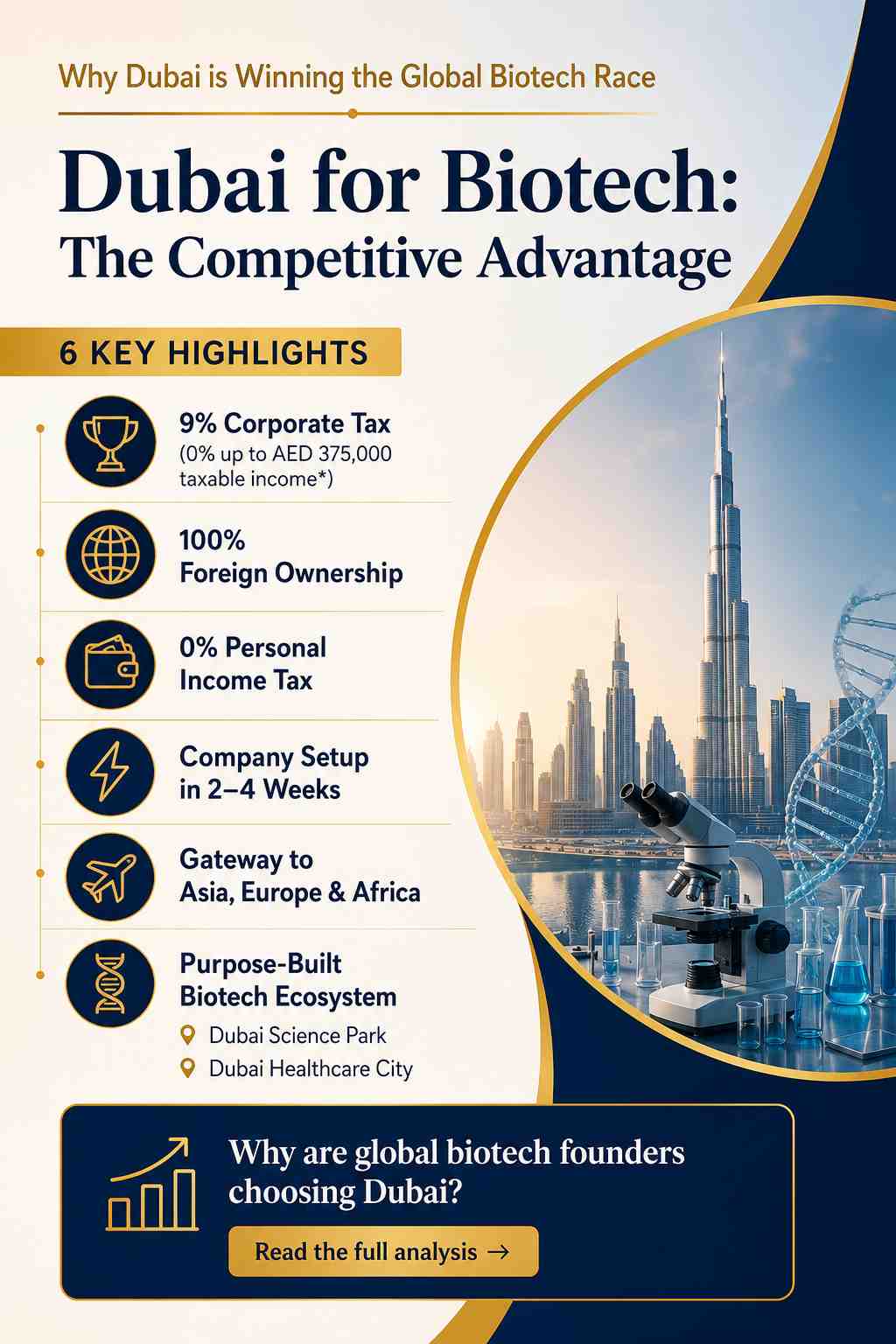
Start with the fundamentals. The UAE offers no withholding taxes on outbound dividends or royalties, unrestricted repatriation of capital and profits, and an extensive network of double taxation agreements — the UAE Ministry of Finance reports 137 concluded agreements, including with most EU member states.[1] Taxable profits below AED 375,000 attract a 0% corporate tax rate, and profits above that threshold are taxed at 9%, a rate that compares favorably with virtually any developed market.[2] Free zone structures allow qualifying biotech entities to maintain preferential treatment provided they meet the zone’s conditions for Qualifying Free Zone Person status, making the choice of free zone one of the most consequential early corporate decisions a founder will make.[2]
Europe: Red Tape as a Business Model
Europe is, by most objective measures, the most structurally hostile environment for a founder attempting to build and scale a biotech company. The problem is not scientific talent or research quality, both of which remain world-class, but everything that surrounds the science: corporate formation, compliance architecture, tax treatment, and the sheer velocity of regulatory change.
Compared to the UAE, which maintains a simplified and low-tax structure that encourages flexibility and international growth, the EU continues to place higher priority on harmonization and transparency through intricate and frequently high-tax frameworks. Corporate tax rates across major European biotech jurisdictions typically range from 25% to 30%, with Germany reaching approximately 30% once the federal corporate income tax, the solidarity surcharge, and municipal trade tax are combined, France at a headline 25%, and the United Kingdom maintaining a main rate of 25% alongside a compliance burden that has grown rather than diminished following its departure from the single market.[3] Beyond the headline rates, founders in Europe contend with VAT obligations, social contribution requirements, mandatory works council structures in certain jurisdictions, GDPR compliance costs that are particularly acute for clinical-stage biotech companies handling patient data, and increasingly fragmented national interpretations of EU-wide regulations.
The regulatory timeline for a biotech company in Europe compounds these corporate costs. The EMA operates across 27 member states with overlapping national competent authorities, each maintaining its own nuances around clinical trial approvals, manufacturing site inspections, and reimbursement negotiations. A company launching a Phase II trial across three European markets will typically engage three separate competent authorities, three ethics committees, and three distinct sets of national requirements, even where the EU Clinical Trials Regulation nominally harmonizes the process. Strategic partnerships and parallel EMA submissions have become critical tools simply to navigate the fragmented regulatory landscape, a telling indicator of how much operational overhead European expansion demands before a single patient is enrolled.
For a founder without pre-existing European corporate infrastructure, the activation cost of establishing a meaningful presence is high, the timeline is long, and the ongoing compliance requirements consume capital that should be allocated to R&D.
The United States: Capital Access at a Price
The US remains the gold standard for venture capital density, scientific talent, and capital markets access. A Delaware C-corporation is the structure expected by institutional investors, and the legal infrastructure around it is mature, predictable, and well-understood. That acknowledged, the cost of operating within that structure is substantial from day one.
The federal corporate tax rate stands at 21%, with Delaware C-corporations required to file annual returns and pay franchise taxes regardless of whether the company generated any income during the year. Combined corporate tax rates in certain US states can exceed 27% when state corporate income taxes are added to the federal rate. The immigration and banking infrastructure around foreign-founded companies adds further layers of cost and time, and the FDA’s 2025 workforce reduction of approximately 3,500 roles, with terminations effective on 1 April 2025, introduced meaningful uncertainty into development timelines.[4] While the Department of Health and Human Services stated that drug, medical device, and food reviewers and inspectors would be spared, independent legal and industry analysts noted that the loss of supporting staff would likely make agency guidance, application feedback, and approval timelines less predictable, with the greatest impact falling on products still in development.[4] For a company not yet targeting a NASDAQ listing, the US structure carries significant overhead relative to the benefits it delivers in the early years.
Australia: A Brief Note
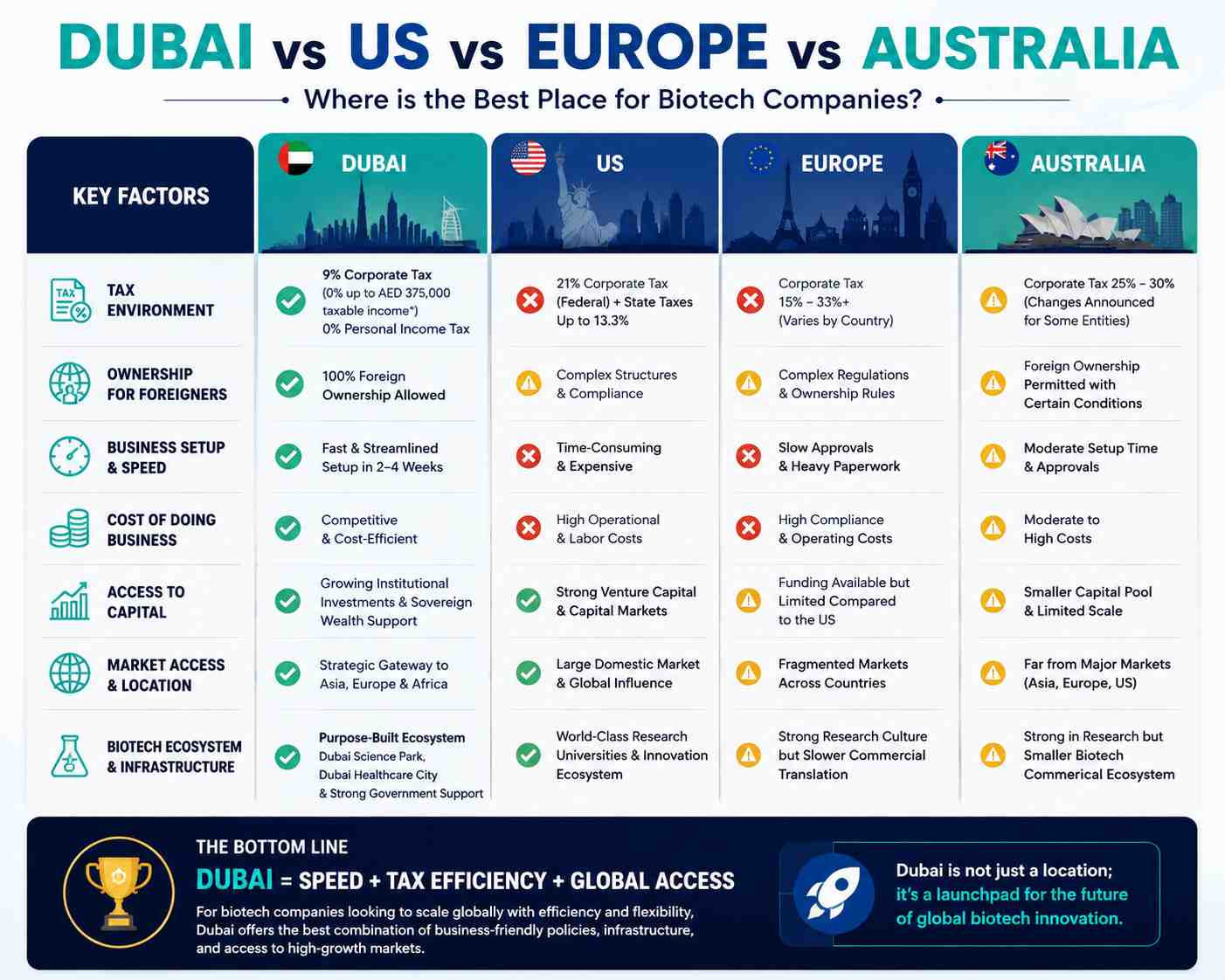
Australia warrants mention only in the sense that it serves as a cautionary example of what policy instability looks like in practice. A market that once offered competitive R&D incentives has progressively undermined its own attractiveness through unannounced regulatory changes. The 2026–27 Federal Budget proposed limiting the refundable tax offset under the Research and Development Tax Incentive to companies less than ten years old, a change the sector says was introduced without consultation. Nine industry bodies, led by AusBiotech, co-signed a letter to the Treasurer requesting an urgent review, with AusBiotech stating that the sector had been “blindsided” by a proposal that fails to recognise the decade-plus development timelines intrinsic to health innovation.[5] AusBiotech further noted that, on its own figures, biotechnology has cumulatively been Australia’s largest value-add export industry outside primary industries since 2016, supporting more than 350,000 jobs across almost 3,000 organisations.[5] The same Budget proposed replacing the long-standing 50% capital gains tax discount with cost-base indexation and introducing a 30% minimum tax on real capital gains, both applying to gains arising after 1 July 2027 — measures that remain proposed legislation not yet passed by Parliament, and which founders and investors warn would materially weaken startup incentives.[6] For a foreign biotech founder, Australia offers neither the capital market depth of the US, the research ecosystem density of Europe, nor the corporate efficiency of Dubai. It is not a serious first-choice jurisdiction for an internationally-oriented life sciences company.
Dubai’s Infrastructure and Speed Advantage
Standard office incorporation in a Dubai free zone takes two to four weeks, with lab installations requiring two to four months due to safety and regulatory permits. That timeline is exceptional by any international standard. The UAE’s move to permit full foreign ownership of mainland companies — introduced through the 2020 amendment to the Commercial Companies Law and effective from June 2021 — allows founders to structure governance entirely on their own terms, without mandatory profit-sharing or local partner requirements.[7] Dubai Healthcare City provides a regulated healthcare-only ecosystem hosting hospitals, clinics, universities, and labs, with particular strength in diagnostics, clinical trials, digital health, and genomics. Dubai Science Park serves R&D-focused companies with wet lab infrastructure and grant access, while Jebel Ali Free Zone serves companies requiring manufacturing scale and export logistics, with direct access to Jebel Ali Port and Al Maktoum Airport and simplified customs exemptions.
The UAE’s logistics network provides reach across Asia, Africa, and Europe within hours, benefiting both digital health companies and pharmaceutical companies conducting regional clinical trials. No comparable jurisdiction combines that geographic access with zero personal income tax, full foreign ownership, and a purpose-built biotech free zone cluster under a single corporate framework.
Institutional Capital and Regional Momentum
Sovereign capital is now a structural feature of the regional life sciences landscape rather than an aspiration. Through Mubadala Capital, the Abu Dhabi sovereign investor holds roughly 45 life sciences companies in its portfolio, with named positions including Recursion Pharmaceuticals, Iambic Therapeutics, and Neumora Therapeutics, and has moved directly into regional biopharma manufacturing through its partnership with Resilience to build the first GMP biologics facility of its kind in the UAE.[8] That capital base sits alongside a Middle East clinical trials market estimated at approximately USD 638 million in 2024 and growing at around 7% annually, with Saudi Arabia alone reporting over 400 active studies and both UAE Vision 2031 and Saudi Vision 2030 explicitly prioritising clinical research infrastructure — signalling a region that has moved well beyond aspiration into operational credibility.[9]
The Conclusion
For a biotech founder evaluating where to build a company with genuine long-term corporate efficiency, access to institutional capital, and proximity to a fast-growing patient population, Dubai is the answer that the numbers consistently support. Europe imposes structural costs that are incompatible with early-stage capital efficiency. The US offers depth but demands a level of overhead that only makes sense at a later stage of maturity. Australia is simply not in the conversation for a globally-oriented founder. Dubai, by contrast, offers the rare combination of zero personal income tax, a 9% corporate ceiling, full foreign ownership, two-to-four-week incorporation, purpose-built infrastructure, and sovereign capital backing. The corporate case has never been stronger.

Explore More
Dubai’s rise as a biotech hub reflects a broader trend—the UAE is becoming one of the world’s most attractive destinations for entrepreneurs and investors across multiple industries. If you’re evaluating expansion opportunities, these resources provide additional insights:
- Top Business Opportunities in UAE for 2026
- How to Build a Successful Startup in the GCC
- Top 10 FinTech Startups in UAE
- How GCC Leaders Are Using AI to Grow Their Business
- Top Real Estate Companies in Dubai
These related guides will help you better understand the business ecosystem that makes Dubai a compelling destination for innovation and growth.
References
[1] UAE Ministry of Finance, Double Taxation Agreements — 137 concluded DTAs (193 DTAs and Bilateral Investment Treaties combined), April 2026.
[2] UAE Federal Decree-Law No. 47 of 2022 (Corporate Tax), administered by the Federal Tax Authority: 0% on taxable income up to AED 375,000, 9% above; Qualifying Free Zone Person regime. Federal Tax Authority guidance, 2026.
[3] Germany Trade & Invest (GTAI), “Corporate Taxation in Germany” — 15% federal corporate income tax plus 5.5% solidarity surcharge and municipal trade tax, combined burden averaging approximately 30%; PwC Tax Summaries, France (25% standard) and United Kingdom (25% main rate), January 2026.
[4] US Department of Health and Human Services fact sheet, March 2025; STAT News, “HHS cuts to include 3,500 FDA layoffs,” 27 March 2025; Skadden, Arps, “Mass Layoffs at FDA Could Have the Greatest Impact on Products in Development,” April 2025 — terminations effective 1 April 2025; HHS stated reviewers and inspectors would be spared, though analysts flagged downstream effects on guidance and approval predictability.
[5] AusBiotech and eight co-signatory industry bodies (Pathology Technology Australia, MTPConnect, ANDHealth, Life Sciences Queensland, Life Sciences WA, BioNSW, BioMelbourne Network, ARCS Australia), joint letter to the Treasurer, June 2026, reported by Biotechdispatch and BioMelbourne Network — proposed limitation of the R&D Tax Incentive refundable offset to companies under ten years old; “largest value-add export industry outside primary industries since 2016” and the 350,000 jobs / 3,000 organisations figures are AusBiotech’s own.
[6] Australian Government, Budget 2026–27, “Tax reform” — replacement of the 50% CGT discount with cost-base indexation and a 30% minimum tax on real capital gains for gains arising after 1 July 2027; Ashurst and Clayton Utz Budget analyses, May 2026; measures remain proposed legislation pending passage through Parliament.
[7] UAE Federal Decree-Law No. 26 of 2020 amending the Commercial Companies Law, permitting 100% foreign ownership of mainland companies, effective 1 June 2021.
[8] BioPharma Dive and PharmaVoice interviews with Mubadala Capital, July 2024 — approximately 45 life sciences portfolio companies; Mubadala corporate release on the Resilience biopharma manufacturing partnership in the UAE; Markets Group, Neumora Therapeutics financing, 2025.
[9] Grand View Research, “Middle East Clinical Trials Market” (USD 638 million in 2024, ~7% CAGR) and “Saudi Arabia / UAE Clinical Trials Market” outlooks, 2025–2026; ResearchAndMarkets, “Saudi Arabia Clinical Trials Market,” February 2025 (over 400 active studies); Clinical Trials Arena, “UAE positions itself as a regional clinical trial hub,” December 2025.



Pingback: Dr. George Syrmalis on Biotech Investment & BEP Strategy