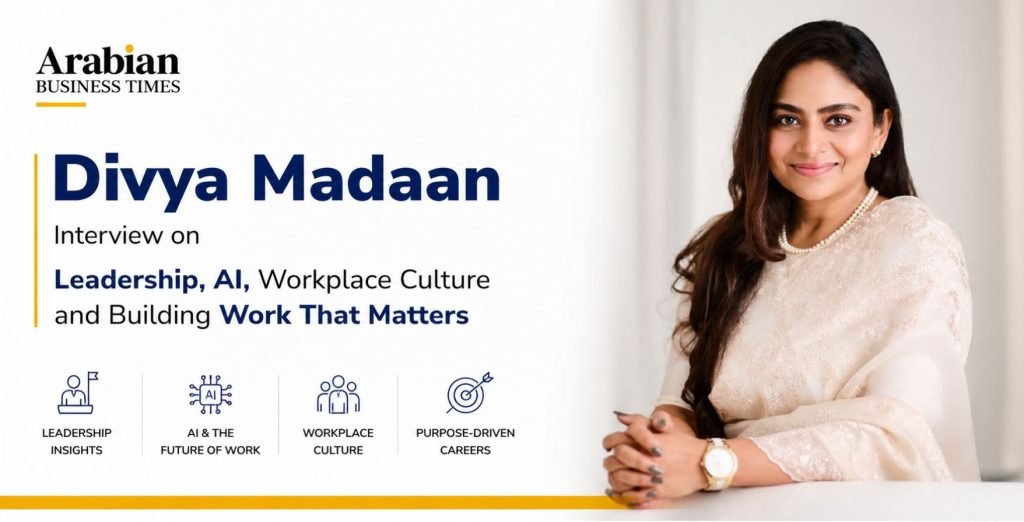
With more than 25 years of experience across technology, business transformation, and leadership, Divya Madaan has built her career around a belief that meaningful transformation is ultimately about people. As Co-founder of WOCULT and author of Digital Transformation for New India, she brings a perspective shaped by leading large technology teams, working across global markets, and observing how workplace culture can determine whether organisations truly succeed.
In this exclusive conversation with Arabian Business Times, Divya shares her perspective on building healthy workplace cultures, the impact of AI on leadership and talent, the challenges women continue to face in professional environments, and the principles that have guided her entrepreneurial journey. At the heart of her philosophy is a simple idea: technology may accelerate change, but human judgment, trust, purpose, and leadership remain the forces that give transformation meaning.
Divya Madaan – Co-founder, WOCULT · Author, Digital Transformation for New India
With over 25 years of experience in technology and business leadership, what inspired your entrepreneurial journey, and what have been the defining milestones that shaped your career?
I began over two decades ago as an engineer, close to the code, and spent the years since inside large technology organisations leading their delivery and transformation portfolios across retail and financial services. I led multi-geographical technology teams of two hundred and more, delivered programmes across the US, Asia and Europe, and eventually wrote a book, Digital Transformation for New India, about doing this well in our own context. But the defining milestones weren’t the titles or the deal sizes. What I learnt, repeatedly, is that the people dimension is the linchpin of any successful and sustained transformation. The technology is rarely the hard part; the human part defines whether the transformation succeeds or fails. The moments that shaped me most were watching genuinely capable people disengage because no one was listening about their experience of working, and I saw the organisations losing their greatest assets — people — who could have taken them from good to great. Wocult is the answer I decided to build rather than keep observing.
You co-founded Wocult, a platform focused on work, culture, and meaningful lives. What inspired you to create Wocult, and what gap did you identify in today’s professional ecosystem?
We founded Wocult because the working professionals had everything except a home of their own and tells a story from their point of view. There is no shortage of content about work but most of it is corporate glorification and messaging, motivational noise, or academic distance, and none of it spoke to the working professional as an intelligent adult with a full life. The gap was editorial, not informational: an independent destination with a point of view, edited to a standard, that treats work, culture and life as one complete story rather than three separate entities. Wocult is India’s first independent editorial destination built for exactly that reader, corporate professionals across every level, industry and career stage. Our promise is simple: work should feel good, and we’re here until it does.
Workplace expectations have changed dramatically over the past decade. In your view, what defines a healthy and high-performing workplace culture in today’s rapidly evolving business environment?
A healthy culture and a high-performing one aren’t two separate things, the idea that you trade one for the other is the most expensive myth in modern management. What defines it is candour without brutality and standards without fear. People perform when they know what “good” looks like, trust that effort will be seen, and believe they can name a problem before it becomes a crisis. Perks and slogans don’t build that; consistency does. The healthiest cultures I’ve observed are almost consistent in their reliability, in healthy cultures decisions are explained, feedback is specific, and the distance between what leaders say and what they do, is small. Everything else is decoration. Culture is the sum of conditions that determine what this place actually values, and what your future here looks like. It is how you feel on a Sunday evening and what you do on Monday when no one is watching. Culture is how people feel about the organisation and about their future in it.
Having witnessed multiple waves of technological transformation, how do you see Artificial Intelligence reshaping leadership, talent development, and the future of work over the next five years?
Over the next five years, AI will remove a great deal of the work that used to fill a career, and expose how little of it was ever the point. The organisations learning this the hard way are the ones that automated aggressively, lost institutional judgement, and rehired the people they had let go. Organisations that are widely experimenting without clearly identifying the value they want to create, are just wasting their resources. The lesson isn’t that AI is overrated; it’s that trust, discernment and context don’t come out of a model.
Leadership shifts from directing tasks to curating judgement, deciding what is worth doing, and holding the line on quality when the machine makes mediocrity effortless. For talent, the premium moves to the distinctly human ability to think critically, own the outcomes, ask the right questions and weigh a decision before making it. The leaders who thrive will treat AI as leverage, not a tech problem to be solved but a business outcome to be owned. AI can be a good slave but not a great master.
AI will expose the mediocre leaders and establish the ones distinctly with time-tested true leadership traits: vision, purpose, ownership, humility, fierce resolve, team-oriented success.
As an author, keynote speaker, and host of the Leaders Unscripted podcast, you’ve had conversations with numerous industry leaders. What leadership traits consistently stand out among the most successful executives?
Across the conversations I’ve hosted, the traits that recur most are honesty, authenticity, adaptability and discipline. The leaders who’ve genuinely earned their standing tend to be unguarded about what they got wrong, learn from failures and move forward with humility, embrace uncertainty, and are precise about the difference between what they know and what they’re guessing. A close second is restraint, the discipline not to fill every silence or solve every problem personally, and to let others carry real weight. And almost all of them share a plainness of speech; they explain complex things simply because they actually understand them. What you rarely find at that level is bluster. The most impressive people I’ve spoken to are usually the calmest ones in the room.
Women continue to make remarkable strides in business and technology. What challenges still remain for women in leadership, and what practical steps can organizations take to build more inclusive workplaces?
The visible barriers have thinned but the structural ones haven’t. Having led diversity and inclusion work inside global organisations, I came away convinced that good intentions are the easy part but the genuine design is the hardest. Women still carry a disproportionate share of the invisible work: the coordination, the emotional labour, the “just organising this” that never appears on a promotion case, and the further up you go, the lonelier the pipeline becomes. The most useful thing organisations can do is stop treating inclusion as sentiment and start treating it as design: transparent criteria for advancement, so judgement can’t hide behind vagueness; sponsorship rather than mentorship, so someone with power is actually spending it on your behalf; and honest scrutiny of who gets the stretch assignments that build careers. I am a huge proponent of the belief that leadership is gender-agnostic. While considering a promotion or identifying a leader for a top-role, the profile of the candidate should be read without the pronoun or the name on it. Let women handle their families, their children and their work on their own; the organisations should handle their own unconscious biases, and let the careers of women blossom based on their capability, skills and leadership traits.
Innovation requires both vision and resilience. What leadership principles have helped you successfully navigate challenges while building businesses and empowering professionals?
Over my long journey, I have acquired the style of situational leadership. I have learned to operate on the idea that effective leaders adapt their style to each situation. No one style is appropriate for all situations and I deploy a different style based on what the situation demands — directing, coaching, delegating and supporting. However, my natural instincts are those of a servant leader.
Three principles guide my thinking. The first is to identify the problem because I believe that a problem is 50% solved when it is clearly articulated. The second is that you move at the speed of trust; you can’t shortcut the relationships that you have with the team. The third is the willingness to be the one who says the uncomfortable thing early, while it’s still cheap to fix; and own the outcomes. Building anything worthwhile, whether a transformation programme spread across time zones or a company from scratch, means being wrong in public and recovering in public.
Resilience, for me, is the adaptability of the mind to recover from setbacks, spirited drive with relentless passion, rooted in an undying belief anchored on purpose.
Today’s professionals often struggle to balance career growth, purpose, and personal well-being. What advice would you give to individuals seeking meaningful and sustainable careers?
One cannot have everything at full intensity at once, and the professionals who burn out are usually the ones trying to. Decide what this particular season of your life is for, protect that, and let the rest run at maintenance without guilt. Second, purpose is far quieter than it appears on social media. Purpose is about becoming a full human being alongside work that you can be respected for. It is about building an earned life. So, I suggest that the professionals optimise for the work they’d be willing to sign their name to, alongside people who make you feel fulfilled. And guard your health as an asset, prioritise what matters. In my opinion, at the end all that matters, either we are leaving an organisation or the world, it’s about leaving it a little better than we found it.
Looking ahead, what emerging trends do you believe will redefine business leadership, workplace culture, and organizational success over the next decade?
As AI commoditises execution, the rare and valuable thing becomes the human judgement. The second is radical transparency; information moves too fast for closed cultures to survive, and the winners will be those comfortable being ‘seen’ clearly. The third is the return of loyalty as a two-way contract. After years of disposable employment, the companies that invest in people through uncertainty will find that talent has a long memory. And beneath all of it, culture stops being an HR programme and becomes the actual product: how it feels to work somewhere will be as consequential to results as the strategy itself.
Finally, what advice would you give to aspiring entrepreneurs, technology professionals, and future leaders who want to build impactful careers while creating lasting value for society?
Build something you’d respect if no one was watching you. The questions I ask myself every day in the morning while looking at myself in the mirror: Am I making this world a better place for others? And is there a regret that I have which I should work towards today?
The incentives to chase attention, funding and speed are enormous, and most of them pull you away from the slow work of making something genuinely good and with conviction. Choose problems you find worth solving for on the days that feel low because that stubbornness is the only thing that survives the middle, when the excitement is gone and the results haven’t yet arrived. Be generous early and precise always. And create value before you extract it; the founders and professionals who last are the ones who build with purpose and let the profit follow, not the other way around.
What personal philosophy or life principle has guided your journey, and what message would you like to share with the next generation of entrepreneurs, innovators, and leaders?
My guiding principle is simple: Live purposefully.
Do work that’s worth the life it costs. Every project, every year, is paid for in time you don’t get back, so the standard I hold is whether the work deserves that price. I am a purpose-driven person and achieving outcomes energises me. At the same time, I like to keep my conscience clean and work towards the larger good for the world around me.
To the next generation, I’d say resist the pressure to be loud before you’re good. Depth is quieter and humbler than visibility, but it lasts far longer. Build things that are honest, useful and made to a standard you’re proud of, and trust that meaning is the by-product of building an earned life.
ABOUT DIVYA MADAAN
| Divya Madaan is the Co-founder of WOCULT, an independent media and editorial destination covering work, culture and life for the modern working professional. A technology and transformation leader with over 25 years across retail and financial services, an IIM Ahmedabad alumna, she is the author of Digital Transformation for New India.
Designation Co-founder, WOCULT | Author, Digital Transformation for New India Website – https://www.wocult.com/ LinkedIn – https://www.linkedin.com/in/divya-madaan-aa5a3211/ Instagram – https://www.instagram.com/divya_on_point |