
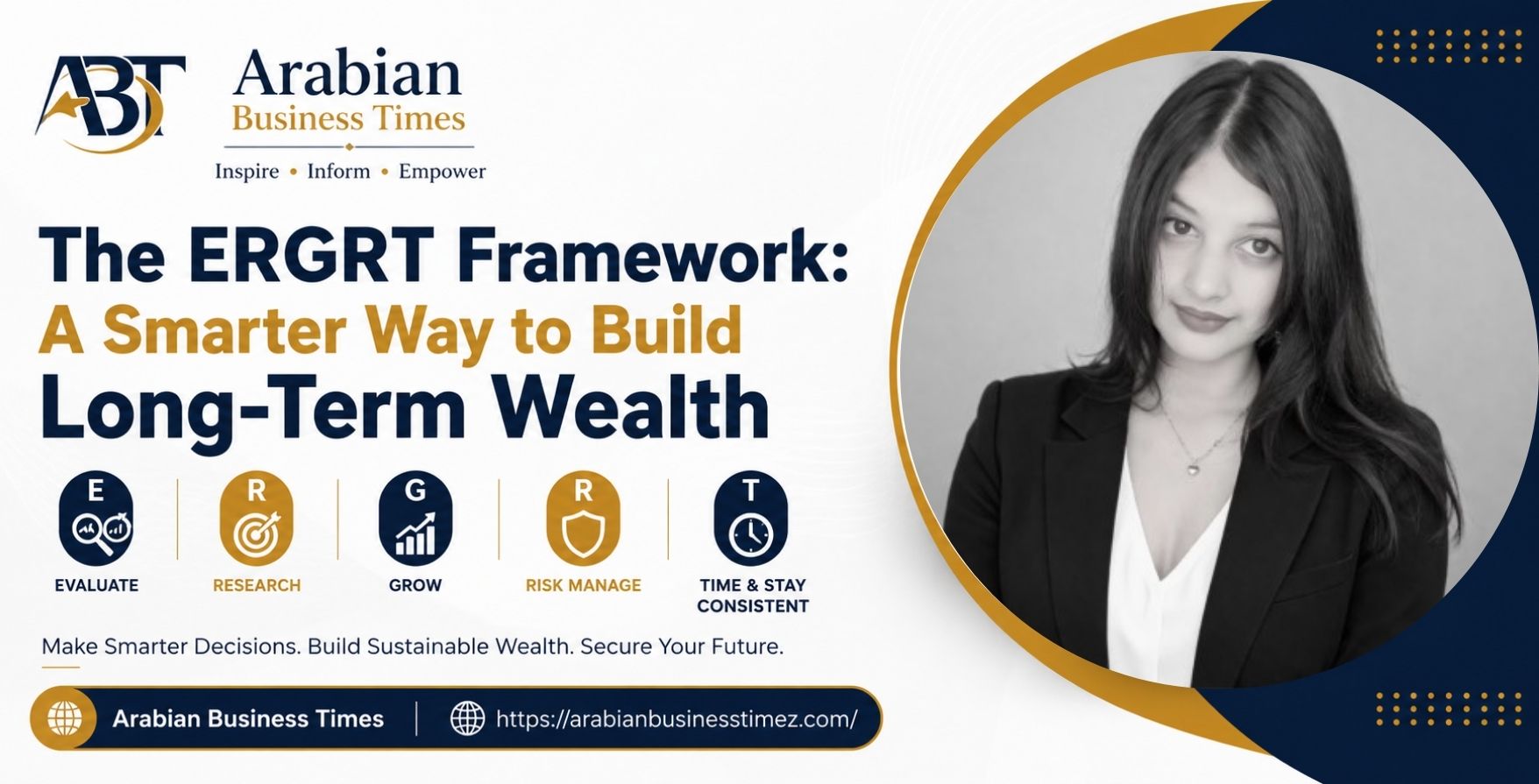
Key Takeaways
- Emergency first: Build a liquid emergency fund covering 3–6 months of essential expenses before investing.
- Risk is broader than volatility: Adequate life and health insurance are foundational to wealth protection.
- Goals drive portfolios: Define specific, time-bound financial goals before selecting any investment product.
- Retirement planning rewards early starters: The compounding advantage of starting early cannot be overstated.
- Tax planning is the final layer, not the first: Build the right financial plan first, then optimize it for taxation.
- The ERGRT Framework – Emergency, Risk, Goals, Retirement, Taxation, puts the person before the portfolio.
Introduction
Over years of working in wealth management and advising investors across age groups and income levels, one pattern keeps repeating itself – and it concerns me.
Not just young professionals, but even seasoned entrepreneurs, senior executives, and business leaders are managing their finances reactively rather than strategically.
Their portfolios may be growing. They may hold stocks, mutual funds, insurance policies, real estate, and various other assets. But rarely do I come across a portfolio that has been thoughtfully designed around the investor’s actual profile — one that is genuinely aligned with every dimension of sound financial planning.
Most people invest first and plan later.
I believe it should be the other way around.
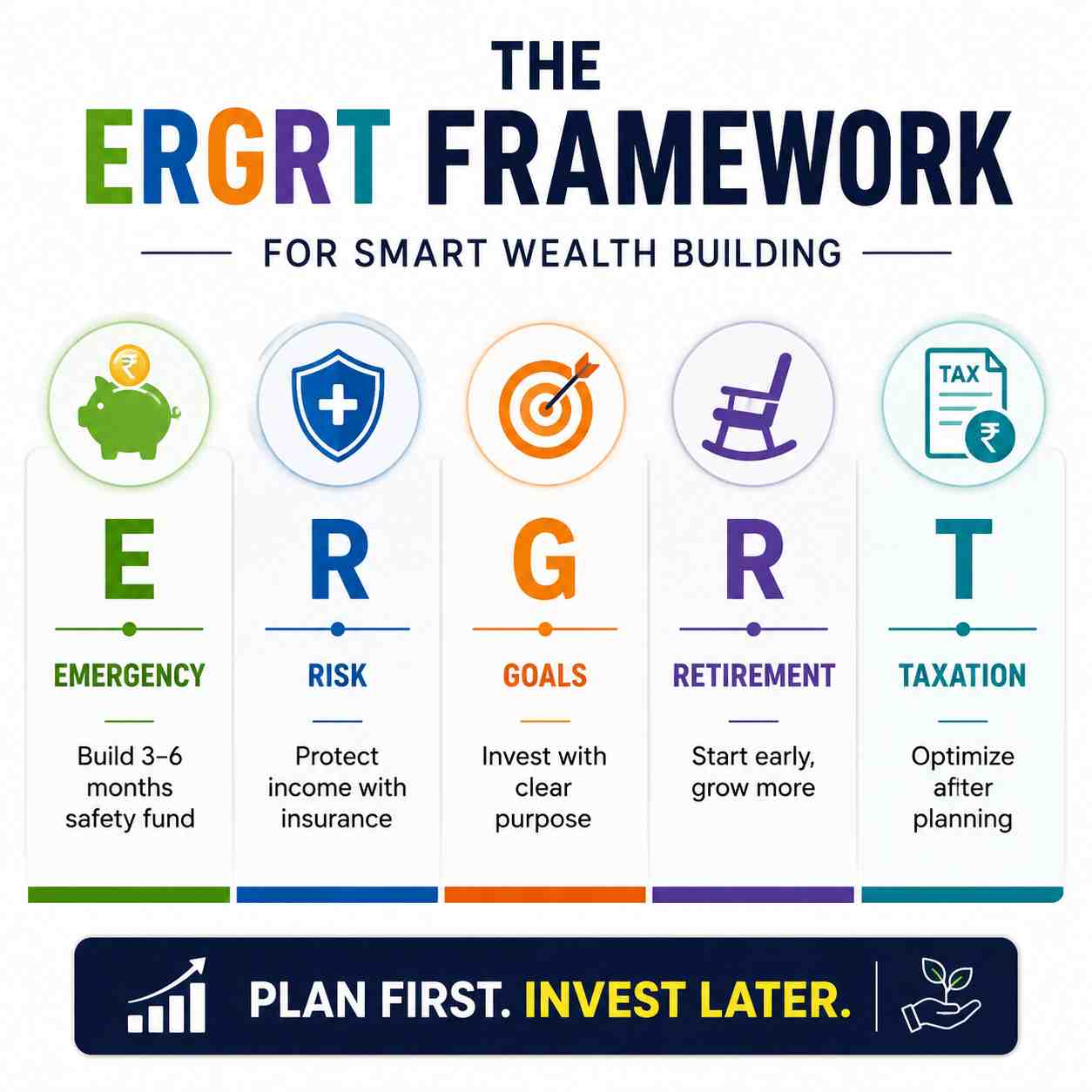
This is why I rely on what I call the ERGRT Framework — a five-step, person-first approach to building long-term wealth. It is not a framework you will find in mainstream textbooks or popular finance courses. It is something I developed through years of on-the-ground experience, observing what truly works for sustainable, purposeful wealth creation.
The framework is built around five pillars:
- E – Emergency
- R – Risk
- G – Goals
- R – Retirement
- T – Taxation
Let us explore each one in depth.
E — Emergency: The Foundation Before the Portfolio
Why an Emergency Fund Is Non-Negotiable
This is perhaps the most overlooked yet most critical step in personal financial planning.
Most investors ask me where they should invest. Very few pause to ask whether they are financially prepared for an emergency.
Life is unpredictable. Job losses happen. Medical crises arise without warning. Businesses go through turbulent phases. Family emergencies do not send calendar invites.
Financial stress should never become the second crisis when you are already managing the first.
How to Calculate Your Emergency Fund
Ideally, every individual or family should maintain an emergency fund equivalent to 3 to 6 months of essential monthly expenses.
This is not part of your investment portfolio. It is your financial safety net.
It must remain easily accessible, held in highly liquid instruments such as:
- Savings accounts
- Sweep-in fixed deposits
- Liquid mutual funds
A straightforward formula to determine your target:
Emergency Fund = Monthly Mandatory Expenses × Number of Months
Mandatory expenses typically include:
- Rent and household costs
- Grocery and utility bills
- Insurance premiums
- Education fees
- EMIs and loan obligations
Practical example: If your monthly essential expenses are ₹60,000 and you want a six-month buffer:
₹60,000 × 6 = ₹3.6 lakh
This reserve ensures you never have to liquidate investments at the wrong time, take high-cost emergency loans, or make panic-driven financial decisions.
For investors seeking portfolio diversification beyond equities and debt, understanding how to invest in UAE real estate can help align long-term wealth goals with tangible assets.
R — Risk: Protect What You Are Building
Understanding Risk Beyond Market Volatility
Once the foundation is secure, the next question becomes: How much risk can you actually afford to take?
Most investors associate risk exclusively with stock market volatility. In reality, financial risk is far broader.
- What if your income stops suddenly?
- What if a medical emergency drains years of savings?
- What happens to your family’s financial security if you are no longer around?
The Role of Insurance in Wealth Protection
This is where comprehensive insurance planning becomes essential.
In my experience, a large proportion of investors are either underinsured or hold expensive policies without truly understanding whether the coverage is adequate.
A practical starting point is calculating your Human Life Value (HLV) — an estimate of the economic value of your future earning capacity.
A widely used thumb rule:
Life Insurance Cover = 10–15× Annual Income + Outstanding Liabilities + Future Financial Goals
For health insurance, young professionals may consider coverage of ₹10–20 lakh, while families with dependents may require significantly higher protection.
Insurance is not a wealth-creation tool. It is a wealth-protection tool. That distinction matters enormously.
Aligning Your Investment Risk Profile
Once your protection layer is in place, assess your investment risk appetite honestly. Ask yourself:
If my portfolio drops by 10 percent overnight, will I lose sleep or stay the course?
Your risk profile is shaped by two factors:
- Your emotional comfort with market fluctuations
- Your investment time horizon
A person investing for three years and a person investing for 20 years should never hold the same portfolio.
| Risk Profile | Time Horizon | Suggested Approach | Benchmark |
|---|---|---|---|
| Low Risk | 3–5 Years | Evergreen sectors: FMCG, healthcare, consumer | Nifty 100 |
| Low Risk | 5–20 Years | 40% evergreen + 60% structural themes (financials, manufacturing, tech) | Nifty 300 |
| High Risk | 3–5 Years | Diversified; avoid over-exposure to cyclicals | Nifty 300 |
| High Risk | 5–20 Years | 40% evergreen + 60% long-term growth themes | Nifty 500 |
There is no universally perfect portfolio. There is only a portfolio that is perfect for you.
Entrepreneurs expanding globally should also consider how taxation intersects with broader international business expansion strategy decisions.
G — Goals: Making Investing Purposeful
Why “Good Returns” Is Not a Financial Goal
This is the stage where investing transforms from activity into intention.
Many investors tell me they want “good returns.” But returns are not goals.
Goals are specific, time-bound, and personal:
- “I want to purchase a home worth ₹1 crore in five years.”
- “I want to fully fund my child’s higher education in 12 years.”
- “I want to accumulate ₹5 crore by the age of 55.”
Building a Goals-Based Portfolio
Once goals are clearly defined, the right questions follow naturally:
- Is this goal realistically achievable?
- How much should I invest monthly to reach it?
- What rate of return is a reasonable assumption?
- What level of discipline and consistency is required?
This is where asset allocation becomes the strategic core of financial planning.
Your portfolio should not be assembled based on market trends or product recommendations. It should be built around:
- Goal amount and target timeline
- Expected return assumptions
- Risk appetite and emotional resilience
- Liquidity requirements at each life stage
Depending on the goal, your asset mix might include:
- Equity for long-term capital growth
- Debt instruments for stability and income
- Gold for portfolio diversification
- Real estate for long-term wealth preservation
- Alternative assets such as AIFs, NCDs, or structured products, where suitable
A goal maturing in two years demands an entirely different allocation from one maturing in 20 years.
Goals-based investing converts a collection of financial products into a structured, purposeful financial journey.
Before allocating capital to property, investors should establish an emergency fund, assess risk tolerance, and define financial goals using the ERGRT Framework.
R – Retirement: The Cost of Starting Late
Why Retirement Planning Cannot Wait
One of the most common and costly mistakes I encounter is investors beginning retirement planning only when retirement is close.
The mathematics of compounding is unforgiving in this regard: the earlier you start, the less you need to invest to reach the same outcome.
Retirement planning begins with a fundamental question:
How much money will I need every month after I stop working?
Calculating Your Retirement Corpus
To arrive at a realistic retirement target:
- Estimate your current monthly living expenses
- Adjust for inflation over your remaining working years
- Determine how many years your corpus must sustain you post-retirement
- Back-calculate the total corpus required
Retirement Planning Vehicles in India
India offers a range of instruments suited to retirement planning:
- EPF (Employee Provident Fund) — employer-matched, tax-efficient
- PPF (Public Provident Fund) — long-term, government-backed
- NPS (National Pension System) — market-linked with annuity options
- Mutual Funds via SIPs — flexible, equity-linked growth
- Pension plans and annuities — guaranteed income post-retirement
- SWPs (Systematic Withdrawal Plans) — structured income drawdown during retirement
I have worked with clients whose retirement portfolios not only sustain their lifestyle comfortably but also support their broader families. That outcome was not the result of chasing the highest returns. It was the result of planning early, investing consistently, and staying aligned with long-term goals.
Retirement is not an age. It is a financial state where work becomes a choice rather than a necessity.
T – Taxation: Optimize Last, Not First
Why Tax Planning Should Follow Financial Planning
Taxation is perhaps the most misunderstood element of personal finance — and understandably so. Rules evolve, exemptions shift, and many investors end up making product decisions driven entirely by tax-saving motivations rather than financial logic.
The result is a portfolio built around tax breaks rather than wealth goals. That is a significant strategic error.
India’s Two Tax Regimes: A Practical Overview
India currently offers investors a choice between two tax structures:
Old Tax Regime
Allows taxpayers to claim deductions and exemptions including:
- Section 80C investments: PPF, ELSS, life insurance premiums
- Section 80D: Health insurance premium deductions
- Home loan interest and principal benefits
- HRA (House Rent Allowance) exemptions
- Education loan interest deductions
This regime may be advantageous for individuals who make substantial tax-saving investments and can leverage multiple deductions.
New Tax Regime
Offers:
- Lower, simplified tax slab rates
- Reduced compliance complexity
- Fewer deductions and exemptions
This regime tends to benefit salaried professionals who do not claim extensive deductions or prefer a straightforward tax structure.
There is no one-size-fits-all answer. The optimal regime depends on your income level, investment profile, deductible expenses, and broader financial goals.
The Right Sequence for Tax Planning
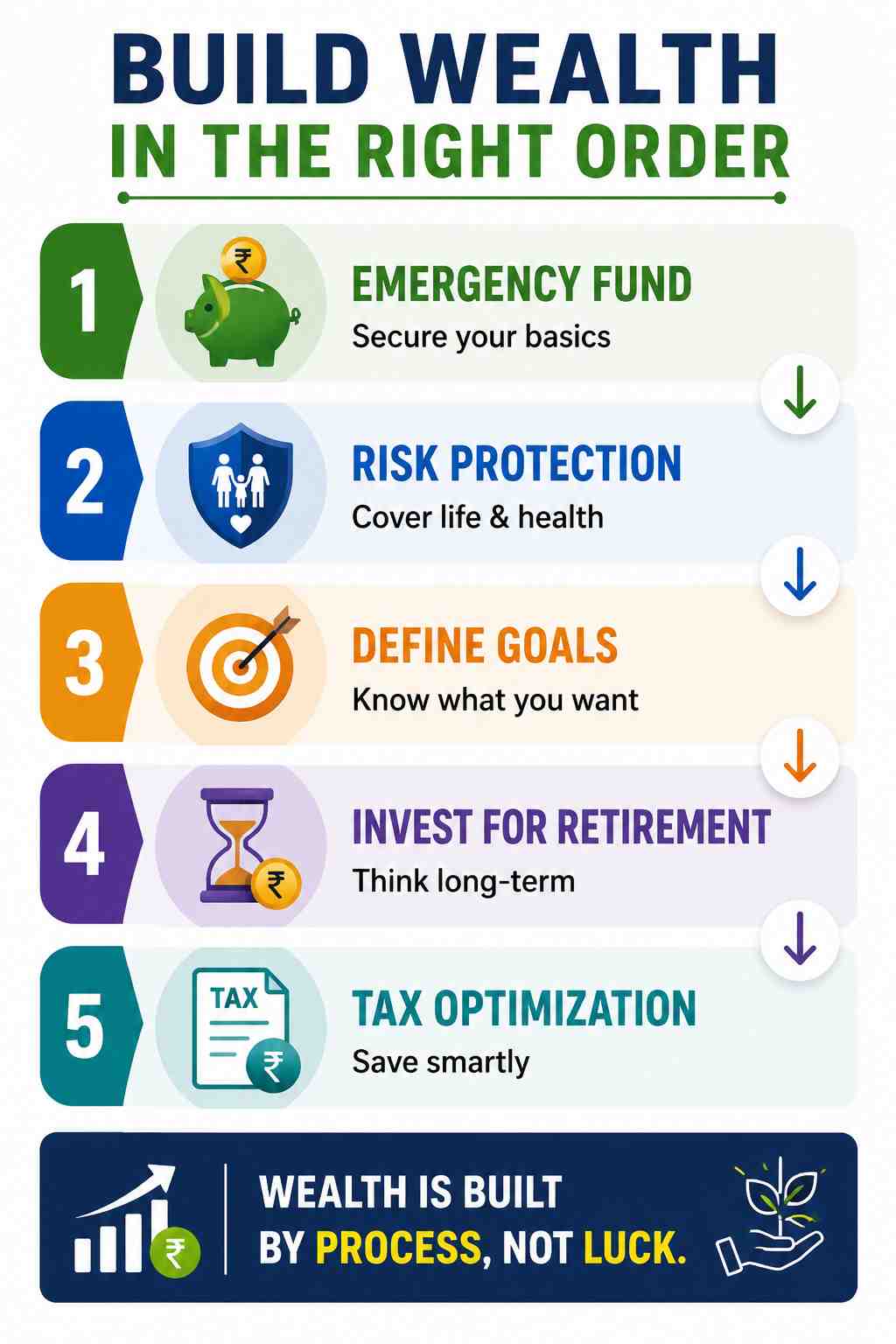
Build the right financial plan first. Then optimize it for taxes.
Taxation should be the final layer of financial planning — not the trigger for financial decisions. Buying a product because it saves tax, without assessing whether it fits your overall plan, is a costly shortcut that undermines long-term wealth creation.
Social commerce platforms are increasingly using AI-powered recommendations, a trend evident in the rapid rise of TikTok Shop fragrance brands.
The Bigger Picture: Wealth Built Intentionally
The ERGRT Framework may appear deceptively simple. But in wealth management, simplicity sustained over time consistently outperforms complexity abandoned along the way.
Start with an emergency fund.
Understand your true risk appetite.
Define your goals with precision.
Plan for retirement early.
Optimize for taxation last.
In my experience, long-term wealth creation is rarely about identifying the next multibagger stock or timing market cycles perfectly. It is about building a financial life that is resilient, purposeful, and deeply aligned with who you are — your values, your responsibilities, and your aspirations.
The most successful investors I have advised are not necessarily the most financially sophisticated. They are the ones who follow a disciplined process and stay the course.
Because long-term wealth is not built randomly.
It is built intentionally.
And the ERGRT Framework is, in my view, one of the most effective places to begin that journey.
Frequently Asked Questions (FAQ)
1. What is the ERGRT Framework?
The ERGRT Framework is a five-step financial planning model developed by wealth management practitioners to help individuals build long-term wealth systematically. It stands for Emergency, Risk, Goals, Retirement, and Taxation — prioritizing the investor’s personal profile before any product or portfolio decision.
2. How much should I keep in my emergency fund?
Your emergency fund should cover 3 to 6 months of essential monthly expenses, including rent, EMIs, groceries, insurance premiums, and utility bills. It should be held in liquid instruments such as savings accounts, sweep-in FDs, or liquid mutual funds for immediate accessibility.
3. How do I calculate the right life insurance cover?
A widely used formula is: Life Insurance = 10–15× your annual income, plus outstanding liabilities, plus the value of future financial goals such as children’s education or a home purchase. The goal is to ensure your family’s financial security is not disrupted in your absence.
4. What is goals-based investing and why does it matter?
Goals-based investing means building your portfolio around specific, time-bound financial objectives — such as buying a home, funding education, or retiring at a target corpus — rather than chasing market returns. It brings discipline, direction, and measurability to your wealth-creation journey.
5. When should I start planning for retirement?
The earlier the better. Thanks to the power of compounding, starting retirement planning in your 20s or early 30s dramatically reduces the monthly investment required to reach the same corpus compared to starting in your 40s. Instruments like EPF, PPF, NPS, and equity SIPs are all effective vehicles for early retirement planning in India.
6. Which tax regime is better — old or new?
It depends on your individual financial profile. The old regime benefits those who make significant tax-saving investments and claim multiple deductions. The new regime is simpler and may suit salaried individuals with fewer deductions. A qualified financial advisor can model both scenarios to identify the optimal choice for your specific situation.
7. What assets should I include in a goals-based portfolio?
Depending on your goal timeline, risk appetite, and liquidity needs, a well-structured portfolio may include equity (for growth), debt instruments (for stability), gold (for diversification), real estate (for long-term preservation), and select alternative assets such as AIFs, NCDs, or market-linked debentures where appropriate.
8. Can the ERGRT Framework work for high-net-worth investors?
Absolutely. As portfolios grow in size, the importance of structured planning increases rather than decreases. The ERGRT Framework is particularly relevant for HNI and UHNI investors, where risk management, tax optimization, retirement corpus sustainability, and alternative asset allocation become significantly more complex.