Editorial Note: This interview has been adapted from an audio conversation with the executive. Responses have been edited only for clarity and readability while preserving the speaker’s intended meaning.
Watch & Listen to the Full Interview
Prefer watching and listening? Experience the complete conversation with Marina Polta (Miles Senta) as she shares her insights on entrepreneurship, skincare innovation, personal branding, artificial intelligence, and the future of the beauty industry.
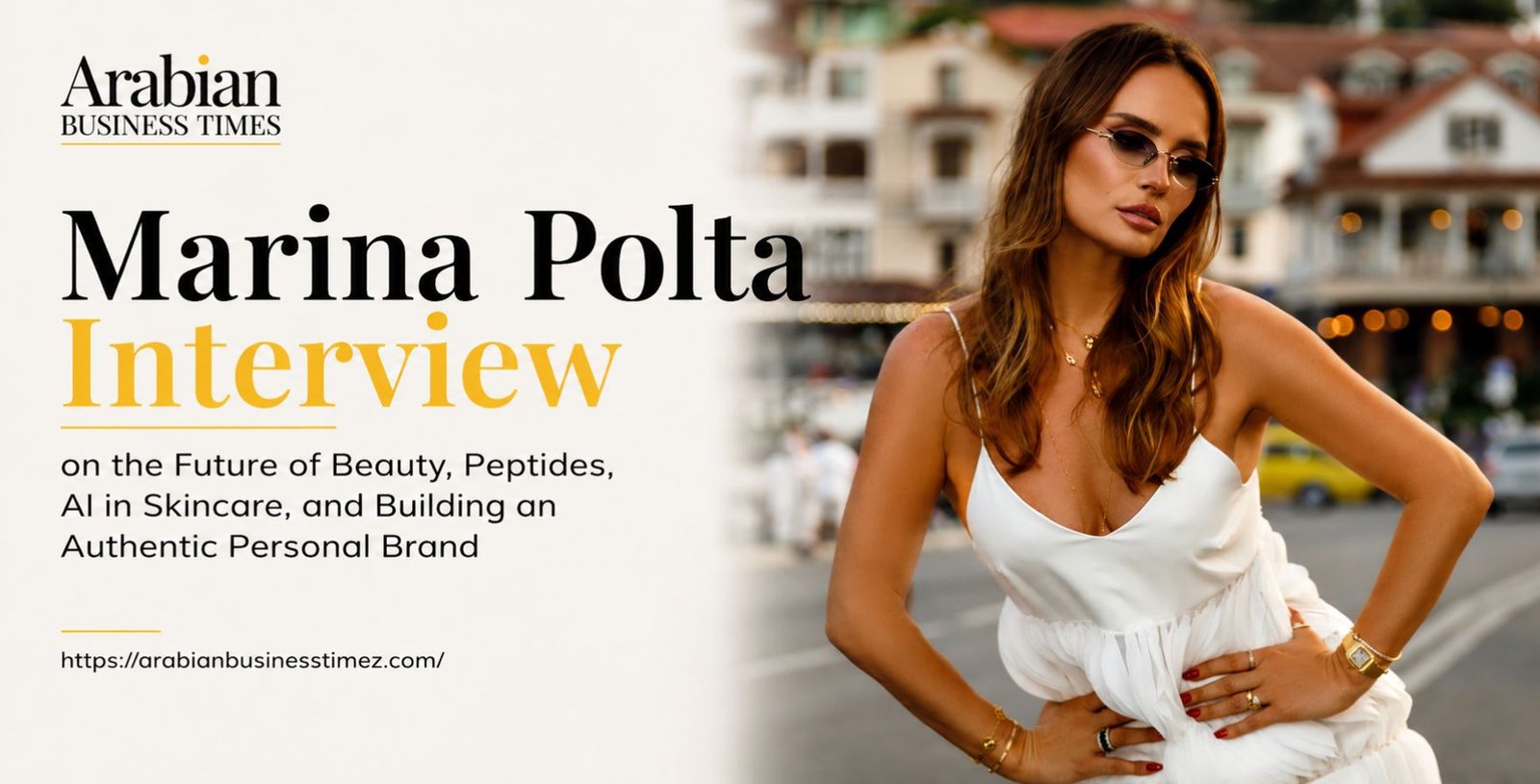
Marina Polta, known to her 120,000 followers on Instagram as Miles Senta, is a cosmetologist, entrepreneur, and digital content creator recognized for her outspoken approach to skincare, beauty industry trends, and personal branding, with a strong emphasis on healthy skincare routines. Over the past two decades, she has built a career that spans clinical cosmetology, cosmetologist training in Italy, and a rapidly growing social media presence built on authenticity rather than polish. In this exclusive interview with Arabian Business Times, Polta speaks candidly about the defining moments of her career, the beauty industry’s shift toward exosomes, peptides, and skin boosters, the misconceptions still holding people’s skincare routines back, and how she has learned to handle public criticism while staying true to herself. She also shares details of her newest venture, a peptide company built around her own protocol, and the advice she gives to women trying to build a career on their own terms.
Your journey combines cosmetology, entrepreneurship, and digital content creation. What inspired you to enter the beauty industry, and what has been the defining moment of your career so far?
I would say it’s been twenty years of very hard work, where it was falling and standing up again, crying through the pain and disbelief, but never giving up hope. That was the most defining part of my journey—the moment I actually started putting myself at the center of my own life, instead of pouring everything into relationships the way I used to.
I started investing in myself. Probably the real turning point was four years ago, when I decided to move from one big cosmetology company to another and start training cosmetologists. I went to Italy for a major training program, and I also started taking lessons in things like public speaking—how to pronounce things properly, how to talk so I could actually reach people, so that whatever knowledge I had could actually land with an audience instead of staying locked inside my own head. So I’d say four years ago was the big step toward this journey. But at the same time, every single failure in my life, every setback along the way, is part of what created who I am today.
Listen to the original answer
The beauty industry has evolved significantly over the past decade. What changes have had the greatest impact on your business, and how have you adapted to meet the expectations of modern consumers?

A lot has changed over the past ten years. For a long time, the beauty industry was focused mostly on fillers and Botox, without much technology involved in improving the skin’s actual elasticity. Over the last five years, exosomes have entered the market in a significant way, and I started focusing more on how our own stem cells can be improved and taught to work properly so they rejuvenate the skin from within.
Salmon DNA also entered the picture, and bio boosters and skin boosters started taking the place that fillers used to occupy. A lot of the time, we saw that hyaluronic-acid-based fillers would attract water, and even though they were supposed to dissolve over time, that didn’t always happen the way it was promised. People started developing what’s known as a “pillow face” effect, where puffiness would change the shape of the face entirely—and instead of adding a youthful appearance, it would actually age women rather than refresh them. On top of that, machines have significantly improved the whole rejuvenation process, giving us tools that work with the skin’s own biology instead of just adding volume underneath it.
As a professional cosmetologist, what are the biggest skincare misconceptions you frequently encounter, and what advice would you give to people looking to build a healthy skincare routine?
The biggest misconception is that you need at least fifty different products—creams, retinoids, vitamin C, amino acids—to have healthy skin. Most of the time, the real problem is that people layer their skin with too many different products without actually understanding what their skin needs.
I always focus on keeping home care minimal. That means double cleansing with two products, followed by a cream, and sometimes a serum. SPF is non-negotiable, and maintaining a healthy skin barrier is just as important as choosing the right skincare products, it’s a must, every single day, no exceptions. I usually recommend double cleansing only in the evening, and in the morning, just washing the face with water to protect the skin barrier before applying anything else. It comes back to the same point: most people don’t actually have a clear idea of what their own skin needs, so they end up overcomplicating a routine that should be simple and consistent instead.
You have built a powerful presence on social media while remaining authentic to your personality. How important is personal branding in today’s digital world, and what strategies have helped you grow such an engaged community?
Honestly, it was never a strategy—it’s my lifestyle, my beliefs, and my principles. I believe we have to be authentic to ourselves, as long as we’re not harming others and we’re genuinely trying to help them, each in our own way.
I understand that a lot of influencers today are trying to create a certain persona. I’m not doing that. The people who know me in real life see the exact same person on social media. I have ups and downs, good moods and bad moods, sometimes frustration or aggression—and that’s completely normal, because we’re human beings, not a curated highlight reel. I try to show women that we can be different without changing who we are or bending to social norms, because strong women come with strong character. And a big part of having a strong character is being able to actually say what you think, even when it isn’t the most polished or convenient thing to say.
Artificial Intelligence is transforming the beauty industry through personalized skincare analysis, virtual consultations, and product recommendations. How do you see AI shaping the future of beauty and customer experiences?

It’s a very interesting question, especially now that people are using tools like ChatGPT to try to build their own home skincare routines. Most of the time, when I see the results of that, I see damaged skin barriers on my patients, because a lot of these AI tools are essentially pay-to-play—brands pay a certain amount of money to have their products featured, and that’s what gets recommended, over and over.
It’s similar to what happens in healthcare more broadly: the more money that’s paid, the more doctors and cosmetologists end up promoting a certain product, regardless of whether it’s actually the right fit for the person using it. That’s something I don’t do. I stay truthful to my own beliefs and my own expertise rather than following whatever is being pushed the hardest by whoever is paying the most.
Building a successful personal brand often comes with public scrutiny and challenges. How have you managed criticism while staying authentic to yourself and your vision?
It wasn’t always easy. In the beginning, it really affected me, because you hear things about yourself that you’ve never heard before, and it’s hard to understand how someone living a normal life would go out of their way to hate a person they don’t even know, just because that person has an opinion.
Being in therapy has helped me a lot with controlling my mood around this. Over time, I started to understand that someone has to be pretty unhappy in their own life to go onto a stranger’s page just to try to tear them down over their beliefs. I realized those people are genuinely sad and unhappy with themselves, and they think that if they upset me, it gives them a bit of power over me. It took time to get there, but after about three months of dealing with it on social media, I became bulletproof. Now, when it happens, I just block them and move on.
As an entrepreneur, what business lessons have been the most valuable in growing your career and creating long-term success?
The most important thing, as an entrepreneur, is trust. I don’t do business with people I don’t trust. I give my full trust, and I expect the same in return. I always ask for prepayment first, because if someone is going to try to cheat me or mislead me, I understand that whatever small amount I might lose in that moment is nothing compared to what they lose—they lose future business opportunities, a potential long-term partner, and most importantly, they lose growth.
My biggest goal as a businesswoman is to work only with people I can trust. Trust is something that’s given freely at the start of any relationship, but it can also be taken away very quickly the moment someone shows me who they really are.
What emerging trends do you believe will define the future of the beauty and cosmetics industry over the next five to ten years?

Right now, people are moving toward skin boosters, exosomes, and different rejuvenation techniques that use advanced machines to stimulate collagen and elastin production. Peptides are also having a real moment, reflecting broader advances in regenerative medicine and biotechnology.
I think we’re heading toward a future where people look younger and live longer, even though we’re living in a more stressful world than we were fifty years ago. Despite that added stress, we’re living longer and looking better at the same time, which tells us that whatever is happening in cosmetology right now, from the machines to the biology-based treatments, is genuinely working. I believe peptides specifically are the future of this industry, and we’re only at the beginning of understanding what they can do.
What exciting projects or business initiatives are you currently working on, and what is your long-term vision for your brand and professional journey?
You’re going to be the first to know this—we’re starting a peptide company built specifically around my own protocol. It will bring together a number of different scientists, and it’s my biggest goal for this year. It’s a big undertaking, and it’s already come with plenty of sleepless nights, but it’s something I truly believe in, and whatever I set my mind to, I always follow through on.
Beyond that, my biggest goal right now is to become a voice and to be unapologetically myself. I trust my own instincts, as I always have, and the most important thing to me is that success should never change who I am. Even with success and recognition, I want to help women work through their own struggles—their own demons, as I like to call them. That, to me, is the part of all of this that actually matters. The company, the recognition, the growth—all of it means very little if it doesn’t also translate into helping the women who follow my journey.
Finally, what advice would you give to aspiring beauty professionals, entrepreneurs, and content creators who want to build successful careers while remaining authentic to themselves?
The most important thing is not to be scared, because fear has destroyed more dreams than anything else. I always say that “no” is something we already have by default, so there’s nothing to lose by trying.
Success isn’t built overnight. You have to step outside your comfort zone and do things that make you uncomfortable, because fear is usually what stops us from doing exactly that. For me, the most important thing is to pursue the projects and opportunities that scare me the most, because that’s usually the right path. If something feels comfortable, it probably isn’t a real challenge, and it probably isn’t going to move you very far from where you already are. That’s the biggest piece of advice I can give to all my ladies.
Conclusion
From twenty years of hands-on cosmetology work to building one of the beauty industry’s most unfiltered voices online, Marina Polta’s journey reflects a simple, consistent philosophy: expertise and authenticity matter more than trends, a philosophy shared by several healthcare and beauty innovators featured by Arabian Business Times.. Whether she’s breaking down why fewer skincare products often work better than fifty, calling out pay-to-play AI recommendations, or explaining why she vets business partners on trust before anything else, Polta’s answers point back to the same idea again and again—real results come from real knowledge, not from chasing what’s popular. As she moves into the next phase of her career with a peptide company built around her own protocol, that same principle looks set to guide her forward, both in the treatment room and in front of her growing audience.