

By Nkeiru Agbarakwe Registered Nurse (RN) | Registered Midwife (RM) | Theatre Recovery Nurse, Countess of Chester NHS | Founder & CEO, Saccahra Skincare
I wear two hats — and both of them shaped everything I know about skin.
By day, I am a Registered Nurse working in theatre recovery at the Countess of Chester NHS. By conviction, I am the founder of Saccahra Skincare, a luxury restorative brand I built from the ground up because I could not find products that aligned with what I was seeing clinically every day.
And I want to tell you something that ties both worlds together.
In theatre recovery, my entire job is to support the body while it heals itself. I do not force it. I do not rush it. I create the right environment — stable, calm, nourishing — and then I get out of the way.
The day I applied that same thinking to skincare was the day everything clicked.
Most people do not have “bad skin.” They have overwhelmed skin. Skin that has been stripped, stimulated, layered with actives, and bombarded with trends — and has quietly stopped functioning the way it was designed to.
This article is everything I have learned from years of clinical nursing and from building Saccahra, a restorative skincare brand rooted in that same principle: the skin heals when you support it, not when you fight it.
What Is the Skin Barrier — and Why Does It Keep Breaking Down?
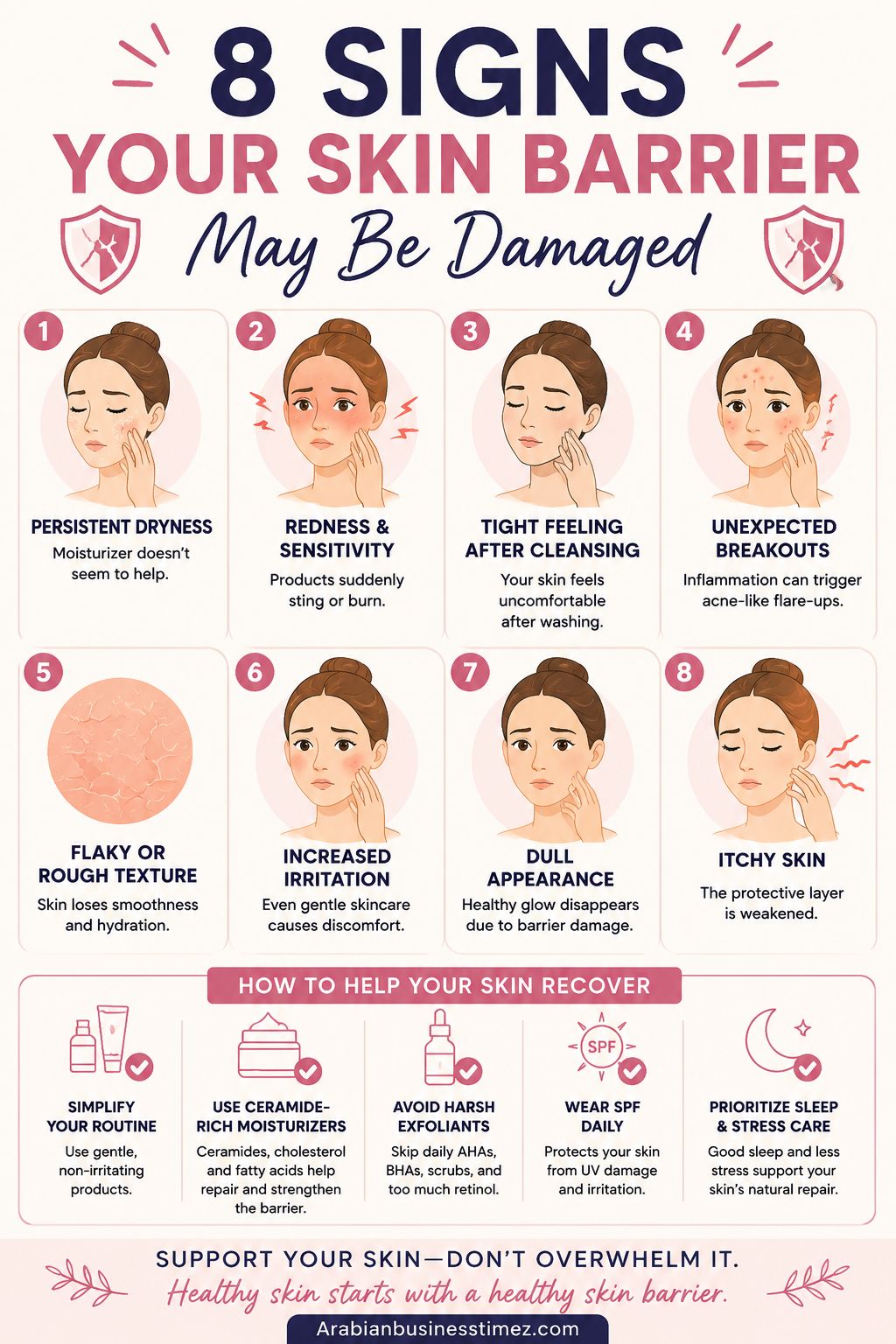
Before we talk about repair, it helps to understand what the skin barrier actually is.
The skin barrier – technically the stratum corneum – is the outermost layer of your skin. Think of it like a brick wall: skin cells are the bricks, and a mixture of ceramides, cholesterol, and fatty acids are the mortar holding everything together. When that mortar is intact, moisture stays in and irritants stay out. When it is compromised, both of those things reverse.
A damaged skin barrier looks like:
- Persistent dryness that no moisturiser seems to fix
- Redness or sensitivity that appears suddenly and without obvious cause
- Skin that feels tight after cleansing
- Breakouts that seem to come from nowhere
- Products that previously worked well now stinging or irritating
Research published in dermatology literature consistently shows that barrier dysfunction is at the root of conditions including eczema, rosacea, and chronic dryness. It is not a cosmetic issue. It is a functional one – and it responds best to functional solutions.
Why Your Skin Barrier Needs Stability, Not Stimulation
Here is the honest truth about most modern skincare routines: they are built around doing more. More acids, more actives, more steps, more products launched every season.
But the skin’s primary need is barrier stability. When the barrier is compromised, everything else becomes secondary. Hydration escapes. Inflammation rises. Even excellent ingredients cannot perform because the foundation that allows them to work is broken.
What your skin barrier actually needs:
- A consistent, predictable routine that does not change every few weeks
- Moisture retention — not just surface hydration
- Ingredients that mimic the skin’s natural lipids (ceramides, cholesterol, fatty acids)
- Reduced exposure to known irritants: fragrance, alcohol denat, harsh surfactants
- Time — genuine, unhurried time to rebuild
What it does not need:
- Daily exfoliation with AHAs or BHAs
- Harsh foaming cleansers that strip the skin’s natural oils
- Layering multiple active ingredients without understanding how they interact
- The pressure – from social media, from marketing, from comparison — to look “glass skin” or “poreless”
Healthy skin is not built through force. It is built through consistency and respect. I see this every day in my clinical work, and I see it in the skin of every client who has moved away from over-stimulation toward a restorative approach.
How to Repair Your Skin Barrier: What Actually Works
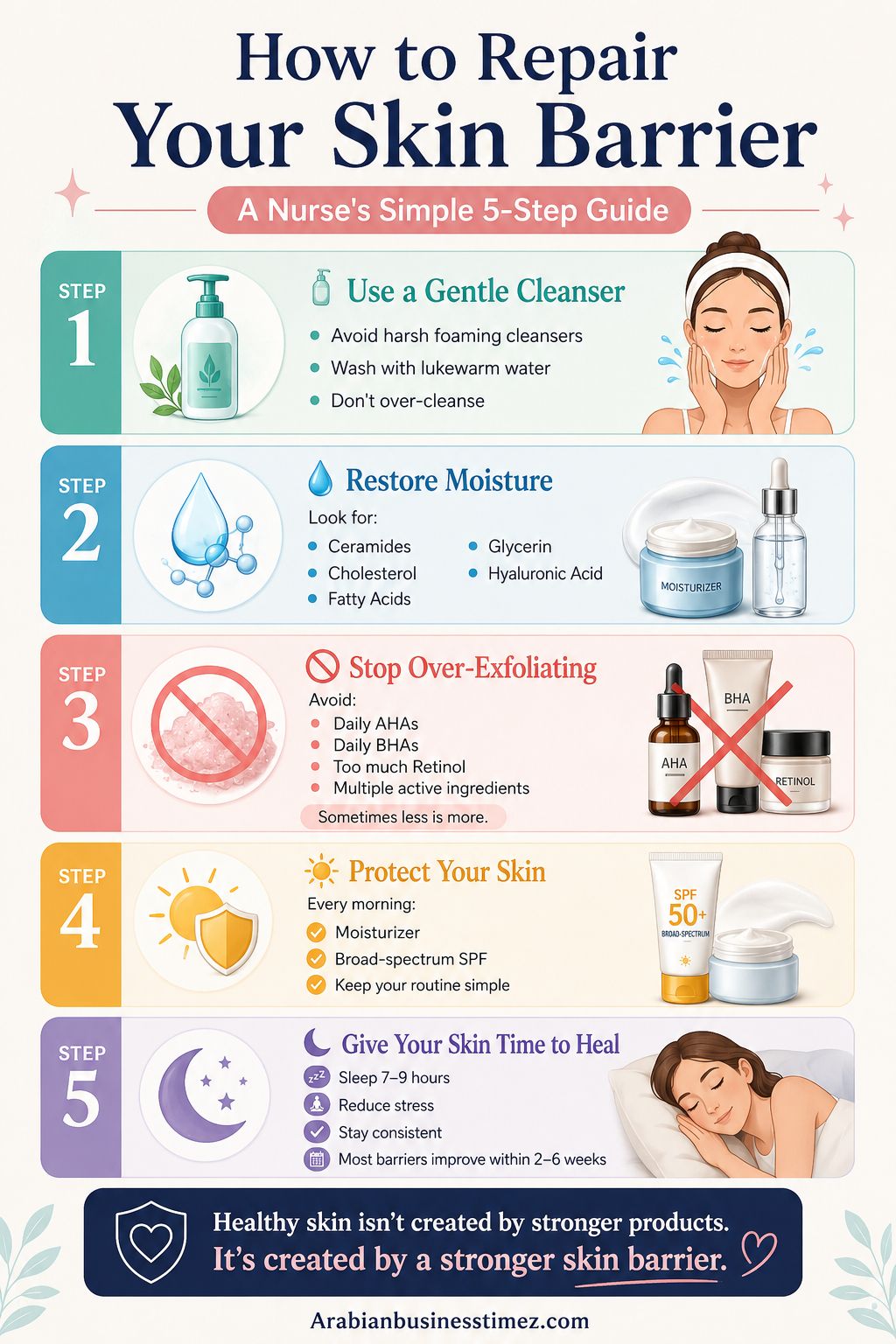
Repairing a damaged skin barrier is not complicated. But it does require patience and the willingness to do less, not more.
Step 1: Simplify immediately
If your routine currently involves more than one exfoliating acid, multiple vitamin C products, retinol, and a ten-step layering system — stop. Temporarily reduce your routine to three things: a gentle cleanser, a barrier-supporting moisturiser, and SPF in the morning. Give your skin two to four weeks to stabilise before reintroducing anything active.
Step 2: Rebuild with the right ingredients
The skin recognises certain ingredients the way the body recognises nutrients. Give it what it already understands, and it responds quickly.
Ceramides are the most important ingredient for barrier repair. They are one of the primary components of the barrier itself — using ceramide-rich products literally gives the skin the building blocks it needs to repair the mortar between its cells.
Cholesterol and fatty acids work alongside ceramides. Studies show that all three together are significantly more effective than any one of them used alone.
Humectants like hyaluronic acid and glycerin draw water into the skin. But here is what many people miss: humectants need to be sealed in with an emollient or occlusive, or they can actually draw moisture out of deeper skin layers in dry environments.
Botanical extracts that calm inflammation — rather than masking it. Ingredients like oat extract, centella asiatica (cica), and allantoin work with the skin’s own anti-inflammatory processes rather than just temporarily suppressing redness.
Step 3: Protect the repair cycle at night
The skin’s natural repair and regeneration cycle is most active between 10pm and 2am. This is not a marketing claim — it is backed by circadian biology research. What you apply at night, and the quality of your sleep, directly affects how effectively that repair occurs.
A restorative night cream applied to clean, slightly damp skin creates the conditions for this cycle to function optimally. At Saccahra, this is the philosophy behind SugarVelvet — it is not designed to “fix” the skin overnight. It is designed to support what the skin already knows how to do, consistently and gently, night after night.
The Connection Between Stress and Skin Barrier Damage
This is the part of skincare education that is almost entirely absent from mainstream advice — and from my nursing background, it is one of the most important things I can share.
Your skin is directly connected to your nervous system. When you are under chronic stress, your body increases cortisol production. Elevated cortisol has been shown in clinical research to reduce the skin’s ability to produce ceramides, slow its repair processes, and increase inflammatory responses.
This is why people break out during exam periods. Why skin flares up during difficult life events. Why you can follow a perfect skincare routine and still see your skin deteriorate when your mental load becomes too heavy.
What the skin needs from a nervous-system perspective:
- Predictable night-time routines that signal safety to the brain
- Textures that feel grounding and calm — not clinical or stimulating
- Sensory moments that create a genuine pause in a busy day
- Sleep that is protective — seven to nine hours where possible
As the founder of Saccahra, this clinical insight is built into every product decision I make. I designed Saccahra’s formulations with sensory intentionality. When a product feels like an exhale – when applying it is a moment of genuine quiet — it is not just a pleasant bonus. It is supporting the very system that governs how well your skin repairs itself.
Ingredients Your Skin Does Not Need (That Most Routines Include)
In my experience, knowing what to remove from a routine is often more valuable than knowing what to add.
High-percentage daily acids: AHAs and BHAs have their place, but daily use at high concentrations is one of the fastest ways to compromise the skin barrier. If you are using an exfoliating acid more than three times a week, your skin is almost certainly operating in a chronic state of mild inflammation — even if it does not look obviously irritated.
Fragrance in skincare: Synthetic fragrance is one of the most common causes of contact dermatitis and barrier sensitivity. It may make a product smell luxurious, but it offers zero functional benefit to the skin and is a known irritant even at low concentrations.
Trend-driven actives that do not match your skin’s current needs: The skincare industry moves fast. New ingredients are launched constantly, and the pressure to adopt each one is significant. But your skin thrives on familiarity, not novelty. Before adding a new active, ask: what specific problem is this solving, and is my barrier stable enough to tolerate it right now?
Your Skin Is Communicating With You – Learn the Language
One of the most important shifts I encourage is moving from a corrective relationship with your skin to a communicative one.
When your skin is dry, it is asking for support. When it is persistently oily, it is often compensating for being over-stripped. When it is inflamed, it is overwhelmed. When it is dull, it is tired — and often under-nourished.
Your skin is not failing you. It is talking to you. The goal of a good skincare routine is not to override those signals with stronger and stronger products. It is to create the conditions where the signals become quieter — because the skin has what it needs.
This is the entire philosophy behind Saccahra. Rest is a treatment. Not passive rest, but intentional, sensory, restorative rest that allows the skin’s own intelligence to take over.
Frequently Asked Questions
How do I know if my skin barrier is damaged?
The most common signs are persistent dryness that does not respond to moisturiser, stinging or burning when you apply products that previously felt fine, sudden sensitivity or redness, and a tight feeling after cleansing. If several of these apply to you, your barrier is likely compromised. The good news is that with the right approach, most people see meaningful improvement within four to six weeks.
What are the best ingredients to repair the skin barrier?
Ceramides, cholesterol, and fatty acids together form the most clinically supported combination for barrier repair. Alongside these, look for humectants (hyaluronic acid, glycerin) and anti-inflammatory botanicals like centella asiatica and oat extract. Avoid anything with synthetic fragrance, alcohol denat, or high-percentage acids while you are in repair mode.
Can you exfoliate while repairing your skin barrier?
I would recommend pausing exfoliation entirely for the first two to four weeks of a barrier repair protocol. Once your skin has stabilised — less sensitivity, improved hydration, reduced redness — you can reintroduce a mild exfoliant once a week and assess how your skin responds before increasing frequency.
Does stress really affect your skin?
Yes — and significantly. Elevated cortisol from chronic stress directly reduces ceramide production, slows the skin’s natural repair cycle, and increases inflammation. Managing your nervous system is not a soft lifestyle suggestion; it is a clinical factor in skin health. Sleep, reduced stimulation, and calming sensory routines all have measurable effects on barrier function.
Is a 10-step skincare routine damaging my skin?
It can be, yes. More steps mean more potential irritants, more opportunities for ingredient interactions, and more stimulation for a barrier that may already be struggling. Most people with compromised skin see better results from three to five well-chosen products than from ten to twelve products with competing actives. Simplicity is not a compromise — for many people, it is the intervention.
What makes Saccahra different from other skincare brands?
As both the founder of Saccahra and a practising nurse, I built the brand from a clinical perspective rather than a beauty industry one. Every formulation starts with the question: what does the skin’s biology actually need? Not what trend is performing well this season. The products are designed to feel grounding and restorative — not just to deliver active ingredients, but to support the skin-nervous system connection that underpins how well the skin repairs itself.
A Final Note
The skincare industry has spent decades teaching people to fear their skin — to fix it, correct it, erase it, and perfect it. That language has caused real harm. It has created a generation of people who have over-treated, over-stimulated, and over-spent their way to skin that is more sensitised than when they started.
Your skin is not a problem to solve. It is a system to support.
When you stop overwhelming it and start listening to it, the changes are often faster and more lasting than anything a new active ingredient could produce. Texture improves. Clarity returns. That elusive “glow” — which is really just well-hydrated, well-rested, inflammation-free skin — comes back.
That is what Saccahra exists to help you find. Not through complexity. Through calm.
Continue Reading: Expert Insights
If you found this guide helpful, you may also enjoy these expert articles on business, innovation, and global growth:
How Biotech Startups Raise Money in 2026: Learn about the latest funding strategies, venture capital trends, and investment opportunities for biotech companies.
- How Biotech Startups Raise Money in 2026: Learn about the latest funding strategies, venture capital trends, and investment opportunities for biotech companies.
- Why Dubai Has Become a Global Hub for Biotech Companies: Explore why Dubai is attracting biotech businesses through its supportive ecosystem and innovation-driven policies.
- How Affiliate Attribution Is Changing in 2026: Discover the latest developments in performance marketing and attribution models with insights from industry expert Mukul Kaushik.
- How TikTok Shop Is Transforming the Fragrance Industry: Understand how social commerce is reshaping consumer buying behavior and brand growth.
- How to Invest in UAE Real Estate: A comprehensive guide covering investment opportunities, legal considerations, and market trends in the UAE.
- International Business Expansion Strategy: Learn practical strategies that businesses can use to successfully expand into international markets.
- Study Abroad Guide for UAE Students (2026): Explore universities, application processes, scholarships, and planning tips for studying abroad.