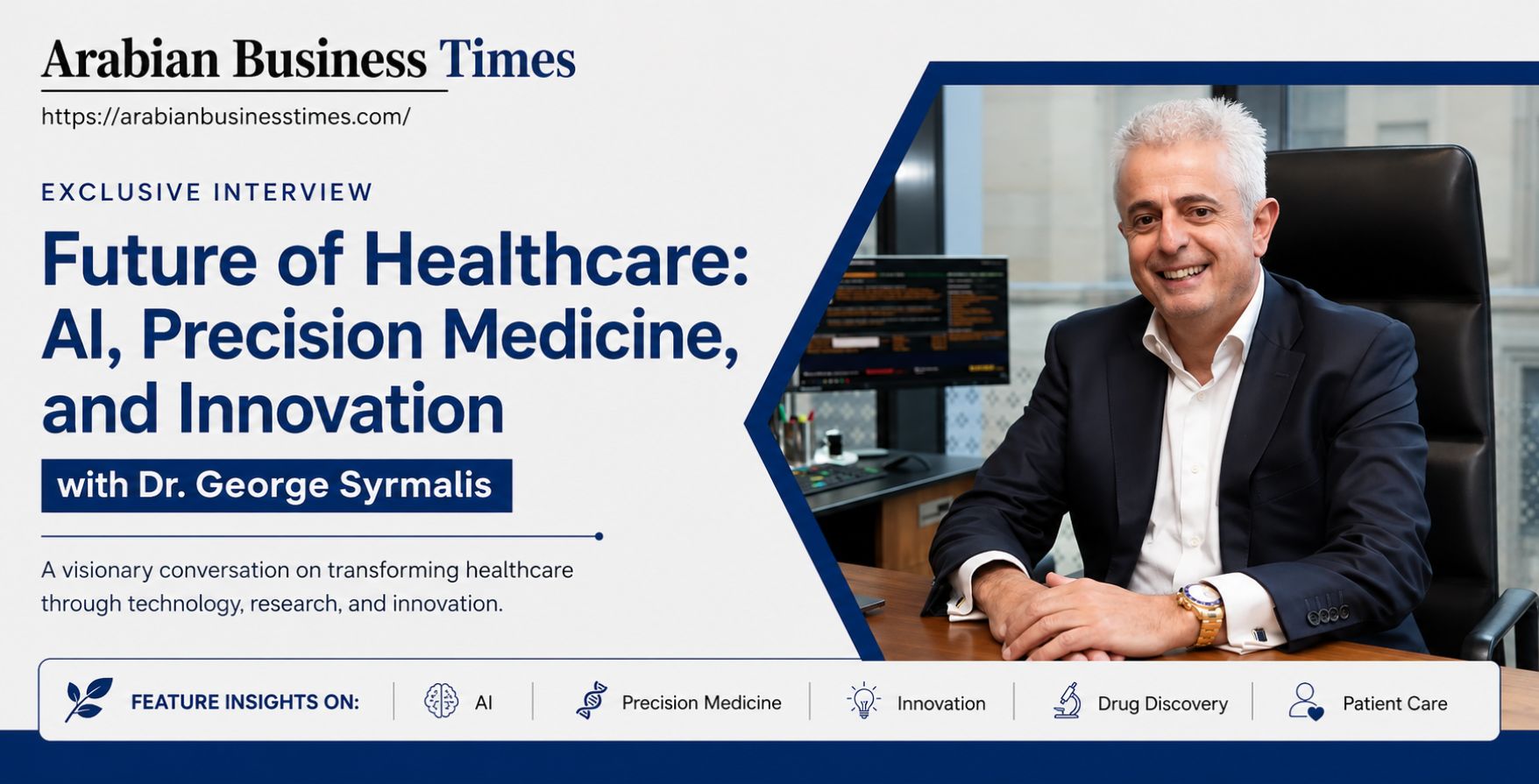
The Future of Healthcare
A Conversation with Dr George Syrmalis
George Syrmalis, MD, PhD, FRSM — Physician · Scientist · Healthcare Investor
Trained in nuclear medicine before building companies in radiopharmaceuticals, biosensors, and diagnostics, and now financing the sector across Dubai, London, New York, and Sydney, Dr George Syrmalis occupies a vantage point few in the field can claim. In this exclusive interview he speaks candidly on artificial intelligence, precision medicine, the rise of the Gulf, and the problems technology has yet to solve.
You trained as a physician in Nuclear Medicine before moving into healthcare innovation. What did practising medicine teach you that pure technologists and investors simply don’t see when they talk about the future of healthcare?
Dr. George Syrmalis: Medicine is not learned in a lecture hall or a data centre. It is learned at the bedside, and what the bedside teaches first is humility. The body does not yield to elegant theory; it instructs you, often by humbling you. In nuclear medicine in particular, one learns to read function rather than mere structure — to interpret an ambiguous signal against the whole of a patient’s history, and to be comfortable acting under irreducible uncertainty. That is the native condition of medicine. It is not a defect to be engineered away.
The technologist tends to see disease as an information problem, and the investor tends to see a market. The physician knows that disease is a human predicament, and that the patient is not a unit of anything. There is a discipline that follows from carrying responsibility for an outcome — from being the one who must sit with a person and tell them the truth, and then answer for what happens next. A model does not carry that. A balance sheet does not carry that. Until you have, you do not fully understand what the practice of medicine actually is.
I would add one thing that my own conviction insists upon: the foundations endure. The history taken with care, the physical examination, the therapeutic relationship between a doctor and the person who has entrusted themselves to him; these have outlasted every technology that was once announced as their replacement. Knowledge is not wisdom, and data is not knowledge. Those who forget the order of those words tend to learn it again the hard way.
AI is now embedded across diagnostics, drug discovery, and clinical decision-making. From where you sit, what is it actually delivering — and where is the hype still running ahead of reality?
Dr. George Syrmalis: Let me be precise, because precision is what the subject deserves and rarely receives.
What AI is genuinely delivering is the compression of early discovery. A preclinical candidate that once took three to four years can now be reached in something closer to eighteen months, and the search through chemical space has been narrowed dramatically; the most celebrated recent candidate was reached with fewer than eighty small molecules synthesised and tested during the discovery phase, rather than the thousands a traditional programme consumes. Novartis has described computationally designing some fifteen million candidate compounds and then working with around sixty in the laboratory. In imaging it is delivering real workflow relief, triage, quantification, the relief of administrative burden; and in safety it is beginning to flag liabilities, such as cardiac risk, before a molecule advances. The landmark is real: this past year, the first drug for which both the biological target and the molecule were designed by generative AI completed a Phase IIa trial, in idiopathic pulmonary fibrosis, showing an improvement in lung function against placebo. By early this year more than a hundred and seventy AI-originated drug programmes were in clinical development, up from roughly two dozen two years earlier.
Now the hype. The seductive claim is that AI changes the probability of clinical success. It does not; not yet. In Phase II, AI-discovered compounds progress at rates comparable to historic industry averages; the early-phase advantage does not yet carry through to where drugs actually succeed or fail. The market knows this better than its press releases admit: partnerships announced at five billion dollars and more have included upfront payments of as little as two per cent of the headline figure; a gap of roughly fifty to one between the announced value and the cash actually committed. That gap is the sound of sophisticated capital hedging. The truth is that AI compresses the front of the pipeline; it does not repeal the hard middle. Human biology remains complex, trials remain bound by patients and time, and regulation and manufacturing answer to neither compute nor enthusiasm. Enthusiasm outrunning evidence is among the oldest patterns in medicine. The instrument is extraordinary. It is not a miracle, and we should be suspicious of anyone who needs it to be one.
The question patients keep asking is whether AI will replace their doctor. What is your honest answer — and what does the physician-AI relationship look like in ten years?
Dr. George Syrmalis: My honest answer is no; not the physician. It will replace certain tasks, and where it does so safely it should, because a physician freed from drudgery is a better physician. But the doctor it cannot replace, for reasons that are not sentimental but structural.
A machine has no hands and no senses; it cannot examine. It performs poorly outside the distribution of what it has seen, which is precisely where the difficult patient lives. And it cannot bear accountability; it cannot be the one who answers for the decision. The unresolved questions of legal liability and trust are not transitional inconveniences; they are the expression of something real. The evidence already shows the asymmetry: while around eighty-five per cent of radiologists express optimism about AI, only about fifty-nine per cent of patients share it, and patients welcome AI for scheduling and triage while remaining cautious about its role in the actual verdict. People are wiser than they are given credit for. They will accept the instrument; they want the judgment to remain human.
In ten years I expect the physician to be augmented, not displaced; AI taking its place in the long lineage of instruments, from the stethoscope to the scanner, that extend the physician’s senses without assuming his conscience. The relationship should deepen precisely where the machine cannot follow: in presence, in meaning, in the carrying of bad news, in the covenant between one human being and another. The genuine danger is not replacement. It is abdication—a reminder that human judgment remains irreplaceable in leadership and medicine. It is abdication; the physician who quietly outsources his judgment and, over a career, de-skills himself into a button he no longer understands. Guarding against that is the responsibility of our profession, and I do not take it lightly.
Precision medicine promises treatment tailored to each patient’s genetics, biology, and lifestyle. How close are we really — and what are the remaining barriers between the promise and the clinic?
Dr. George Syrmalis: Closer than the public imagines in a few places, and further than the marketing suggests almost everywhere else. In oncology it is already a working reality; molecular subtyping, targeted therapy, genome-guided decisions that genuinely change outcomes. In the routine of general medicine, it remains largely a promise.
The barriers are honest ones. The first is biology itself: we possess the parts list, the genome, but not the wiring diagram. Genotype rarely maps cleanly onto phenotype, and most disease is the work of many genes acting with environment, behaviour, and what we now call the exposome. The second is data; heterogeneous, siloed, poorly interoperable, and skewed toward populations that are not representative of humanity, which quietly limits how “precise” the medicine can be for the rest. The third is evidence: the randomised controlled trial, the foundation on which modern medicine was rightly built, strains against a future of treatments tailored to a single person. The fourth is economics and access — a bespoke therapy is a remarkable thing until one must deliver it at the scale of a population, affordably.
I will say something that I believe is too rarely said. The word “precision” oversells the matter. The older word, “personalised,” is nearer the ancient ideal — for Hippocrates treated the patient and not merely the disease. In a sense we are travelling, by an expensive technological road, back toward a very old principle: that the individual before you is particular, and must be treated as such. That the most advanced science of our age is rediscovering the oldest instinct of the healer is, to me, a point worth dwelling on.
You have built and scaled healthcare companies across Dubai, New York, London, and Sydney. How does the GCC compare to Western markets in terms of readiness to lead the next wave of global healthcare innovation?
Dr. George Syrmalis: I will answer this directly, because I have built and financed both, and the comparison is more interesting than the usual flattery allows.
The Gulf holds three advantages that the West has largely surrendered, particularly as Dubai continues strengthening its biotech ecosystem. The first is unity of will. National visions — Vision 2030 in the Kingdom, We the UAE 2031; align government, regulator, and capital behind decade-long objectives, and they deploy patient capital that is not hostage to the next quarter. The second is capital at scale and speed: the sovereign funds remain the central engine of healthtech funding across the region, and they can commit at a magnitude and tempo that Western markets, for all their depth, can no longer easily match. The third is the clean slate, the ability to build national genome programmes and digital health systems without the dead weight of legacy fragmentation. The ambition is concrete: the Kingdom’s National Biotechnology Strategy targets a contribution of some thirty-four and a half billion dollars to non-oil GDP by 2040, and the GCC healthcare market is projected to grow from roughly a hundred and twenty-two billion dollars this year to over a hundred and seventy billion by 2030.
What the West still holds, and what the Gulf cannot simply purchase, is scientific depth; the universities, the accumulated talent of generations, and the architecture of law and intellectual property that took the better part of a century to build and earn trust. This is the crux. Capital and will are necessary; they are not sufficient. The decisive task before the region, and it is the work of a generation, not a budget cycle; is to convert capital into the slow, compounding asset of genuine research culture and protected intellectual property. Institutions are grown; they are not bought. My own view, formed in part through advising on the building of the region’s biotech ecosystem, is that the Gulf has every ingredient to lead, provided it has the discipline to be patient with the one ingredient that demands patience. If it holds that discipline, it will not merely participate in the next wave. It will set its terms.
AI is now being used to design drugs from scratch. As someone who has built companies in biosensors and diagnostics, what does this mean for how we develop and test new therapies — and does it change what it means to be a Med-Tech entrepreneur today?
Dr. George Syrmalis: Having built companies across the field; first in therapeutics, then in biosensors and diagnostics; I can speak to this from inside the work rather than from the commentary around it. My first venture, The Bionuclear Group, was in radiopharmaceuticals: we held a leasehold on a nuclear reactor so that we could produce the isotopes ourselves. There is no software abstraction in that. You are bound by physics, by half-lives that begin their countdown the moment the material is made, by the unforgiving logistics of delivering a decaying substance to a patient while it still has therapeutic value, by regulation that does not negotiate. And the lesson there, repeated again in diagnostics, was always the same: the constraint was never the shortage of ideas. It was validation, regulatory clearance, manufacturing, and — above all — the trust required to place an instrument, or a therapy, in a clinician’s hand and have him stake a patient on it. AI multiplies candidates. It does not multiply clinical truth, which only the trial reveals.
So the consequence is a migration of the bottleneck. As discovery is automated and front-loaded, scarcity moves downstream — to clinical validation, to evidence, to regulatory navigation, to reimbursement, to manufacturing at scale. Note where the regulators are actually moving: the first AI tool formally qualified for use in drug-development trials was cleared only this past December, and it was a tool to help pathologists score biopsies — not a drug designer. That tells you where confidence is being earned, step by careful step.
For the Med-Tech entrepreneur, this changes the location of the moat, especially as biotech startups compete for investment and validation, and therefore changes the craft. The idea commoditises; soon enough the model itself commoditises. What does not commoditise is proprietary data, hard-won clinical evidence, a mastered regulatory pathway, and trust. The entrepreneur’s work shifts from invention toward integration and validation — and the most durable opportunities now lie not in competing to design molecules but in building the unglamorous infrastructure around that explosion of possibility: the layer that turns generated candidates into verified truth. I would put it plainly. The fundamentals of building a real company; evidence, trust, and a product a physician will risk a patient on; have not changed at all. They have simply become more valuable, because the noise has grown so much louder. The discipline of proof is the enduring edge, particularly when investors evaluate healthcare startups through rigorous due diligence.
What are the biggest problems in global healthcare that technology still hasn’t solved — and why not?
Dr. George Syrmalis: The deepest ones, and the reason is the same in nearly every case: they are not technical problems at all.
Access and distribution come first. We live in an age of medical miracles unevenly delivered. The obstacle is rarely a missing molecule; it is a missing nurse, a broken supply chain, a financing gap, a clinic too far away. No algorithm has yet conjured a workforce or repaired the logistics of a poor district. Second is the burden of chronic and lifestyle disease, which accounts for most of the world’s suffering and is governed by human behaviour, and behaviour, adherence, the long discipline of prevention, has resisted every clever intervention thrown at it. Third is fragmentation: data that will not speak to itself, systems that do not connect, an inability to assemble the whole picture of a single human life. Fourth is the irreducible slowness of certain biology — ageing, neurodegeneration, the conditions where we still lack the mechanistic understanding on which any real cure depends. And fifth, quietly but importantly, is the erosion of trust and of the human relationship at the centre of care.
The reason these endure is that technology solves what is soluble by technical means and leaves behind a residue of governance, incentives, institutions, and human nature. Those are the oldest problems we have, which is precisely why the oldest disciplines; public health, stewardship, the clinic itself; remain indispensable. The recurring error of our moment is to mistake a human problem for an engineering one, even as organizations continue building technology-driven innovation ecosystems. We keep building more sophisticated answers to questions that were never really technical, and then we are surprised when the questions remain.
If you could build one healthcare company from scratch today, using everything you know, what problem would it solve — and why?
Dr. George Syrmalis: I would build the layer of trust; the independent validation and clinical-evidence infrastructure, married to definitive diagnostics delivered at the point of need and to the connectivity that carries their signal instantly to wherever the expertise resides. Picture a biosensor in a small village clinic whose reading travels, over the 5G networks of today and the 6G networks now taking shape, in very nearly the same instant to a centre of excellence in a major city — the diagnosis effectively made everywhere at once, the distance between the patient and the specialist collapsed to nothing. That is the thing I would build: the bridge between the coming flood of AI-generated possibility and the patient who must actually be helped, wherever that patient happens to live.
The reasoning runs straight through everything I have said. The future will not be short of intelligence, nor of molecules, nor of candidates and signals. It will be short of two things: verified truth and reliable access. As discovery is automated, the scarce and therefore valuable commodity becomes the trusted process that turns a generated possibility into something a physician can act upon with confidence — and the means to deliver the resulting certainty to where the patient is, rather than where the laboratory happens to be. Connectivity is the other half of access, and too often the forgotten half: a definitive result is of little use to a person three hundred kilometres from the nearest specialist unless its signal can reach that specialist in something close to real time. The networks now make that collapse of distance possible; the discipline is to build trustworthy clinical infrastructure upon them. That is the bottleneck the whole field is migrating toward, and it is exactly the seam where my three lives meet: the physician who knows what the clinic actually requires to trust an instrument, the entrepreneur who built radiopharmaceuticals and then diagnostics and learned that validation and trust are the true product, and the financier who can see where durable value will be captured.
And I would anchor it where capital, will, and a clean slate exist together — building a genuine, sovereign-grade backbone of evidence, diagnostics, and connectivity rather than another laboratory chasing the next molecule. The deepest problems in medicine are problems of trust and of access. Healthcare leaders across the GCC are increasingly exploring how AI can strengthen both innovation and patient outcomes. A company built squarely on both would be, to my mind, the most consequential thing one could attempt — and the most faithful to the principle I have carried throughout: that trust, like access, is earned. It is never simply extended.
As AI, precision medicine, and digital health continue to reshape healthcare, Dr. George Syrmalis reminds us that innovation alone is not enough. The future of medicine will be built on trust, evidence, and patient-centred care.
What are your thoughts on the future of healthcare? Share your perspective in the comments below.