And Why the Leaders Who Know This Will Define the Next Era of Global Business
Key Takeaways
- AI investment is outpacing investment in human leadership capacity by 44 times, according to IDC and LinkedIn data — a gap the author calls a “philosophy problem,” not a technology problem.
- 77% of executives report decision fatigue as their top leadership challenge (Deloitte, 2023).
- AI can simulate empathy, personalization, and communication — but cannot replicate embodied empathy, relational authority, or psychological safety.
- Cultural intelligence remains a critical human capability: only 12% of AI training datasets reflect non-Western cultural contexts (MIT Media Lab, 2021).
- The article identifies 10 specific human leadership capacities AI cannot replace, from ethical judgment to legacy-building.
- The core argument: organizations that thrive in the AI era will be those that invest in human leadership development, not just technology infrastructure.
Introduction
The boardrooms I have walked into across three continents share a common anxiety. Leaders are racing to implement AI tools, deploy enterprise copilots, and automate workflows at a speed that would have seemed impossible five years ago. And underneath all of it, quietly, there is a question no one is asking loudly enough: what happens to the human being at the center of all this technology?
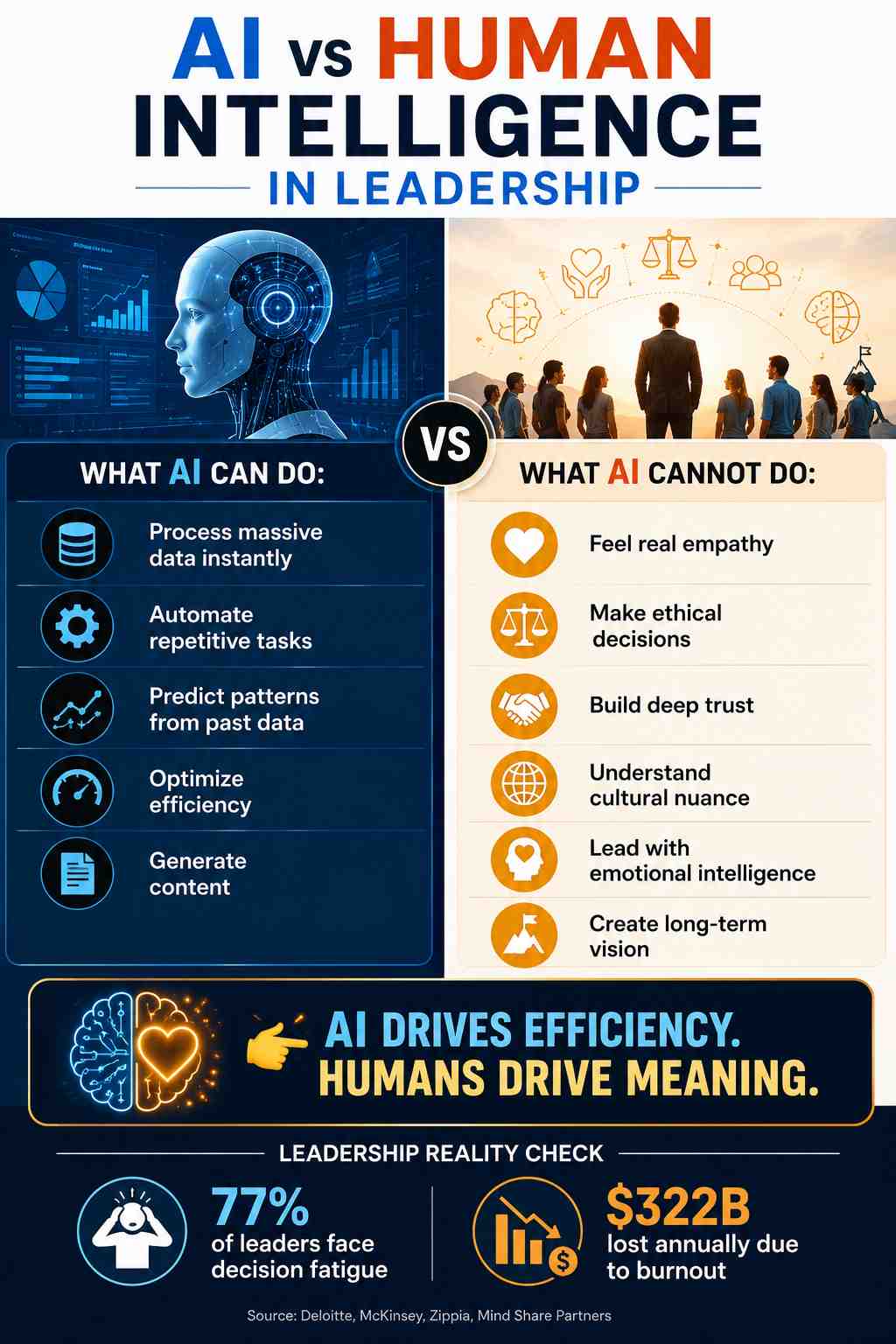
I am a learning scientist, doctoral researcher, and global speaker whose work sits at the intersection of generative AI and culturally responsive design. I have delivered this message from Bangkok to Paris to Chicago, and the data I carry into every room tells the same story. Organizations are investing in AI infrastructure at a rate 44 times greater than they invest in the human nervous systems that will actually operate those systems (IDC Worldwide AI Spending Guide, 2024; LinkedIn Workplace Learning Report, 2023). Seventy-seven percent of executives report decision fatigue as their top leadership challenge (Deloitte Global Human Capital Trends, 2023). Three hundred twenty-two billion dollars are lost annually to burnout-related turnover worldwide (Gallup, 2023).
The crisis of our era is not technological. It is human.
AI is not the threat. The threat is the leader who abandons their humanity trying to keep up with it. So before your organization deploys another tool, before you automate another workflow, I want to offer you this: a practitioner-scholar’s list of ten things no algorithm, no matter how sophisticated, will ever be able to do.
“The next generation of global leaders will not be those who mastered the algorithm. They will be those who preserved their humanity while the world automated around them.”
As AI adoption accelerates across industries, many GCC leaders are already leveraging it for growth.
???? Read how: How GCC Leaders Are Using AI to Grow Their Business
The 10 Things AI Cannot Do
01. Feel Embodied Empathy
Empathy is not a sentiment. It is somatic attunement to human suffering and dignity. It is the capacity to register another person’s reality in your own body before you formulate a response. AI can analyze emotional language patterns and generate compassionate-sounding text. What it cannot do is feel the weight of what someone is carrying across a table, or adjust its presence in real time to the unspoken grief in a room. This is the foundation of ethical leadership, and it lives in the body, not the algorithm.
02. Exercise Prophetic Imagination
The most consequential decisions leaders make are not about what is. They are about what has not yet manifested. Prophetic imagination is the capacity to hold tension, sit with uncertainty, and see possibility in the absence of evidence. AI is extraordinarily good at pattern recognition within existing data. It cannot imagine what has never existed. It cannot hold the creative tension that produces genuine innovation. That capacity belongs to the human mind operating from a place of stillness and depth.
Building future-ready organizations requires more than automation—it requires vision.
???? Learn how to build a future-ready startup: How to Build a Successful Startup in the GCC
03. Navigate Cultural Intelligence with Nuance
Only 12% of AI training datasets reflect non-Western cultural contexts (MIT Media Lab, 2021). One and a half billion multilingual workers globally face AI evaluation tools calibrated to monocultural norms of confidence, directness, and assertiveness (UNESCO, 2023). This is not a minor gap. It is a systemic design failure. Cultural intelligence, specifically the ability to read layered human contexts with genuine relational literacy and not merely pattern-match, requires lived experience, cultural humility, and the willingness to be changed by what you encounter. AI can translate language. It cannot translate humanity.
Sources: MIT Media Lab (2021); UNESCO (2023)
Understanding diverse markets is essential for expansion.
???? Read global expansion strategies: International Business Expansion Strategy
04. Regulate a Nervous System Under Pressure
Chronic stress reduces cognitive flexibility by up to 40% (Arnsten, 2015). The prefrontal cortex, which governs executive function, ethical reasoning, and complex decision-making, is compromised under sustained stress. Leaders who practice intentional deceleration demonstrate 28% greater executive function under pressure (Tang et al., 2015). This is nervous system wisdom: the capacity to remain regulated when everything around you is in chaos, and to model that calm for the people you lead. AI does not have a nervous system. It does not know what it costs to stay present in a crisis. You do. That is a leadership advantage.
Sources: Arnsten (2015), Nature Neuroscience; Tang et al. (2015)
05. Build Relational Authority
Trust is not a data output. It is built through presence, consistency, and being genuinely known by those you lead. Relational authority, the kind that moves people without coercion and makes a team willing to follow you into uncertainty, accrues over time through thousands of small moments of showing up. AI can simulate personalization. It cannot remember the conversation you had with a team member on their worst day, and show up differently because of it. Relational authority is irreplaceable because it is personal.
Strong leadership is also reflected in the region’s most successful companies.
???? See top leaders shaping industries: Top 10 Tech Company CEOs in the UAE
06. Exercise Ethical Judgment
AI can generate content. It cannot evaluate whether that content should exist, be shared, or be acted upon. Ethical judgment requires the integration of values, context, consequence, and conscience: none of which can be fully encoded. The organizations that will navigate this era with integrity are not those with the best AI governance policies. They are those with leaders whose ethical muscles are developed enough to override the output when the output is wrong. Discernment, knowing when not to use AI, is the most underrated leadership competency of our time.
Ethical decision-making becomes even more critical as AI adoption rises across industries.
???? Explore how leaders are navigating this shift: How GCC Leaders Are Using AI to Grow Their Business
07. Carry Lived Experience as Instructional Capital
In adult learning science, we have long understood that experience is not anecdote. It is evidence. Contemporary research affirms that the learning cycle is both episodic and lifelong, and that experiential learning environments that reflect real-world scenarios enable learners to recontextualize theoretical knowledge and deepen the transfer of learning into professional practice (Dillard, Sisco & Collins, 2024; Radović et al., 2023). The practitioner who has rebuilt a struggling organization, navigated a cross-cultural team through crisis, or led through personal loss brings a form of knowledge no dataset can replicate. Lived experience is the kind of wisdom that makes a mentor irreplaceable, a coach transformative, and a leader worth following. AI can curate information. It cannot earn wisdom.
Sources: Dillard, N., Sisco, S. & Collins, J.C. (2024). New Directions for Adult and Continuing Education. Wiley. | Radović et al. (2023)
08. Design for Cultural Responsiveness
Culturally responsive design requires that systems, tools, and environments actively reflect the cultural assets and contexts of diverse people, not merely translate or accommodate them. This is a design philosophy that demands the designer be willing to be humbled by what they do not know about the communities they serve. AI trained on dominant-culture data will replicate dominant-culture bias at scale. It takes a human being, with genuine cultural humility and relational accountability, to interrupt that replication. Culturally responsive AI design is not a DEI initiative. It is a quality standard. And it requires human leadership to enforce it.
09. Create Psychological Safety
Psychological safety, the condition under which people feel safe to speak, question, fail, and learn without fear of punishment, is built by human leaders through consistent behavior over time (Edmondson, 2018). It cannot be automated. A team’s willingness to surface a problem before it becomes a crisis depends not on the tools they use but on whether they trust the person leading them. That trust is earned face by face, decision by decision, and it lives in the relational space between human beings. AI can facilitate communication. It cannot create belonging.
Source: Edmondson, A. (2018). The Fearless Organization. Wiley.
10. Build a Sustainable Legacy
Legacy is not an output. It is the long arc of a life spent in service to something larger than productivity metrics. The Default Mode Network, the brain’s visionary thinking system, activates during rest and is responsible for the insight, integration, and long-range thinking that defines legacy leadership (Buckner et al., 2008). Legacy is built not in urgency, but in depth. Not in automation, but in presence. Not in efficiency, but in love. No machine can want to leave the world better than it found it. That longing is distinctly, irreplaceably human.
Source: Buckner et al. (2008)
A Final Word to Global Leaders
The question for your organization is not whether to adopt AI. That conversation is already over. The question is whether the humans operating your AI systems are developed enough to wield them with wisdom, equity, and integrity.
Every item on this list is a leadership development priority. Not a soft skill. Not a wellness initiative. A strategic investment in the human infrastructure upon which all your technology depends.
AI spend is 44 times greater than investment in human leadership capacity. That gap is not a technology problem. It is a philosophy problem. And it requires a human being, in a position of authority, to decide to close it.
“Regulate first. Lead second. Softness is not the opposite of strength. It is its most evolved form.”
The organizations that will define the next era of global business are not those who automated the fastest. They are those who preserved the irreplaceable humanity of their leaders while the rest of the world was busy watching the algorithm.
That is the leadership imperative of our time. And no machine can answer it for you.
Frequently Asked Questions (FAQ)
1. What are the 10 things artificial intelligence cannot do, according to Dr. Darcell L. Streeter?
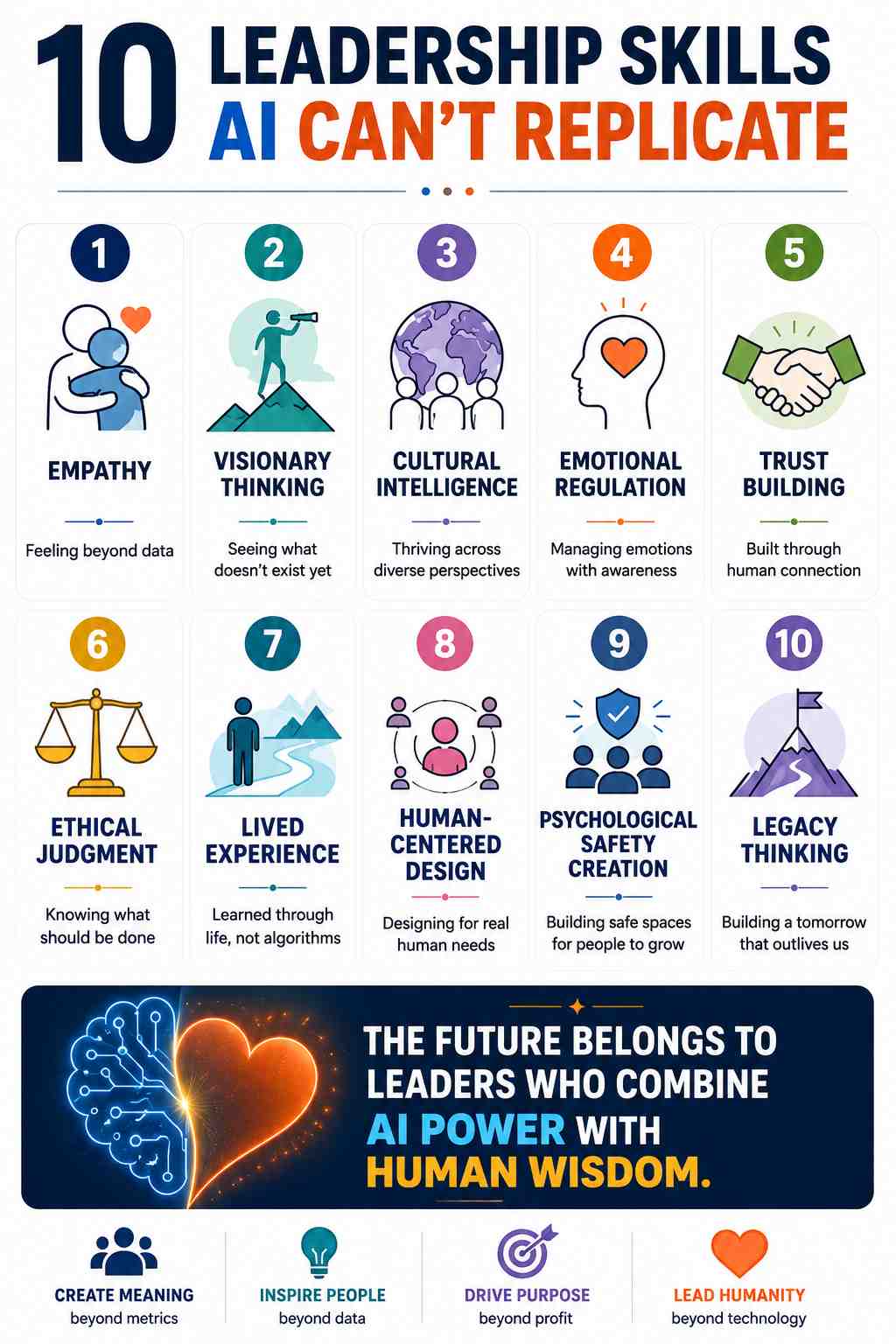
The 10 capacities are: feeling embodied empathy, exercising prophetic imagination, navigating cultural intelligence with nuance, regulating a nervous system under pressure, building relational authority, exercising ethical judgment, carrying lived experience as instructional capital, designing for cultural responsiveness, creating psychological safety, and building a sustainable legacy.
2. How much more do organizations invest in AI compared to human leadership development?
According to IDC’s Worldwide AI Spending Guide (2024) and the LinkedIn Workplace Learning Report (2023), organizations invest in AI infrastructure at a rate 44 times greater than they invest in developing the human leadership capacity to operate those systems.
3. Why can’t AI replicate cultural intelligence?
Per MIT Media Lab (2021) research cited in the article, only 12% of AI training datasets reflect non-Western cultural contexts, and UNESCO (2023) data shows 1.5 billion multilingual workers face AI evaluation tools calibrated to monocultural norms. Cultural intelligence requires lived experience and relational literacy that pattern-matching cannot replicate.
4. What is psychological safety and why does it matter in AI-driven workplaces?
Psychological safety, a concept developed by Amy Edmondson (2018), refers to the condition under which people feel safe to speak, question, fail, and learn without fear of punishment. The article argues this is built through consistent human leadership behavior over time and cannot be automated.
5. How does chronic stress affect leadership decision-making?
Research by Arnsten (2015) cited in the article shows chronic stress can reduce cognitive flexibility by up to 40%, impairing the prefrontal cortex functions responsible for executive reasoning and ethical decision-making. Tang et al. (2015) found that leaders practicing intentional deceleration demonstrate 28% greater executive function under pressure.
6. Who is Dr. Darcell L. Streeter?
Dr. Darcell L. Streeter is a learning scientist, global speaker, author, and nonprofit CEO whose doctoral research bridges generative AI and culturally responsive design. She is the founder of B.HER™ Global, CEO of The Women’s Circle, Inc., and founder of Positive Images Consulting. She is the author of the Softness as a Superpower™ book series and host of Power of the Pause on Women Thrive Media.
7. What is the main argument of this article?
The article argues that the central challenge of the AI era is not technological but human: organizations are over-investing in AI tools relative to the leadership capacity needed to wield them with wisdom and integrity. It positions human capacities like empathy, ethical judgment, and relational trust as irreplaceable strategic assets rather than soft skills.
8. Is this article suggesting organizations should avoid adopting AI?
No. The article explicitly states that whether to adopt AI is “not the question” and that conversation is “already over.” Instead, it argues for parallel investment in the human leadership development required to deploy AI responsibly and effectively.
Related Articles
- Top 10 Oil & Gas Industry CEOs in the GCC
- Top Real Estate Companies in Dubai
- Top Business Opportunities in UAE for 2026
- How to Scale a Small Business in Dubai (2026)
- Top 10 Fintech Startups in UAE