
Buying property abroad is one of the most exciting financial decisions you can make. Whether you’re dreaming of a holiday home on the Mediterranean, a lease-to-own house in Southeast Asia, or a long-term investment in a high-growth Gulf market, the appeal is real. I’ve worked with buyers across the Middle East and Gulf region for years, helping them navigate international real estate — and I can tell you firsthand: the process is rarely as simple as it looks on a property portal.
The good news is that with the right preparation, buying abroad can be incredibly rewarding. The key is knowing what questions to ask before you fall in love with a property — not after. Here’s everything I wish every buyer knew before they started.
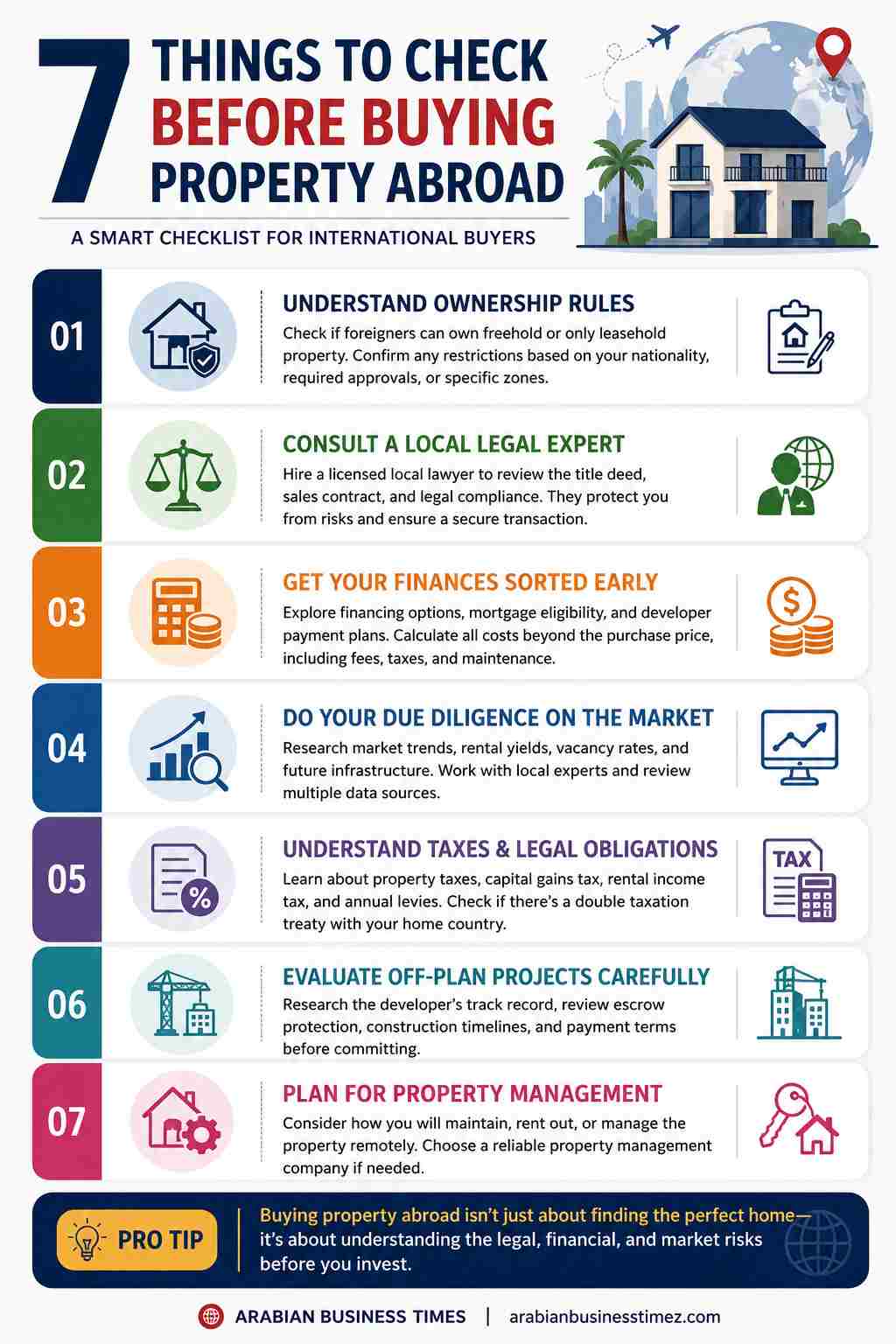
Understand Who Can Actually Own Property There
This is the first thing I tell every client, and yet it’s the one most people overlook in the excitement of searching listings. Not every country allows foreigners to own property outright. Some permit it in specific zones only, others allow long-term leasehold rather than freehold ownership, and a few have additional requirements based on nationality.
In the UAE, for example, expatriates can only purchase in designated freehold areas. Qatar, Oman, and even Saudi Arabia have also opened up specific zones to foreign ownership in recent years. Other popular destinations, like Thailand, restrict foreign freehold ownership of land entirely — you can own a condominium unit, but not the land it sits on.
Before you do anything else, research the ownership structure available to you as a foreign national. Ask:
- Is this freehold or leasehold? If leasehold, for how many years?
- Are there restrictions based on my nationality?
- Do I need a local partner or sponsor to hold the title?
- Are there any caps on the percentage of a development that foreigners can own?
Getting this wrong can mean you end up with rights that are far more limited than you expected — or worse, a transaction that isn’t legally valid at all.
Consult a Local Legal Expert – Not Only Your Agent
I say this to you as well as to myself: please hire a local lawyer. A real estate agent’s job is to help you find and buy a property. A lawyer’s job is to make sure that transaction protects you legally. These are very different things, and you need both. You can find an experienced agent with a lot of expertise who can explain most of the transactions to you, but you should still also consult a lawyer for the finer details and to make sure that when you’re buying, you’re safe and sound.
Legal systems vary enormously from country to country. Property law in Spain is not the same as property law in the UAE, which is not the same as property law in Indonesia. A local lawyer… will review the title deed, check for encumbrances or liens, verify the developer’s credentials if you’re buying off-plan; a caution echoed in guides on starting a business in Dubai without connections, where trust and verification matter just as much., verify the developer’s credentials if you’re buying off-plan, and ensure the sales contract is enforceable.
Lawyers are good to help you spot potential red flags to watch out for, such as:
- Sellers or agents who discourage you from getting independent legal advice
- Contracts written only in the local language with no certified translation
- Pressure to sign quickly before you’ve had time to review documents
- Vague or missing details about handover dates, penalties, and ownership transfer
The cost of a good property lawyer might in some cases be somewhat expensive; however, it’s modest compared to the cost of a transaction gone wrong.
Get Your Finances Sorted Early
One of the biggest mistakes buyers make is starting their property search before they’ve figured out their financing. While buying a property is sometimes an emotional experience, in international real estate this matters even more than in domestic markets, because your options may be more limited than you think.
Can You Get a Local Mortgage?
Some countries allow non-residents to access local mortgage financing; many do not, or offer it on much less favorable terms. In markets like the UAE, Qatar, and even Oman, certain banks do offer mortgages to non-residents and expatriates, but the loan-to-value ratios are often lower, meaning you’ll need a larger deposit.
If local financing isn’t available or attractive, you have options: refinancing against a property you own elsewhere, using savings, or exploring developer payment plans; the same discipline behind the ERGRT framework for long-term wealth. — which are extremely common in the Gulf and can offer favorable terms, particularly on off-plan purchases.
Factor In All the Costs
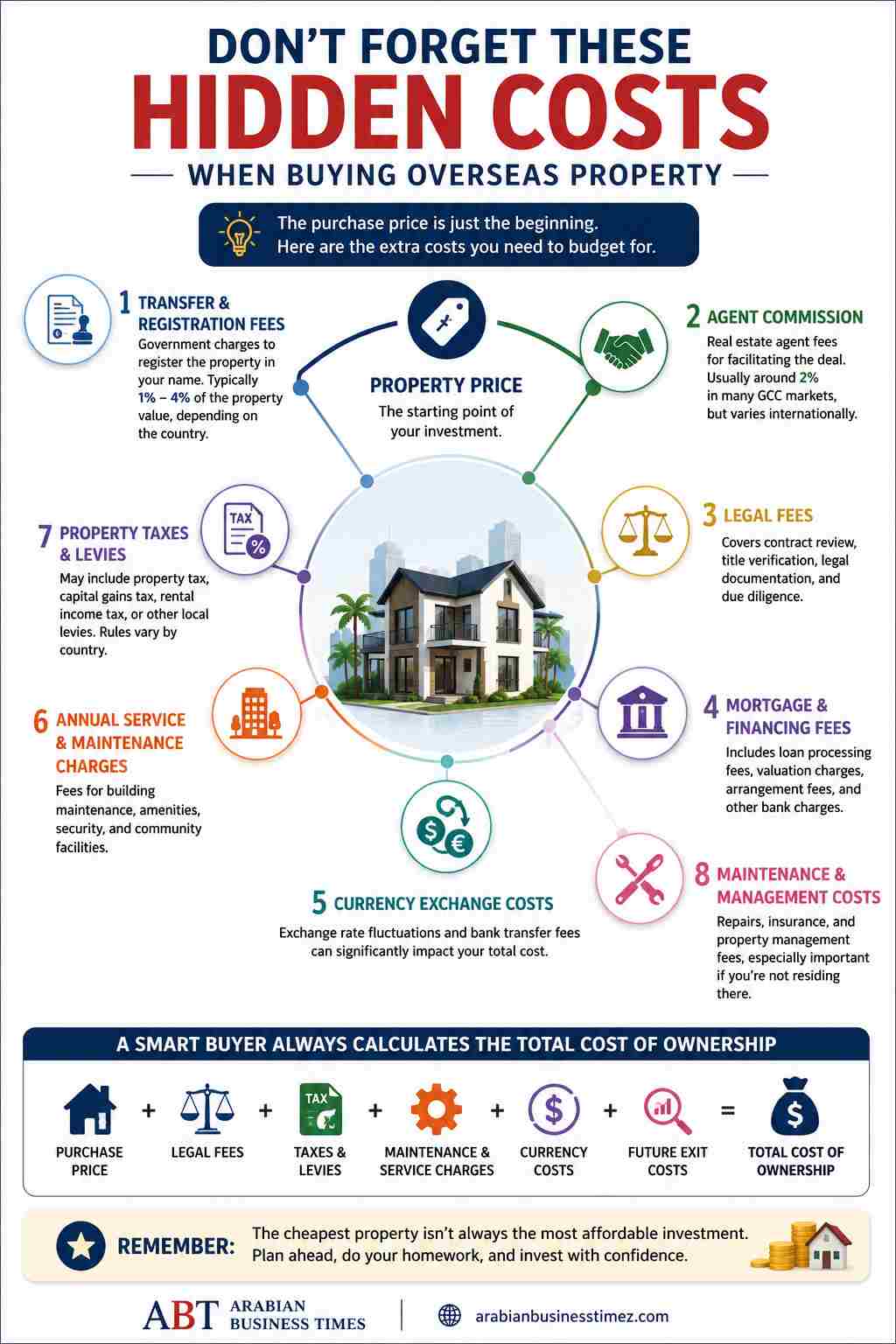
The purchase price isn’t the only thing you’re paying. International buyers often forget to ask about the total cost of acquisition, service charges, community charges, and so on. Depending on the country, you may need to budget for:
- Transfer fees and registration costs (in Dubai, for example, the transfer fee is 4% of the purchase price; elsewhere it’s 1%–3% of the total unit value)
- Agent commissions (often 2% in the GCC, but varies widely internationally)
- Legal fees in some countries
- Mortgage arrangement fees and valuation costs if financing
- Currency conversion costs and transfer fees
- Annual service charges and maintenance fees
- Property tax or equivalent levies
A purchase that looks affordable based on the listed price can look very different once you add up acquisition costs. Always ask for a full cost breakdown before committing.
Currency Risk
If you’re earning in one currency and buying in another, exchange rate movements can significantly affect your effective purchase price. A currency that moves 5–10% between the time you agree on a price and the time you complete could cost — or save — you tens of thousands. Consider using a specialist currency broker rather than your high street bank, and explore whether hedging options make sense for your situation.
Do Your Due Diligence on the Market
Falling in love with a country is easy. Understanding its property market is harder — but essential if you’re buying as an investment or planning to sell or rent the property in the future.
Questions I always encourage buyers to research:
- What has price growth looked like over the last 5–10 years? Is the market rising, stable, or cooling?
- What is the rental yield in this area? Is there genuine demand from tenants?
- What are the vacancy rates? A high vacancy rate is a warning sign.
- Is the local economy and population growing? This drives long-term demand.
- Are there any major infrastructure projects or developments planned nearby?
- What is the political and economic stability of the country?
The Gulf markets; particularly Dubai, have attracted enormous international investment over the past decade, partly because of strong rental yields, zero income tax, and significant infrastructure investment, as covered in how to invest in UAE real estate. But even within a strong market, location and property type matter enormously. A well-located apartment in a high-demand area will outperform a poorly positioned one, even in the same city.
Be cautious of anyone who guarantees returns. Good agents and advisors give you realistic projections based on comparable data — not promises.
Understand the Tax Implications – In Both Countries
This is an area where buyers frequently get caught off guard. Buying property abroad doesn’t just mean dealing with taxes in the country where you’re buying — it may also have implications in your home country.
Depending on where you’re based:
- Rental income from a foreign property may be taxable in your home country, even if it isn’t taxed at source
- Capital gains from selling an overseas property may be taxable at home
- Some countries require you to declare foreign property assets, even if no income is generated
- Inheritance and estate rules vary dramatically — who inherits your property and under what conditions can differ significantly from your home country’s laws
Always speak to a tax advisor who understands both jurisdictions before you buy. The UAE, for instance, has no income tax or capital gains tax on property — which is a genuine advantage. But that doesn’t mean your home country can’t tax you on the same income.
Double tax treaties between countries can mitigate some of this risk, but the details are complex and country-specific. Don’t assume — verify.
Think Carefully About Off-Plan Purchases
Off-plan property — buying a unit before it’s built — is enormously popular in the Gulf, and for good reason. Prices are typically lower than for completed properties, payment plans are spread over the construction period, and you can often benefit from capital appreciation by the time the project completes.
But off-plan comes with its own risks:
- Developer risk: what happens if the developer runs into financial trouble or the project is delayed?
- Completion risk: will the finished product match what was shown in the renders and floor plans?
- Market risk: will the market still be strong when your property completes in 2–3 years?
If you’re buying off-plan, research the developer thoroughly. Look at their track record — have they delivered previous projects on time and to specification? In markets like Dubai, developers are required to hold buyer deposits in escrow accounts regulated by RERA, which offers important protections; a theme also explored in AI and Dubai real estate investment strategy. Check what protections exist in the market you’re buying in.
Request a clear timeline with milestone dates, and understand what happens — contractually — if those milestones are missed. Get this in writing.
Plan for the Practical Side of Owning Abroad
Even after you’ve bought, owning property in another country requires ongoing management. This is something buyers often think too little about in advance.
Consider:
- How will the property be managed if you’re not based there? Will you use a property management company, and what will that cost?
- How will maintenance issues be handled remotely?
- If you plan to rent it out short-term (Airbnb-style), is this permitted under local regulations? Short-term rental rules vary enormously and are increasingly being tightened in many cities.
- What are the rules around bringing rental income back to your home country? Are there currency controls?
- How will you handle the eventual sale from abroad?
Having a reliable local contact — whether a property manager, agent, or trusted friend — makes an enormous difference. Don’t assume you can manage everything remotely without local support.
Final Thoughts
Buying property abroad is genuinely one of the best investments many of my clients have ever made. I’ve seen people build significant wealth, create a home away from home, and secure their retirement through international real estate. The Gulf markets in particular continue to attract buyers from around the world for good reason.
But the buyers who do best are the ones who go in prepared. They take the time to understand the legal framework, assemble the right team of professionals, do their market research, and think through the financials thoroughly before they fall in love with a specific property.
The dream is absolutely achievable. Just make sure you’re building it on a solid foundation.