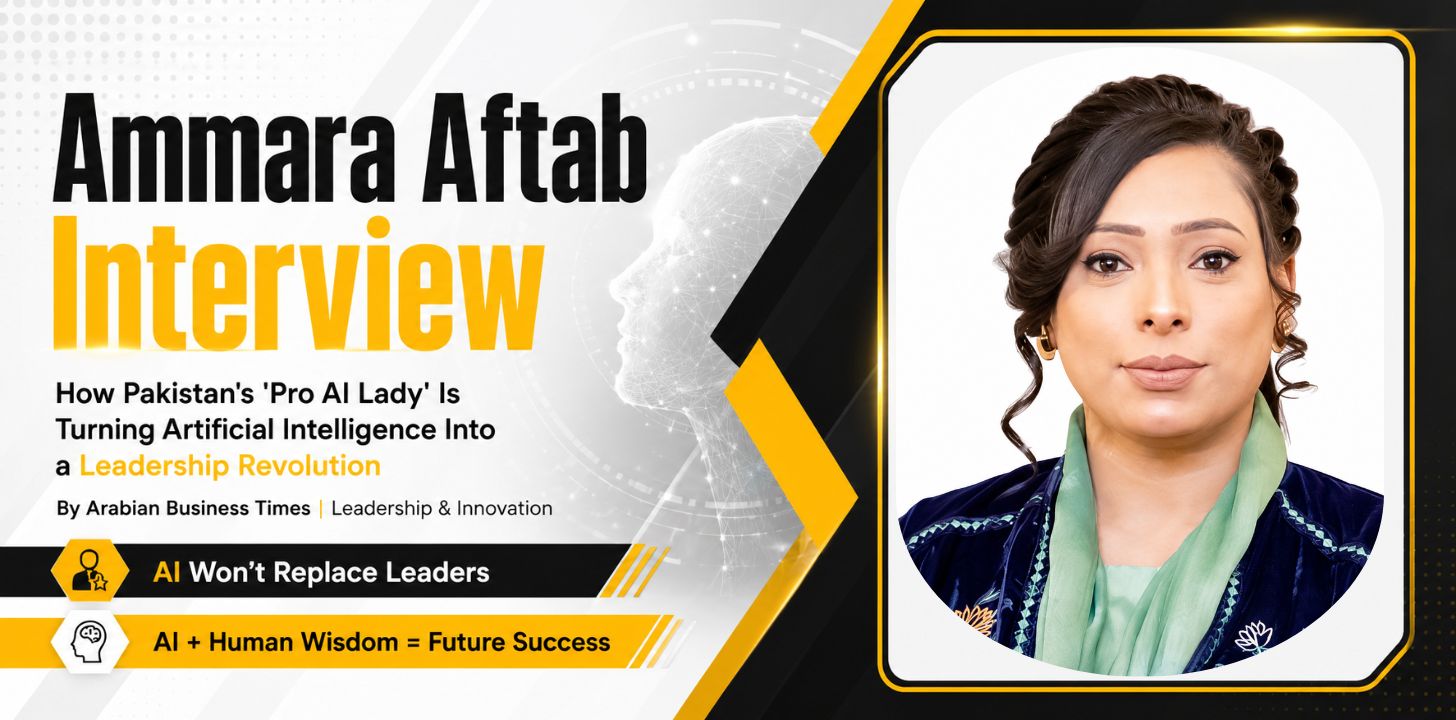
The International AI Catalyst Award-winning founder of Pro AI Global is on a mission to make AI accessible, actionable, and impactful — one boardroom, classroom, and government office at a time.
By Arabian Business Times | Leadership & Innovation
There is a particular kind of leader who does not wait for the world to catch up. They see the gap, name it clearly, and build the bridge themselves. Ammara Aftab, Founder & CEO of Pro AI Global, International AI Catalyst Award Winner, Pakistan’s First Female AI Trainer, Daughter of the Nation, and one of Asia’s emerging Women in AI voices, is that kind of leader.
She operates at an intersection most professionals avoid: where cutting-edge technology meets human transformation. In a world where conversations about Artificial Intelligence tend to swing between breathless hype and existential fear, Aftab has carved out a third lane — one grounded in practical adoption, strategic clarity, and an unwavering belief that AI belongs to everyone, not just engineers.
Her recognition as an International AI Catalyst Award Winner at the Future IT Summit in Dubai — where Pro AI Global was honored for its contribution to AI education, awareness, advocacy, and practical adoption — was not simply an accolade. It was a signal that the work she has been quietly building in Pakistan is earning international attention.
Arabian Business Times sat down with Aftab for an exclusive conversation about her journey, her philosophy on AI leadership, and why the biggest barrier to AI adoption is not technology — it is mindset.
From Applied Statistics to AI Ecosystems: A Journey Built on Execution
Ammara Aftab’s professional story does not follow a conventional path into technology. Her background spans Applied Statistics, business development, infrastructure, CPEC-related projects, and leadership — a breadth that would eventually become one of her greatest assets.
“My journey has always been connected with execution,” she explains. “From working on large-scale projects to building AI awareness platforms, I have always believed that vision is not enough unless it reaches people.”
The turning point came when she recognized a pattern forming across sectors: AI was being discussed everywhere, but the conversation was almost entirely inaccessible to the people who needed it most. Leaders were confused. Professionals were afraid. And the framing of AI as a purely technical domain was leaving decision-makers — CEOs, government officials, doctors, lawyers, entrepreneurs — without the tools to participate in one of the most consequential shifts of their professional lives.
“I saw that AI was being discussed everywhere, but most people were either afraid of it, confused by it, or treating it as a technical subject only for engineers,” she says. “I wanted to make AI understandable for leaders, professionals, women, students, public sector officers, and business owners.”
That insight gave birth to Pro AI Global — a community, training, and advisory platform designed to promote practical AI adoption across industries, academia, government, and communities. The platform now operates across multiple verticals: corporate AI training, policy conversations, Pro AI Talks with AI Lady, Pakistan’s first AI-focused podcast in English and thought leadership platform, along with Pro AI Talks Urdu, created to make AI awareness more accessible for a wider regional audience, AI solutions, women in AI, and youth empowerment initiatives.
What ‘Pro AI Lady’ Really Means

Ask Ammara Aftab about her brand identity — Pro AI Lady — and the answer goes considerably deeper than personal branding strategy.
“Pro AI Lady represents confidence, courage, and responsibility,” she says. “It is not just a personal brand. It is a message that women can lead in the age of Artificial Intelligence — not only as participants, but as decision makers, trainers, founders, advisors, and vision builders.”
The identity was constructed deliberately. In a field still dominated by a narrow demographic, Aftab wanted to create a visible proof of concept: that a woman from an emerging market could not only master AI but shape how it is taught, understood, and applied at the highest levels of business and government.
“For me, Pro AI Lady represents a woman who is bringing AI to boardrooms, classrooms, government offices, communities, and public conversations,” she says. “It also represents my mission to make AI more accessible, practical, and inclusive.”
That mission now extends to a growing body of written work. Her books include Falling in Love with AI for C Suite Leaders, Voice of AI: From CPEC to AI, and Human Intelligence in the Age of Artificial Intelligence. Each project connects AI with leadership, national development, human transformation, and real-world execution.
The Biggest Mistake Non-Technical Leaders Make With AI
If there is one conversation Ammara Aftab has had more than any other, it is this one: an organization decides it is time to “do AI,” and the first question out of the room is, “Which tool should we buy?”
She is direct about why this is the wrong starting point.
“The biggest mistake is treating AI as a tool purchase instead of a leadership transformation,” she says. “Many organizations start by asking, ‘Which AI tool should we buy?’ Instead, they should ask, ‘What business problem are we trying to solve?'”
According to Aftab, sustainable AI adoption requires something far more foundational than software selection. It demands clarity of purpose, honest process assessment, data readiness, people readiness, and — critically — leadership alignment. Without these foundations, organizations find themselves with a collection of tools and no coherent strategy to deploy them.
“AI is not only about software,” she emphasizes. “It is about mindset, workflow, governance, decision making, and measurable outcomes.”
This perspective has been tested across an unusually wide range of clients and training participants. Through Pro AI Global, Aftab has trained and engaged professionals from corporate sectors, government institutions, academia, legal communities, health professionals, youth, and women leaders. Across all of them, she has identified a consistent pattern in how groups first approach AI.
“Most of them begin with curiosity and hesitation at the same time,” she observes. “They know AI is important, but they do not always know where to start.”
What follows, in her training rooms, is a careful process of translation — converting the abstract promise of AI into the specific language of each sector. Doctors want to understand AI without compromising ethics and patient trust. Lawyers want to know how AI can support research, drafting, and legal analysis. Government officials want practical tools for governance and public service delivery. Corporate professionals want productivity, automation, and sharper decisions. Students want future skills and career direction.
“The common point is this,” she says. “Everyone wants AI to be useful, but they need guidance to make it practical.”
The One AI Use Case Every Organization Should Explore Now
When asked which AI application delivers the fastest, broadest value across industries, Aftab does not hesitate.
“Every organization should explore AI for knowledge management and decision support,” she says.
The logic is straightforward, and the pain point it addresses is near-universal. Most organizations are sitting on enormous volumes of scattered knowledge — embedded in emails, documents, reports, policies, proposals, meeting notes, customer queries, and internal databases. That knowledge is rarely organized, rarely searchable at speed, and rarely leveraged to its full potential.
“AI can help teams retrieve information faster, summarize documents, generate insights, support decision making, improve customer communication, and reduce repetitive work,” Aftab explains. “This is one of the safest and most practical starting points because it improves productivity across departments.”
It is a recommendation grounded not in theory but in the pattern she has observed across training engagements — the moment when professionals realize that AI does not require a complete overhaul of their operations. It can start by making what they already have more accessible and more useful.
How AI Training Changes the Way People Think
The most powerful outcome of Aftab’s work, she says, is not the tools people leave with. It is the shift in how they think.
“In many of my sessions, professionals enter the room thinking AI is only about ChatGPT or automation. By the end, they begin to see AI as a strategic thinking partner.”
One example she returns to regularly is her work with government officers. Going into those sessions, participants tended to frame AI in narrow, vague terms — a future technology with unclear relevance to their daily responsibilities. By working through specific applications — policy drafting, reporting, citizen communication, administrative efficiency, decision intelligence — the conversation shifted fundamentally.
“The shift was visible,” she says. “They started asking implementation-based questions instead of only general questions.”
That movement, from passive curiosity to active implementation thinking, is what Aftab considers her most meaningful professional contribution.
“AI adoption begins when people stop seeing AI as a threat and start seeing it as a capability,” she says. “When someone says, ‘Now I understand how AI can help me,’ that is real impact for me.”
Where Organizations Lose Time – and How to Avoid It
For all the momentum around AI adoption, Aftab is candid about where organizations consistently go wrong during the early stages.
“Most organizations waste time in random experimentation without direction,” she says. “They try many tools, attend many sessions, and talk about AI transformation, but they do not map their workflows, identify high-value use cases, define success metrics, or prepare their people. This creates noise instead of progress.”
Her alternative approach is deliberately constrained: start small, but start strategically.
“Choose one process, one department, one measurable problem, and one clear outcome,” she advises. “The better approach is to start small but strategically.”
It is a framework that runs counter to the impulse many organizations feel when confronted with the scale of AI’s potential — the temptation to transform everything at once. Aftab’s argument is that precision, not scope, is what separates successful AI initiatives from expensive experiments.
The Future of AI Adoption: What the Next Five Years Will Look Like
Looking ahead, Aftab sees the landscape of organizational AI shifting from a question of whether to one of how.
“In the next two to five years, AI will move from experimentation to integration,” she predicts. “It will become part of daily work across departments – HR, finance, marketing, legal, operations, education, healthcare, customer service, and governance.”
The competitive advantage, in her view, will not belong to organizations that simply deploy the most AI tools. It will belong to those that develop the capacity to use those tools responsibly, securely, and effectively — and who understand how to pair AI capability with human judgment, ethics, and leadership.
“Organizations will no longer ask whether they should use AI. They will ask how responsibly, securely, and effectively they can use it,” she says. “The winners will be those who combine AI capability with human judgment, ethics, leadership, and execution.”
On the question of which industries remain most behind, her assessment is measured but honest. Small and medium businesses, many public sector departments, education institutions, certain legal practices, and parts of manufacturing and logistics still have significant ground to cover. The barriers, she notes, are rarely about technical complexity.
“In many cases, the issue is not that AI is too difficult. The issue is that organizations have not translated AI into their own language and business context.”
Why Women Leaders Are Central to the Future of AI
One of the more provocative arguments Aftab makes — and defends with precision — is that the future of AI cannot be left to technology companies alone.
“AI should be shaped by people who understand society, ethics, inclusion, education, family systems, workplaces, and communities,” she says. “Women bring empathy, resilience, communication, inclusion, and people-centered leadership into AI conversations.”
She is equally passionate about the role of community builders in democratizing access to AI — extending the conversation beyond elite circles to reach students, entrepreneurs, women, persons with disabilities, and emerging leaders across all sectors.
“Community builders make AI accessible beyond elite circles,” she says. “That is why I strongly believe women in AI and community-led AI movements are essential for the future.”
It is a conviction she embodies through her own work — from her Pro AI Talks podcast to her initiatives connecting industry with academia, her advocacy for women in AI, and the ecosystem she continues to build through Pro AI Global.
Practical Advice for the Non-Technical Leader Ready to Start
For the executive who has read this far and is wondering where to actually begin, Aftab offers guidance that is both specific and immediately actionable.
“Start with your own work, not with the technology,” she says.
The exercise she recommends is simple: write down the tasks that consume the most time. Identify where repetitive decisions are made, where teams spend hours drafting, reporting, researching, communicating, analyzing, or responding. Then — and only then — explore how AI can support those specific tasks.
“A non-technical leader does not need to become a programmer to start with AI,” she says. “They need to become AI literate. They need to understand use cases, risks, governance, productivity opportunities, and how to lead teams in an AI-powered environment.”
The distinction matters. AI literacy for leaders is not about learning to code or understanding neural networks. It is about developing a working knowledge of what AI can and cannot do, how to evaluate AI tools against real business problems, and how to build organizational cultures that can adapt as the technology evolves.
One Message to the World
Asked to distill her work, her vision, and her purpose into a single message, Ammara Aftab does not reach for jargon or a safe corporate platitude. Instead, she offers something closer to a challenge.
“AI is not here to replace human potential. It is here to challenge us to upgrade it.”
“The future will not belong only to people who use AI,” she adds. “It will belong to people who combine AI with wisdom, ethics, creativity, leadership, and human purpose.”
It is a fitting summation of a career spent arguing that the most powerful variable in any AI transformation is not the algorithm — it is the human being deciding how, and why, to use it.
Quick Facts: Ammara Aftab
| Role | Founder & CEO, Pro AI Global |
| Recognition | International AI Catalyst Award Winner (Future IT Summit, Dubai) |
| Known As | Pro AI Lady; Pakistan’s First Female AI Trainer |
| Expertise | AI Strategy, Corporate AI Training, AI Adoption, Women in AI, AI Education |
| Books (In Progress) | Falling in Love with AI; Voice of AI: From CPEC to AI; Human Intelligence in the AI Age |
| Platform | Pro AI Talks (Podcast & Training Initiative) |
| Website | http://www.proaiglobal.com/ |
| linkedin.com/in/ammaraaftab | |
| @ammara.ailady |
Arabian Business Times profiles the leaders, founders, and visionaries shaping business across the GCC and beyond. To suggest a leader for our executive interview series, contact our editorial team.
Related Interviews & Insights
- ???? Read how GCC leaders are using AI to drive business growth
- ???? Explore our exclusive interview with Anis Sfar on AI and Dubai’s real estate sector
- ???? Discover insights from Dr. George Syrmalis on innovation and leadership:
- ???? Read our conversation with Valia Abou Alfadel on business and transformation
- ???? Don’t miss the Monday Man Interview featuring Wasif Mazhar
- ???? Learn more about Dr. Sofica Bistriceanu
- ???? Explore the profile of Dr. Desziree Richardson