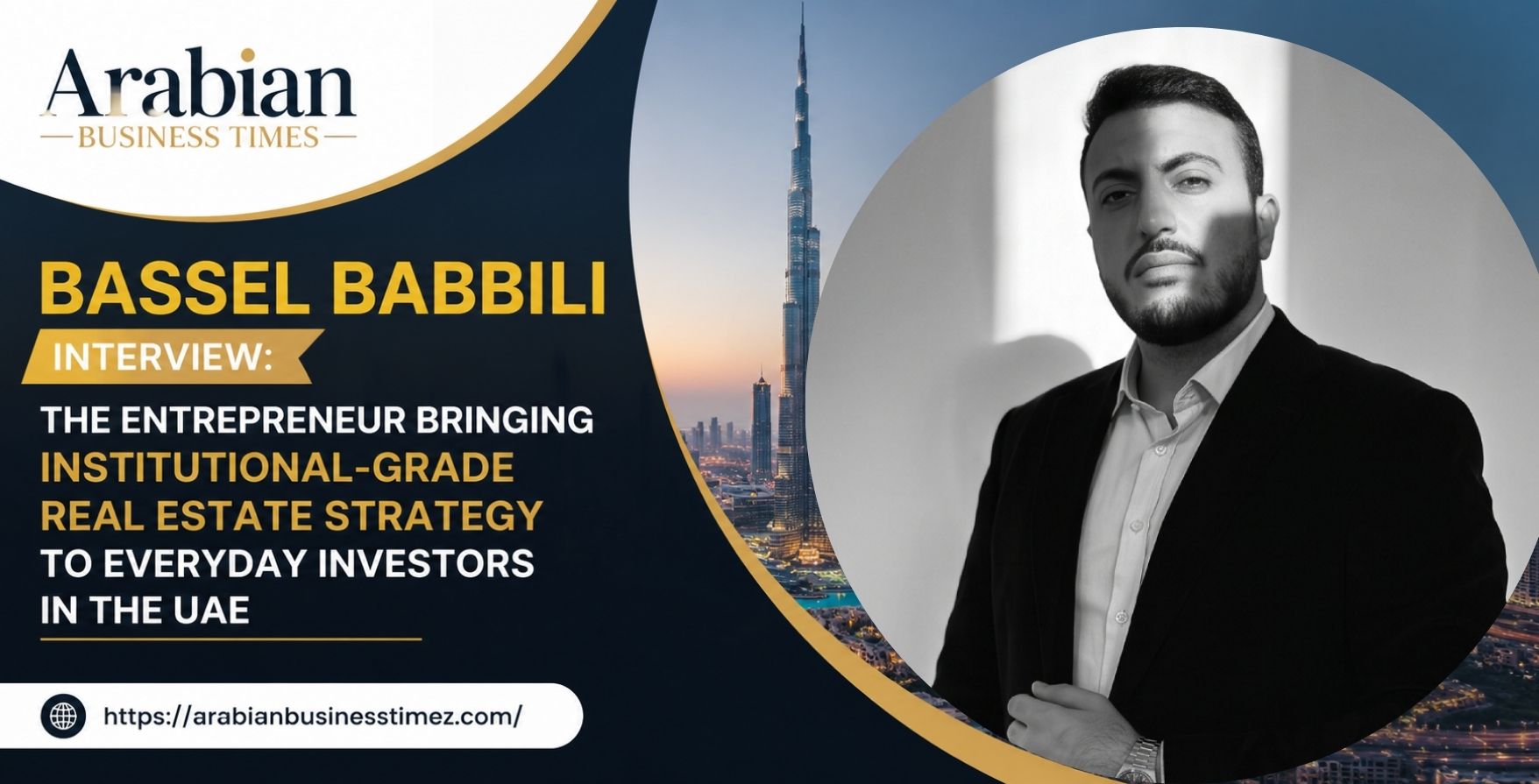
The Co founder of Keraspace Real Estate Brokers on why most retail investors get it wrong, what AI can and cannot do for property buyers, and where the smart money is looking in Dubai right now.
Most people who end up building careers in real estate will tell you they did not plan it that way. Bassel Babbili is no different, except that what began as an accidental entry into the industry in Istanbul in 2017 has since evolved into something considerably more purposeful.
Today, Babbili is the Co founder of Keraspace Real Estate Brokers, one of the UAE’s emerging advisory-led property firms, and a recognized name on the Top 10 Innovative Entrepreneurs UAE list. His firm operates on a premise that is straightforward to state but genuinely difficult to execute: give retail investors access to the same quality of strategic thinking that institutional players take for granted.
“We don’t sell homes,” he says. “We bring you assets.”
It is a distinction that defines everything about how Keraspace operates, and it is the thread that runs through Babbili’s thinking on real estate investing, market cycles, technology, and the future of the UAE property market. Arabian Business Times sat down with him for a wide-ranging conversation on all of it.
From Istanbul to the UAE: A Decade Built on Conviction
Bassel Babbili’s entry into real estate was, by his own admission, unplanned.
“No one enters real estate on purpose,” he says. “It’s a huge responsibility and has a lot at stake once you realize how impactful it is on people’s lives.”
He started in Istanbul in 2017, found himself drawn deeper into the industry, and a decade later it had become both his career and his passion. The trajectory from accidental participant to deliberate firm founder came when he recognized something the market was not providing: advisory services built on genuine values rather than transaction volume.
“Keraspace was created once the values I believe in had to be the decision maker,” he explains. “In such a fast market, going with the waves without foundations or core values is a sign of failure.”
Building the firm in its early stages taught him lessons that no amount of market knowledge can substitute for. The most costly, he says, was also the most universal challenge for any growing services business.
“Out of many, the real challenge for any emerging company is finding the right people for the right place,” he says. “This is the biggest cost in a small to mid-size business, especially in the services industry.”

The Leadership Principle Most Entrepreneurs Avoid
Ask Bassel Babbili which leadership principle has contributed most to his success, and his answer is not the one most founders give.
“Accepting that in order to be someone, you can’t simply please everyone, nor be able to do business with anyone,” he says.
It is a principle he applies with conviction, and one that has direct commercial implications at the highest levels of the market. Even at the nine-figure deal level, he argues, real estate transactions are fundamentally emotional. That reality demands a particular kind of selectivity.
“Regardless of the person, until this very day, the vast majority of deals – even at the nine-figure level – happen emotionally,” he says. “At such a level, you have to get selective and get ready to refuse some deals.”
For a founder in a competitive brokerage market, this is not a casual position. It reflects a deliberate choice to build a firm whose reputation is staked on quality of advice rather than volume of transactions, and to accept the commercial constraints that come with that choice.
What Keraspace Actually Does Differently
The UAE real estate market is not short of brokers, platforms, or advisory services. What Babbili argues Keraspace offers is something qualitatively different: institutional-grade strategic thinking applied to retail investor situations.
“It’s easy to throw words like quality, professionalism, and care,” he acknowledges. “But it is simply that we provide an institutional level advisory to the retail investor.”
The practical implication of this is that Keraspace does not treat all clients or all transactions the same way. Each investment case, he says, is custom-designed around the client’s specific cash flow position and realistic return expectations, rather than matched to whatever inventory needs to move.
This matters most, he argues, because retail investors are frequently unaware of who they are actually competing against.
“Retailers most often don’t realize or even have their exit strategy,” he says. “Most people think they are competing with similar people, but this isn’t always the case, especially when it comes to master developments. We match expectations to reality.”
The approach extends to how Keraspace thinks about risk. In Babbili’s view, risk assessment without data is not risk assessment at all.
“You can’t assess anything without data and tools,” he says. “You need to have a trusted partner, someone who can profit only when you do. Promises or claims without data is buying into dreams.”
The Most Common Mistake First-Time Real Estate Investors Make
With a decade of experience advising investors across market cycles, Babbili has a clear view of where first-time buyers consistently go wrong. His answer is precise.
“Buying based on names blindly,” he says.
The UAE real estate market has no shortage of developer brands that carry significant marketing weight. For inexperienced investors, particularly international buyers entering the market without local knowledge – the temptation to equate a recognizable name with a sound investment is understandable. Babbili’s position is that it is also one of the most reliable paths to a poor outcome.
The corrective, in his view, is straightforward in principle: link yourself to an advisor whose financial interests are aligned with yours. “Nothing is stronger than linking financial fate,” he says. “Either give it your whole time and effort to learn and keep up with trends, news, and regulations – or partner up with someone who only profits when you do.”
How Market Cycles Have Changed – and What Investors Are Missing
One of the more analytically interesting arguments Babbili makes is about the structural shift in how real estate market cycles operate today, and why most investors are applying an outdated mental model.
“Here is where people get it wrong,” he says. “The real question isn’t with today’s real estate market. Real estate is simply an asset, while investment cycles keep shifting with the people involved.”
His point is generational. Baby boomers and Gen X operated in a market defined by long, predictable cycles. The dominant retail investor demographic today is millennials, and their expectations around transaction speed are fundamentally reshaping how markets behave globally.
“Fifteen to twenty years ago, someone did not expect the property to be in the market twice in about five years,” he explains. “While now, it is very competitive to see the same property hit the market twice or even more in less than two years. This changes the market completely and allows for micro cycles in micro locations.”
For investors, the implication is significant. The analytical tools and time horizons that worked for previous generations may not map accurately onto a market defined by shorter cycles, faster transactions, and a more liquid secondary market. Understanding this shift, Babbili argues, is foundational to making sound investment decisions in the current UAE environment.
What AI Can and Cannot Do for Real Estate Investors
Given the intensity of conversation around Artificial Intelligence across every sector, Babbili’s view on AI in real estate is notably grounded, and worth taking seriously precisely because it pushes back against the prevailing narrative.
“It’s shocking maybe to know that it’s not reshaping anything – at least yet,” he says.
His position is not that AI is irrelevant to real estate. It is that the conditions required for AI to be genuinely reliable in property investment decision-making do not yet exist at scale. The core problem is data quality and regulatory infrastructure.
“When asking AI a question, just remember that you are asking a tool that has the entire internet as a source, and this is not by any chance reliable enough to take a decision,” he says.
The areas where he does see AI making a meaningful difference are architecture, concept visualization, and general sales and marketing, useful, but not yet transformative at the investment decision level.
He is, however, genuinely optimistic about where AI in real estate is heading, particularly in the UAE context.
“Once more regulation comes in place with correct databases and official information sources, AI can be more reliable for decision making,” he says. “I know for a fact that until today, the UAE is leading worldwide in this step, and I wouldn’t be surprised seeing it in action before 2033.”
His advice to real estate professionals preparing for that future is characteristic of his broader philosophy: stay curious, keep learning, and ask better questions.
“The key isn’t the technology itself – it is coming, and there are smart people working on it,” he says. “Instead of focusing on the technology itself, focus on the regulations in your market and build relationships with decision makers there.”
Where the Smart Money Is Looking in Dubai Right Now
For investors actively evaluating the Dubai market in the current cycle, Babbili offers specific and timely guidance.
He identifies a significant and underappreciated opportunity in the structural undersupply affecting certain asset categories across the UAE – a gap that is not yet fully reflected in how most retail investors are positioning themselves.
For those who have already decided against villas or townhouses but still want meaningful exposure to Dubai’s growth, his current recommendations as of Q2 and Q3 2026 are concrete: Jumeirah Garden City (JGC), Al Jaddaf, and the emerging generation of sea view developments represent the areas showing the strongest case for investment attention.
“If you are not buying a villa nor a townhouse and still want to invest in the market, you have JGC, Al Jaddaf, and the new era sea views,” he says.
Why Dubai Continues to Attract Global Capital
Asked why Dubai remains one of the world’s most consistently attractive destinations for real estate investment, Babbili moves past the standard answers quickly.
“Besides what we all know about taxes and financial attractions, there is one simple answer,” he says. “Lifestyle, harmony, safety, purpose.”
It is a framing that reflects something real about how high-net-worth individuals and institutional investors increasingly evaluate markets. Tax efficiency and yield matter, but so does the quality of the environment in which wealth is created and held. Dubai’s sustained ability to deliver on both dimensions is, in his view, the most durable explanation for its continued global appeal.
One Piece of Advice for the Next Generation of Investors
For entrepreneurs, investors, and business leaders preparing for a real estate market shaped by AI, shifting demographics, and faster cycles, Babbili’s closing guidance is both practical and forward-looking.
“Instead of focusing on the technology itself, focus on the regulations in your market and build the relationship with decision makers there,” he says. “Take part by staying informed and curious. Don’t be afraid to ask questions and research. Quick access to information is what brings you results. Be close to those who are.”
It is advice that carries the weight of a decade’s experience in markets that do not forgive complacency, and from a founder who built something lasting precisely by refusing to take the easier, faster, less selective path.
FAQ
Who is Bassel Babbili?
Bassel Babbili is an entrepreneur and the founder of Keraspace Real Estate Brokers in the UAE. Recognized on the Top 10 Innovative Entrepreneurs UAE list, he has over a decade of experience in real estate investment advisory across Turkey and the UAE, with a focus on providing institutional-grade strategies to retail investors.
What is Keraspace Real Estate Brokers?
Keraspace Real Estate Brokers is a UAE-based real estate advisory and brokerage firm Co founded by Bassel, George, Ahmad and mohammed. The firm specializes in providing retail investors with professional, data-driven investment strategies typically associated with institutional real estate buyers. Its guiding principle is: “We don’t sell homes, we bring you assets.”
What is the biggest mistake first-time real estate investors make in Dubai?
According to Bassel Babbili, the most common mistake is buying based on developer or brand names without conducting independent due diligence. Inexperienced investors, particularly international buyers, often equate recognizable names with sound investments, which frequently leads to poor outcomes.
Which areas in Dubai offer the best real estate investment potential in 2026?
As of Q2 and Q3 2026, Bassel Babbili highlights Jumeirah Garden City (JGC), Al Jaddaf, and emerging sea view developments as the areas showing the strongest investment case for buyers not focused on villas or townhouses.
Can AI be trusted for real estate investment decisions in the UAE?
Bassel Babbili argues that AI is not yet reliable enough for real estate investment decision-making due to data quality and regulatory gaps. However, he notes that the UAE is leading globally in building the regulatory infrastructure needed to make AI more dependable in this context, and expects meaningful progress before 2033.
How can retail investors compete with institutional real estate buyers?
Babbili’s advice is to partner with an advisor whose financial incentives are directly aligned with the investor’s success, someone who profits only when the client does. He also emphasizes the importance of having a clear exit strategy from the outset, which most retail investors lack.
Quick Facts: Bassel Babbili & Keraspace Real Estate Brokers
| Youtube | https://www.youtube.com/@BasselBabbili |
| Role | Partner, Keraspace Real Estate Brokers |
| Recognition | Top 10 Innovative Entrepreneurs UAE |
| Location | Dubai, UAE |
| Experience | 10+ years in real estate investment advisory |
| Started | Istanbul, Turkey, 2017 |
| Firm Focus | Institutional-grade advisory for retail real estate investors |
| Core Motto | “We don’t sell homes, we bring you assets.” |
| Key Markets | UAE, Dubai real estate investment |
| Expertise | Investment strategy, market cycles, AI in real estate, B2B & B2C growth |
| linkedin.com/in/bassel-babbili-199328151 |
Arabian Business Times profiles the leaders, founders, and visionaries shaping business across the GCC and beyond. To suggest a leader for our executive interview series, contact our editorial team.
Related Interviews & Insights
- ???? Read how GCC leaders are using AI to drive business growth
- ???? Also check – Ammara Aftab Interview
- ???? Explore our exclusive interview with Anis Sfar on AI and Dubai’s real estate sector
- ???? Discover insights from Dr. George Syrmalis on innovation and leadership:
- ???? Read our conversation with Valia Abou Alfadel on business and transformation
- ???? Don’t miss the Monday Man Interview featuring Wasif Mazhar
- ???? Learn more about Dr. Sofica Bistriceanu
- ???? Explore the profile of Dr. Desziree Richardson