There is a paradox quietly reshaping consumer markets. The more powerful artificial intelligence becomes, the more people seem to crave something it cannot deliver – a genuine feeling.
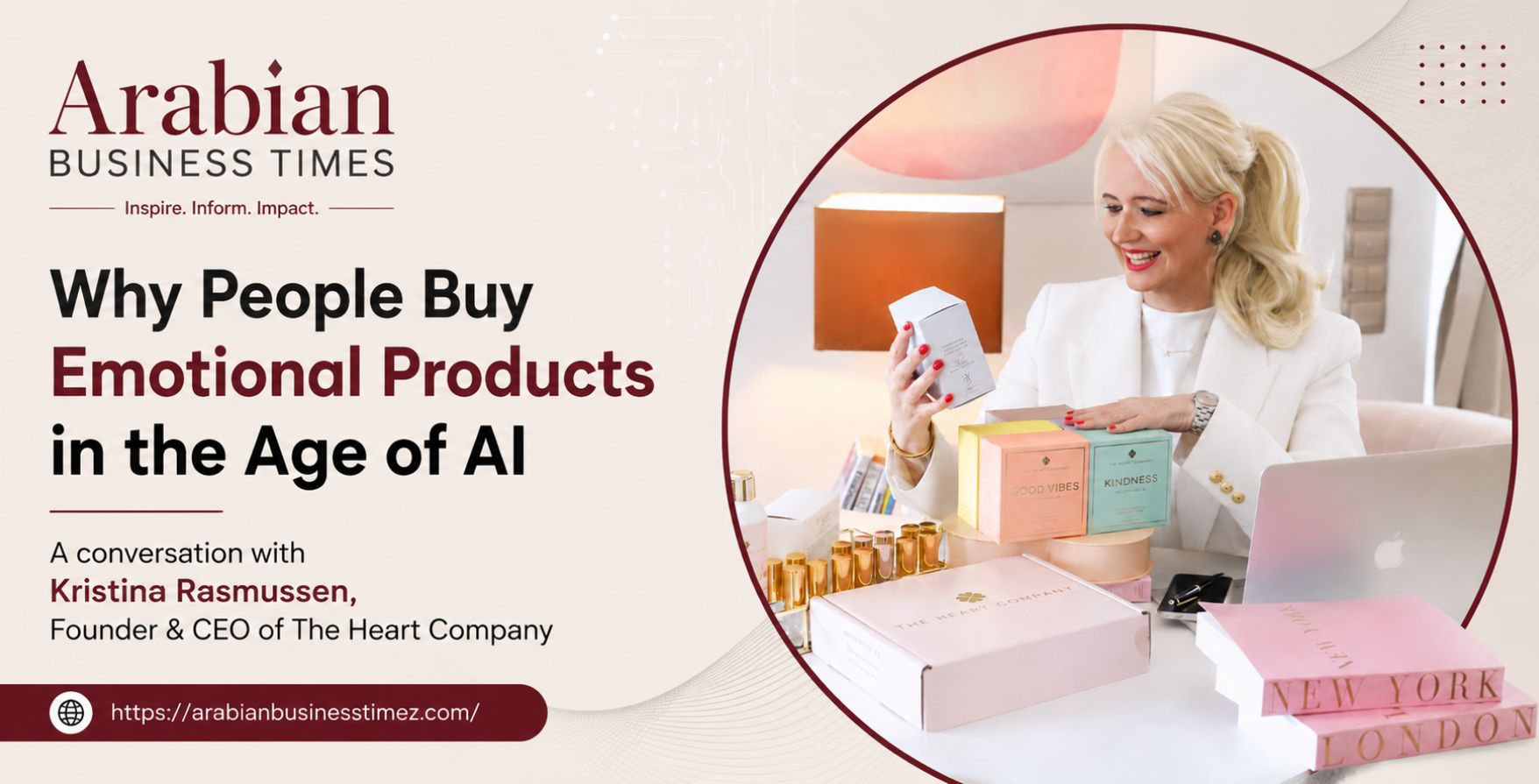
Kristina Rasmussen has built her entire company around that idea. As the founder and CEO of The Heart Company, an emotional fragrance brand trademarked across Europe, the United States, and China, she has spent years studying why people buy what they buy; and what that means for brands navigating an AI-driven world. Her fragrances, with names like Love in a Bottle and Kindness in a Bottle, are not sold on specifications. They are sold on feeling.
In this conversation, Kristina shares why she believes emotion is becoming the defining competitive advantage of our era, how AI is reshaping the rules for small brands, and why the founders who combine technological intelligence with human connection will be the ones who last.
What Drives People to Buy With Their Hearts, Not Just Their Heads
Q: AI is transforming almost every industry. Why do you believe emotional products will become even more important?
Because AI can automate many things, but it cannot replace human emotion. As our lives become more digital, people increasingly seek experiences that make them feel something real. We don’t remember algorithms. We remember how people, brands, and moments made us feel.
Q: You often say “Emotion is the new luxury.” What do you mean by that?
Traditional luxury was often about status, exclusivity, and price. Modern luxury is increasingly about emotional value. Consumers are looking for products that create comfort, joy, optimism, confidence, or connection. In a world filled with information and automation, emotion becomes the true differentiator.
Q: How does this apply to the fragrance industry?
Fragrance has always been emotional. Nobody buys perfume because they need it to survive. People buy fragrance because of how they want to feel. They want confidence before an important meeting. They want comfort after a difficult day. They want to remember a person, a place, or a moment. Fragrance is one of the most emotional product categories in the world.
Q: Some people fear AI will make brands less human. Do you agree?
Only if brands use AI incorrectly. I see AI as an amplifier, not a replacement. AI can help us create content, analyze data, and understand customers better. Businesses across the region are already adopting these strategies, as discussed in our guide on How GCC Leaders Are Using AI to Grow Their Business.
Q: What role will founders play in the future?
Founder visibility will become increasingly important. Consumers trust people more than corporations. They want to know who is behind a brand, what they believe, and why they started the company. AI makes information abundant. Authenticity becomes more valuable.
Q: How are purchasing decisions changing?
Consumers are increasingly buying through trust and storytelling rather than traditional advertising. This shift is particularly visible in social commerce, where platforms such as TikTok are transforming product discovery, as highlighted in TikTok Shop Fragrance Brands & Social Commerce 2026. rather than through traditional advertising alone. Social commerce, creator recommendations, founder content, and community-driven discovery are becoming powerful forces. People buy from brands they feel connected to.
Q: What does this mean for beauty brands specifically?
Beauty brands must move beyond features and benefits. As AI reshapes customer engagement, emotional storytelling is becoming increasingly important, a trend we examined in How AI Is Changing Beauty Marketing. Consumers can compare ingredients and prices within seconds. The real question is: What does this brand stand for? How does it make me feel? Why should I care? Brands that answer those questions will win.
Q: What do you believe the next decade will look like?
I believe we’ll see a fascinating paradox. Technology will become more powerful than ever, while human connection becomes more valuable than ever. The brands that thrive will combine both. They will use AI to scale efficiency while using emotion to build loyalty.
Q: What is your advice for entrepreneurs?
Use AI aggressively. But never outsource your humanity. Founders who combine technology with authentic brand building are more likely to succeed, similar to the principles discussed in How to Build a Successful Startup in the GCC.
Q: In one sentence, what is the future of branding?
The future belongs to brands that combine technological intelligence with emotional intelligence.
The AI Advantage Small Brands Are Only Beginning to Discover
For decades, independent founders operated at a structural disadvantage. Large corporations had the budgets, the agencies, the headcount. That gap is closing faster than most people realize.
Q: Many founders feel disadvantaged compared to large corporations with billion-dollar budgets. What is the opportunity today?
Ironically, AI is creating the biggest opportunity for smaller brands in decades. Historically, large companies had an advantage because they could hire larger teams, agencies, consultants, and analysts. Today, a founder with AI can access capabilities that previously required dozens of employees. The gap between large and small organizations is narrowing.
Q: Does this mean small brands can now compete with industry giants?
A: Not immediately, but the rules have changed. You no longer need a 50-person marketing department to create content, analyze customer feedback, improve listings, research competitors, or develop communication strategies. AI gives founders leverage, and leverage is one of the most powerful forces in business.
Q: Where should founders focus their limited resources?
A: On assets rather than activities. Build products. Build intellectual property. Build customer trust. Build distribution. Build community. AI can help execute many tasks, but founders should focus on creating durable assets that compound over time.
Q: You run a lean organization. Is that intentional?
A: Absolutely. A lean organization creates clarity. Every investment matters. Every project matters. Every hire matters. AI allows small teams to stay focused while still operating at a surprisingly high level.
Q: Can a small team really compete internationally today?
A: More than ever before. Technology has dramatically reduced barriers. Small teams can sell globally, manufacture globally, communicate globally, and build audiences globally. Entrepreneurs looking to accelerate growth can also explore our guide on How to Scale a Small Business in Dubai in 2026. Geography is becoming less important than execution.
Q: Has AI changed how working mothers can build companies?
A: Absolutely. AI is becoming one of the most powerful support systems ever created for entrepreneurs. It helps with research, writing, planning, analysis, and communication. For many founders, it acts like an additional team member.
Why Amazon Is No Longer Just a Shop
Most people still think of Amazon as a place to complete a purchase. Kristina sees it differently — as one of the most powerful brand discovery platforms on the planet, and one where the data flowing back to sellers is unlike anything that existed a generation ago.
Q: What role does Amazon play in this shift?
A: Amazon is often misunderstood. Many people still think of it as simply a place to buy products. In reality, it has become one of the world’s largest discovery engines. Consumers increasingly start their product searches on Amazon rather than on Google.
Q: Why is Amazon particularly interesting for emerging brands?
A: Because it is one of the few places where customer behavior, intent, conversion, reviews, search terms, and product performance are all visible in one ecosystem. Every review, every keyword, every conversion teaches you something about your customer.
Q: You often talk about “feeding the flywheel.” What does that mean?
A: Every business activity should strengthen another business activity. Social media creates awareness. Awareness drives Amazon searches. Amazon reviews improve conversion. Better conversion improves ranking. Better ranking generates more visibility. More visibility creates more sales. Sales create more data. Data improves decision-making. That’s the flywheel.
Q: How important is data for modern founders?
A: Extremely important. Data reduces assumptions. The beauty of platforms like Amazon is that they provide constant customer feedback. Reviews are not just ratings. They are one of the largest focus groups a brand can ever have.
Q: What is the relationship between social media and commerce today?
A: Social media increasingly functions as the top of the funnel. People discover products through creators, founders, and communities. Platforms create trust. Commerce platforms capture demand. The strongest brands connect both worlds.
On Leadership, Judgment, and What AI Will Never Replace
Q: How should founders think about AI?
A: AI should not replace thinking. It should amplify thinking. The best founders will not be the people who use AI the most. They will be the people who combine AI with judgment, creativity, empathy, and decision-making.
Q: What is one common mistake founders make with AI?
A: Using AI only for efficiency. Efficiency matters, but AI also creates opportunities for creativity, research, strategic thinking, and customer understanding. The biggest value often comes from better decisions rather than faster execution.
Q: What challenges still cannot be automated?
A: Relationships. Leadership. Trust. Brand vision. Product quality. Supply chain decisions. Strategic judgment. In industries such as fragrance, beauty, or consumer products, physical execution still matters enormously.
Q: What makes fragrance particularly challenging?
A: Fragrance combines emotion with operational complexity. You have formulation, compliance, manufacturing, packaging, logistics, regulations, inventory management, and quality control. At the same time, consumers buy primarily based on emotion.
Q: What does leadership look like in an AI-driven world?
Leadership becomes more human, not less. While AI can improve efficiency, trust, empathy, and strategic judgment remain uniquely human skills. We explored this further in Things AI Cannot Do in Leadership.
Q: How do you lead distributed and digital teams?
A: Through communication, transparency, trust, and shared goals. Modern teams are often global. Leadership is less about control and more about alignment.
Q: What role does positive psychology play in business?
A: Resilience. Entrepreneurship is a long game. Markets change. Platforms change. Technologies change. Optimism is not naïve. It is a competitive advantage because it allows people to keep building when others stop.
Q: As a founder and mother, how do you think about productivity?
A: I don’t believe in being busy. I believe in being effective. Parents often become very efficient because time is limited. You learn to prioritize what actually moves the business forward.
Q: What advice would you give founders entering the next decade?
A: Build leverage through technology, but build loyalty through humanity. AI can help people discover your business. Human connection is what makes them stay.
Questions Readers Are Asking
Why do people buy emotional products rather than functional ones?
Purchasing decisions have always carried an emotional dimension, but in an era of instant price comparison and infinite product choice, emotion has become the deciding factor more than ever. People buy to feel something — confident, comforted, hopeful, connected. Kristina Rasmussen’s work is built around this shift, particularly in fragrance, where the emotional pull of a product has always outweighed its functional purpose.
What does “emotion is the new luxury” actually mean for brands?
It means the old markers of luxury — high price, exclusivity, heritage — are no longer enough on their own. Consumers today want to feel something when they engage with a brand. That emotional response, whether it’s comfort, joy, or a sense of identity, has become the real currency of premium positioning.
Can AI help small brands compete with much larger ones?
Kristina argues it already is. The capabilities that once required large agency teams — content production, customer research, competitor analysis, listing optimization — are now within reach for a founder working alone or with a small team. The playing field is not level yet, but it is measurably more accessible than it was five years ago.
Why has Amazon become so important for brand discovery?
Consumer search behavior has shifted. A growing number of product searches now begin on Amazon rather than Google, making it as much a discovery platform as a transaction one. For brands, this means Amazon is not just a sales channel — it is one of the most data-rich environments for understanding what customers want and how they decide.
What is the “flywheel” strategy and why does it matter?
It describes a self-reinforcing business loop where each activity feeds the next. Social media generates awareness, which drives search behavior, which produces reviews, which improve ranking, which creates more visibility, which generates more sales and data. For lean founder-led brands, building this kind of compounding system is more valuable than any single marketing campaign.
What parts of running a business genuinely cannot be handed to AI?
Kristina’s answer is direct: relationships, leadership, trust, brand vision, product quality, and judgment. Especially in physical product categories like fragrance and beauty, where operational complexity meets emotional expectation, the human role remains irreplaceable.
What does healthy, sustainable leadership look like today?
For Kristina, it means being effective rather than just busy, building calm and clarity into how you work, and recognizing that wellbeing and performance are not in tension — they are connected. She describes beach walks, intentional environments, and structured thinking time as part of how she leads, not separate from it.
What is her single most important piece of advice for the next decade?
Build leverage with technology. Build loyalty with humanity. The two are not in competition — they work together. AI extends what founders can do. Human connection determines whether anyone stays.
Related Blogs
If you enjoyed this interview on emotional branding, AI, entrepreneurship, and leadership, you may also find these articles insightful:
- How GCC Leaders Are Using AI to Grow Their Business
- Things AI Cannot Do in Leadership
- How AI Is Changing Beauty Marketing
- How TikTok Shop Is Transforming Fragrance Brands Through Social Commerce
- How to Build a Successful Startup in the GCC
- How to Scale a Small Business in Dubai in 2026
- International Business Expansion Strategy: A Guide for Growing Companies