Quick Facts: EFG-HUB Technologies
| Company | EFG-HUB Technologies (Enterprise of the Future Generation) |
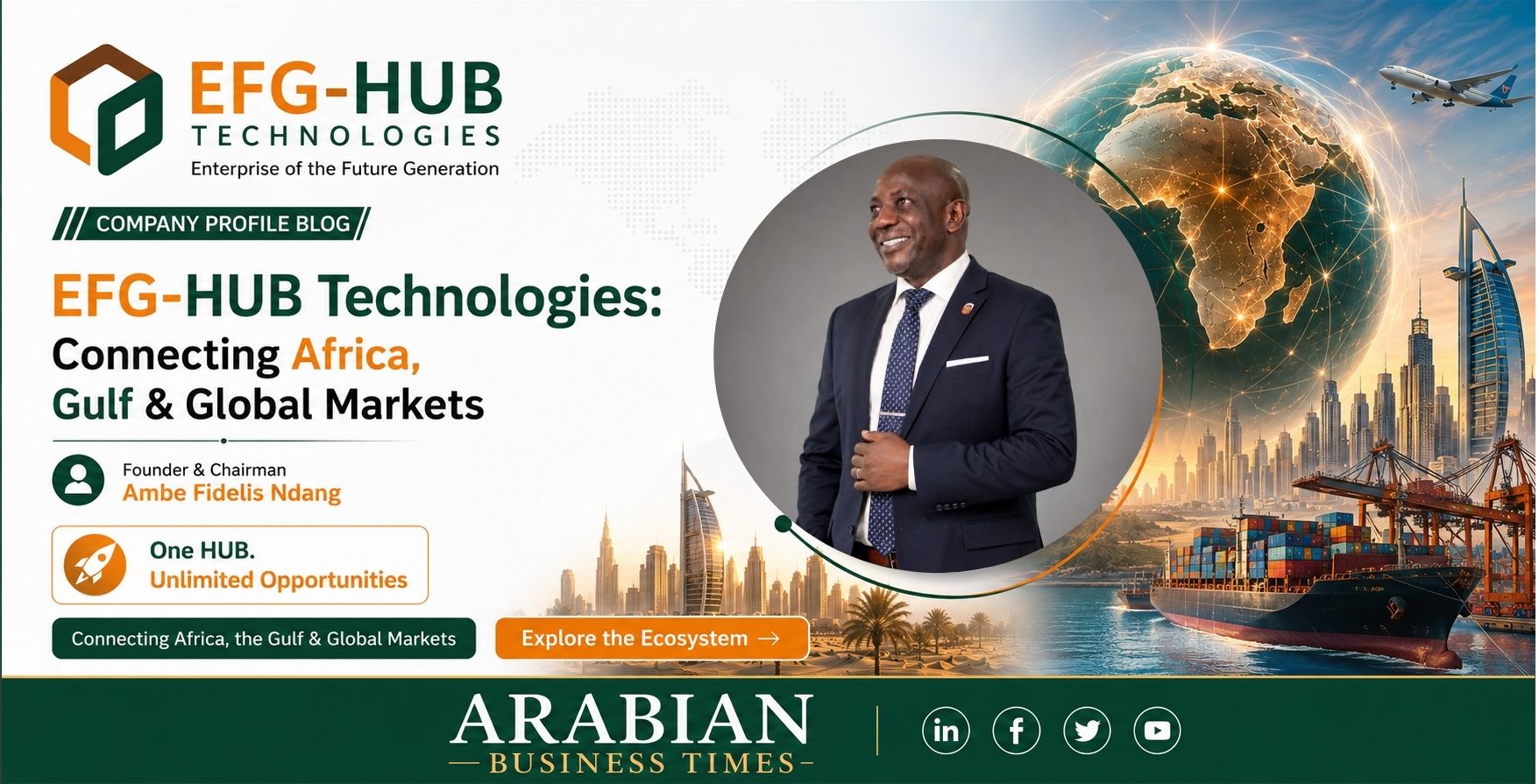
| Founder & Chairman | Ambe Fidelis Ndang |
| Headquarters | Office 206, Abraj Al Mamzar Building, Block A, Al Ittihad Road, P.O. Box 90229, Dubai, UAE |
| Trade License No. | 1554147 (Issued: 19 September 2025 / Expiry: 18 September 2026) |
| UAE Recognition | DE@AE Tier 1, Digital Economy Initiative |
| Registered Activities | Computer Systems & Software Design, Education & Training Software, Cyber Risk Management, Digital Portal Services, Cloud Services & Datacenter Provision, IT Network Services |
| Number of Divisions | 8 |
| Initial African Markets | Cameroon, Nigeria, Gabon, Benin, Côte d’Ivoire |
| Official Websites | www.efghubtech.com / www.efghub.ae |
| Official Emails | info@efghubtech.com / info@efghub.ae |
| Brand Promise | One HUB. Unlimited Opportunities. |
Introduction
In a business landscape where most companies are built around a single product or service, EFG-HUB Technologies has taken a fundamentally different approach. The Dubai-headquartered organization, founded and chaired by Ambe Fidelis Ndang, describes itself as an ecosystem — a coordinated platform of eight interconnected divisions spanning B2B trade, corporate services, AI and cybersecurity, media and branding, training and certification, logistics, technical facility management, and automotive technology.
The ambition behind EFG-HUB is not simply to provide services. It is to create a structured institutional bridge connecting African suppliers, entrepreneurs, and youth to Gulf infrastructure and global markets. For Arabian Business Times’ readership of investors, executives, government decision-makers, and business leaders, this feature examines the commercial logic, operational model, governance framework, and strategic priorities behind what Ndang is building.
An Ecosystem, Not a Company: The Business Case
EFG-HUB Technologies describes itself as an ecosystem, not just a company. For investors, executives, and business leaders, what exactly does that mean in practice, and why does it matter?
Ndang frames the distinction in operational terms. “EFG-HUB is an integrated business ecosystem connecting trade, technology, logistics, training, media, AI, cybersecurity, and corporate services under one structure.”
The practical implication, he explains, is about eliminating the fragmentation that stakeholders typically face when navigating cross-border markets. “In practice, this means a supplier, entrepreneur, institution, or investor can access multiple solutions through one trusted platform. It matters because modern business challenges are connected, and EFG-HUB is built to solve them in a complete, scalable, and structured way.”
The strength of the model, as EFG-HUB’s institutional documentation puts it, is that each division can “operate independently while contributing to a shared ecosystem that strengthens market access, brand credibility, customer acquisition, operational support and long-term institutional growth.” An African supplier onboarding to Afro Market Portal may simultaneously need corporate structuring through EFG Corporate Services, logistics coordination through EFG Logistics & Supply Chain, digital protection through EFG NextGen AI & Cybersecurity, and media visibility through EFG Vision. Within EFG-HUB, those services connect rather than compete.
Afro Market Portal: The Trade Opportunity and What Sets the Model Apart
The Afro Market Portal sits at the heart of your trade vision — connecting African suppliers directly to global buyers. How big is the opportunity you are targeting, and what makes your model different from existing B2B trade platforms?

Ndang starts with the core structural problem. “Africa has enormous trade potential, but many suppliers still lack access to verified buyers, logistics, documentation, and digital visibility.”
His differentiation argument centers on the depth of the infrastructure behind the portal. “Afro Market Portal is different because it is not just a listing platform. It is a controlled B2B trade system with supplier verification, KYC, local representatives, product approval, logistics coordination, and buyer protection. Our goal is to make African trade more trusted, structured, and globally accessible.”
The division’s documented service scope — spanning supplier onboarding and verification, product listing and buyer matching, RFQ and order coordination, representative dashboard supervision, payment and settlement control, and trade documentation — reflects a model designed to reduce the risk that typically discourages international buyers from engaging with African markets directly. Local country representatives play a critical role: they support supplier onboarding, provide on-the-ground verification, and serve as the accountability layer between the platform and the physical supply chain.
The UAE Regulatory Advantage and What DE@AE Tier 1 Means for Cross-Border Operations
You launched EFG-HUB under the UAE’s DE@AE Tier 1 Digital Economy Initiative. How does the UAE regulatory and business environment support what you are building, and what advantages does a Dubai base give you for operating across Africa?

For Ndang, the UAE’s role is structural rather than merely geographical. “The UAE provides a strong base for digital business, innovation, logistics, investment, and international trade. Dubai gives EFG-HUB credibility, global connectivity, access to investors, and a strategic bridge between Africa, the Gulf, and international markets. It allows us to operate with international standards while building practical solutions for African markets.”
EFG-HUB’s official registration reinforces this positioning. The company holds UAE Trade License No. 1554147 under the Trader License category, with registered technology activities covering computer systems and communication equipment software design, education and training computer software, cyber risk management services, digital portal services, cloud services and datacenter provision, and information technology network services. Recognition under the DE@AE Tier 1 Digital Economy Initiative signals that EFG-HUB’s digital infrastructure meets UAE standards for cloud-ready, technology-driven business operations — a credential relevant to both government engagement and investor due diligence.
How Eight Divisions Function as One Value Chain
EFG-HUB spans eight divisions including AI, cybersecurity, logistics, media, and automotive technology. How do these divisions genuinely work together as one ecosystem rather than operating as separate standalone businesses?

Ndang describes the divisions as a value chain rather than a portfolio. “Each division supports the others. Afro Market creates trade opportunities; logistics moves goods; AI and cybersecurity secure digital operations; training develops talent; media builds visibility; corporate services support business structure; and other divisions add specialized solutions. Together, they create one value chain rather than separate businesses.”
The eight divisions and their primary institutional roles are as follows. EFG Afro Market Portal handles B2B trade, export facilitation, supplier onboarding, buyer access, and product verification. EFG Corporate Services Provider covers business setup, licensing, PRO support, documentation, and advisory. EFG NextGen AI & Cybersecurity focuses on AI awareness, cybersecurity training, cloud readiness, and digital risk management. EFG Vision — Media & Branding delivers podcasting, media production, corporate branding, and digital content. EFG Institute — Training & Certification provides professional training, certification coordination, internship programs, and workforce development. EFG Logistics & Supply Chain manages freight coordination, warehousing, import and export support, and trade facilitation. EFG Technical Solutions & Facility Management covers maintenance, technical manpower, facility coordination, and infrastructure support. Hayat Al Wadi Automotive Technology specializes in vehicle electronics, Android system upgrades, interior and exterior transformation, and automotive branding.
Building On-the-Ground Trust Across African Markets
Africa is a continent of 54 countries with very different markets, regulations, and languages. What is your strategy for building presence and trust across African markets, and where will you begin?
Ndang is clear that EFG-HUB will not attempt a simultaneous continent-wide launch. “We will build trust through local representatives, supplier verification, KYC, training, documentation, and strong country-level coordination. Our first focus will be selected African markets such as Cameroon, Nigeria, Gabon, Benin, and Côte d’Ivoire, before expanding gradually across the continent. The strategy is simple: combine local presence with international standards.”
This sequenced approach aligns with EFG-HUB’s documented strategic roadmap, which structures expansion through five phases: institutional foundation, digital infrastructure, Africa representative growth, strategic partnerships, and global scaling. The representative network model — where local agents support supplier onboarding, document collection, field coordination, and market intelligence — is central to how EFG-HUB plans to maintain quality control as it scales across diverse regulatory and linguistic environments.
Governance, KYC, and Accountability Across a Multi-Division Cross-Border Operation
Governance, KYC, and compliance are prominently featured in your portfolio documents. For investors and institutional partners reading this, how do you ensure accountability and transparency across a multi-division, cross-border operation?
Ndang positions governance as a design choice embedded from the start, not an addition after the fact. “Governance, KYC, compliance, and documentation are built into our model from the beginning. We use verification, role-based controls, approval processes, transaction records, reporting systems, and audit trails to ensure accountability. For investors and institutional partners, transparency is not an option; it is part of our operating foundation.”
EFG-HUB’s compliance framework, as outlined in its institutional documentation, covers license and activity alignment, KYC and due diligence, contract and NDA controls, audit logs for digital platforms, financial reconciliation, and data protection. Risk controls include clear authorization levels, representative supervision protocols, document verification requirements, service provider screening, and a formal partnership approval process. On the digital side, the company’s platform standards require secure access, role-based permissions, OTP verification, and cybersecurity practices across all systems — standards directly supported by EFG-HUB’s registered activity in cyber risk management services.
AI and Cybersecurity: The Five-Year Outlook for Africa and the Gulf
EFG NextGen AI & Cybersecurity is one of your fastest-growing focus areas. How do you see AI and cybersecurity reshaping business and government operations in Africa and the Gulf over the next five years, and where does EFG-HUB fit into that transformation?

Ndang draws a clear line between where markets are headed and where EFG-HUB is positioned. “AI will improve efficiency, automation, decision-making, education, trade, and government services. Cybersecurity will be essential as more businesses and institutions move online. EFG NextGen AI & Cybersecurity is positioned to support this transformation through training, awareness, digital protection, and practical AI adoption for businesses, governments, youth, and institutions.”
The division’s scope spans AI awareness and practical training, cybersecurity fundamentals and advanced programs, cloud and digital transformation orientation, managed cyber risk awareness, instructor and training partnerships, and talent development pathways. Its target stakeholders include students and young professionals, companies undergoing digital transformation, institutions and training partners, cybersecurity instructors and agencies, and government and innovation bodies — a cross-sector audience that positions the division as relevant to both public and private sector clients across the Gulf and Africa simultaneously.
What an Ideal Strategic Partnership Looks Like
You have positioned EFG-HUB for government partnerships, university collaborations, and private investment simultaneously. What does an ideal strategic partnership with EFG-HUB look like, and what should a ministry, university, or investor expect in return?
Ndang sets out a single principle that applies across all partner categories. “An ideal partnership is structured, measurable, and mutually beneficial.”
For governments, the focus is programmatic. “For governments, it may involve youth empowerment, digital transformation, trade, or SME support.” For universities, it is capability-focused. “For universities, it may involve training, certification, internships, and innovation.” For investors, the proposition is the breadth of the ecosystem itself. “For investors, it offers access to a scalable Africa-Gulf-global ecosystem with multiple growth channels.”
EFG-HUB’s documented partnership models reflect this segmentation. Governments and ministries can engage through public-private collaboration on digital transformation, youth development, trade promotion, and SME support. Universities and training institutions can collaborate on certification pathways, internship programs, AI awareness, and youth ambassador initiatives. Investors and financial partners can engage through strategic funding, platform expansion, and market entry opportunities. All partnerships, per EFG-HUB’s governance framework, are documented with MoUs, NDAs, defined scope of work, financial terms, reporting structures, and measurable outcomes.
The Three Critical Objectives for the Next 12 Months
The ecosystem is in its early execution phase with ambitious milestones ahead. What are the three most critical objectives EFG-HUB must achieve in the next 12 months to prove the model works, and how are you measuring progress?
Ndang lays out a focused, sequential set of priorities.
“Our first objective is to complete and strengthen the core digital platforms, especially Afro Market Portal. The second is to activate pilot African markets with verified suppliers, representatives, and trade opportunities. The third is to secure serious institutional, investor, training, and strategic partnerships.”
On measurement, he is equally specific. “We will measure progress through verified users, active suppliers and buyers, partnerships signed, platform activity, successful trade leads, revenue growth, and compliance records.”
These milestones correspond directly to EFG-HUB’s documented success indicators: signed partnerships, training enrollments, supplier onboarding numbers, investor meetings, media visibility, and operational revenue channels — a framework designed to give investors and institutional partners concrete, trackable proof points rather than aspirational targets.
A Message for Ministers, Gulf Investors, and African Entrepreneurs
Arabian Business Times reaches influential decision-makers across the region. If you could leave one message for a government minister, a Gulf investor, or an African entrepreneur reading this today, what would you want them to know about EFG-HUB and the future you are building?
Ndang’s closing message reframes the opportunity. “Africa is not only a market of challenges; it is a market of future opportunities. EFG-HUB is building a bridge between Africa, the Gulf, and the world through trade, technology, talent, innovation, and structured partnerships.”
His final words are addressed directly to each audience. “To governments, investors, and entrepreneurs, my message is this: the future belongs to those who build early, connect markets, and invest in the next generation with vision and discipline.”
About EFG-HUB Technologies
EFG-HUB Technologies — Enterprise of the Future Generation — is a UAE-registered, multi-division business ecosystem operating under Trade License No. 1554147, recognized under the UAE’s DE@AE Tier 1 Digital Economy Initiative. The company is headquartered at Office 206, Abraj Al Mamzar Building, Block A, Al Ittihad Road, P.O. Box 90229, Dubai, UAE. Its eight divisions — EFG Afro Market Portal, EFG Corporate Services Provider, EFG NextGen AI & Cybersecurity, EFG Vision (Media & Branding), EFG Institute & Training, EFG Logistics & Supply Chain, EFG Technical Solutions & Facility Management, and Hayat Al Wadi Automotive Technology — serve governments, investors, institutions, universities, entrepreneurs, and youth ambassadors across Africa, the Gulf, and global markets. Contact: info@efghubtech.com | info@efghub.ae | www.efghubtech.com | www.efghub.ae

Frequently Asked Questions
What is EFG-HUB Technologies?
EFG-HUB Technologies (Enterprise of the Future Generation) is a Dubai-based, multi-division business ecosystem connecting African suppliers, entrepreneurs, and institutions to Gulf infrastructure and global markets through trade, technology, logistics, media, training, corporate services, technical solutions, and automotive technology.
What is EFG-HUB’s official trade license number?
EFG-HUB Technologies operates under UAE Trade License No. 1554147, issued on 19 September 2025 and valid until 18 September 2026.
Which African markets is EFG-HUB entering first?
EFG-HUB’s initial focus covers Cameroon, Nigeria, Gabon, Benin, and Côte d’Ivoire, with planned gradual expansion across the continent through local representative networks.
What does the DE@AE Tier 1 recognition mean?
The UAE Digital Economy Initiative’s DE@AE Tier 1 designation recognizes EFG-HUB as a digitally native technology business operating under UAE cloud-ready and cyber-aware infrastructure standards, strengthening its positioning with government, investor, and institutional stakeholders.
How can investors, governments, or universities partner with EFG-HUB?
Investors can engage across multiple divisions including Afro Market Portal, AI and cybersecurity training, media production, logistics, and the EFG Institute. Governments and ministries can engage through youth empowerment, digital transformation, trade facilitation, and SME programs. Universities can partner on certification, internships, and AI awareness initiatives. All partnerships are governed by formal written agreements with defined scope, financial terms, and measurable outcomes.
This feature is part of Arabian Business Times’ Leaders & Interviews series, spotlighting entrepreneurs, executives, and organizations shaping business across the GCC and beyond.
Interviews & Insights
- ???? Read how GCC leaders are using AI to drive business growth
- ???? Also check – Ammara Aftab Interview
- ???? Explore our exclusive interview with Anis Sfar on AI and Dubai’s real estate sector
- ???? Discover insights from Dr. George Syrmalis on innovation and leadership:
- ???? Read our conversation with Valia Abou Alfadel on business and transformation
- ???? Don’t miss the Monday Man Interview featuring Wasif Mazhar
- ???? Learn more about Dr. Sofica Bistriceanu
- ???? Explore the profile of Dr. Desziree Richardson