Building Institutions That Outlive Their Founders
Most leaders build careers. A rare few build institutions. Here is the difference, and the framework that separates legacies that endure from organizations that collapse the moment their founder steps back.
By Prof. Ona C. Miller, EdD, PhD · Founder & CEO, Global Female Civility Leadership Institute
Consider two organizations founded in the same year, by equally visionary leaders, with equally compelling missions. One is still operating today, larger, more influential, and more impactful than its founder ever imagined it could be. The other quietly closed within three years of its founder’s departure.
The difference was not vision. Both founders had it. The difference was not passion. Both had that too. The difference was not even funding, though that played a role. The difference was architecture. One founder built a platform around their personality. The other built an institution around a purpose, and designed the systems, governance structures, and leadership pipelines to carry that purpose forward without them.
That distinction is the central challenge of our time for women led organizations across the GCC, the United States, and around the world. And it is the question I have devoted my career to answering: what does it actually take to build something that lasts?
“The true measure of a leader is not what they build while they are present. It is what continues to grow after they are gone.”
WHY MOST ORGANIZATIONS DON’T SURVIVE THEIR FOUNDERS
The statistics are sobering. In Kenya alone, nearly 70 percent of businesses close within their first three to five years, and governance experts consistently identify the same root causes: weak corporate governance, lack of formal business structures, and an absence of succession planning. The pattern repeats across sectors and continents.
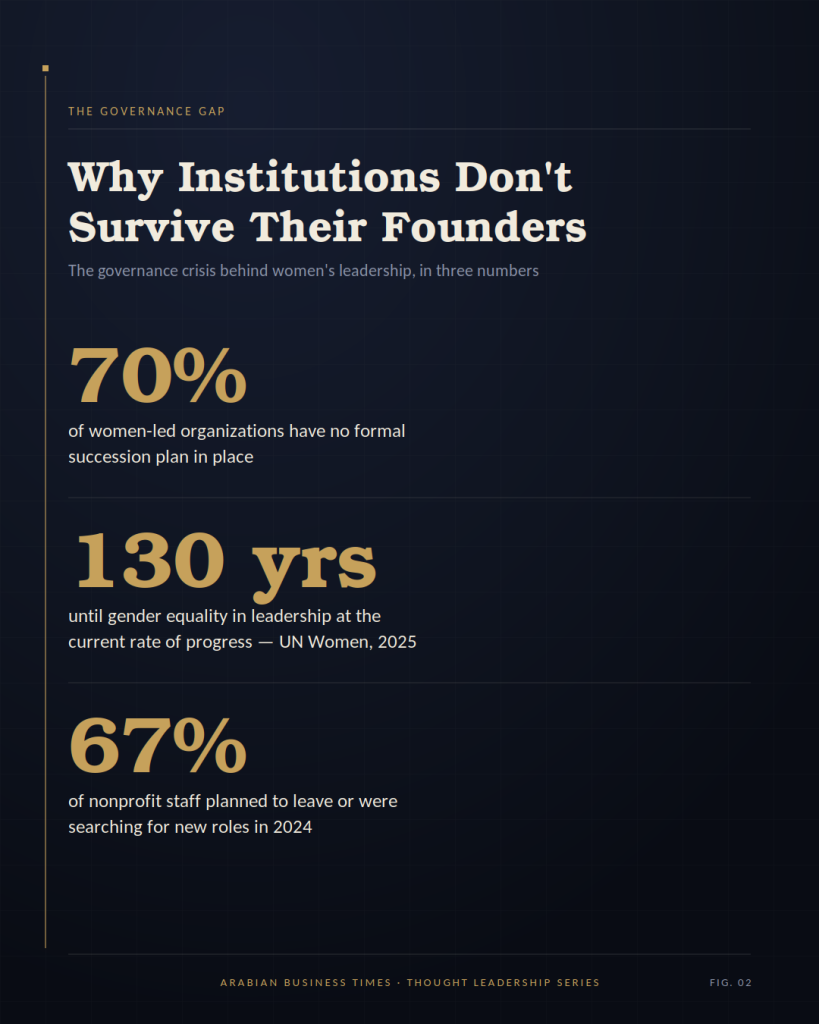
In the nonprofit sector, 2025 saw record CEO departures globally, with over 860 exits in the United States through April alone, a 15 percent year over year increase. At the same time, 67 percent of nonprofit employees reported searching for new positions or planning to leave within a year. Organizations without institutional frameworks were left dangerously exposed.
In the political arena, UN Women reported in 2025 that women’s representation among Cabinet Ministers had actually declined to 22.9 percent, down from 23.3 percent the previous year. And at the current rate of progress, gender equality in the highest positions of power will not be reached for another 130 years. Women’s institutional leadership is not just a moral imperative. It is one of the most urgent governance challenges of our generation.
But the crisis is not simply about numbers. It is about durability. When the rare woman who does reach the top of an organization departs, through retirement, transition, or circumstance, the institution she built is too often built around her presence rather than a system designed to outlast her. That is the founder’s trap. And escaping it requires intentional, structural thinking that most leadership programmes never address.
70%* of women led organizations have no formal succession plan in place*
130 yrs* until gender equality in leadership at the current rate of progress, UN Women 2025*
67%* of nonprofit staff planned to leave or were searching for new roles in 2024*
WHAT AN INSTITUTION ACTUALLY IS AND WHAT IT IS NOT
Before we can build institutions that outlive their founders, we need to be precise about what an institution actually is, because the word is used loosely, and the confusion is costly.
An institution is not a programme. A programme has a beginning, a middle, and an end. It depends on funding cycles and the energy of whoever is running it. When the founder steps back, the programme typically steps back with them.
An institution is not a brand. A brand can travel with a person. It can be built on the strength of one voice, one face, one story. When that voice goes quiet, the brand often goes with it.
An institution is not even a team. A talented team is a remarkable thing, but without governance structures and documented systems, a team reorganizes around the next available leader rather than carrying forward the original mission.
An institution is a system of purpose, governance, and culture that can function, grow, and create impact independent of any single individual. Harvard University has been operating for nearly 400 years, far longer than any of its founders lived. The International Red Cross, founded by Henry Dunant in 1863, has served over 160 years of humanitarian crises and now operates across 191 countries. These organizations have survived wars, financial crises, and the loss of countless leaders because they were built on systems, not personalities.
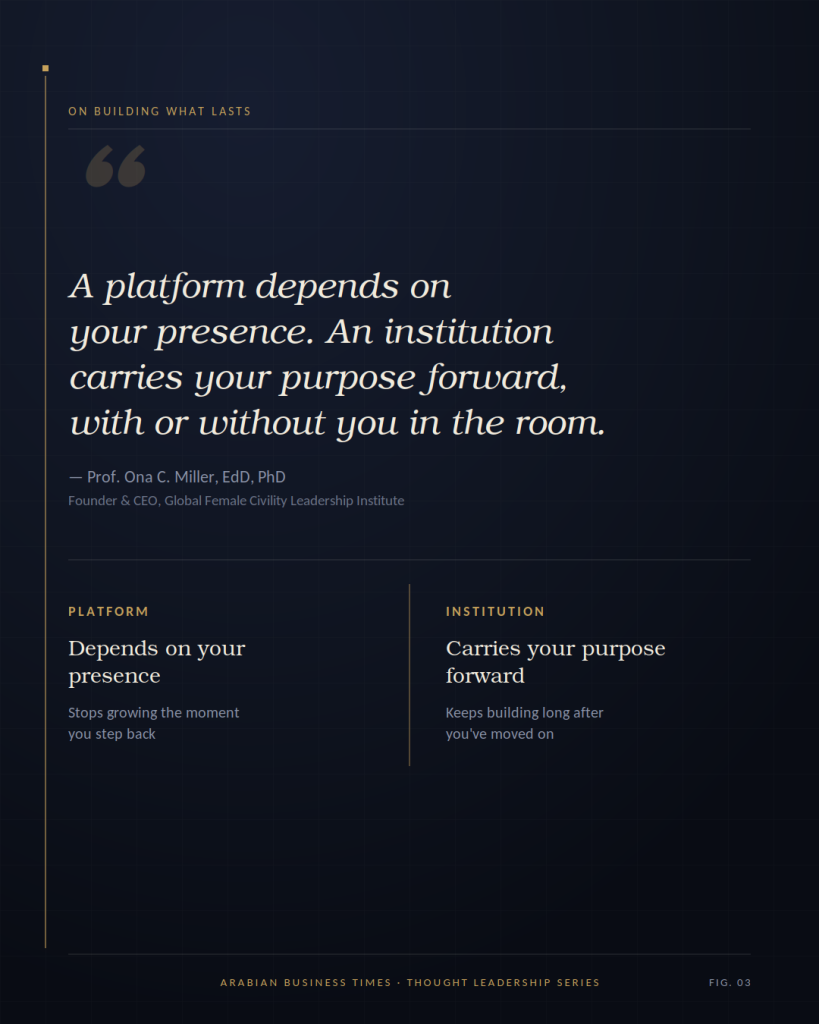
“A platform depends on your presence. An institution carries your purpose forward, with or without you in the room.”
The distinction matters especially for women leaders, who are building in environments that have historically offered less access to the mentorship networks, governance knowledge, and institutional infrastructure that allow organizations to reach institutional maturity. The result is a generation of extraordinary women leading organizations that are doing remarkable work on foundations that were never designed to last.
THE FIVE PILLARS OF INSTITUTIONAL ARCHITECTURE
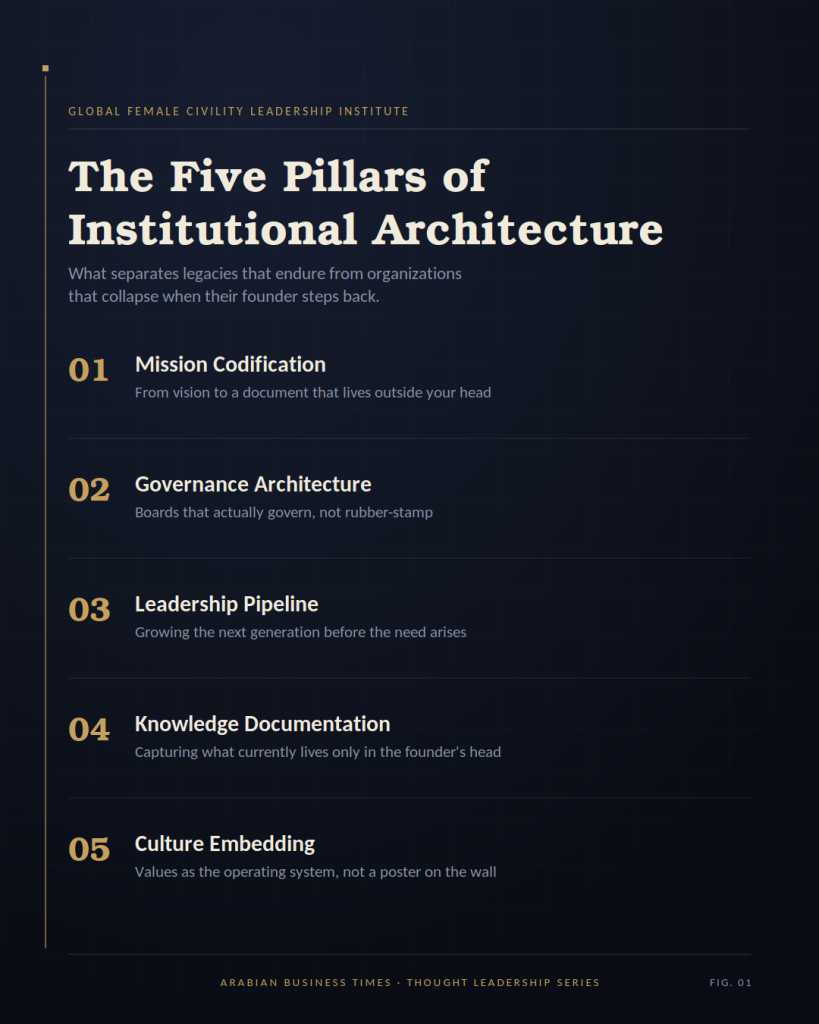
Through years of advising women led organizations across multiple sectors and continents, I have identified five elements that consistently determine whether an organization becomes an enduring institution or remains perpetually dependent on its founder. I call these the Five Pillars of Institutional Architecture.
01. Mission Codification: From Vision to Document
Every institution that lasts has done one thing early and deliberately: it has translated the founder’s vision into language that lives outside the founder’s head. This means documented mission statements, written values frameworks, and articulated theory of change, not as marketing materials, but as operational documents that guide every decision the organization makes. When the founder cannot be in the room, these documents answer the question: what would she do? Mission codification is not bureaucracy. It is the foundation of continuity.
02. Governance Architecture: Boards That Actually Govern
The single most consistent gap I find in women led organizations is the absence of genuine board governance. Many organizations have boards in name, individuals who appear on a letterhead or attend annual meetings. What they lack are boards that actually govern: that review strategy, provide accountability, manage risk, plan for succession, and exercise independent judgment. A functioning board is not a rubber stamp for the founder’s decisions. It is the structural backbone that holds the institution upright when the founder is absent. Building that kind of board, with clear charters, defined responsibilities, and genuine independence, is one of the most important investments any founder can make.
03. Leadership Pipeline Development: Growing the Next Generation
Institutions that endure do not scramble for the next leader when the current one departs. They have been deliberately developing the next generation of leadership for years before the transition becomes necessary. This means identifying emerging leaders early, creating formal development pathways, mentoring with intentionality, and building a culture where leadership is understood as something the organization produces, not something it imports in a crisis. The organizations that navigate leadership transitions successfully share one characteristic: they prepare long before the need arises.
04. Institutional Knowledge Documentation: Capturing What Lives in Heads
In most founder led organizations, the most critical knowledge, donor relationships, strategic context, the reasoning behind key decisions, the unwritten culture norms that make the organization what it is, lives entirely inside the founder’s head. When she leaves, it leaves with her. Institutional knowledge documentation means systematically capturing this information: in process guides, relationship maps, decision frameworks, and organizational histories. It is painstaking work. It is also the work that allows an organization to keep running at full capacity through a leadership transition, rather than losing years of momentum to rediscovery.
05. Culture Embedding: Values as Operating System
The final and perhaps most powerful pillar of institutional architecture is culture. Not culture as a values poster on the wall, but culture as the actual operating system of the organization, the behaviors that are rewarded, the decisions that are questioned, the way conflict is handled, the standards that are non negotiable regardless of who is leading. When culture is genuinely embedded, it guides behavior without requiring the founder’s presence. It is the invisible governance that fills the spaces between written policies. And it is what allows an institution to remain recognizably itself across decades and through multiple generations of leadership.
THE TATA GROUP LESSON AND WHAT IT MEANS FOR WOMEN BUILDERS
One of the most instructive examples of institutional architecture in action is unfolding right now in one of the world’s oldest and most respected business houses. Following the death of Ratan Tata in October 2024, the Tata Group, worth over $150 billion, began a governance transition that had been quietly underway for nearly a decade. N. Chandrasekaran had become Tata Sons chairman in 2017. Noel Tata joined key board structures in 2019. Senior advisors were gradually transitioned out in favor of board led discipline rather than founder led instinct.
The Tata Group did not scramble for succession when it needed to. It had been building the institutional architecture, the governance structures, the board systems, the leadership pipelines, that would allow one of history’s great business institutions to carry forward a 160 year mission without its most iconic leader.
For women building organizations today, whether in the GCC, the United States, across Africa, or anywhere else in the world, the Tata example carries a crucial lesson: institutional architecture is not something you build when you need it. It is something you build long before you think you will need it. The best time to put governance structures in place is during the growth phase, when the organization has energy and momentum. The worst time is during a crisis or transition, when the absence of those structures is already costing the mission.
“Governance is not the administration of what exists. It is the architecture of what will endure. Get it right, and your institution carries your mission across decades. Get it wrong, and the mission ends when you do.”
A DIRECT MESSAGE TO WOMEN FOUNDERS
If you are building an organization right now, whether it is a nonprofit, a consultancy, an advocacy initiative, a research institute, or a social enterprise, I want to speak to you directly.
The work you are doing matters. The vision you carry is real and necessary. But if everything you are building depends on your presence, you have not yet built an institution. You have built a very impressive platform. And when you step back, when life changes, when you are ready to move to the next chapter of your leadership journey, that platform will be far more fragile than you realize.
You do not need to have all five pillars fully developed to begin this work. You need to start. Document your mission in language that lives outside your head. Recruit at least three genuinely independent board members who will ask you hard questions. Identify two people in your organization and begin deliberately developing them as future leaders. Schedule six hours this quarter to document the processes that currently exist only in your memory. Begin naming and reinforcing the culture behaviors you want to see persist long after you are gone.
None of this happens overnight. Institutional architecture is built incrementally, over years, through consistent and intentional investment. But it begins with a decision: the decision to build something that outlasts you.
The world does not need more extraordinary women building organizations that collapse when they leave. The world needs extraordinary women building institutions that grow stronger with every generation of leadership that passes through them.
“Do not build a legacy that requires your presence to survive. Build an institution that will honor your purpose long after you have moved on to your next great work.”
HOW PROF. ONA C. MILLER ARE ADVANCING THIS WORK
At the Global Female Civility Leadership Institute, this work is not theoretical. It is what we do every day, with real organizations and real leaders across multiple countries and sectors. We partner with women led organizations to audit their governance structures, design their leadership pipelines, build their board capacity, and create the institutional architecture that allows their missions to endure.
Through PurposePhD, we are extending this work into the educational space, developing the next generation of institution minded leaders before the habits of founder dependence have time to form. And through the Global Library of Female Authors, we are ensuring that women’s intellectual contributions, the ideas that will shape the institutions of the future, are permanently preserved and globally accessible.
This is what institutional leadership looks like in practice. Not a single programme. Not a one time training. A sustained, systemic investment in the organizations that women lead, because when those organizations are strong, the communities they serve become stronger. And when communities are strong, they leave legacies that no single lifetime could contain.
Arabian Business Times is proud to platform this conversation. Because the leaders who will define the GCC’s next chapter are not just those who hold titles today. They are those who are, right now, building the institutions that will still be creating impact when the names on the founding documents are a piece of history.
ABOUT THE AUTHOR
Prof. Ona C. Miller, EdD, PhD
Global Institutional Leadership Advisor | Institution Builder | Governance Strategist
Professor Ona C. Miller is the Founder & CEO of the Global Female Civility Leadership Institute and PurposePhD. She holds an EdD in Organizational Leadership and a PhD in Professorship, and has spent her career building the governance frameworks, leadership systems, and institutional architectures that allow women led organizations to achieve lasting impact. She serves as National Chairman, Women & Entrepreneurship Committee (USA) with the Asian African Chamber of Commerce & Industry and is an Honorary Member of the World Peace and Diplomacy Organisation.
🌐 conoriconsults.org · purposephd.com · 💼 linkedin.com/in/professorona · 📸 @dronaconori